A fast first draft can leave an editor with more work: finding the missing source, restoring a qualification, and figuring out which version somebody approved. The draft arrived quickly. The article still cannot move.
A useful workflow makes that unfinished work visible and sends it to someone who can resolve it. Start with one type of written content your team already produces. Define what AI should contribute, what a person must decide, and what the next person needs to receive.
An AI content workflow connects several tasks into an editorial process that people can repeat. For example, a content owner approves a reader question and source material; AI proposes an outline and draft; an editor checks the claims and explanation; and a publisher releases the approved version.
The connection matters. A prompt asking for a blog post may produce a document, but it does not tell your colleague whether the sources were checked, which claims remain unresolved, or whether the draft is approved. A workflow carries those decisions with the work.
It can operate through ordinary documents, a task board, and manual handoffs. Automatic transfers are an implementation choice. You do not need several agents or connected applications before you can define who receives the next task and what counts as complete.
This guide concerns written editorial content, including articles and their email or social adaptations. Enterprise document routing, invoice processing, and video production have different inputs and acceptance checks. Their automation diagrams may look similar while doing a different job.
Decide What AI Should Do and Who Owns the Result
Choose a specific contribution. AI might organize supplied research, suggest an outline, draft an explanation, or adapt approved material into a shorter format. Give a person responsibility for deciding whether that contribution serves the reader and is supported by the evidence.
For a small team, the following division is enough to begin:
| Responsibility | AI Can Help Prepare | Accountable Human Decision |
|---|---|---|
| Content direction | Questions, outline options, or gaps in supplied material | The content owner selects the reader job, scope, and useful contribution |
| Evidence and drafting | A source summary, draft, and claim-to-source notes | The editor checks support, conditions, and whether the explanation answers the brief |
| Unresolved information | A clearly stated question or missing source | The relevant factual owner supplies evidence or agrees to narrow or remove the claim |
| Release and upkeep | Metadata suggestions, adaptations, and proposed update tasks | The authorized publisher releases the approved package; the content owner assigns corrections and review triggers |
These are responsibilities, not four required hires. One person may act as editor and publisher. They still need to recognize that reviewing a draft and releasing it are separate decisions.
Source access also has limits. An employee's ability to open a customer document does not establish that its contents may be sent to a particular AI service or published. Establish which inputs the organization permits in the selected tool and account, and which information may appear in public. Keep restricted material out of the task unless its use is authorized.
For example, Microsoft's Copilot application card, under its grounding and oversight guidance, describes access based on user permissions and warns that even responses based on supplied sources can include information absent from those sources. Those are product-specific descriptions. Do not assume that every AI account has the same permissions, data handling, or protections.
Begin with manual AI assistance if the task still changes substantially each time. Once the inputs, destination, and return conditions are stable, a rule can route a draft or notify its owner. A more autonomous agent needs a defined task, permitted actions, and a way to stop or return unresolved work. Assigning more autonomy does not remove the editorial decisions.
Build the Workflow One Handoff at a Time
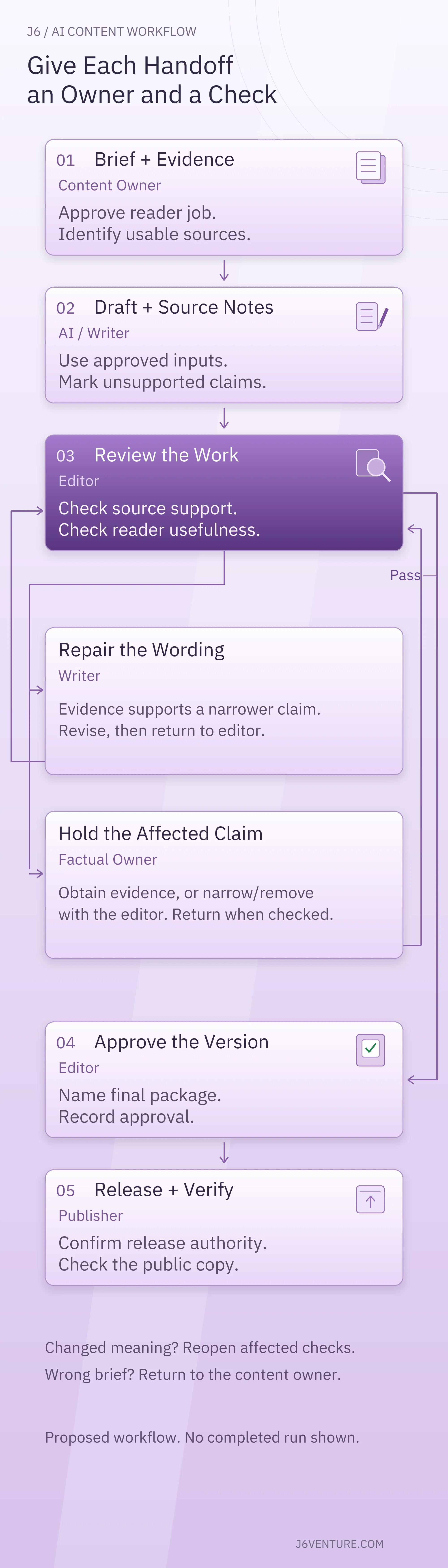
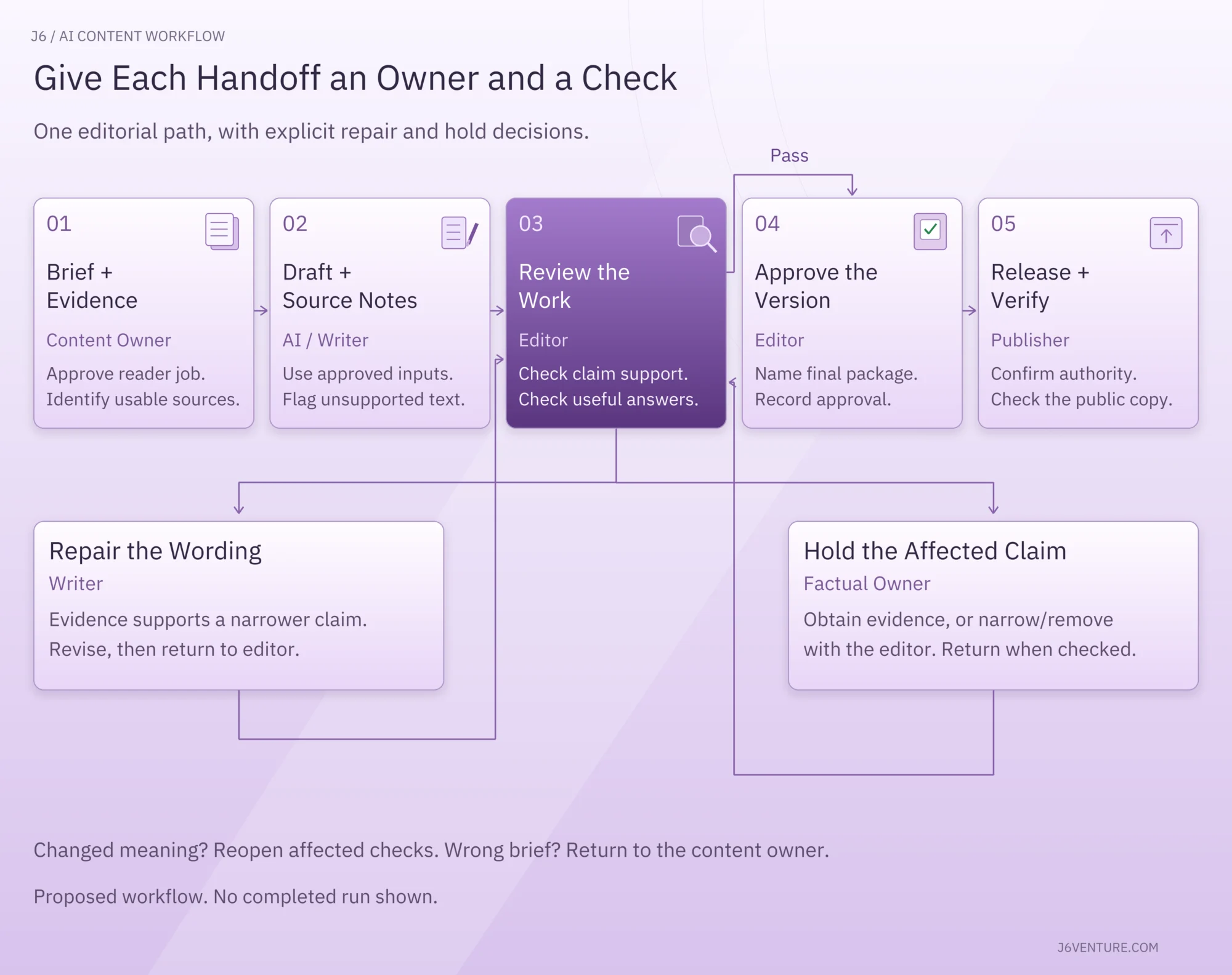
For each handoff, write down five things: the task, the input, the expected output, the owner who checks it, and the pass or return condition. Use the following steps for one article before applying them across your calendar.
Step 1: Approve the Brief and Source Packet
The content owner first approves what the article must help its reader understand or do. Record the audience, question, scope, format, and useful contribution. A full SEO content brief can hold the wider planning detail; the workflow needs an identifiable approved version of it.
Attach the material the writer is allowed to use. For each consequential source, keep its URL or document reference, date or version, relevant passage, and important conditions. Include approved brand guidance and identify what information is missing or restricted.
“Explain our export feature” is an incomplete input if nobody has supplied which plans include it or what can be exported. The factual owner must provide those details, or the content owner must narrow the assignment. Asking AI to fill the gap gives the editor another claim to investigate.
The handoff is complete when the next person can identify the approved brief, locate its evidence, and understand the limits. If an essential fact is missing, assign that question to its owner and hold the affected passage. Other supported work can continue without presenting the missing fact as settled.
Step 2: Give AI a Bounded Drafting Task
Tell the AI what to produce from those inputs. State the reader's job, desired format, source boundaries, conditions to retain, and what it should return when the evidence is insufficient.
Here is a proposed instruction you can adapt; it is not an executed test:
Task and inputs: Using brief B1 and source packet S1, draft the explanation for the named reader.
Evidence and conditions: Preserve the source conditions and dates that change the answer. Do not invent product capabilities, experience, statistics, or outcomes.
Output: Return the draft and notes linking each externally checkable claim to its supporting source, passage, and limiting conditions.
Missing or conflicting support: Identify the claim, explain the gap, and return a question for the factual owner.
Status: The output is a draft for review, not an approved article.
In this instruction, B1 identifies the approved brief, and S1 identifies the evidence actually supplied. The claim notes connect a statement to a source passage; the editor must still judge whether the passage establishes that statement. A matching phrase or a quotation demonstrates where words came from, not necessarily what they prove.
Ask for an outline first when you need to settle sequence or coverage before generating a long draft. A separate drafting task can then use the accepted outline. Keep each task's inputs and completion condition clear enough that you can diagnose a failure without rerunning the whole process.
Anthropic's hallucination-reduction guidance recommends allowing uncertainty and making source support inspectable. Such prompting can assist review. It does not establish that a response is correct or eliminate the need to check its claims.
Step 3: Review the Evidence and Repair Failed Claims
The editor checks two things together: whether the article is supported and whether it helps the intended reader. A technically accurate paragraph can still leave the question unanswered. A clear explanation can still make a claim its source does not support.
Open the original evidence for consequential statements. Check the subject, date, conditions, and strength of the claim. Did “available on this plan” become “available to everyone”? Did a possible outcome become a promise? Does the cited page describe the current feature or an older version?
Then read the article as a newcomer. Does it answer the heading directly, explain unfamiliar terms where needed, and show how the reader can apply the advice? Check that the body develops the answer capsule rather than repeating it. Remove claims of first-hand experience the organization has not supplied and supported.
Give each failed item a usable next action:
- Supported evidence, overstated copy: return the claim and source condition to the writer for a narrower revision. The editor checks the replacement in context.
- Missing or conflicting evidence: send the specific question to the factual owner. Hold, remove, or narrow the affected claim; do not quietly substitute a plausible answer.
- Wrong reader job or scope: return to the content owner. More copy editing will not resolve a direction that no longer serves the brief.
AI can help find possible inconsistencies or apply a review rubric. Its confidence or score is not a factual source. If a draft fails a meaningful check, repair the work or reconsider the requirement openly. Weakening a review standard merely to obtain a passing number does not resolve the defect.
Keep the rejected wording and decision in the working record. The next person should be able to see what failed, who owns the repair, and what evidence would close it.
Step 4: Approve the Exact Version for Publication
An approval must identify what was reviewed. Record the final draft version, its source packet, the approving person, and the approved publication package. That package includes the headline, metadata, images, captions, and alt text as applicable.
Google's guidance on generative AI content, under “Focus on accuracy, quality, and relevance,” calls for manual factual review before publication and explicitly includes metadata and image alt text. An accurate body does not rescue a meta description that adds an unsupported promise.
If a later edit changes a claim, condition, headline promise, or intended meaning, reopen the affected checks. The previous approval applies to the previous version. A purely presentational correction can receive a proportionate check; it need not restart unrelated research.
Keep editorial approval distinct from permission to publish. A reviewer may confirm that draft D2 meets the brief while a campaign owner still controls its release. The publisher needs both the identified approved package and the authority to release it.
A Worked Handoff From Source to Corrected Copy
The following is a proposed editorial exercise using an actual public source. The brief, sample draft, roles, and approval record demonstrate the method. No AI run, client campaign, publication, or measured improvement is claimed.
Step 1 applied: approve the input. Brief B1 asks for a short explanatory note for marketing editors: “What must we check before publishing AI-assisted content?” The content owner approves that question and a source packet S1 containing Google's current guidance, last updated October 1, 2026, and retrieved for this article on October 25. The full AI-content-safety discussion belongs in the AI content safety guide.
The source provides two relevant conditions: generating many pages without added user value may violate Google's scaled-content-abuse policy, and AI-generated content needs manual review. It does not promise that a reviewed page will rank.
Step 2 applied: inspect the proposed output. Suppose draft D1 says:
Human review makes AI-generated articles compliant with Google's policies and ready to rank.
It adds two outcomes that the evidence does not establish. Its fluency does not satisfy the handoff.
Step 3 applied: return and repair the claim. The editor returns D1 to the writer with a specific instruction: remove the compliance and ranking guarantees, preserve the user-value condition, and keep the review requirement. Proposed replacement D2 reads:
Before publishing AI-assisted content, manually check its accuracy, relevance, and trustworthiness. Google warns that producing many pages without adding user value may violate its scaled-content-abuse policy. Completing a review does not establish that a page will rank.
The editor can trace the review requirement and conditional policy warning to the source. The final sentence limits the conclusion rather than predicting a result. The factual comparison is now inspectable without pretending that a model's score proves it.
Step 4 applied: complete the illustrative decision record. In this exercise, the corrected note passes the stated editorial checks, while release remains on hold:
- Input: B1, source packet S1, Google page dated October 1, 2026; retrieved October 25.
- Output under review: D2, the corrected note above, for marketing editors.
- Illustrative editor decision: accept the D2 note text for B1 using S1. It preserves the manual-review requirement and conditional user-value warning, removes the unsupported guarantees, and answers the selected reader question. This accepts the note text only; it is not a real organizational approval.
- Closed repair in the exercise: the writer removed D1's compliance and ranking guarantees; the editor's source comparison above verifies the retained policy condition in D2. Keep D1 as the rejected version and D2 as the accepted text.
- Release state: on hold. Headline and metadata approval, the intended destination, and release authority are not supplied in this exercise. The content owner must complete that package with the editor; the publisher checks the exact approved package and release instruction before proceeding. No publication has occurred.
If a future request adds a ranking promise: treat it as a new unsupported request. The content owner must remove the promise or obtain appropriate evidence; the new wording cannot inherit D2's acceptance. This is not an open item in the current D2 record.
Now consider an adaptation. A proposed social post says, “Human review lets you scale AI articles safely.” That removes the relevant qualification and introduces a broad safety assurance. Return it to the adaptation owner. A supported alternative is: “Review AI-assisted content before publishing, and check that each page adds value for readers.” Link the fuller explanation so the short format does not have to carry every detail.
Approval of D2 does not automatically approve that social post. Its new wording needs its own proportionate check. If a source later changes, the content owner identifies the affected note and adaptations and assigns their review.
Publish, Reuse, and Maintain the Approved Content
The publisher receives the exact approved package and its release instruction. A task board, shared folder, or content management system (CMS) draft can carry the reference; the workflow works only if the publisher can identify the right version and its approval state.
After release, confirm that the public page contains the intended text, links, and media. A successful transfer to a CMS is not the same state as a public page. A scheduled item has a planned release; record publication only when the content is actually public.
For reuse, start with the approved source version and identify the new audience, format, and destination. Shortening an article can remove a limitation, change the meaning of a statistic, or make an image caption misleading. Send consequential changes back through the relevant factual and editorial check. Keep the adaptation connected to its parent version so later corrections can reach both.
Assign a maintenance owner and a review date or trigger. A product change, revised source, reader-reported error, or changed campaign can reopen the work. The owner should know which assets are affected, what needs checking, and who can release the correction.
You can automate routing, reminders, and transfers once those states are reliable. If a transfer fails, leave the task with an identifiable owner and retain the approved material. Verify the destination before retrying a consequential release so an uncertain response does not become a duplicate publication.
Test the Workflow Before Expanding It
Choose one repeatable content type and define acceptance before the pilot: the draft serves the approved reader job, consequential claims have adequate support, material conditions survive, and the intended version reaches the right destination with the required approval.
Anthropic's evaluation guidance, under “Define your success criteria” and “Build evaluations,” recommends specific, relevant criteria and test cases that resemble the actual task, including difficult cases. For an editorial pilot, include work with a missing source or a condition easy to lose. A process that only handles the cleanest brief has not demonstrated how it recovers.
Compare similar assignments and include the work after generation. Record active human time for research, briefing, checking, editing, corrections, and release. Keep model runtime and waiting time separately identifiable; overlapping intervals cannot simply be added to produce elapsed time. Record actual tool charges where available, and mark unavailable cost data unknown.
Count assignments attempted, accepted final outputs, items still on hold, and unresolved defects alongside time. Keep revisions and retries within their originating assignment's effort record; they are not separate accepted outputs. If drafting gets faster but editors spend longer repairing unsupported claims, the workflow may have moved the bottleneck. One small pilot can identify a problem or suggest a useful boundary; it does not establish universal productivity gains or search performance.
Finish with an owned decision. Keep the task if the accepted work justifies its full effort. Adjust the input, instruction, or handoff when the failure is specific and repairable, then retest the affected cases. Pause the automation when a consequential failure cannot yet be controlled; preserve the useful work and send the unresolved question to its owner.
For your next article, write one handoff note: approved brief and source versions; AI task and output; checking owner; failed-item action; approved package; release state; and next review trigger. Give the pilot owner a date to review those records. Close the pilot with its evidence and decision, while keeping any unfinished correction separately assigned. Expand when you can explain why that workflow helps the next reader and the next person receiving the work.