
Perplexity can mention your company while linking to someone else's website. That may help people discover you, but it gives you a different result from a citation to your own product page, guide, or research.
Start with one question your website can answer well and one page that should answer it. Then check what Perplexity can access, what your page establishes, and what the resulting answer actually cites. This gives your team a specific improvement to make and a result it can interpret.
Your website is cited when an answer includes a source link to a page on your site. Perplexity's explanation of how it works, under “Citing sources,” describes numbered citations that link to original sources. Follow that link to see which page received the citation and what information it supports.
Suppose an answer names your software but cites a review site. Your brand appeared, and the review site received the source link. If the answer instead links to your documentation for a particular feature, your page is the cited source for that point. Neither observation establishes that someone clicked through, started a trial, or became a customer.
Keep the observations separate in your reporting: brand mentioned, your URL cited, another site's URL cited, and a referral visit recorded. A source link can also support a paraphrase; it does not mean Perplexity quoted your words exactly.
Finally, read the claim beside the citation. An answer can attach your page to a statement that goes beyond what the page establishes. You want to know both whether your URL appeared and whether it was used accurately.
What Can Your Website Actually Control?
You control the page you publish: its public availability, the question it answers, the evidence behind its claims, and how clearly it communicates the conditions that matter. You can also investigate whether your own access rules prevent legitimate Perplexity requests from reaching it.
Perplexity controls which sources it selects for a particular answer. Its official description explains searching, summarizing, and citing sources, but it does not disclose a publisher-controlled formula for winning a citation. Treat a useful content improvement as an improvement you can verify, while keeping its effect on citation selection open until observed.
The access distinction begins with two different agents in Perplexity's official crawler documentation:
- PerplexityBot is described as a bot that surfaces and links websites in search results. Perplexity says this bot is not used to crawl content for foundation-model training.
- Perplexity-User handles user actions. A question might cause it to visit a page and include a link. Perplexity describes it as separate from web crawling and training collection, and says this user-requested fetcher generally ignores robots.txt rules.
These are Perplexity's published descriptions of its agents. A robots.txt setting is not a complete description of every way an answer can obtain information, nor is a bot's name a guarantee that a request is genuine. Access checks need the actual request context and the relevant controls.
Source labels are another separate matter. Some citations show a shield labeled Government, Academic, or Trusted. Perplexity's source-label explanation, particularly “What labels do not tell you,” says labels describe domains, not the accuracy of individual claims. An unlabeled site is not thereby judged low quality. Do not make obtaining a shield your citation strategy or treat one as approval of everything a page says.
How to Prepare a Page for Perplexity
Work through the following steps for one page. The output is a public answer with a traceable basis, followed by an observation you can use to choose the next action.
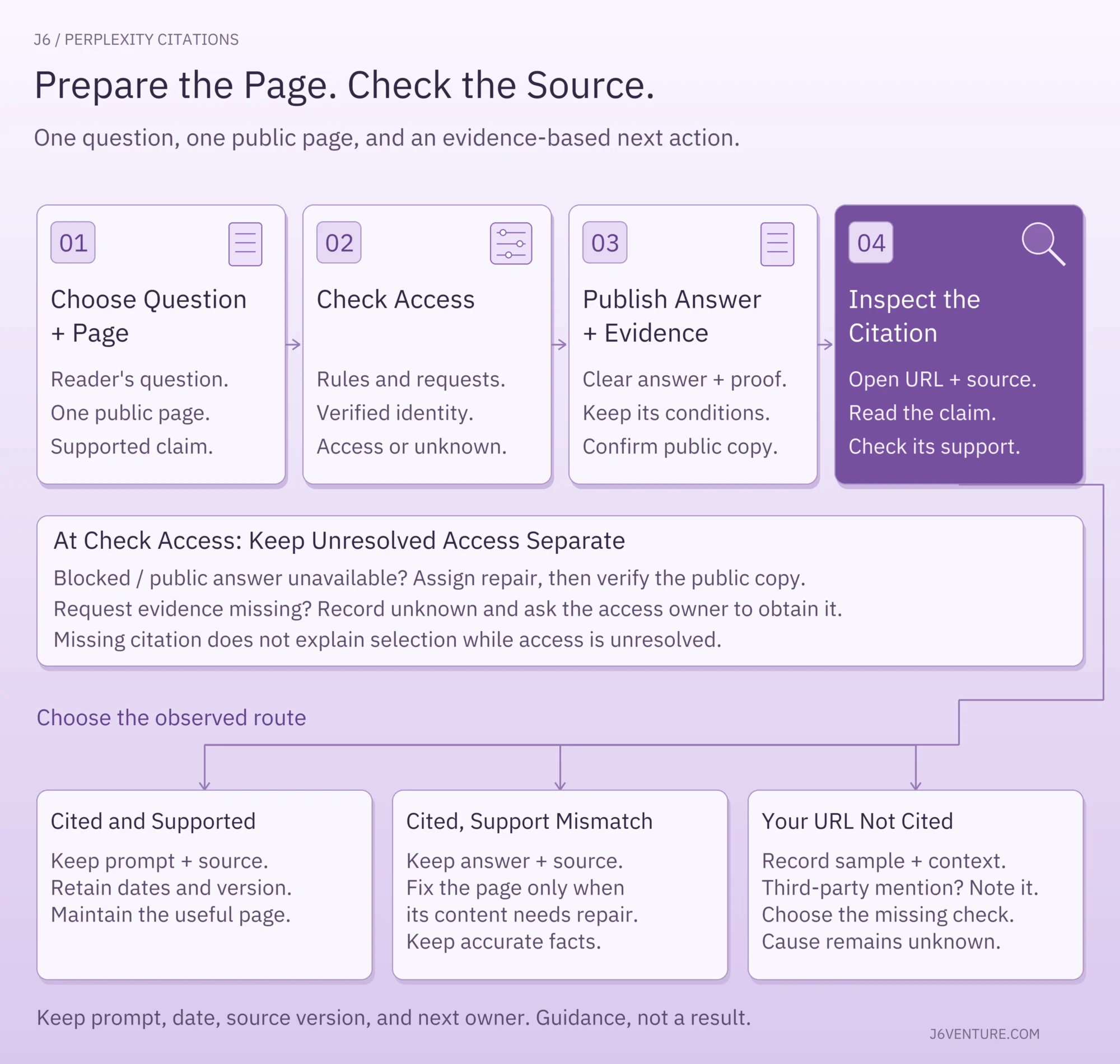

Step 1: Choose the Question and the Page
Choose a question that matters to an intended reader and that your organization has enough evidence to answer. It could concern a product's availability, an implementation requirement, a technical distinction, or a finding from research you can publish.
Write the question as the reader would ask it. Then name the page that should answer it and the specific claim that page can establish. “We want AI visibility” is too broad to guide a revision. “This public guide should explain which crawler handles search discovery” gives the writer and technical owner a clear task.
If several pages compete to answer the same question, decide which should own the useful answer before expanding them all. A search-intent map can help with that page assignment. This is an editorial ownership decision, not a claim that consolidating pages automatically earns Perplexity citations.
Keep your evidence close to the question. A product capability needs current documentation or a supported product record; a research finding needs its method, population, date, and limits. If you cannot support the claim, narrow it or obtain the missing evidence before publishing it.
Step 2: Check Perplexity's Access to the Content
First, confirm that the intended answer is on the public URL, with the text and conditions a visitor needs. A private document, unpublished draft, or preview link is a different source from the page you expect people to discover.
Ask the person responsible for the website to review its robots.txt file, which gives instructions to crawlers, and any web application firewall, or WAF, rules affecting legitimate Perplexity requests. Perplexity recommends allowing PerplexityBot in robots.txt and permitting its published IP ranges. Use its current crawler documentation, under “WAF Configuration” and “IP Address Sources,” for the applicable guidance.
That documentation combines the User-Agent, the request's declared client identity, with verified official IP ranges. It provides current endpoints for PerplexityBot addresses and Perplexity-User addresses. Give those references to the technical owner instead of copying an address list that may become outdated. The owner should evaluate a scoped rule for legitimate requests; disabling the whole firewall is not the task.
Where logs are available, retain the requested URL, timestamp, verified agent identity, relevant response, and whether the expected public content was successfully served. A blocked request identifies an access issue to investigate. A successful request establishes something about access under those conditions. It does not show that the page became a source in a generated answer.
If you have no relevant log records, keep that fact as an evidence gap. It does not establish that Perplexity never accessed the content. Likewise, allowing another engine's training bot or seeing a Google Search Console result does not establish Perplexity access. Use the Perplexity-specific evidence for this check.
Step 3: Write an Answer With Evidence Readers Can Check
Answer the selected question clearly near the relevant heading, then develop the explanation. A reader should be able to tell what you are claiming, the circumstances in which it holds, and where to inspect the supporting evidence.
For example, a page explaining a product's export feature should state what can be exported, which plan or permission is needed, and any material limit. A heading that says “Exports” followed by a broad promise of flexibility leaves the real question unanswered. Adding a short paragraph with the actual capability and its conditions helps the reader evaluate the feature.
Use a table when comparing genuinely parallel facts. Use steps when the reader must perform actions in sequence. Keep the explanation connected; making every paragraph an isolated miniature answer can remove context that readers need. There is no reason to force the same word count, question-heading pattern, or number of statistics into every section.
Make the evidence traceable. Link to the relevant primary source or publish the method and limitations behind your own finding. Name the author or responsible organization where that helps establish accountability. Update substantive facts when they change, and use dates that describe real revisions.
Perplexity's linked documentation establishes agent roles, access recommendations, and source-label limits. It does not establish a mandatory passage length, schema type, llms.txt file, refresh schedule, or citation turnaround. Treat claims that these tactics guarantee inclusion as claims that need evidence, not publishing requirements.
Put the question, page, claim, supporting records, and important conditions into the writer's brief. Once the revision is approved, publish it or confirm that the existing public page already contains the intended answer. Check the public version before observing results; an improved draft alone has not changed the source available to readers.
Step 4: Check Whether Your Page Is Cited and What It Supports
Open Perplexity Search, start a fresh conversation, and enter the question you selected.
Preserve enough context to interpret the answer. Record the exact prompt, date, and mode name shown, if any; if no name is displayed, record that. Also note whether you supplied a URL, preferred source, file, or other special context. Perplexity's product page, under “Your web, your files, your apps,” describes several source types and saved context. Those settings can change what you are observing.
Keep an ordinary discovery question separate from “Read this URL.” If you directly supplied your page, a result involving that page does not establish that an independent search would have discovered it. Follow-up questions also carry context; use a fresh conversation when you want a separate observation.
For each answer you inspect:
- Open the numbered citation beside the relevant claim. Check the actual destination URL, not just the company name or source label.
- Read the cited passage and its conditions. Does it establish the answer's claim, a narrower point, or something different? Retain the answer and dated source passage when the distinction matters.
- Classify what happened. Your page cited, another source cited, brand mentioned without your URL, or no relevant citation observed are distinct outcomes. If your page is cited inaccurately, record that mismatch separately.
Perplexity's source-label guidance, under “Reading a label,” describes selecting or hovering over a source to inspect its details. A label can provide context about the domain. Reading the original page remains necessary for claim support.
Interface and access guidance were checked against official documentation on October 25, 2026. The J6 editorial owner should recheck these instructions at the next article review or after a reported product change.
Keep the scope of your conclusion as small as the evidence. One answer tells you what appeared in that answer. For a broader view, repeat a defined set of relevant questions under recorded conditions and retain the results, including the misses. Comparing observations before and after a revision can reveal a change in that sample; it does not isolate the revision as its cause or establish a universal citation rate.
A Worked Page Revision Using Public Evidence
This is an illustrative revision for a fictional hosting provider's public guide. The source facts come from Perplexity's documentation. The draft copy, planned page, and follow-up record are hypothetical; no citation experiment or improvement is claimed.
The guide needs to answer: “What is PerplexityBot used for?” Its intended readers are site owners deciding which access rules to review. The page's useful claim is the distinction between PerplexityBot's stated search role and Perplexity-User's user-directed role.
Before: an answer with an unsupported outcome
Open your crawler settings to Perplexity so AI can read your site. Keep your content fresh and citations will follow.
The passage does not identify the agent, explain the setting, or support its promised result. A reader cannot use it to distinguish search crawling from a user-requested fetch.
Revised passage: a defined answer with a traceable source
Perplexity describes PerplexityBot as a bot for surfacing and linking websites in its search results, rather than collecting content for foundation-model training. Its documentation recommends allowing this bot in robots.txt and permitting its published IP ranges.
Perplexity-User has a separate role: it supports page visits requested through user actions and may include a page link in an answer. If you use a web application firewall, ask its administrator to check the relevant User-Agent and official IP ranges together. Permitting a legitimate request addresses access; source selection remains Perplexity's decision.
The live version of this hypothetical passage would link to the official crawler documentation and its agent table. It would preserve the source date and any relevant change to the published policy.
The evidence mapping is straightforward:
- Agent purpose: the official PerplexityBot entry supports the search role and stated non-training role. It does not establish how every Perplexity service handles information.
- Separate user action: the Perplexity-User entry supports the distinct page-visit role and conditional possibility of a link. It is not a promise that each requested page will be cited.
- Access action: the WAF guidance supports checking both identity and current IP ranges. It does not turn a successful request into proof of source selection.
The revised answer helps a site owner identify which agent’s access rules and request records to review with their administrator, with the official policy in front of them.
Prospective record for the page owner
- Question and page: “What is PerplexityBot used for?” on the fictional provider's public crawler guide.
- Supported claim: Perplexity describes PerplexityBot as serving search discovery, not foundation-model training; Perplexity-User has a separate user-directed role.
- Evidence checked: Perplexity's agent table and WAF guidance, retrieved October 25, 2026. The content editor owns the source-to-sentence check.
- Publication state: proposed revision, not yet confirmed public. The editor must verify that the intended text and link are on the public URL before observing an answer.
- Access state: not tested in this example. The website administrator owns the rules and relevant request-log check; missing records remain unknown.
- Observation plan: the content analyst owns a fresh-conversation question without a supplied URL or preferred source. The analyst will record the date, visible mode, answer, linked source URL, and supporting passage. Those result fields remain pending because no observation has been made.
- Next review trigger: after the public revision is confirmed and the access check is recorded, the analyst performs the planned observation and assigns the next action from the result.
- Observation completion: the analyst has preserved the prompt and context, answer, linked URL or absence, support assessment, and an owned next action or maintain/revisit decision. Receiving a citation is not required to complete that observation task; an unresolved access or support finding remains separately open.
A possible mismatch, not an observed answer: suppose a hypothetical answer cites the guide and says, “PerplexityBot collects website content for foundation-model training.” That conflicts with the attributed official policy the revised page explains.
The content editor first checks that the public guide still contains the correct policy statement and its conditions. If the page is accurate and clear, the analyst records an unsupported answer claim, retaining the answer, cited URL, dated page version, and contradictory source passage. The cause remains unknown. The observation record can be complete while the support mismatch remains open for review. The editor should correct the page only if its own content is wrong or ambiguous; accurate facts stay intact.
Choose Your Next Action From What You Observed
Use the observation to decide what your team should do next. Several conditions can coexist, so keep each finding attached to its evidence and owner.
| Observation | What It Establishes | Next Action |
|---|---|---|
| A legitimate request was blocked, or the expected public answer was unavailable | An access or publishing issue exists under the observed conditions | The website owner investigates the relevant rule or public version, makes a scoped correction, and verifies the expected content can be served |
| The expected page was successfully served to a verified agent | Access worked for that request; citation selection is still unknown | Keep the access evidence, then inspect the answer's actual source links |
| Your URL is cited and supports the relevant claim | Your page was used appropriately for that point in that answer | Preserve the prompt, context, answer, URL, and source version; keep the useful page accurate |
| Your URL is cited, but the answer exceeds or misrepresents its evidence | A source-support mismatch exists; the cause is not yet established | Retain the exact claim and source context. Correct the page if wrong or unclear; otherwise record the answer problem without changing accurate facts |
| Your brand appears through a third-party source | Your brand was mentioned, while another site received the citation | Check the third-party passage's accuracy; decide whether your own page answers the intended question more directly, without claiming it received the citation |
| Your URL is absent from the answers you inspected | No citation was observed in that defined sample | Review question fit, public content, and evidence gaps; choose one justified next check instead of inferring a specific algorithmic rejection |
There is no supported universal waiting period after which absence proves failure. Give an investigation a bounded owner and review point. If access and content checks are complete but there is still no observed citation, decide whether another useful improvement is justified or whether to maintain the page and revisit it when the question or evidence changes.
Your Next Page and Recheck
Before expanding the work across your site, finish one record: question, public page, supported claim, access evidence or unknowns, observed answer context, next action, owner, review date or trigger, and completion criterion. For an observation task, completion means retaining the answer/context, source URL or absence, support assessment, and next decision. Keep an inaccurate citation distinct from a supported one and an unperformed check distinct from a negative result.
At the next review, ask what changed for the reader and what the observation actually showed. A clarified policy, a corrected product fact, or a usable answer can be a completed content improvement even while citation selection remains outside your control. A citation is then an additional observation to inspect, not permission to skip the source check.
Choose the next page when you can name the question it should answer and the evidence it can contribute. That keeps the work grounded in something a reader can use and gives your team a concrete reason for each revision.