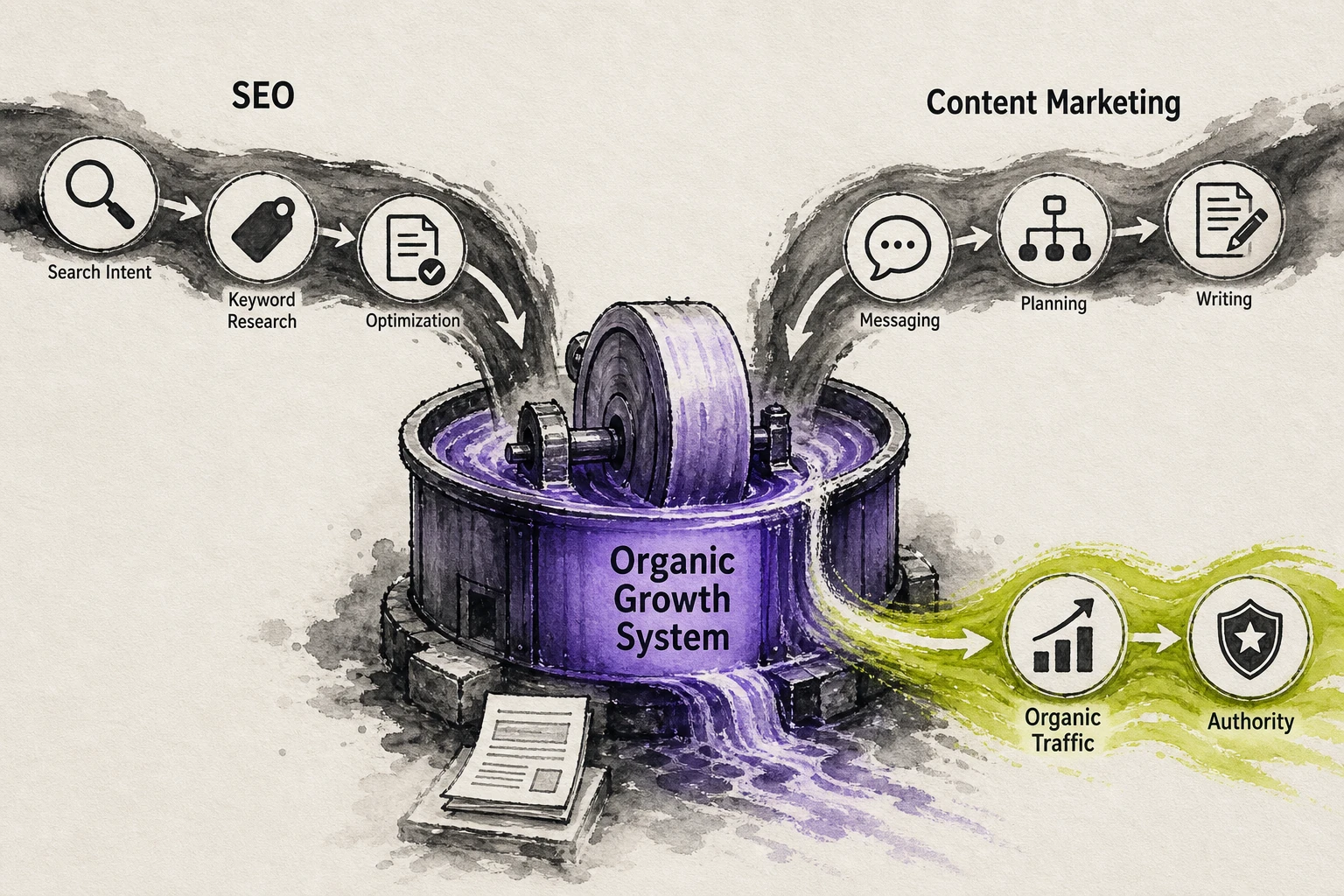
SEO and content marketing work together by shaping the same page from the start: SEO aligns it with search demand, while content marketing provides the substance, clarity, and trust that make it useful after the click. When planned together, the page can better match the query, answer the need, and support marketing goals.
SEO and Content Marketing Are Different Disciplines, but They Work as One Growth System
The split sounds logical, but it breaks the work. In a working model, search engine optimization is the discoverability system that helps a page align with search demand, while content marketing is the value-and-trust system that gives that page substance, clarity, and a reason to matter after the click. SEO and content marketing are different disciplines, but they should shape the same asset from the start. When SEO content is planned this way, the page serves search, supports marketing goals, and gives the reader a stronger reason to stay.
Why “Content Marketing and SEO” Is Not a Choice Between Two Separate Tracks
A team does not choose between being discoverable and being useful. Content marketing and SEO solve different parts of the same growth path: one helps the right search reach the right page, and the other determines whether that page answers the need well enough to build trust. A search-led asset without substance may attract attention and still fail to move the reader. A strong marketing asset without search intent can miss discovery altogether. The real decision is whether both disciplines influence the same content choices before drafting begins.
A search-led asset without substance may attract attention and still fail to move the reader.
The real decision is whether both disciplines influence the same content choices before drafting begins.
Why SEO Content Marketing Is Not Just Blog Publishing or Keyword Placement
More output does not fix weak alignment. SEO content marketing only works when search logic and editorial substance are built together, so the page matches the query, covers the topic with enough depth, and supports a clear marketing objective. Publishing blog posts on a schedule can create motion without creating value. Adding keywords late can help surface terms, but it cannot rescue thin SEO content that never answered the underlying search problem.
- More blog posts do not create integration if each page is disconnected from search demand and topic focus.
- Keyword placement alone does not repair weak structure, vague messaging, or shallow answers.
- Content marketing becomes stronger when the page is planned as a useful search asset, not as copy that gets optimized afterward.
Why Teams Fail to Combine SEO With Content Marketing
The failure usually starts upstream. Teams struggle to combine SEO with content marketing when coordination breaks before drafting begins, which limits website traffic and weakens the compounding effect that integrated content marketing work should create across the website.
- If planning silos keep search insight separate from editorial planning, the asset is shaped before the right inputs meet.
- If teams report to different KPIs, revisions arrive as conflicts instead of shared decisions.
- If separate calendars govern SEO, drafting, and reviews, alignment slips between deadlines.
- If late-stage handoffs delay structural fixes, published pages carry performance drag before compounding can begin.
Once that pattern becomes normal, the split stops being a communication issue and becomes an operating model problem.
Separate Planning Breaks Search Intent, Messaging, and Topic Focus
Planning silos show up in the asset long before anyone checks performance. Once search intent and messaging are developed in separate conversations, teams produce pages that either match the query but feel generic or sound sharp but miss what the search actually asked for. The brief then carries that split forward, so the angle, page goal, and supporting points stop reinforcing the same search task. Topic focus also degrades because separate planners commission overlapping work instead of building connected coverage.
- Brief mismatches: the page target, angle, and call to action pull in different directions.
- Query-to-message disconnects: the search promise brings readers in, but the body answers a different problem.
- Topic overlap: separate owners create assets that compete for the same search space instead of reinforcing a shared theme.
Split Ownership Slows Organic Traffic Before Authority Can Compound
Split ownership slows organic traffic because the most important fixes arrive after the asset is already drafted, approved, or published. Search gaps, internal-link needs, and message problems then move through another round of handoffs instead of being resolved at the planning stage. That delay slows learning across related pages and weakens compounding authority, because rankings, links, and topical reinforcement depend on coordinated timing. The next problem is predictable: teams repeat the same operating mistakes that keep the split alive.
The Mistakes That Keep SEO and Content Marketing Split
The split usually survives through sequencing errors, not theory. In SEO and content marketing, the visible handoff may look coordinated while the real decisions still happen too late for content marketing to shape the asset.
- Starting content creation before search intent or keyword clarity is established.
- Treating writing as late-stage execution instead of an input that shapes angle, structure, and usefulness.
- Finishing the page, publishing it, and relying on on-page fixes after launch to repair weak alignment.
- Judging SEO and content performance by publishing volume instead of by search traction, engagement, and topic contribution.
Creating Content Before Search Intent and Keyword Research Are Clear
A strong topic idea is not enough.
Treating Content Writing as the Last Step Instead of a Strategic Input
Writing changes the asset long before draft cleanup begins. When teams treat content writing as the final production pass, they lock the angle, page structure, and supporting evidence too early, then ask the writer to decorate decisions that should still be open. That late-stage execution model creates copy that may sound aligned yet remains thin where the reader needs substance.
- Writers can challenge whether the page is answering the right question.
- Writers can shape how the page develops the argument, not just how it phrases it.
- Writers can identify where the content needs examples, comparisons, or clearer transitions to craft content that is genuinely useful.
The issue is not prose quality alone. It is whether the writer had influence before the page hardened into a fixed outline.
Publishing First and Adding On-Page Optimization Later
Late fixes have limits.
Chasing Content Volume Instead of Measuring Search Performance
A full calendar can hide a weak system. Teams fall into a volume trap when they treat output as proof that SEO and content are working, even though search performance may be flat and topic coverage may remain scattered. The better question is not how much shipped. It is what moved in search.
- Count organic clicks to see whether pages are earning actual visibility.
- Review engagement signals to judge whether the content matches the visitor's need after the click.
- Check whether each asset strengthens topic coverage instead of adding another isolated post.
- Use search performance to decide what to expand, update, combine, or stop publishing.
Output is an activity metric. Search performance is the operating standard that shows whether integration is real.
How Integrated Content Strengthens the SEO Signals That Matter
The gain is structural. When content strategy, query targeting, and page execution are planned together, web pages send clearer evidence to search engines and to readers at the same time. That is what makes content a crucial part of effective SEO: it improves how a page answers the search, how fully it covers the need, and how consistently that value compounds into more traffic over time.
- Relevance signals show whether the page matches the query and the reader's actual need.
- Depth signals show whether the page covers the subject with enough substance, context, and supporting detail to be useful.
- Engagement signals strengthen when readers can quickly recognize the page as helpful and stay with it long enough to use it.
- Link signals improve when the asset gives other publishers a reason to cite, reference, or share it.
- Topical breadth grows when connected pages cover related questions instead of leaving the website with isolated pieces of content.
High-Quality Content Builds the Relevance, Depth, and Engagement Signals SEO Depends On
Quality is not a finishing touch. High quality content strengthens SEO when integrated planning shapes the page before drafting begins, so the structure, examples, and explanations are built around the query instead of patched in later. A page with relevant content usually works better because it gives users a complete answer, not a partial one. That completeness helps search systems read the page as more relevant and gives readers fewer reasons to return to the results for something clearer.
- Relevance improves when high quality content aligns the page with the question, language, and expectation behind the search.
- Depth improves when quality content explains the main point, covers adjacent subquestions, and adds enough context to make the answer usable.
- Engagement improves when valuable content is easy to follow, specific enough to be trusted, and organized so users can act on it without friction.
- Taken together, those signals make the page more likely to rank higher over time, not because one element guarantees it, but because the page does a better job of serving the reader.
Link Building Works Better When Content Gives People Something Worth Citing
Link building gets easier when the asset carries independent value. Promotion can create awareness, but other websites usually cite a page because it helps them support a claim, extend an argument, or point readers to a resource they did not create themselves. Integrated planning matters here because it pushes the team to build the asset around what the page can contribute, not just what term it wants to target.
- Original research gives publishers something specific to reference when they need evidence or a fresh data point.
- Strong synthesis turns scattered material into a clearer explanation, which makes the page easier to cite than a thin rewrite.
- Useful resources such as templates, frameworks, or curated references give the page durable utility beyond one search query.
- Valuable information, thought leadership, and well-structured white papers can all support citation when they add something concrete that another writer can confidently carry forward.
Breadth Across a Topic Builds More Authority Than Standalone Posts
Single pages can perform, but a connected website builds more authority when it answers a cluster of related search queries instead of reacting to isolated or trending questions. That topical breadth helps search systems interpret the site as consistently useful within the subject, especially when each page supports the others with clear thematic relationships. The result is not just more coverage. It is a stronger signal that the website deserves more authority across the topic, which is why the next question is how to produce that alignment on purpose.
A Practical Workflow for SEO and Content Marketing Strategy
Integrated execution needs a sequence, not two parallel teams handing work back and forth. In a working SEO and content marketing model, each stage produces an artifact that keeps strategy, writing, and optimization aligned before drift sets in.
- 1Start with audience questions, search intent, and keyword priorities to produce a prioritized opportunity map.
- 2Turn that research into a content program built around themes, journeys, and planned content strategy choices.
- 3Build a shared brief that aligns the target query, angle, structure, internal links, CTA, and core on-page requirements before drafting.
- 4Review published pages inside a maintenance loop so the team can refresh, repurpose, re-optimize, consolidate, or retire work based on context.
That is the operating core of an SEO content marketing strategy. A durable SEO content strategy treats content marketing, SEO content, and broader marketing decisions as one managed workflow, with clear key components at each stage rather than isolated tasks owned by separate functions.
Start With Audience Questions, Search Intent, and Keyword Priorities
Most workflow problems start too late. If planning begins with a draft topic instead of the target audience, the team usually treats search intent, keywords, and messaging as cleanup work instead of the starting logic.
- 1Collect the recurring questions the target audience is already asking in sales calls, support threads, demos, reviews, and search behavior. The first output is a question list grounded in real demand.
- 2Group those questions by intent so the team can separate pages that should teach, compare, validate, or convert. That keeps search intent tied to the job the page must do.
- 3Translate each question cluster into keyword options, including broad terms and long tail keywords that reveal a clearer problem, audience state, or decision stage.
- 4Prioritize keywords by fit, not just volume. A smaller query with clear intent often supports a stronger page than a broader term with mixed search behavior.
- 5Turn the priority set into a planning document that pairs each page idea with its main intent, supporting keywords, and the specific questions it must answer.
The point is not to collect more keywords. It is to make search evidence and audience understanding govern the same first decision.
Turn Research Into Content Marketing Strategies, Not One-Off Article Ideas
Raw research becomes useful only when it creates structure. Teams stall when they move from a keyword list straight into article ideas, because isolated drafts rarely build coverage or a coherent content program.
A stronger move is to turn search and audience inputs into content marketing strategies that connect discoverability to decision stages. Instead of asking what to publish next, map how content marketing should guide a reader from first problem recognition to evaluation, comparison, and action. That shift clarifies which content formats fit each job, which themes deserve repeated coverage, and where marketing priorities should concentrate effort.
- Define a small set of themes the business can cover with depth.
- Map each theme to a reader path so early, mid, and late-stage content support different decisions.
- Assign content formats by purpose, such as explainers for education, comparisons for evaluation, and supporting assets for conversion.
- Build an editorial sequence so each page strengthens the next instead of competing as a standalone post.
This is where a backlog becomes a system. The real output is not a pile of topics. It is a governed content program.
Build Briefs That Align Content Writing, On-Page Optimization, and Internal Links
Alignment usually fails at the handoff. A shared brief fixes that by giving content writing and on page optimization one operating document before the page exists.
- Target query: define the main search term the page is built to win.
- Intent statement: note what the searcher is trying to accomplish and what kind of page best matches that need.
- Angle and promise: clarify the perspective, claim, or practical outcome that makes the page relevant.
- Structure: outline the sections, decision order, and page logic before drafting begins.
- Target keywords and relevant keywords: list the primary phrase plus supporting terms that belong naturally in the page.
- On-page requirements: note title direction, metadata needs, heading logic, and any page-level constraints that affect optimization.
- Internal links: specify which existing pages should link in, which related pages this page should support, and why those connections are relevant.
- CTA: define the action the page should support so the close matches the reader state, not just the topic.
When this brief is shared early, the page stops being split between editorial and technical interpretations. The coordination point is the brief, not the page.
Refresh, Repurpose, and Re-Optimize Instead of Publishing and Forgetting
Publication is a checkpoint, not the finish line. Search conditions change, business priorities move, and existing content can either compound or decay depending on what the team does next.
- 1Review the page against its original job. If the page still matches intent but the examples, framing, or supporting detail feel dated, refresh it.
- 2Re-optimize when the substance is still strong but the page no longer aligns cleanly with how people search, scan, or move through the page.
- 3Repurpose when one solid asset can serve another format or channel without changing the core message, such as turning a guide into a comparison page, email sequence, or sales support asset.
- 4Consolidate when several overlapping pages compete for the same search outcome and weaken each other instead of building authority.
- 5Retire content when the page no longer serves the business, attracts the wrong audience, or adds noise that makes the broader system harder to manage.
There is no fixed timing rule for this maintenance loop. The right trigger depends on performance signals, topic volatility, business change, and how much existing content still supports the current search goal. The next question is which tool categories help teams run each workflow job without replacing judgment.
Which Tools Support an Integrated SEO and Content Workflow
The workflow is clear. The next decision is whether the tool stack reinforces it or fragments it again. In an integrated SEO and content system, tools should be judged by the job they support: research before planning, optimization before publication, and reporting after launch.
| Tool category | Primary workflow job | Best evaluation criteria | Decision it should improve |
|---|---|---|---|
| Research tools | Surface topics, search queries, and content gaps before resources are committed | query coverage, view of search engine results, freshness of search data, export usefulness | what to target and what to skip |
| Optimization tools | Strengthen the page before publication through briefing, structure, metadata, links, and QA | editorial collaboration support, page-level guidance, workflow fit, QA coverage | what to improve before the page goes live |
| Reporting tools | Turn performance signals into review and update decisions | visibility across sources, trend clarity, segmentation, export or API usefulness | what to expand, revise, consolidate, or retire |
The useful comparison is not which platform looks most complete. It is which category improves the right decision at the right stage of search.
Research Tools That Help You Choose Which Topics, Queries, and Gaps Deserve Content Investment
Research errors start before a draft exists. A strong research tool category helps a team compare search queries, inspect search engine results, and judge whether a topic fills a real gap or repeats what is already on the page. Looking beyond one dataset also matters, because patterns from other search engines can sharpen prioritization across search engines.
| Research tool category | What it helps examine | Best fit decision | What to evaluate |
|---|---|---|---|
| Query discovery tools | topic clusters, query language, and demand patterns across search queries | whether a topic deserves initial investment | coverage breadth, grouping logic, and export depth |
| Search result inspection tools | the live search engine results page, ranking formats, and competitive page types in search engine results | what kind of page should be created | SERP clarity, intent visibility, and ease of manual review |
| Gap analysis tools | missing subtopics, weak coverage areas, and unresolved content gaps | where the current library is thin | comparison flexibility, content mapping, and workflow fit |
| Multi-source research inputs | patterns from other search engines, internal site search, and adjacent demand sources | whether the opportunity is broad enough to matter | source diversity, freshness, and ease of synthesis |
Optimization Tools That Strengthen Briefs, Sharpen Pages, and Catch Editorial QA Gaps
Optimization tools are most useful before publication, when the asset can still change. Their role is to support alignment between the brief, the page structure, the metadata, and linking choices so the final page reflects the original search intent. That makes this category most valuable when it reduces preventable misses, including weak internal links and avoidable problems in meta descriptions.
| Optimization tool category | Primary job | Best fit decision | What to evaluate |
|---|---|---|---|
| Briefing support tools | turn research into usable writing guidance | whether the draft reflects the intended topic, angle, and required coverage | collaboration support, brief clarity, and workflow fit |
| Page structure tools | review headings, section order, and content depth on the page | whether the page is organized for both clarity and search visibility | structural guidance, editability, and page-level feedback |
| Metadata and snippet QA tools | check titles, meta descriptions, and packaging elements | whether the page is likely to earn the right click from search results | QA reliability, preview usefulness, and consistency checks |
| Internal linking tools | surface missed connections across related pages | whether the page strengthens topic relationships across the site | link discovery, context relevance, and handoff into editing workflows |
| Editorial QA tools | catch omissions, inconsistencies, and basic technical issues | whether the page is ready to publish without obvious quality gaps | coverage breadth, false-positive rate, and team usability |
Reporting Tools That Help You Judge Which Visibility, Engagement, and Conversion Signals Warrant Action
Reporting becomes useful when it changes a decision. A reporting source category should show what happened in Google Search, what visitors did after the click, and whether that behavior led toward conversion. That is why teams combine Google Search Console, Google Analytics, and other Google inputs instead of expecting one view to answer every question.
| Reporting source category | Primary signal type | Best fit decision | What to evaluate |
|---|---|---|---|
| Google Search Console | queries, impressions, clicks, and average position from google search | whether visibility is improving and which pages deserve review | query detail, page detail, and trend clarity |
| Google Analytics | engagement behavior, traffic quality, and conversion paths | whether traffic is useful after arrival | segmentation, attribution view, and connection to business actions |
| Page-level reporting views | URL-specific performance across search and on-site behavior | whether a page should be updated, expanded, merged, or left alone | clarity by page, time comparison, and ease of annotation |
| Combined reporting layers | visibility, engagement, and conversion signals in one review flow | which signals warrant action now versus later | integration quality, export or API usefulness, and decision support |
Once those inputs are in place, the next question is how to interpret early traction without mistaking it for final success.
How to Measure Whether Your Integrated Model Is Working
Measurement decides whether the system is gaining traction or only producing activity. In an integrated model, SEO success shows up through two layers at once: earlier movement in visibility and engagement, and slower proof in pipeline, conversions, or revenue contribution. Keeping those layers separate matters because SEO performance rarely matures in a straight line, and a page can improve in search before the business impact is fully visible. The goal is not a single score. The goal is a decision-ready view of what is strengthening, what is stalling, and what the portfolio should do next.
| Measurement layer | What it tells the team | Typical decisions it supports |
|---|---|---|
| Early signals | Whether the page is earning more visibility, stronger engagement, and broader query reach in seo | Keep monitoring, refine the page, or support it further |
| Business outcomes | Whether that visibility is turning into commercially useful action | Expand investment, consolidate effort, or retire weak assets |
Track Early Signals Before Rankings Fully Catch Up
Strong pages often register movement before they break into stable top positions. In practice, early traction signals show whether integrated work is aligning with search demand, page relevance, and user response before major ranking gains appear. That matters because search teams often misread a lagging headline metric as failure when the underlying pattern is improving inside Google Search and other search engine results. The safer read is to watch for coordinated movement across visibility and engagement, not to wait for one dramatic jump.
- Impressions rise across priority queries, which suggests the page is entering more search engine results even before traffic scales.
- Clicks begin to move with those impressions, showing that the website is earning initial demand rather than sitting passively in search.
- Click through rates improve, which can indicate tighter alignment between query intent, title, and page promise.
- Ranking spread widens across related terms, meaning the page is gaining relevance beyond one exact phrase.
- Engagement quality strengthens on the website through deeper reading, stronger next-step behavior, or less immediate abandonment signaled by bounce rate patterns.
- The website's visibility improves for the queries that matter most, which is often a better early read than one headline position in Google.
Separate Leading Indicators From Business Outcomes
These metrics answer different questions, so they should not compete for the same interpretation. Leading indicators show whether the integrated system is moving in the right direction. Business outcomes show whether that movement is creating commercial value. When teams collapse both into one scorecard, they either cut promising work too early or protect work that attracts attention without contributing enough downstream.
| Metric class | What it answers | What belongs here | How to use it |
|---|---|---|---|
| Leading indicators | Is the system gaining traction? | Impressions, clicks, CTR movement, ranking spread, engagement quality, and visibility across priority queries | Use these to judge direction, spot momentum, and decide whether a page deserves more support |
| Business outcomes | Is that traction producing value? | Conversions, qualified leads, assisted revenue, pipeline contribution, or other business results the site is built to influence | Use these to judge commercial impact and decide whether the topic deserves deeper investment |
In practice, one set should inform patience and the other should inform scale. A page with stronger leading indicators may deserve continued refinement even if the business outcome is still forming. A page with weak business outcomes over time may still need a harder decision, even if surface visibility looks respectable. The governing principle is separation with coordination.
Use Measurement to Decide What to Update, Expand, or Retire
Measurement matters when it changes the portfolio. The right move depends on the pattern, not on a universal threshold or fixed timetable. Some pages need refinement, some deserve broader coverage, some should be merged to reduce overlap, and some should stop absorbing effort. That is how reporting turns into portfolio action instead of passive observation.
01Update
The page shows early traction through better visibility or engagement, but the promise, structure, or on-page alignment still looks incomplete.
Tighten the match between search intent, page depth, internal links, and conversion path before replacing the topic.
02Expand
One page is gaining traction across adjacent queries, and the topic appears broader than the current asset can cover well.
Build supporting pieces, deepen coverage, or create connected pages so the topic can capture more of the search surface.
03Consolidate
Several pages compete for overlapping terms, split authority, or create inconsistent messaging across the same theme.
Merge or redirect overlapping assets so one stronger page carries the topic with clearer focus and stronger authority.
04Retire
The page shows persistent weakness, weak strategic fit, or little sign that the topic deserves continued investment.
Remove, redirect, or de-prioritize the asset so effort shifts toward pages with a clearer role in the system.
No single metric decides any of these moves on its own. The reader should look for repeated patterns across early traction signals, leading indicators, business outcomes, and portfolio actions, then choose the response that improves coordinated visibility, engagement, authority, and business contribution rather than publishing activity alone.