Enterprise SEO project management turns an approved change into work that teams can implement and verify. Preserve its scope, agree on observable acceptance checks, name the handoff and release owners, and retain dated production evidence. Count verified releases separately from tickets closed for other reasons. Then review Google’s processing and business outcomes on their own evidence.
Closing an SEO ticket settles the ticket’s job. It might record a release, a decision to defer, or a move to another team’s queue. To understand what reached your website, you need the closure reason and the evidence behind it.
That distinction matters when one recommendation crosses SEO, engineering, content, legal, and regional teams. A checked box can belong to any point in that journey.
What Is Enterprise SEO Project Management?
Enterprise SEO project management coordinates the people, dependencies, approvals, and checks needed to deliver SEO changes across a large or complex organization. Its practical unit is an approved change with a defined purpose, affected pages, responsible team, and observable completion condition.
Scale can come from shared templates, several markets, multiple publishing teams, or engineering systems that serve many pages. The coordination problem is getting the intended change through those systems while preserving its boundaries.
An enterprise SEO strategy decides which work deserves investment. Project management carries that decision into delivery. Keep the approved purpose attached to the work so a handoff does not quietly become a different project.
You can use the team’s existing issue tracker and documents. Connected records with clear meanings are more useful than a new board that hides the same unresolved decisions.
What a Closed SEO Issue Proves
A closed issue proves that someone or some process closed a record. Its description, linked records, discussion, and release evidence determine what that closure means. GitLab’s public history shows why you should follow the chain before counting delivery.
Read GitLab’s Checked Task and Closure History
In GitLab’s parent issue #24289, a checked task says to create an issue for implementing canonical tags. It links to #25065. The checked task establishes issue creation. The linked implementation request is a separate piece of work.
The March 2017 closure discussion says follow-up issues were created. That can be a legitimate end to an investigation: the implementation continues in linked records.
The canonical request’s later history contains several different signals:
| Public Observation | Supported Reading | Next Evidence to Find |
|---|---|---|
| Parent task checks off creating #25065; follow-up issues are discussed | The request was broken into follow-up work | The linked implementation record and its delivery evidence |
| A June 2018 bot comment says the issue will be closed for inactivity and no milestone | A proposed administrative closure has documented criteria | An implementation or release reference |
| The old request displays Closed (moved); a September 2019 migration message links a successor | The work’s identity continues in another record | The successor, without counting the move as another release |
| Successor #16584 displays Complete and contains later discussion and routing | A status label and record maintenance are visible | Dated production evidence for the requested behavior |
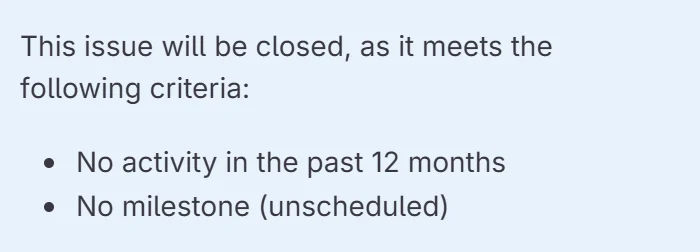
GitLab bot comment, June 28, 2018. It proposes closure using administrative criteria and supplies no deployment evidence. Read the original comment. Captured October 12, 2026.
Keep Missing Release Evidence Explicit
The inspected canonical records do not establish an implementation, deployment, or production check. Record that evidence as unknown. It does not establish that GitLab never implemented canonical tags or has a canonical problem today.
The parent also contains historical crawler-recovery reports and later conflicting visibility reports. Those concern broader crawling and visibility; the story is not that no SEO activity followed the original investigation.
Read each record against its assigned job. Follow the successor, identify what each task was meant to accomplish, and keep administrative closure separate from verified implementation. A move or duplicate can resolve a record correctly while delivery remains tracked elsewhere.
Define the Change Before Assigning the Ticket
A workable SEO request specifies the intended behavior and how the receiving team can check it. “Fix canonicals” leaves too many decisions inside a two-word instruction.
For a canonical change, the team needs to agree which URLs should point to which preferred URLs, where the rule applies, and which exceptions matter. Google’s canonical guidance describes canonicalization signals; it does not supply your site’s intended URL relationships.
Preserve the Approved Scope and Exceptions
Carry the original decision into the handoff. Include affected page families, markets, templates, and explicit exclusions. If implementation reveals that the approved approach cannot work as specified, return that decision to its authorized owner.
A proposed handoff record for your own change can use these fields:
- Purpose and approval: the problem being addressed and the reference to the approved decision.
- Scope: affected pages or templates, important exceptions, and exclusions.
- Intended behavior: what should change in the actual output.
- Ownership: requester, receiving team, approver or release authority, implementer, and verifier.
- Dependency: what must be available before work can proceed.
- Acceptance: representative cases, expected results, and the evidence needed.
- Delivery record: release reference, dated production check, closure reason, and any unresolved action.
Applied to the public example, the known record references are #24289, #25065, and #16584. The inspected sources do not provide a verified release owner, production test, or delivery result. Those fields stay unknown; filling them with plausible details would turn an evidence-reading exercise into a fictional case.
Use the same approach internally: distinguish a missing field from a field that genuinely does not apply. For a document-only decision, a deployment reference may be inapplicable. For an implementation request, missing production evidence remains an open check.
Agree on Observable Acceptance Checks
Acceptance describes what the team will observe when the approved change behaves as intended. Atlassian’s definition-of-done guidance emphasizes agreed completion criteria; the SEO-specific behavior still needs to be defined for the change.
For a canonical implementation, acceptance could require checking the declared canonical on an included URL, checking a relevant exception, and confirming that the target matches the approved relationship. These proposed checks are for the reader’s own change. They are not reported GitLab results.
Agree on risk handling before release. A shared template change may warrant staged expansion and checks on critical exceptions. A narrow CMS correction may need only a proportionate check of the affected output. Name who can stop further rollout and who can authorize a repair or feasible rollback if an agreed production check fails.
“SEO reviewed it” is too vague to serve as acceptance. State what was reviewed, where, against which expected result, and what remains unchecked.
Give Each Handoff an Owner and a Next Action
A handoff is usable when the receiving team accepts the work and knows its next action. Assigning an issue does not establish that the team has the necessary information, capacity, or decision authority.
The requester explains the SEO requirement. The implementer determines how to deliver the approved behavior. The approver resolves decisions within their authority. The verifier compares the actual result with the agreed checks. One person can hold several roles where that is practical; consequential changes may benefit from a separate check.
Three execution skills make these handoffs work:
- Translate the requirement: turn an SEO recommendation into behavior the receiving team can implement and test.
- Interpret the evidence: distinguish live output, Google’s indexed representation, and subsequent performance.
- Escalate the decision: identify precisely what is blocked and which owner can resolve it.
Coordinate Technical and Content Workstreams
Technical and content changes can share a purpose while taking different delivery paths. Preserve those differences in the handoff.
| Workstream | Handoff That Matters | Observable Completion Check |
|---|---|---|
| Shared-template technical change | Engineering receives approved behavior, scope, exceptions, and dependencies | The released production output meets the agreed cases |
| Content change | Editorial or CMS owner receives approved purpose, evidence, and required legal or regional approvals | The published page contains the approved material and functioning intended elements |
| Combined page change | Technical and editorial owners agree which prerequisite unlocks the other | Both components are checked against the same approved page purpose |
The content row is a delivery check. The SEO content creation workflow covers the separate job of researching and writing an article.
If different teams use different tools, retain a shared scope reference and link their records. The reader of either record should be able to find the receiving owner and current dependency without reconstructing the project from messages.
Resolve Blocked Dependencies
A blocked status should explain what will unblock the work. “Waiting for engineering” does not tell engineering what to do.
Record the missing decision or input, its owner, the next action, the review date, and the condition for resuming. For example, a canonical request may need an authorized decision about a URL exception before the implementer can finalize the rule. The escalation should ask for that decision directly.
If the work is no longer worth doing, record the authorized decision to defer or decline it. If its scope needs to change, return to the approval owner. Keeping an impossible request assigned indefinitely makes the board less informative.
From Request to Verified Release: A Short Step-by-Step Guide
Use this sequence for one approved change. Keep the same scope reference attached as the work passes between teams.
- 1Define the request. Record its purpose, affected pages, exceptions, and intended behavior.
- 2Agree on the handoff. Confirm the receiving owner, dependencies, approval authority, and observable acceptance checks.
- 3Implement and link the release. Preserve the approved scope and attach the production release or version reference. Escalate unresolved decisions before proceeding.
- 4Verify the agreed behavior. Check the released output and relevant exceptions. Retain dated results; route a failed check to the release owner for stop, repair, or authorized rollback decisions.
- 5Record the disposition and follow-up. Count a checked implementation as delivery. Link moved or duplicate records, preserve authorized defer or decline decisions, and assign missing evidence checks. Review Google processing and intended outcomes separately where relevant.
The next section explains what production verification should establish and where its evidence ends.
Verify the Release in Production
Verify the behavior that was agreed, on the released version. A successful staging check is useful preparation; the production record tells you what users and crawlers can receive.
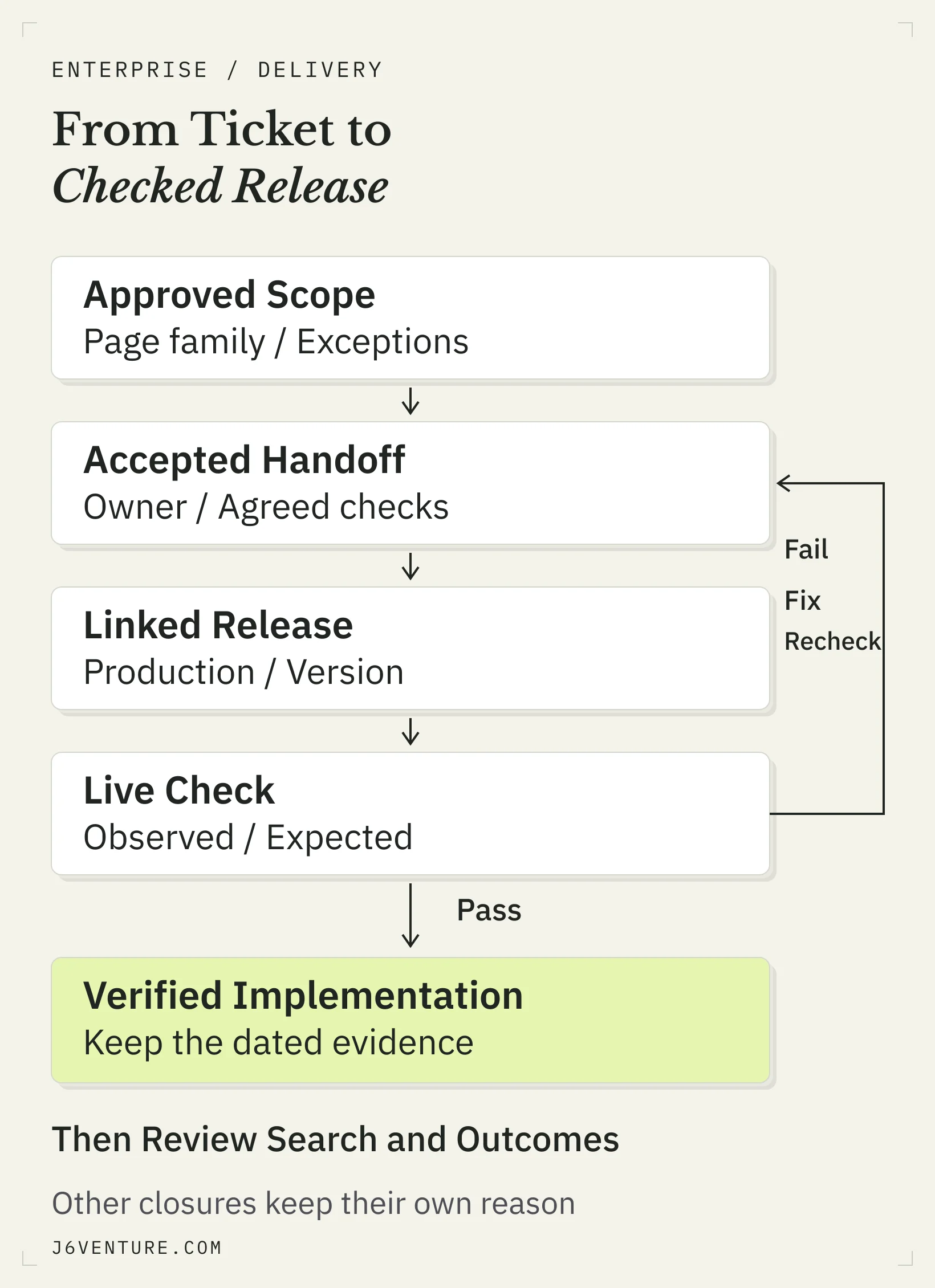
J6’s proposed delivery path. Production verification checks the agreed implementation; search processing and outcome review follow separately.
Check the Agreed Behavior
Retain the release or version reference, check date, tested URLs or cases, expected behavior, observed result, and unresolved exceptions. Choose checks according to the change’s reach and risk.
A passing sample supports the cases inspected. It is not exhaustive proof across an entire template family. Include critical exceptions and investigate mismatches before extending a broad release.
When an agreed production check fails, route the observation to the responsible release owner. That owner should stop further rollout where appropriate, arrange repair, or decide whether an authorized rollback is feasible. Preserve the failed evidence so the confirming check tests the actual defect. A rollback is a delivery response; it does not guarantee restoration of search outcomes.
Do not use a delayed ranking improvement as evidence that the implementation itself failed. First check whether the intended behavior is present.
Keep Google Processing and Outcomes Separate
Three questions need different evidence:
- 1Did the change reach production correctly? Inspect the agreed behavior on the released page or system.
- 2Has Google processed the relevant version? Examine available indexed evidence and its dates.
- 3Did the intended search or business outcome improve? Review comparable results for the page’s assigned purpose.
Google’s URL Inspection documentation separates live testing from information about the indexed version. A live test cannot predict Google’s selected canonical. Observing the intended canonical declaration therefore checks your output; Google’s indexed canonical selection is a separate observation.
Keep that follow-up open when it matters, without making Google processing a universal gate for declaring an engineering implementation correctly delivered. The SEO timing guide explains how to decide whether to wait, fix a blockage, or change approach after implementation.
Record Why the Work Closed
Record the closure reason alongside the work status and verification evidence. These meanings answer different questions and can fit your existing system without a new software schema.
- Implemented and checked: retain the release reference and dated acceptance evidence.
- Duplicate: link the record that owns the underlying work and its current state.
- Moved: link the successor so the delivery trail remains navigable.
- Deferred or declined: retain the authorized decision, reason, and any reconsideration condition.
- Administrative closure: retain the rationale and identify unresolved delivery evidence.
A parent task to create follow-up issues can be complete when those issues exist. A request to implement behavior needs evidence of that behavior. Judge completion against the record’s actual job.
Count the underlying delivered intervention once. Moving or duplicating its record should not create additional delivery credit. If production verification is missing, retain a pending check rather than assuming success or failure.
Automate Coordination With Evidence Checks
Automation is useful when its permitted action is clear. Routing a request, reminding an owner, collecting a release link, or flagging a failed check can support coordination. Each needs a trigger, expected output, exception route, and responsible owner.
For example, a workflow can flag an implementation ticket marked complete without its required evidence link. The flag asks someone to inspect the evidence; a filled field alone does not establish that the linked release meets acceptance.
Keep release authorization and substantive verification explicit. Automated labeling and routing visible in a public record show record maintenance, without establishing delivery effectiveness. Choose automation for a repeated coordination problem you have; a platform list cannot make that decision for you.
Review Progress Without Counting Every Closure as Delivery
Review verified releases, other closure reasons, pending checks, and blocked work separately. Define what each count includes before using it to describe progress.
Start with the underlying change and ask:
- What reached production and passed its agreed checks?
- What ended through a legitimate decision, duplicate, or move?
- What still needs implementation or verification?
- Which unresolved dependency needs a decision now?
- Which delivered change needs a separate search or business review?
This review should end with owned actions, decisions, or a clear next observation. It should not reward administrative cleanup as shipped work or penalize a legitimate deferral as an implementation failure.
Delivery, Google processing, and business performance can progress at different times. Keeping those states visible lets the team address the right problem without building a new dashboard around ambiguous ticket totals.
Start With One Approved Change
Choose one existing approved change and follow its record from purpose to current disposition. Find the receiving owner, agreed checks, release reference, and dated production evidence. Follow any successor or duplicate links.
Leave the record with a clear disposition and next action. Missing release evidence needs an assigned check. A decision to defer or decline needs its authorized reason. A verified release needs its dated proof and, where relevant, a separate review of the outcome it was intended to improve.
Enterprise SEO project management should make that trail understandable to the next person: what was approved, how the work ended, and which evidence supports the next decision. A team should be able to explain why work stopped as clearly as how it shipped.
Make the change traceable before you call the work complete. Start with that one record, resolve its next decision, and retain the evidence that makes its completion meaningful.