SEO changes can take weeks or months to show an effect, and growth in qualified leads can take longer. There is no guaranteed month when SEO starts working. Judge progress from when the work went live, what Google has processed, and the result you expected to improve. Then decide whether to wait, remove a blockage, or change the approach.
Make the timeline question actionable: what evidence says we should wait, fix a blockage, or change course? “SEO takes time” still leaves your team accountable for what went live, what changed, and when it will reassess.
A metric gives you a clue; diagnosis connects it to a decision. Our suggested method separates delivery, search visibility, and business outcomes so you can hold each part of the work accountable.
How Long Does SEO Take to Work?
The time depends on the change and the outcome. Google’s SEO Starter Guide says effects can appear within hours or take several months. It generally suggests allowing a few weeks before assessing search impact. That is observation guidance for changes, with some taking months or producing no noticeable improvement; it sets no universal minimum or results deadline.
Build your plan around implementation, search evaluation, and customer response. A forecast for leads needs the relevant pages, expected audience, conversion assumptions, and your buying cycle behind it.
Rankings, Traffic, and Leads Follow Different Timelines
Define what “working” means before accepting a forecast. A page appearing for a relevant search, receiving a visit, generating an inquiry, and contributing to a sale are different outcomes.
Ranking for a low-demand query may bring little traffic. An educational article may help a buyer long before that person requests a proposal. A service page can attract interested visitors while an unclear offer prevents inquiries.
Set one search outcome and one business outcome for the pages you are improving. Keep the connection plausible: a stronger service page might aim for relevant search visits and qualified inquiries. A glossary page may support discovery and further reading. It should not inherit the service page’s conversion expectations.
New Websites and Existing Pages Start From Different Positions
An existing page may already have relevant impressions, useful links, and a history you can compare. A new website has less observed performance to guide a forecast. That changes how confidently you can judge progress.
For an existing page, save the queries already generating impressions and identify the reader need the refresh should serve better. Relevant internal links and links from other sites may already help people and search engines find it. Preserve those useful connections while improving the answer. Compare its own query history after the change instead of starting with an unrelated industry average.
For a new site, first establish whether priority pages are discoverable and indexed, then which relevant searches begin to surface them. With little history, a forecast has to carry more uncertainty. You may need to build useful coverage and earn recognition before meaningful visibility develops. Domain age alone gives you little basis for choosing a deadline.
Why Does SEO Take Longer for Some Websites?
Competition, the starting condition of the site, and implementation capacity affect the work needed before results can improve. Separate time spent delivering that work from time spent evaluating it. A delayed launch and a published page struggling to compete are different problems with different owners.
Competition and Your Existing Search Presence
Review the pages serving your intended searches. What do they help readers understand or accomplish? Does your page provide the evidence, explanation, or functionality that the search calls for?
Waiting will not supply a missing comparison, repair an incorrect answer, or make an irrelevant page fit a buying decision. Keep useful pages stable through ordinary fluctuations, and address a demonstrated weakness when you find one.
Use the page’s own relevant queries as its baseline. A broad industry term can obscure progress on the narrower problem your page owns. Our explanation of organic SEO and where to start covers how to identify that first useful improvement.
The Work Required and How Quickly It Gets Implemented
A title edit, a content rewrite, and a site migration have different scopes and dependencies. Writers may need subject expertise; developers may need release time; an owner may need to approve changes.
Ask for the published work and its implementation date. A recommendation sitting in a document has not changed what a searcher or crawler encounters. More resources can reduce delivery delays, but they cannot guarantee faster ranking gains.
When Should You Start Measuring SEO Progress?
Use the campaign start date to judge delivery and the implementation date to evaluate a change. Keep both visible. A late release should not erase the earlier delay, and an unpublished recommendation has had no opportunity to improve the page.
Record When the Changes Went Live
Save the URL, the change, its purpose, and the date it became publicly accessible. Preserve the previous content or technical state so you can distinguish a completed improvement from a reported task.
Retain earlier versions and dates when you edit again. That keeps the team accountable and helps you interpret results when several changes overlap.
Check Whether Google Has Processed the Changes
Use URL Inspection to compare the last crawl date with implementation and inspect the available indexed-page information. Check that Google selected the intended canonical URL, meaning the version it treats as representative when similar pages exist.
A crawl after implementation shows that Google visited the page after the change. Inspect the fetched content where available to see what it received. Neither observation proves that all ranking effects have taken place.
The live test checks the page as it can be fetched now. It does not prove that this version is already indexed. Where the reported crawl predates the work, record the processing evidence as incomplete rather than declaring the rewrite ineffective.
Define Which Result You Expect to Improve
Match the measure to the work. Removing an unintended indexing restriction calls first for an indexing check. Improving a page’s fit for a search calls for relevant query performance. Repairing a broken inquiry form calls for a successful submission check and subsequent inquiry data.
Use comparable reporting periods and consistent page, country, device, and search-type filters. Exclude incomplete days from a comparison. For seasonal topics, review the wider demand pattern too. Record other changes that could explain a result; a before-and-after comparison alone does not establish causation.
How Can You Tell Whether SEO Is Working?
Judge each page against its assigned outcome: eligibility, relevant visibility, visits, or qualified inquiries. Check the queries behind a rising total and the people behind an inquiry count. Report progress at the stage where it happened, then examine what should happen next.
An Indexed Page Still Needs to Earn Visibility
Google’s URL Inspection documentation distinguishes eligibility from guaranteed appearance. An indexed page can still receive few impressions or appear far below the results people choose.
If indexing was the problem, resolving it is a completed technical improvement. Report that achievement accurately. Assess relevance and search performance separately before claiming the broader SEO approach is succeeding.
More Impressions Need a Closer Look at the Queries
Filter the Search Console Performance report to the page and inspect its queries. Are the increases connected to the audience and problem you intended to serve? Did growth come from your brand name, a new topic, or searches in another market?
Compare a consistent group of relevant searches where the data allows. A page-level average can change when its query mix changes. That makes the total useful for orientation, while individual query patterns help explain the movement.
With only a few impressions, keep the conclusion narrow: the page has begun appearing. Gather a fuller query pattern before forecasting inquiries.
More Clicks Need a Separate Check on Lead Quality
Confirm that visits reach the intended page and that the inquiry path works. Then examine whether the inquiries fit the business: the right problem, customer type, and market.
A page can be working in search before it is working commercially. Rising relevant visits and later inquiries belong to different parts of the buying journey. Use your own sales history to judge that interval; a documented buying cycle provides context for the lag without excusing poor-fit traffic or a broken inquiry path.
Should You Wait, Fix a Blockage, or Change Your SEO Approach?
Choose the next action from the observed problem and the evidence still missing. Waiting can be reasonable when work is recent and relevant signals are developing. A confirmed obstacle needs attention. Persistent weak performance calls for a review of the approach, with broader changes and data limitations considered.
Assign the problem to the work that can resolve it: unpublished improvements are a delivery issue; indexing restrictions are a technical issue; weak query fit calls for content or strategy review; relevant visits with poor-fit inquiries call for an offer and conversion review. These are investigation routes, with tracking checked first.
Choose the Next Check
| Observation | Check Before Deciding | Next Action |
|---|---|---|
| Recent implementation, limited results | Crawl timing, indexed content, and the intended outcome | Fix a confirmed obstacle. If evidence is missing, assign the check. If observation is appropriate, set a review date. |
| More impressions, flat clicks | Query relevance, positions, and comparable periods | Investigate unrelated query growth or weak listings. Recheck improving relevant queries using the same filters. |
| More relevant clicks, flat leads | Tracking, inquiry path, visitor volume, and buying lag | Test the conversion path and audience fit before changing search targeting. |
| Several pages lose visibility | Shared timing, site changes, indexing, and demand | Investigate the wider pattern before rewriting individual pages. |
The Work Went Live Recently and Results Are Still Limited
Separate a delivery delay from a short observation window. If the agreed changes are still unpublished, name the owner and completion date. If they are live, check whether Google’s available crawl information includes them.
For a recently changed page, that might mean checking for a post-edit crawl at the next review, then comparing its relevant queries over complete reporting periods. If the page becomes unavailable or an unintended indexing restriction appears, act immediately. If the expected signal remains absent, investigate why before extending the wait.
You can assess the answer and offer while waiting for more search data. A confirmed content weakness still deserves attention.
A J6 Review in Progress: Hold the Verdict on a Fresh Rewrite
On October 8, 2026, we published a substantial refresh of our Organic SEO article, giving it a clearer job: help the reader choose the first useful improvement.
Its pre-edit Search Console baseline for September 1 through October 5 was 460 impressions, zero clicks, and average position 83.4. The query “organic search engine optimisation” accounted for 51 impressions at average position 71.1. Those numbers describe the earlier page.
When we inspected the URL on October 9, Google reported it indexed with the expected canonical, but the latest reported crawl was still September 12, before the rewrite. That changed what we could responsibly assess: the report did not yet give us post-edit crawl evidence.
Our decision: hold the search-performance verdict and preserve the rewrite for observation, while continuing to fix any confirmed defects. At publication, no post-edit query movement or recovery was established. The next review is October 16: check for a later crawl and compare available finalized query data with the saved baseline. If crawl evidence is still missing, investigate discovery and access; if the data is too sparse, document that limitation and set the next review. This is an ongoing decision record, with the result still open.
Impressions Are Growing but Clicks Are Flat
Check whether new impressions come from useful searches, how often the page appears for them, and at what positions. Growth from unrelated queries gives little support for waiting on the original business objective.
If relevant queries gain visibility but remain low in the results, compare the page’s answer, evidence, and functionality with the pages above it to identify a useful improvement. If positions are relatively stable and clicks weaken, examine the displayed title, competing results, and the searcher’s options. Avoid treating a click-through-rate change as proof that the title caused it.
Continue observing an improving relevant query pattern with a defined next check. If performance stays weak across comparable reviews, choose a change that addresses a diagnosed problem:
- Retarget the page when the intended searches ask for something your business is poorly placed to answer.
- Rewrite its purpose when the query needs a decision aid but the page delivers a generic definition.
- Consolidate overlapping pages when they serve the same reader job and divide useful content; review query ownership before planning redirects.
- Stop pursuing the topic when it has little business relevance and no defensible contribution worth building.
Relevant Clicks Are Growing but Leads Are Flat
Test the form, booking link, or other intended action first. Verify that measurement still records it. A broken route or missing event can make a productive page look unproductive.
Consider the visitor’s task and the next step offered. An educational visitor may need a relevant comparison or service explanation before making an inquiry. For limited traffic, allow enough observations to evaluate that path; use your own history rather than imposing a universal conversion threshold.
If a working conversion path receives enough relevant visits to warrant investigation but produces poor-fit inquiries, review the offer, page promise, and targeting together. Choose the change that addresses the observed mismatch.
Visibility Has Fallen Across Several Pages
Compare the affected pages and dates before treating every decline as a content defect. Google’s traffic-drop guidance identifies multiple possible causes, including technical problems, ranking changes, seasonality, and reporting issues.
Check whether the affected pages share a template, deployment, market, or topic. Treat the timing of a Google update as one investigative lead alongside site changes and demand.
Escalate confirmed access or indexing problems promptly. Use an SEO audit for the detailed investigation. Keep a record of the wider issue when assessing an individual rewrite, so its performance is not judged in isolation.
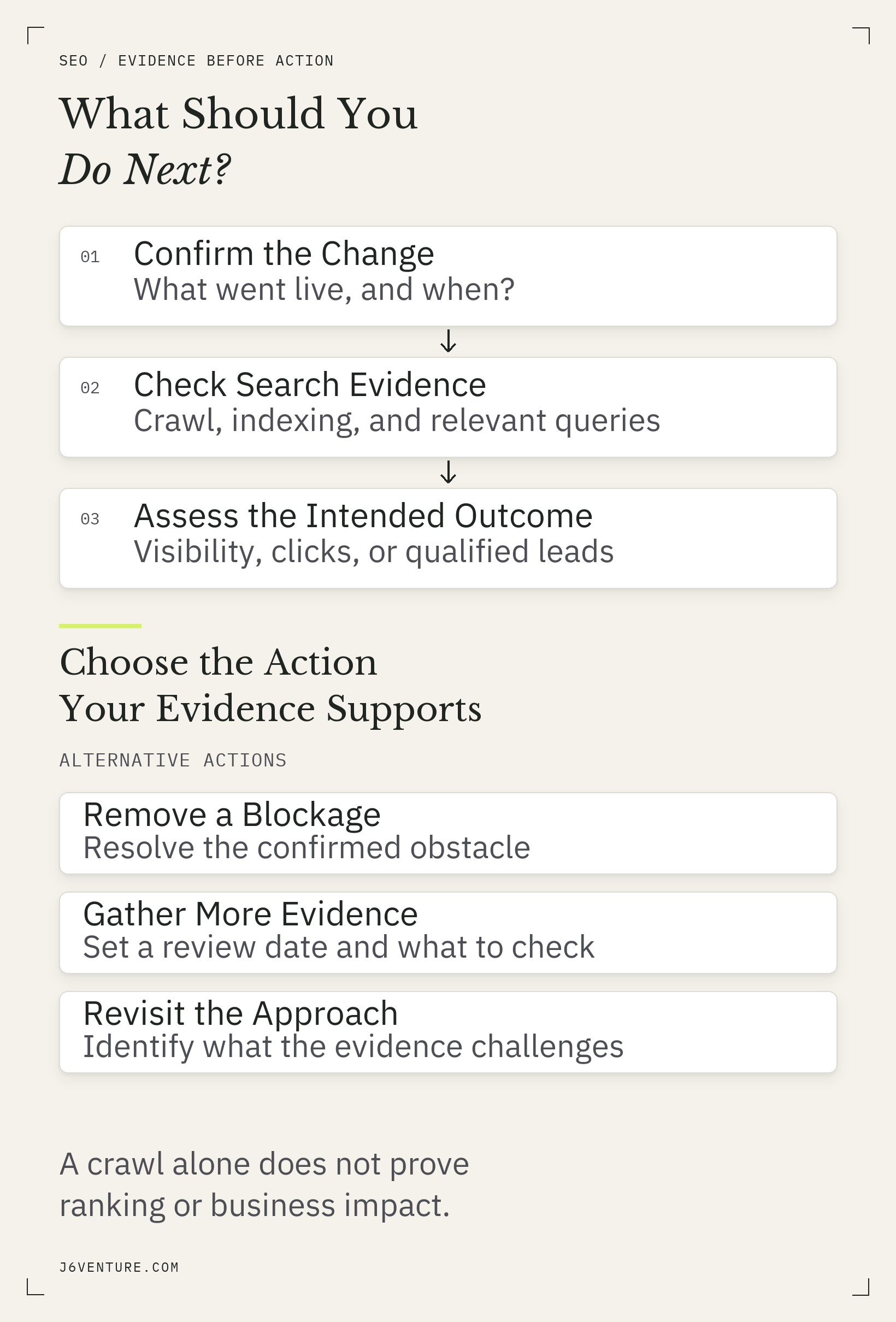
Record the implemented change, available search evidence, and intended outcome before choosing the next action. A crawl alone does not establish that every ranking effect has occurred. When evidence is insufficient, name the missing check and a review date.
Record the Evidence, Uncertainty, and Next Action
Complete this working template with your own evidence for each priority change:
Page and intended outcome: Identify the URL and the result the work should affect.
Change and implementation date: Describe what went live and preserve the previous version.
Google’s available evidence: Record crawl timing, indexing, and what remains unconfirmed.
Comparable result: Name the period, filters, relevant queries, and business measure.
Decision and uncertainty: Explain why you will wait, fix, or revise, including other plausible explanations.
Owner and next review: Assign the action, date, and evidence needed to reconsider it.
For an indexing fix, the next review should establish whether the intended URL is indexed. For a rewrite, compare the same relevant query group with the saved baseline. For an inquiry-path fix, first confirm a successful submission, then review subsequent inquiries. Set the review date according to the change and available data.
What an SEO Report Should Never Ask You to Accept
- A fixed six-month answer with no evidence from the pages being improved.
- A campaign-start chart that conceals a much later implementation date.
- More impressions without showing which relevant queries grew.
- Traffic presented as commercial success without examining inquiry quality.
- Another period of waiting with no signal, review date, or action condition.
Ask the agency or internal owner to supply the missing evidence and a next step. An elapsed month should make the decision clearer.
What Can You Do to Avoid Unnecessary SEO Delays?
You can reduce preventable delays by getting agreed improvements live, resolving confirmed obstacles, and keeping evaluation clear. These actions improve delivery and diagnosis. They cannot force a ranking or compress every part of Google’s processing and your customers’ buying decisions into a chosen schedule.
Resolve Implementation and Indexing Blockages
Assign an owner to each priority change and verify completion on the live page. Investigate unintended indexing restrictions, failed page access, or an unexpected canonical before commissioning another rewrite.
Google says recrawling can take days to weeks. Repeating an indexing request for the same URL will not make it get crawled faster. Resolve the underlying issue and monitor the result.
Prioritize Work That Addresses the Observed Problem
Use the review to choose the next task. A page missing a necessary explanation needs editorial work. A broken inquiry form needs a functional fix. A site-wide access problem needs technical investigation.
Publishing more pages does not complete any of those tasks. Before creating another URL, check whether an existing page already owns the reader’s question and could be improved.
Keep a Change Record So You Can Evaluate Results
Log meaningful edits, releases, and measurement changes. When practical, avoid changing several unrelated elements together. If changes must ship together, record the package and evaluate it with that limitation.
Keep fixing confirmed problems. A cleaner comparison is useful, but it is not a reason to leave a broken page in place.
Can a Six-Month SEO Study Predict Your Results?
A study of selected websites reaching a ranking milestone cannot set your lead-generation deadline. Check its population, starting point, and measured outcome. Semrush’s 2023 ranking study shows why those details matter.
How Semrush Narrowed 28,000 Domains to 2,155
Semrush selected 28,000 domains newly appearing in its US database in July 2021 with at least one top-100 keyword. It followed them through July 2022, excluding domains that disappeared from the top 100 entirely at any point. That left 2,155 qualifying websites.
Among that selected group, around 41% ranked in the top 10 for at least one keyword after six months. Websites that failed the continued-visibility requirement had already been excluded from this analysis. The percentage therefore describes a narrower population than all new websites.
Why a Ranking Milestone Cannot Set Your Deadline for Leads
First appearance in a database is not a verified launch or SEO implementation date. A top-10 keyword also says little by itself about query value, qualified inquiries, or recovered costs.
Use the study to understand ranking development within its selected group. To apply a benchmark to your own plan, ask three questions: Are these businesses comparable to ours? Are we measuring from the same starting point? Is the outcome the one we need? A mismatch weakens the forecast. The 41% figure supplies neither your individual ranking probability nor a six-month deadline for leads.
What Should Your Next SEO Review Decide?
“SEO takes time” still leaves four questions to answer: what went live, what changed, what remains blocked, and when will we reassess? Keep delivery, search progress, and business results visible together. Give a fresh improvement a fair evaluation, fix confirmed obstacles, and revise an approach when the evidence challenges it.
Choose one priority page and complete the review record. Leave the meeting knowing what went live, what has changed, what remains uncertain, and who will do what next.
If the first unanswered question is whether Google can access and index that page, start with the Search Console-led audit before commissioning more content.