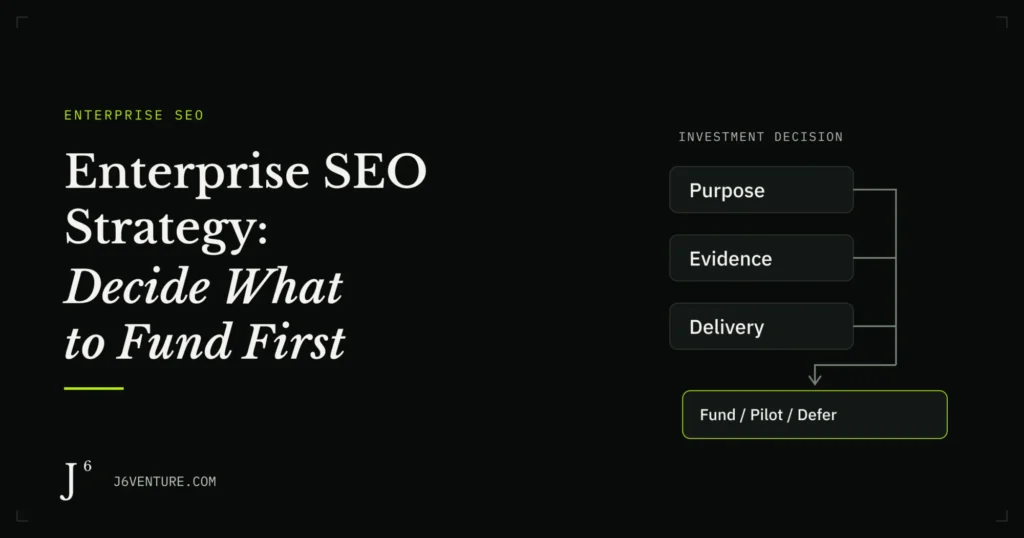
Enterprise SEO is organic search optimization across a large or complex website and organization. A strategy connects the business outcome, the affected page group, and the teams that can deliver a change, then decides whether to fund an intervention, test an important unknown, or defer the work.
Enterprise scale makes SEO a resource-allocation problem across shared systems and teams. The first investment can be engineering time, editorial capacity, or budget. Its value depends on what the business needs to protect or improve and how much evidence supports the proposed action.
A long audit can identify hundreds of issues while leaving that decision unanswered. Before adding another project to the roadmap, ask: What business job does this change serve, and what evidence makes it worth doing now?
What Is Enterprise SEO?
Enterprise SEO helps people discover a business through unpaid search while coordinating optimization across shared systems, substantial content inventories, markets, and teams. Its defining challenge is managing the consequences of scale and organizational complexity.
Page count is one clue. A common product template can affect an entire catalog; a regional change can need several approvals; separate business units can publish pages that compete for the same reader job. A company with a smaller website can still face these coordination problems.
The underlying work remains recognizable: make useful pages discoverable, help search engines understand them, match relevant searches, and support the visitor’s next decision. Organic SEO explains those foundations.
Enterprise SEO concerns public search visibility. Internal enterprise search retrieves information inside an organization. Search engine marketing can also include paid advertising, which requires its own investment decisions.
What Changes When SEO Operates at Enterprise Scale?
Enterprise scale changes the unit of work. A recommendation may need to address a page family and the system that produces it, with ownership split among SEO, engineering, content, product, regional teams, and leadership.
Enterprise SEO governance defines who can change shared rules, who approves exceptions, and how changes are verified. Centralize standards that need consistency, such as shared publishing requirements and release checks. Keep market and product decisions with the teams holding the necessary context, and name who resolves conflicts across those responsibilities.
That creates repeatability and substantial downside. A shared improvement can reach many relevant pages; an incorrect shared rule can damage those pages together. Count the pages that share the issue and intended outcome before treating a sitewide change as an opportunity.
| Area | What Changes at Enterprise Scale | Strategic Consequence |
|---|---|---|
| Technical access | Shared code and infrastructure can affect entire page groups | Identify the responsible system and the value at risk |
| Content | Many pages and contributors can repeat, age, or contradict information | Set page purpose and quality expectations before expanding production |
| Architecture | Navigation and internal links help people and search engines reach large inventories | Prioritize useful routes to important pages |
| Markets and business units | Audiences, offers, languages, and local responsibilities differ | Assess opportunities in the relevant market and business context |
| Authority | PR, brand, subject experts, and regional teams hold evidence and relationships across the organization | Coordinate access to the experts, evidence, and relationships that support credible material |
| Delivery | The person finding an issue may have no authority to change it | Confirm capacity and dependencies before committing |
Crawl-budget work is one possible technical priority. Google’s advanced crawling guide focuses on very large or rapidly changing sites and sites with substantial discovered-but-unindexed inventories. A large-company label alone does not establish a crawling constraint. Choose technical work from evidence of the affected problem.
Does Your Website Need an Enterprise SEO Program?
An enterprise program becomes useful when shared systems and organizational dependencies make isolated optimization difficult to sustain. The question is whether coordinated work can serve a valuable audience and whether the organization can deliver it.
Look for recurring conditions:
- Several important pages share a template, data source, or publishing rule.
- SEO recommendations depend on teams with their own priorities and release schedules.
- Multiple markets or business units need a common approach with meaningful exceptions.
- Existing valuable pages are exposed to migrations, redesigns, or frequent shared changes.
- Decisions need to consider both opportunity and the cost of affecting a large inventory.
Together, these conditions justify assessing a coordinated program. They do not establish a requirement to buy an enterprise platform. A tool purchase needs a separate assessment of the actual bottleneck and whether the team will use the capability.
Readiness also includes an accountable sponsor, access to useful performance and business evidence, and time from the people who can implement changes. If delivery capacity is absent, fund that prerequisite or reduce the commitment before promising a broad SEO program.
Which Enterprise SEO Benefits Are Worth Funding?
Enterprise SEO can support qualified discovery, protect existing search access, and make useful improvements repeatable. Each benefit needs an audience or business outcome worth serving and a feasible intervention behind it.
- Qualified discovery: relevant searches bring people to pages that help them evaluate an offer, learn something useful, or complete a transaction. Volume matters alongside audience fit and the value of that task.
- Protection: SEO involvement in shared changes can help preserve useful URLs, content, and routes to important pages. Specify what is exposed and the change that could affect it.
- Repeatable improvements: a sound template or publishing rule can reach an eligible page group without editing every page separately. Its benefit depends on the group’s relevance and the rule’s correctness.
- Better allocation: an agreed objective, supporting evidence, and known dependencies help leaders distinguish work ready for delivery from work that first needs investigation.
Include implementation and upkeep in the investment: engineering, content review, analytics support, localization where relevant, tools, and expected refresh frequency. Free organic clicks still require resources to earn and maintain.
A useful benefit statement names its condition: “Improve discovery for this category’s qualified searches by addressing this demonstrated gap.” A promise of more traffic across the whole site leaves both relevance and delivery unresolved. Our benefits of SEO discussion examines business fit and investment conditions in more detail.
Start With the Business Job: Protect, Unlock, or Explore
Classify the immediate purpose of an initiative before comparing it with the rest of the backlog. We suggest three jobs: protect existing valuable demand, resolve a blocked prerequisite, or explore demand the business has yet to establish.
Start with a relevant page group and market. Name its intended outcome, such as useful product discovery, qualified inquiries, or completed purchases. Inspect query, visit, and conversion evidence for that group alongside what the business knows about its audience and offer. Separate branded demand and other markets when their performance could obscure the opportunity you are considering. Separate observations from forecasts.
The jobs can overlap. A shared repair may protect current performance and allow future growth. Classify it by the immediate problem and dependency so a speculative expansion does not displace necessary protection solely because its forecast sounds larger.
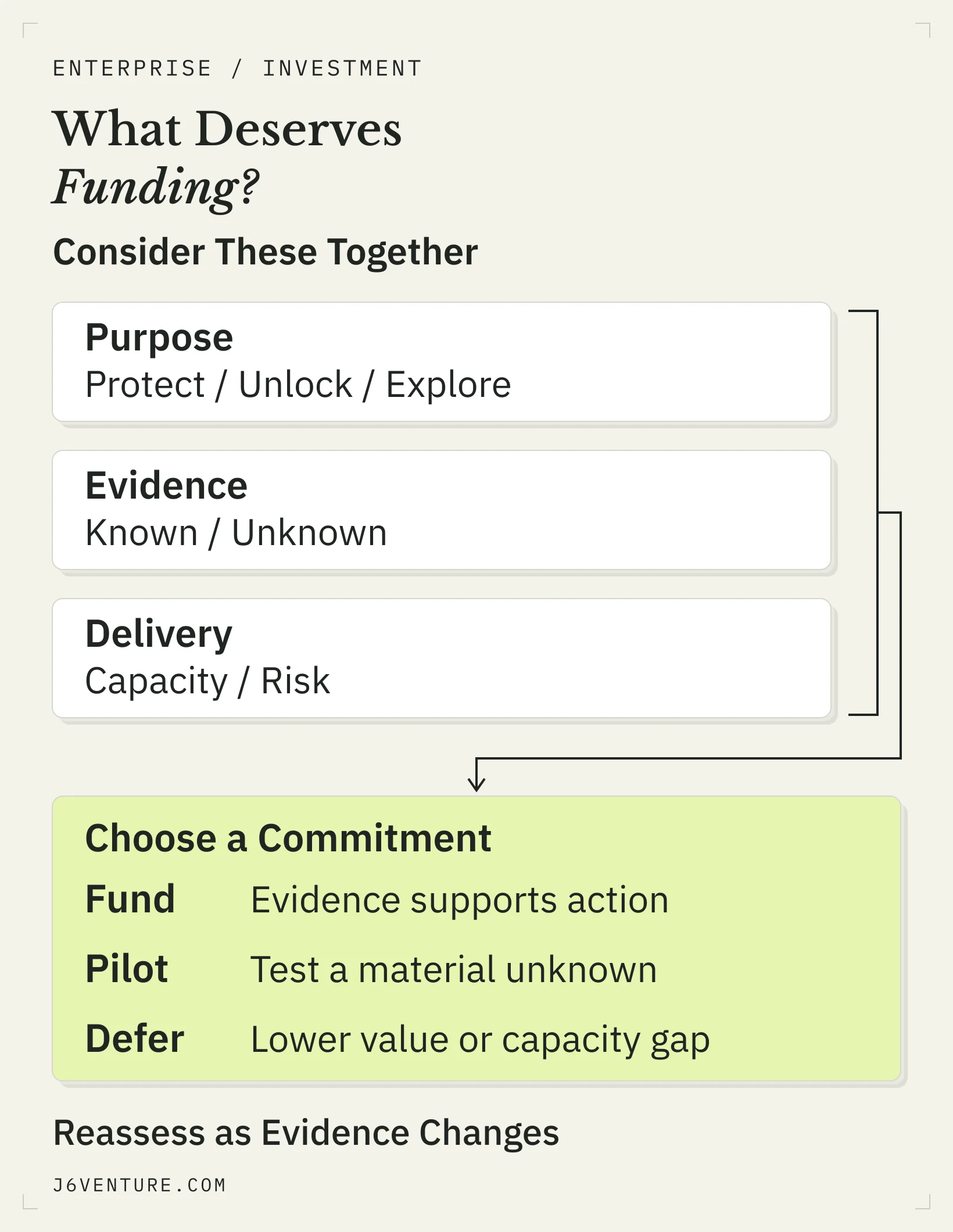
A planning aid: consider these inputs together. Reassess the commitment when evidence or implementation conditions change.
Protect Existing Valuable Demand
Protection work responds to value already present or a credible exposure to loss. During a planned migration, for example, the relevant questions concern the existing valuable pages, the changes affecting them, and how access and meaning will be preserved.
Its case does not require a promise of incremental growth. Evidence of an important asset and an impending risk can justify safeguards. Keep that reasoning separate from a forecast of additional traffic.
Unlock a Prerequisite
A prerequisite is something that must work for the intended opportunity to be served. If relevant pages are confirmed inaccessible to Google, producing more content on the same affected system leaves that access problem unresolved.
A decline in clicks by itself does not establish this diagnosis. Confirm the missing prerequisite and its connection to the intended pages. That finding can justify a bounded repair even while the eventual commercial upside remains uncertain.
Explore New Demand
Exploration asks whether a proposed audience, page purpose, or approach deserves a larger commitment. High search volume alone leaves questions about buying relevance, the available offer, competition, and useful differentiation.
Choose a consequential unknown that can be investigated. If the business cannot serve the audience, a publishing experiment will not fix that mismatch. If fit exists but a material assumption remains uncertain, a bounded pilot can inform the next investment.
Consider the difference between two proposals already described here. For a migration affecting established valuable pages, evidence of those pages and the impending change can support funding safeguards, even without a growth forecast. For pages aimed at a new audience, a large search-volume estimate leaves business fit unresolved. If the offer fits and an answerable unknown remains, a bounded pilot can earn capacity; if the business cannot serve that audience, defer. A single projected-impact score can hide the difference between protecting observed value and exploring an unproved opportunity.
What Rakuten’s Public Case Shows About Scale
Google’s historical Rakuten Recipe case demonstrates how an implementation through a shared CMS can reach a relevant content inventory. It also shows why a reported success needs a separate assessment before it becomes a current funding recommendation.
What the Record Establishes
Google published the Rakuten Recipe case on May 8, 2018. It described approximately 1.9 million recipes and menus and reported that structured data was implemented through the CMS within two weeks. That is an implementation duration for this historical case.
The record reported increased search-engine traffic and longer average sessions. It gives no controlled comparison design, implementation budget, or business-value forecast for a different website. Its older testing tools and search interfaces belong to that historical account.
The strategic observation is the connection between a relevant page family and a shared implementation. The record gives a leader a reason to examine whether their own important pages have a comparable system-level opportunity.

Source: Google Search Central’s historical Rakuten Recipe case, captured October 12, 2026. The two-week statement describes this implementation; it is not a results deadline.
What a Current Investment Decision Still Needs
The following is our application of the public evidence. It is separate from Rakuten’s reported decisions and outcomes.
| Established Fact | Decision Input Still Needed | How It Changes the Commitment |
|---|---|---|
| Rakuten implemented recipe structured data through its CMS | Which current eligible page group shares the rule? Who can change it, and what else could be affected? | Assess a shared intervention alongside isolated edits. Broad reach calls for a downside check as well as an opportunity estimate. |
| The case reported search and engagement gains in its historical context | Does today’s proposal fit current requirements, a valuable audience, available capacity, implementation cost, expected upkeep, and acceptable risk? | Historical gains alone leave rollout funding unresolved. Investigate a consequential unknown through a bounded check or pilot; defer when fit or a needed prerequisite is absent. |
| The record describes a full release and supplies no controlled comparison | What evidence will distinguish implementation success from the intended search or business outcome? | Specify the observable result before committing further capacity. Do not attribute a pilot or isolated causal return to this case. |
For a present recipe site, confirming current recipe feature eligibility and the CMS’s ability to represent the required visible information would address applicability. That check can change the choice before any performance experiment. If applicability fails, revisit the proposal. If the opportunity is relevant and feasible but its effect remains uncertain, define the pilot’s question and the observation that could answer it.
A small edit can still be the best priority when it addresses an important, well-supported problem. A shared change can deserve more effort when it reaches a valuable eligible group. Ease and page count are inputs; neither supplies the business case.
Choose Between Funding, a Pilot, and Deferral
Record the commitment the evidence supports. Use fund, pilot, and defer as planning choices, with the unknowns and constraints visible beside the action.
Fund a Bounded Intervention
Fund work when the relevant problem or opportunity is sufficiently supported, the proposed change plausibly addresses it, the responsible team can deliver, and the downside is acceptable. Name the initial page group and what the commitment includes.
- The business job and intended outcome are clear.
- The evidence connects the issue or opportunity to the affected group.
- Necessary dependencies and delivery capacity are available.
- The intervention has safeguards proportionate to its reach and reversibility.
- A review will decide whether to continue, expand, repair, or stop.
Confirmed severe harm may require prompt action with suitable safeguards. A pilot should not delay a necessary repair merely because incremental upside is difficult to forecast.
Run a Pilot That Answers a Consequential Question
A pilot earns resources when it can resolve an uncertainty that changes the larger decision. Define the question before defining the deliverable.
For the recipe opportunity, a feasibility question could be whether the CMS can consistently publish the required information on eligible pages. The signal is the implemented page output and its conformity with current requirements. A technical check answers that question; it does not establish increased revenue.
A performance question needs a different observation: whether the changed page group shows a relevant search or visitor improvement against a suitable baseline, allowing for other changes, seasonality, and processing time. Some results will remain uncertain; do not force a rollout decision from an uninformative test.
Specify what would justify expansion, what would stop the work, and when enough information should be available to review it. If the proposed observation cannot answer the unknown, redesign the test or defer it.
Defer Work With a Clear Reason
Deferral preserves scarce capacity when business fit, prerequisites, evidence, or implementation conditions do not support the proposal. Record the reason and what finding would reopen it.
Useful reasons include an audience the business cannot serve, a shared dependency awaiting resolution, no capacity from the implementing team, or a test that would not resolve the deciding uncertainty. A proposal’s popularity or vendor benchmark does not remove those constraints.
Deferral is also appropriate when expected value is too weak for the effort and risk. There is no obligation to keep every SEO opportunity in permanent pursuit.
Build a Roadmap Around Capacity and Evidence
An enterprise roadmap begins with a bounded intervention and a next decision. It should reserve the capacity required to complete the work, observe the relevant evidence, and respond to what it shows.
- 1Choose the first commitment. State the business job, page group, reason, and fund/pilot/defer decision.
- 2Confirm the dependency. Identify the implementing team and the prerequisite that could prevent delivery. Reduce the scope when capacity cannot support it.
- 3Define the review. Record the signal, baseline, observation window, and condition that would change the commitment.
- 4Keep the next opportunity conditional. Expand only when the first result and remaining capacity support it; otherwise repair, investigate, or stop.
Separate delivery evidence from outcome evidence. A correct release confirms implementation. Relevant query movement concerns search performance. Qualified inquiries or transactions concern business contribution. The SEO timeline framework explains why those observations run on different clocks.
Give confirmed protection and necessary prerequisite work room on the roadmap alongside exploration. An attractive growth forecast should not silently consume the resources needed to keep existing valuable pages working.
How AI Search Changes the Priorities
AI search adds questions about where a business is cited or described, while retaining important search foundations. For Google’s AI Overviews and AI Mode, avoid treating a special schema rollout as a universal enterprise requirement.
Google says supporting links must be indexed and eligible for a search snippet. It sets no additional technical requirements for these features and recommends existing SEO practices, including useful content, internal links, textual information, and structured data that matches the page.
Assess AI-related initiatives by the same business job and evidence standard. A recorded mention is a visibility observation; it leaves questions about relevant discovery and business value to answer. Eligibility also leaves selection uncertain.
When the broader channel mix changes, revisit the intended audience and outcome. J6’s SEO-to-GEO discussion covers the adjacent team, budget, and measurement decisions.
Leave With One Decision Your Team Can Act On
Your first enterprise SEO priority should identify the value being served, the relevant page group, the evidence, and the commitment that follows. Use a short decision record:
Your Enterprise SEO Decision Record
- Business job: protect, resolve a blocked prerequisite, or explore.
- Scope: the page group, market, and intended outcome.
- Evidence: what is known and which consequential question remains.
- Capacity and risk: the implementer, dependency, and acceptable downside.
- Decision: fund, pilot, or defer, with a bounded action.
- Next review: the signal, timing, and expand, repair, or stop condition.
Choose one proposal already on your backlog and complete this record before adding another. Take it to the team that owns the next dependency and resolve the commitment: fund a bounded change, test the deciding unknown, or defer it with a reason. Enterprise scale becomes manageable when the next investment has a reason, an owner, and an outcome worth checking.