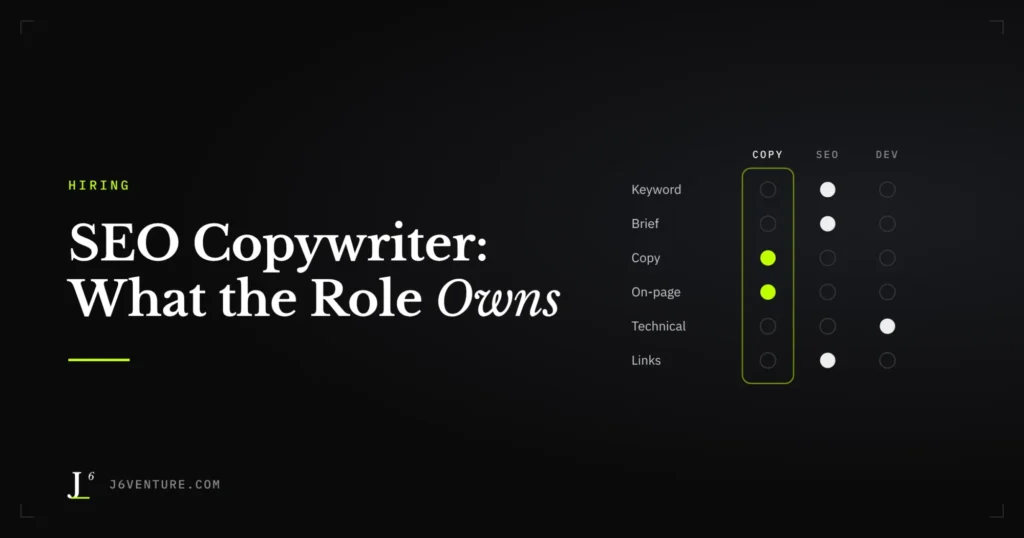
An SEO copywriter writes web pages that match what people search for and persuade them to act. They directly own the words on the page and contribute to how it ranks. Keyword strategy, technical SEO, and links usually sit with an SEO specialist, though senior copywriters sometimes take on keyword research and briefs.
Job ads, agencies, and freelancers use “SEO copywriter” loosely. Some mean a writer who handles the words; others expect keyword research, technical fixes, and links bundled in. The title tells you very little about which of those you are buying.
J6’s position: hire the gap, not the title. Map the work behind a page, find the decisions nobody owns, then hire for those.
What an SEO Copywriter Owns, and What They Only Influence
An SEO copywriter turns a target query and a brief into a page that answers the searcher’s question and moves them toward an action, such as a demo request. They own the copy. They influence rankings, but they do not control most of what decides them.
Directly owns:
- Body copy and headings, written to the search intent in the brief
- Sources for every claim, linked
Drafts for someone else to approve: title tag, meta description, and H1, plus internal link suggestions (SEO specialist); call-to-action copy (marketing lead).
Contributes to, without controlling: rankings and conversions. Technical health, indexing, site architecture, links from other sites, brand demand, competitors, and algorithm updates all move rankings, and none of them sit with the writer.
Should understand and challenge: the target query, the intent behind it, and any claim in the brief they can’t source.
Keyword “density” is the skill to stop paying for. Google’s spam policies define keyword stuffing as “filling a web page with keywords or numbers in an attempt to manipulate rankings,” including “repeating the same words or phrases so often that it sounds unnatural.” A writer who talks about hitting a keyword percentage is optimizing a number Google does not publish; pushed far enough, it becomes the stuffing that policy describes.
SEO Copywriter vs SEO Content Writer vs SEO Specialist vs Conversion Copywriter
The cleanest split is by the job each page does. An SEO copywriter writes commercially oriented search pages (service, product, comparison); an SEO content writer writes informational search content (guides, explainers); an SEO specialist decides what gets targeted and keeps the site findable; a conversion copywriter writes pages and emails where the offer is the main lever and search plays a smaller part.
| Role | Page job | Directly owns | Contributes to |
|---|---|---|---|
| SEO copywriter | Commercial search pages | Copy and headings (drafts title, meta, and CTA for approval) | Rankings and conversions on those pages |
| SEO content writer | Informational search content | Article drafts to a brief | Organic traffic and topic coverage |
| SEO specialist | The site’s search plan | Keyword targets, briefs, on-page sign-off, technical SEO with dev | Site-wide organic results |
| Conversion copywriter | Offer-led landing pages, ads, emails | Offer framing, messaging, copy tests | Conversion rate and revenue |
This is J6’s recommended model. Employers attach these titles to different jobs, and a senior SEO copywriter may also do keyword research, briefs, and on-page work. That person fills several rows at once, which is fine if you know you are hiring for those rows. Define the role by the rows you need filled in the table below.
Who Owns What on One Page
J6 splits one page into ten decisions and gives each a single owner. Contributors can and should challenge the owner, but one name carries the decision.
| Decision on the page | Owns | Contributes or challenges |
|---|---|---|
| Which query and intent the page targets | SEO specialist | Founder or marketing lead; copywriter validates intent |
| The brief: angle, outline, sources, must-answer questions | SEO specialist or editor | SEO copywriter |
| Body copy and headings | SEO copywriter | Subject expert (accuracy) |
| Title tag, meta description, H1 | SEO specialist approves | SEO copywriter drafts |
| Internal links | SEO specialist | SEO copywriter suggests |
| Indexing, speed, canonicals, schema | SEO specialist | Developer |
| Links and mentions from other sites | SEO specialist or PR | Founder (relationships) |
| Offer and call to action | Marketing lead | SEO or conversion copywriter |
| Quality sign-off before publishing | Editor | SEO specialist |
| Measuring the page | SEO specialist | Marketing lead |
Any row with no name on your team is work nobody is doing, however good the writing is. The copywriter owns one row and drafts or contributes to five more; the rest decide whether the page gets found, trusted, and measured. For how the SEO and writing sides keep feeding each other after launch, see why SEO and content work best as a loop.
Which Mix Fits Your Stage
Who you hire first depends on which rows are empty. The cards are J6’s recommendations for B2B teams.
01Seed: Few Pages, No Search History
A freelance SEO copywriter for the pages that sell (home, product, pricing, and two or three core use cases), with a part-time SEO specialist or consultant owning targets, briefs, and indexing.
02Growth: Product-Market Fit, a Content Plan Forming
An SEO specialist (in-house or agency) owns the plan and briefs. One or two SEO content writers cover informational topics; the SEO copywriter stays on service and comparison pages, where wording affects revenue.
03Scale: Many Pages, Several Markets or Products
An editor owns quality sign-off across writers. Technical SEO gets a named owner who works with your developers. A conversion copywriter tests high-traffic landing pages, while SEO copywriters refresh pages that already rank.
For most B2B products with established search demand, fix the money pages before scaling informational publishing. If you can hire only one person and nobody has checked the site for indexing problems, start with the SEO specialist: a copywriter cannot fix technical blocks such as a stray noindex tag, a robots.txt rule, or a wrong canonical.
What Goes Wrong When a Row Is Empty or Misassigned
Each failure below starts in a specific row of the ownership table. Find the row, and you find the fix.
- 1Indexing row empty: good copy nobody can find. A noindex tag or robots.txt rule keeps the copywriter’s pages out of results, and better writing changes nothing.
- 2Brief row empty: a keyword dump instead of a brief. UK copywriter Jenny Lucas describes a keyword list made of “alphabetical batches of keywords, which were all variations of each other. Some were getting a lot of monthly searches, others were getting zero.” Without a brief, the writer guesses at intent, and keyword counts fill the gap.
- 3Targeting and offer rows misaligned: traffic that never buys. In the same piece, Lucas describes a business owner who “was getting traffic, but his bounce rate was through the roof and he wasn’t making any sales.” Lucas doesn’t diagnose the cause; in ownership terms, traffic without sales points to the targeting and offer rows.
- 4Measurement row given to the writer: judged on what they don’t control. A writer measured on rankings alone carries technical, link, and competitor effects that sit in other rows. Judge copy on whether the page answers the brief, and read its conversion rate alongside the offer, which the marketing lead owns.
- 5Quality sign-off row empty: scaled pages nobody checked. Google lists “using generative AI tools or other similar tools to generate many pages without adding value for users” as scaled content abuse. A writer paid per page with no editor has an incentive to drift toward it. Google’s guidance on AI content also says “Appropriate use of AI or automation is not against our guidelines,” so the fix is an owner for sign-off; the tools can stay.
A better writer fixes none of these; each needs an owner in its row first.
What an SEO Copywriter Costs
Price the scope; a per-word rate alone tells you little. A quote should cover research, writing, sourcing, title and meta drafts, and a set number of revisions; a low rate that excludes research moves that work onto your editor.
For a budget anchor, the Editorial Freelancers Association’s median range for work-for-hire blog posts puts a 1,500-word article at about $375 to $675, and its business and marketing range at about $480 to $1,313 (our arithmetic from the rates below). We found no source that publishes rates for the title “SEO copywriter,” so each figure comes with its caveat.
| Source | What it measures | Rate | Date | Caveat |
|---|---|---|---|---|
| EFA rate chart | Work-for-hire blog posts | Median range 25.0¢–45.0¢ per word; $74.50–$87.50 per hour | Survey Nov 2025 to mid-Jan 2026 | Over 1,100 self-reported respondents; “for guidance only and are not mandated or recommended rates” (EFA) |
| Same chart | Work-for-hire business/marketing writing | Median range 32.0¢–87.5¢ per word; $65.00–$75.00 per hour | Same | Editorial community; no SEO-specific row |
| Upwork | SEO content writers, hourly | $15–$35 per hour; median $23 | Read Oct 6, 2026 | “Historical contracts worldwide,” so not US pricing |
| Upwork | SEO experts (specialists), hourly | $15–$35 per hour; median $21 | Read Oct 6, 2026 | Same worldwide, historical basis |
Upwork’s lower figures come from a worldwide sample, so EFA is the closer guide for a US budget. Marketplace starting prices, such as Fiverr Pro’s “from” packages, vary too widely in scope to serve as a budgeting benchmark.
How to Vet an SEO Copywriter
A portfolio shows writing quality, and it can’t show who caused a ranking. Two checks close that gap: verify ranking claims yourself, then pay for a test piece written to a real brief.
Check Ranking Claims With a Live Search
- 1Ask for three URLs the candidate wrote, each with the exact query it ranks for and the country.
- 2Search each query in a private window, or use a rank tracker set to the target country. Results vary by location, device, and over time, so treat one check as a snapshot.
- 3If the client gave them access, ask for a Search Console Performance screenshot filtered to that page, showing the query, clicks, and average position.
- 4Ask what else changed on the page: links earned, a migration, technical fixes, or a brand campaign. The answer shows whether they understand which rows moved the result.
A guaranteed ranking ends the conversation. Google’s guide to hiring an SEO states: “No one can guarantee a #1 ranking on Google. Beware of SEOs that claim to guarantee rankings.”
Run a Paid Test Brief
Give two or three candidates the same brief, pay each one, and judge the drafts against the same four checks below. A weak brief makes every draft look alike, and the test stops telling candidates apart. Use this format for the page you test candidates on; it is the eight-field format J6 publishes in how we write briefs that rank. Here it is filled in for this article:
The J6 Brief for this article (October 6, 2026)
Keyword: SEO copywriter (US)
Intent Statement: Someone searching “SEO copywriter” is trying to decide whether to hire one, for which pages, and at what price.
Primary Question: Is an SEO copywriter the person my team is missing, and if so, what should they own?
Competitive Landscape (US top 3): Indeed’s career guide covers definition, duties, and skills, and misses pay, rates, and what the role doesn’t cover. Jacob McMillen’s practitioner guide gives a concrete six-step process, and misses market rates and sources for its statistics. Mediabistro’s career guide covers reporting lines and breaking in, and misses pay, rates, scope, and hiring. Gap: none tells a buyer who owns what on one page, what the work costs from dated sources, or how to test a candidate.
Angle/Thesis: Hire the gap, not the title. Split one page into the decisions behind it, find the empty rows, and hire for those rows.
Sections: What the copywriter owns and only influences; the four roles split by page job; who owns what on one page; which mix fits your stage; what goes wrong when a row is empty; what it costs; how to vet one; a short FAQ for job seekers; the ownership decision.
Evidence Requirements: EFA 2026 and Upwork rates, each dated with its caveat. Google’s own wording on keyword stuffing, scaled content, AI use, and ranking guarantees. BLS pay with the self-employed exclusion stated. No J6 rates, client results, or hiring outcomes unless supplied.
Internal Linking: How SEO and content work as a loop; how we write briefs that rank; the Editorial Engine.
CTA/Next Step: Fill in the owner column for your team before posting the role.
Check each draft against the four areas J6’s quality assurance desk signs off before anything publishes, adapted to a test piece. J6’s rule for that desk applies: “Nothing publishes until someone who didn’t write it signs it off.” Have a second person check the drafts without knowing who wrote which. The areas are not equal. Invented facts, claims stronger than their evidence, or a draft that misses the brief’s intent mean do not hire; house style, SEO mechanics, and layout can be coached after hiring.
| QA area | What it checks on a test piece | If it fails |
|---|---|---|
| Research and accuracy | Every number and quote matches its source and date; no claim stronger than its evidence; nothing invented | Hard fail: do not hire |
| Search and structure | Answers the primary question early, follows the brief’s sections, covers the questions searchers ask, drafts a usable title and meta | Missing the brief’s intent or primary question: hard fail. Title, meta, and heading mechanics: coachable |
| Writing and brand | Plain, specific, free of filler; follows your voice rules | Coachable |
| Visual and publication quality | Tables, images, and links read cleanly on mobile; no layout rework needed | Coachable |
What a strong candidate does, before and in the draft:
- Asks who the reader is and what action the page should drive
- Questions or validates the target query and intent (the SEO specialist owns the choice)
- Flags any claim in the brief they can’t source
- Returns a source for every number, unprompted
- Drafts title, meta, and internal link suggestions for approval
- Never mentions keyword density or promises a ranking
Is SEO Copywriting a Well-Paid Career?
Salaried writing pays above the typical US job. BLS has no separate SEO occupation; copywriters fall under writers and authors, whose median annual wage was $76,910 in May 2025, against $50,980 for all workers (BLS). That figure covers salaried roles only: BLS says it “does not include pay for self-employed workers,” and 65% of writers and authors are self-employed.
Hire the Gap, Not the Title
Fill in the owner column before you post the role. If targeting, the brief, technical SEO, quality sign-off, and measurement already have owners, hire the writer. If they don’t, a better writer will not solve the underlying problem; hire for the empty row first.
If you want help filling in that owner column for your team, talk to J6.