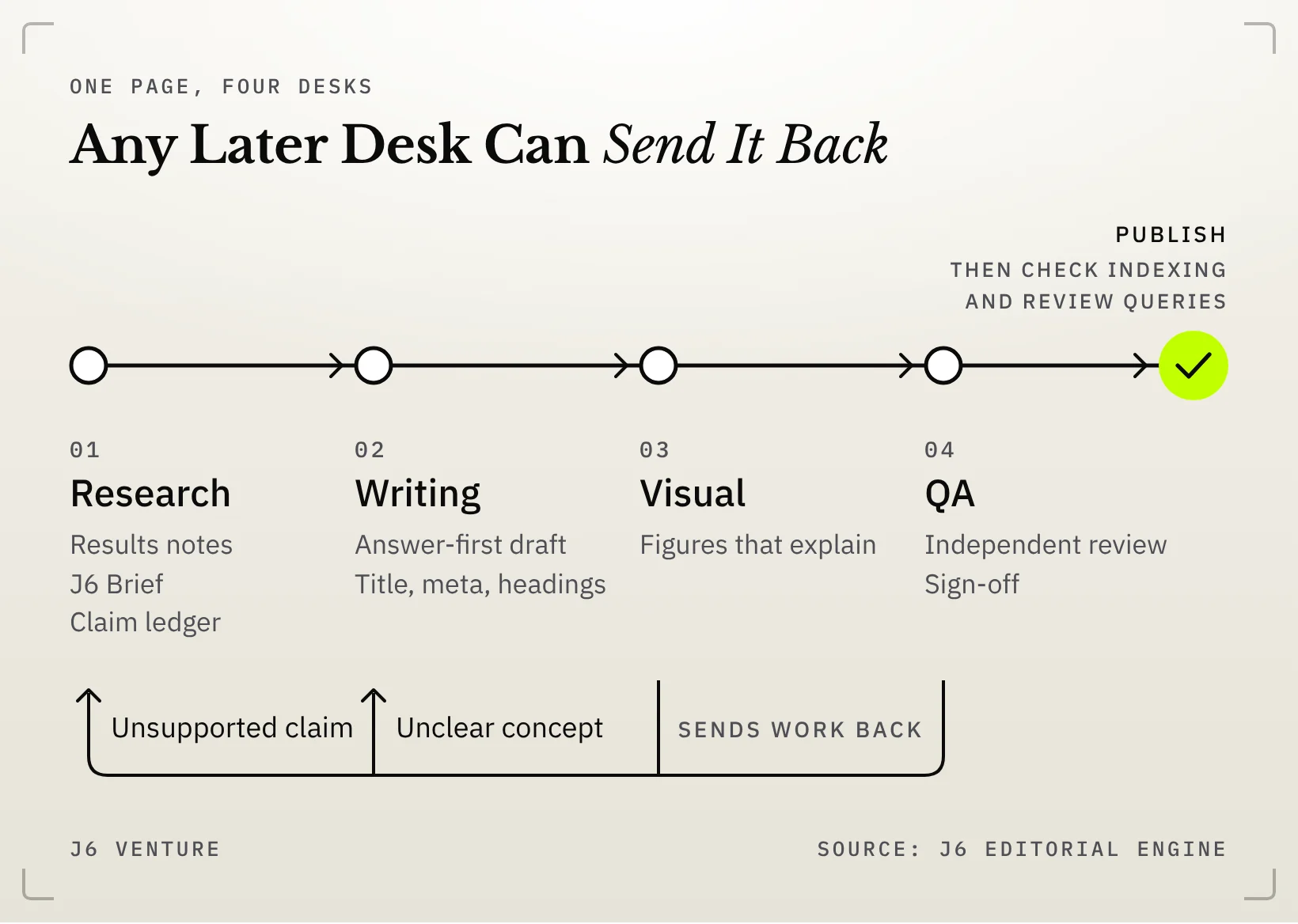
SEO content creation is the work of turning one search query into a page that answers it better than the pages already ranking. At J6 it runs through four desks (Research, Writing, Visual, and Quality assurance), and every stage produces something another person can inspect before the page moves on.
Our workflow is built to stop four problems before publication: a weak claim nobody challenged, an invented quote, a misread study, and AI output nobody checked. Every stage leaves something inspectable, and any desk can send the page back. We call it the Editorial Engine: “Every article moves through four specialist desks: research, writing, visuals and quality assurance. Each owns a different part of the result, and each one can send it back.”
This is how we do that work on one page, using the real brief for this article and real catches from a B2B SaaS blog we rebuilt in October 2026. Choosing which topics deserve a page belongs to SEO content strategy; how SEO and writers work together across many pages is in SEO and content work best as a loop.
What SEO Content Creation Covers, and Where Strategy Ends
SEO content creation covers one page, from a chosen keyword to an indexed URL. Strategy decides which keywords deserve a page; creation decides what that page must contain and proves it delivers.
| Desk | Stage | What it leaves to inspect | Done when |
|---|---|---|---|
| Research | Read the results and AI answer | Research notes: reader needs, gaps, claims to check | You can name what the leading results miss |
| Research | Brief | The J6 Brief | A writer could start without asking a question |
| Research | Evidence | Claim ledger and first-hand material list | Every planned claim has an opened, dated source |
| Writing | Draft and on-page | Answer-first draft, title, meta, headings | Each section opens with a passage that stands alone |
| Visual | Visuals | Visuals beside the ideas they explain | Each visual shortens an explanation or is dropped |
| Quality assurance | Sign-off | Review findings and fixes | An independent reviewer signs it off |
| After publishing | Indexing and query review | Indexing check and query notes | URL Inspection shows the page indexed |
Each desk enforces its standard by sending work back: an unsupported claim goes to research, an unclear concept goes to writing, and nothing publishes with an open gap.
Research Desk: Read the Results Page and the AI Answer
Review enough of the leading results to understand the dominant intent, the coverage they repeat, the information they miss, and the answers that are weak. J6 typically starts with ten. The output is a short set of notes, and the gap they reveal becomes the angle.
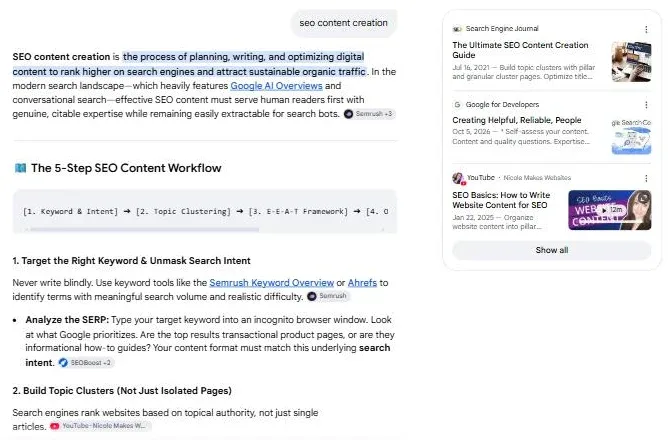
For this keyword (October 6, 2026), about half of the ten results were mostly about planning a content program, and none showed a real page being made. That set this page’s angle: one page, start to finish.
Read Google’s AI answer as a list of claims to check. On October 6, 2026, Google AI Mode told searchers: “Search engines rank websites based on topical authority, not just single articles.” Google’s ranking documentation says its systems “are designed to work on the page level,” with “site-wide signals and classifiers” contributing (ranking systems guide). So we build each page to win on its own, and leave site-wide topic coverage to strategy.
Research Desk: Write the J6 Brief
The brief fixes the thesis, the angle, and the promise before a heading exists, so the writer never has to guess. J6 uses eight fields. This is the brief for the page you are reading; copy the field names for your own.
The J6 Brief: SEO content creation (October 6, 2026)
Intent Statement: Someone searching “SEO content creation” is trying to get a method they can run, or hand to a writer or AI, that turns one keyword into a page that deserves to rank, and to know when a draft is ready to publish.
Primary Question: How does one SEO page get made, stage by stage, and how do you know it’s ready?
Competitive Landscape: Google’s SEO Starter Guide tells readers what to stop worrying about but has no page-production workflow. Siteimprove separates strategy from content well, then spends most of the page on strategy. Nathan Gotch’s video treats editing as craft, inside a tool pitch. Gap: no result shows a real page being made, maps Google’s AI guidance onto specific steps, or offers a pre-publish check built from Google’s own questions.
Angle/Thesis: One page, start to finish, through J6’s four desks. Every stage produces something another person can inspect, so weak claims, invented evidence, bad interpretation, and unchecked AI output are stopped before publication.
Sections: Scope vs strategy; Research desk (results and AI answer, the brief, evidence); Writing desk (draft, on-page); Visual desk; what AI can do at each stage; Quality assurance desk (real catches, claim strength, independent review, Google’s questions); after publishing.
Evidence Requirements: Google Search Central documentation, opened and quoted, with dates. The October 6 AI Mode answer, with a screenshot. Real edits and review findings from a B2B SaaS blog rebuild. Drop any number that can’t be traced to its source.
Internal Linking Opportunities: The Editorial Engine, strategy (topic choice), the SEO-and-content loop, SEO-friendly URLs, and AI content safety.
CTA/Next Step: Readers who want this run on their own pages go to J6’s content marketing service.
The brief also sets length, estimated section by section. Google says “the length of the content alone doesn’t matter for ranking purposes (there’s no magical word count target, minimum or maximum…)” (SEO Starter Guide). On the B2B SaaS blog we rebuilt, five of seven posts had already been rewritten at 4,400 to 5,300 words without recovering, and all seven rebuilt drafts came out shorter.
Research Desk: Evidence Before Claims
Every claim the page will make gets a source before the writer starts. The output is a claim ledger: the claim as it will be worded, the source, the quoted passage, the date, and whether the source supports it. J6 labels each entry:
- Supported: the source says it, at the strength the page will use
- Needs qualification: true only with a date, market, or limit attached
- Unsupported: sent back, and the claim is cut or reworded
Then add what only you have: your data, tests, screenshots, and decisions. Google’s first content question asks whether a page provides “original information, reporting, research, or analysis,” and its description of quality raters’ criteria adds that “attribution or giving credit to other sources doesn’t replace the need for original effort” (Google Search Central). On this page, the first-hand material is the brief, the edits, and the review findings. Ranking and traffic results from the rebuild are not in yet, so none appear here.
Google says E-E-A-T “itself isn’t a specific ranking factor” and that “of these aspects, trust is most important.” On the page, trust comes from sources a reader can open, a real byline, and an honest account of method.
Writing Desk: Draft Answer-First
The writer works from three approved inputs: the brief, the claim ledger, and the voice guide. We open with the answer to the query within the first 100 words, then start each section with a two- or three-sentence answer that makes sense quoted alone. We use this structure because a passage that stands alone serves the skimming reader and can be quoted in a featured snippet or an AI answer without losing its meaning.
Drafting rules at J6:
- One claim per sentence, with its source linked where the claim needs one
- Real examples linked to where they came from; invented teaching examples labeled as illustrative
- Every sentence should move the reader’s understanding forward
- A line that needs a claim research didn’t approve goes back to research
Keywords go where they read naturally; Google says “keyword stuffing is against Google’s spam policies” (SEO Starter Guide).
On-Page Elements
Google sets no character limit for titles or meta descriptions (long ones are truncated in results); the October 6 AI Mode answer gave fixed ones (50 to 60 and 150 characters).
| Element | What Google’s documentation says | What we do |
|---|---|---|
| Title tag | “While there’s no limit on how long a <title> element can be, the title link is truncated in Google Search results as needed, typically to fit the device width” (title links). |
Lead with the query’s words, keep it short enough to avoid truncation, and match the H1’s promise |
| Meta description | “Google primarily uses the content on the page to automatically determine the appropriate snippet” (snippets). | Write a short summary unique to the page; expect Google to show other text for some queries |
| Headings | Semantic order is “fantastic for screen readers, but from Google Search perspective, it doesn’t matter if you’re using them out of order” (SEO Starter Guide). | Keep a logical order for accessibility |
For slugs, keep them short and readable; Google says keywords in the URL path “alone have hardly any effect beyond appearing in breadcrumbs” (SEO Starter Guide; more on URLs). Link anchors should name the page they point to.
Visual Desk: Keep Only Visuals That Explain
A visual stays only if it shortens an explanation, shows a relationship, or helps a decision, and it sits beside the idea it explains. Decorative images are dropped. On this page, that rule kept two screenshots: the AI answer being checked and the indexing report that confirms a page is live. Alt text describes what each image shows in terms of the section it supports, since Google says alt text “helps search engines understand what your image is about and the context of how your image relates to your page” (SEO Starter Guide).
What AI Can Do at Each Stage, and What Still Needs Human Judgment
AI can speed up every desk, and every AI output still needs a person to check it before it moves on. Google says “appropriate use of AI or automation is not against our guidelines” (February 2023), and that using generative AI “to generate many pages without adding value for users may violate Google’s spam policy on scaled content abuse” (generative AI guidance). J6’s rule is shorter: “AI drafts. It does not decide, and it does not publish” (Is AI content safe for SEO?).
| Stage | What AI can do | What still needs human judgment |
|---|---|---|
| Results and AI answer | Summarize pages, extract headings and claims | Choosing the angle; treating the AI answer as one dated run to verify |
| Brief | Draft the question list from People Also Ask and the AI answer | The thesis, the evidence rules, and the first-hand material |
| Evidence | Find candidate sources | Opening each source and confirming the passage |
| Draft | Write a first version from the brief | Experience, judgment, and real examples |
| On-page | Propose titles, meta descriptions, and alt text | Checking each against the page |
| Quality assurance | Flag overclaims, filler, and style breaks | Final claim strength and sign-off |
The evidence row matters most. Google warns that “generative models don’t retrieve facts, but predict a likely sequence of words based on their training data,” and that the manual fact-check “also applies to metadata like <title> elements, meta description elements, structured data, and alternate texts for images” (generative AI guidance). A number or quote an AI tool supplies enters the claim ledger only after a person finds it in the source.
Quality Assurance Desk: Independent Sign-Off
Nothing publishes until someone who didn’t write the page has checked it and signed it off. The QA desk checks four areas (research and accuracy, search and structure, writing and brand, and visual and publication quality) and sends any failure back to the desk that owns it.
What Gets Sent Back: Three Real Catches
These come from the October 2026 rebuild of a B2B SaaS email-outreach blog. The first was found while auditing the old page; the other two came from the first review round on the new drafts.
| Catch | Before | After |
|---|---|---|
| Unverifiable quote | “If an issue takes more than three emails to solve, it’s not an email problem…” credited to “Harvard Business Review, 2024.” We could not find the quote in any source we searched. | Replaced with the earliest dated source found: author Phil Simon’s blog post of March 6, 2015, and the line from his email signature, “I abide by a three-email rule. After three, we talk.” |
| Misread source | “Some also exclude final-sale items from price adjustments and extra discount codes (Crocs, Levi’s, and FARM Rio say so in the table below).” | “Some also exclude final-sale items from price adjustments (Crocs and Levi’s) or from extra discounts (Levi’s and FARM Rio).” FARM Rio’s FAQ allows a price adjustment to a final-sale price within 7 days. |
| Correlation written as cause | Templates stay short “because longer emails tend to wait longer for an answer.” | “In the Kooti study, longer received emails were associated with slower replies (a correlation, which doesn’t prove that length caused the delay), so short is the safer default.” |
Claim Strength: Wording That Matches the Evidence
After the factual pass, QA checks that each claim is worded no stronger than its evidence, and uses the same strength everywhere it appears, from title to conclusion.
| Evidence | Wording that fits |
|---|---|
| One study | “One study found…” |
| A few studies pointing the same way | “Several studies suggest…” |
| Independent studies that agree | “Multiple independent studies consistently find…” |
| Settled by the primary source itself | A plain statement, such as “Google says it has no preferred word count” |
Absolute words such as always, never, and only get tested one by one.
Independent Review: What Each Lens Catches
Across seven rebuilt articles and three rounds, none reached 10 on every lens. Logic and calibration ended at 8.5 on all seven, the cap the review applies when any claim is stronger than its evidence, and six of the seven reviews asked for more first-hand proof, which only the business can supply. The fixes for those last findings were applied but not re-scored. The reviewers were AI models briefed as hostile critics, run separately from the drafting and given the page, its handoff notes, and the scoring rules; each scored six lenses from 0 to 10 and returned every finding as an exact fix. Each lens catches something the others miss:
- SEO strategist: a title promise the page doesn’t keep, or questions the results and AI answer cover that the page skips
- Fact-checker: a quote or number that doesn’t match the opened source
- Logic and calibration: a claim stronger than its evidence, or a conclusion the body doesn’t support
- Editor: filler, house-style breaks, and sentences that add nothing
- Skeptical reader: anything that would send the reader back to search
- Completeness: sections that are promised but thin, or an ending that stops short
The Sign-Off Questions, From Google
Google suggests asking “others you trust but who are unaffiliated with your site” for “an honest assessment.” The QA desk turns Google’s self-assessment questions into tests:
| Google’s question | Test before sign-off |
|---|---|
| “Does the content provide original information, reporting, research, or analysis?” | Name the item that exists only on this page. If you can’t, the page goes back. |
| “Does the content provide substantial value when compared to other pages in search results?” | Everything the leading results and the AI answer cover is here, plus at least one gain. |
| “Does the main heading or page title provide a descriptive, helpful summary of the content?” | Every promise in the title and meta is delivered in a section. |
| “Does the content have any easily-verified factual errors?” | Every number and quote traces to an opened, dated source. |
| “Does your content leave readers feeling like they need to search again to get better information from other sources?” | The reader should not need another search to complete the job this page promised to solve. |
| “Is it self-evident to your visitors who authored your content?” | A real byline that links to the author’s background. |
After Publishing: Confirm Indexing and Review the Queries
Confirm the page is indexed, link to it from related pages, and wait a few weeks before judging it. Google says some changes take effect “in a few hours, others could take several months,” and that “you likely want to wait a few weeks to assess whether your work had beneficial effects” (SEO Starter Guide).
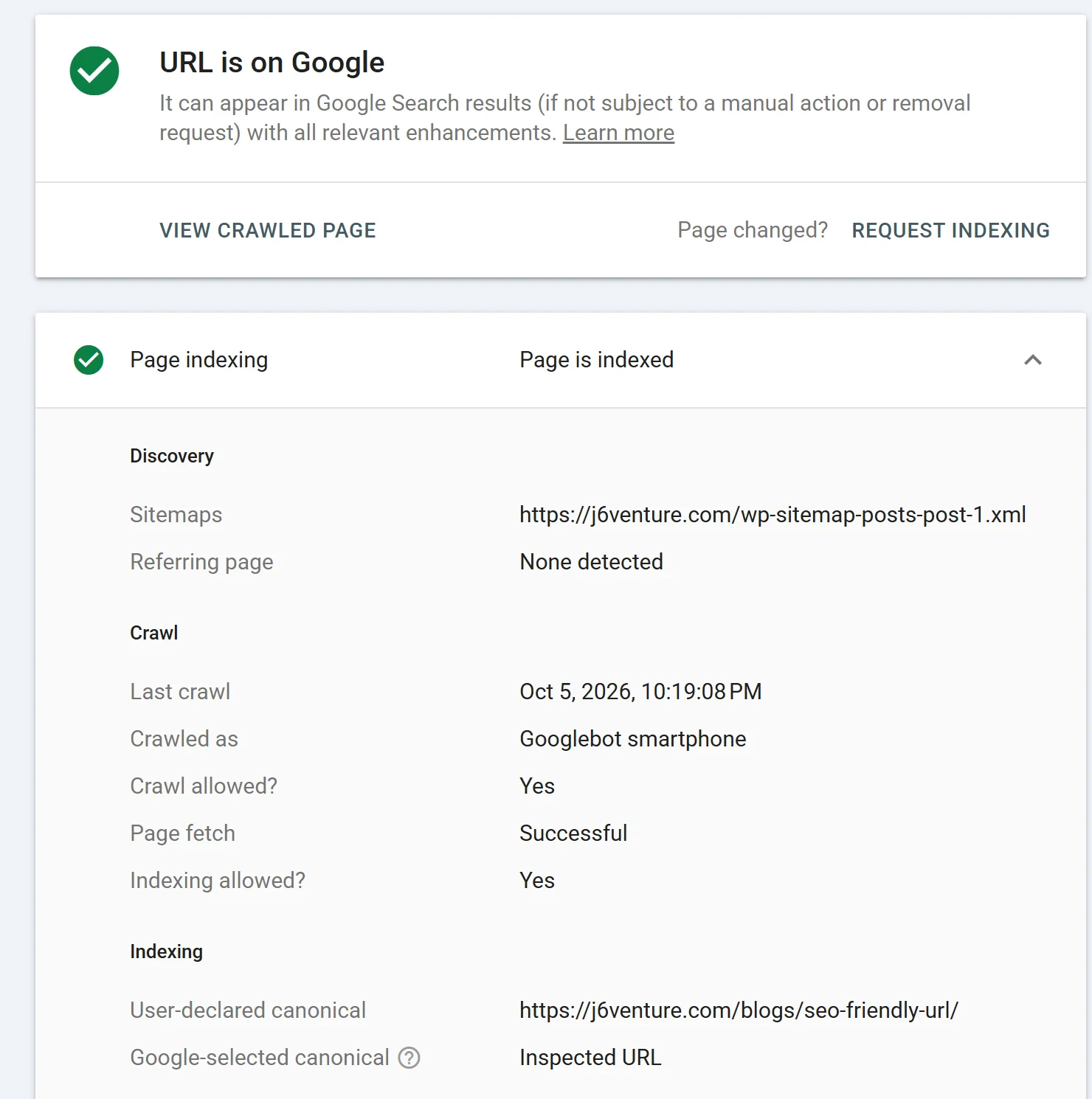
- 1Inspect the URL in Search Console. The check on one of our own posts (October 6, 2026) showed “URL is on Google” and “Page is indexed.”
- 2Add internal links from related pages. The same report listed the referring page as “None detected.” Link to it from related posts.
- 3Review the page’s queries after a few weeks. In the Performance report, filter to the page. Queries it doesn’t yet answer are the next revision.
- 4Change the date only with the content. Google lists “changing the date of pages to make them seem fresh when the content has not substantially changed” as a warning sign.
Keep the two kinds of evidence separate. In the rebuild, this workflow has shown its quality-control value: it caught an unverifiable quote, a misread source, and a correlation written as a cause before publication. Its ranking impact is not yet established.
When a Page Is Ready
A page is ready when its promise, evidence, and execution have each been inspected by someone who didn’t produce them, and held up. Creation finishes after publication, when the indexing check and early query data close the loop.
This page went through the Editorial Engine’s four desks under J6’s AI rule: “AI drafts. It does not decide, and it does not publish.” AI gathered the sources, drafted the page from the brief above, and ran the review rounds; the Quality assurance sign-off and the decision to publish are Vikas Jha’s. If you want this run on your own pages, see how J6’s content marketing work is set up.