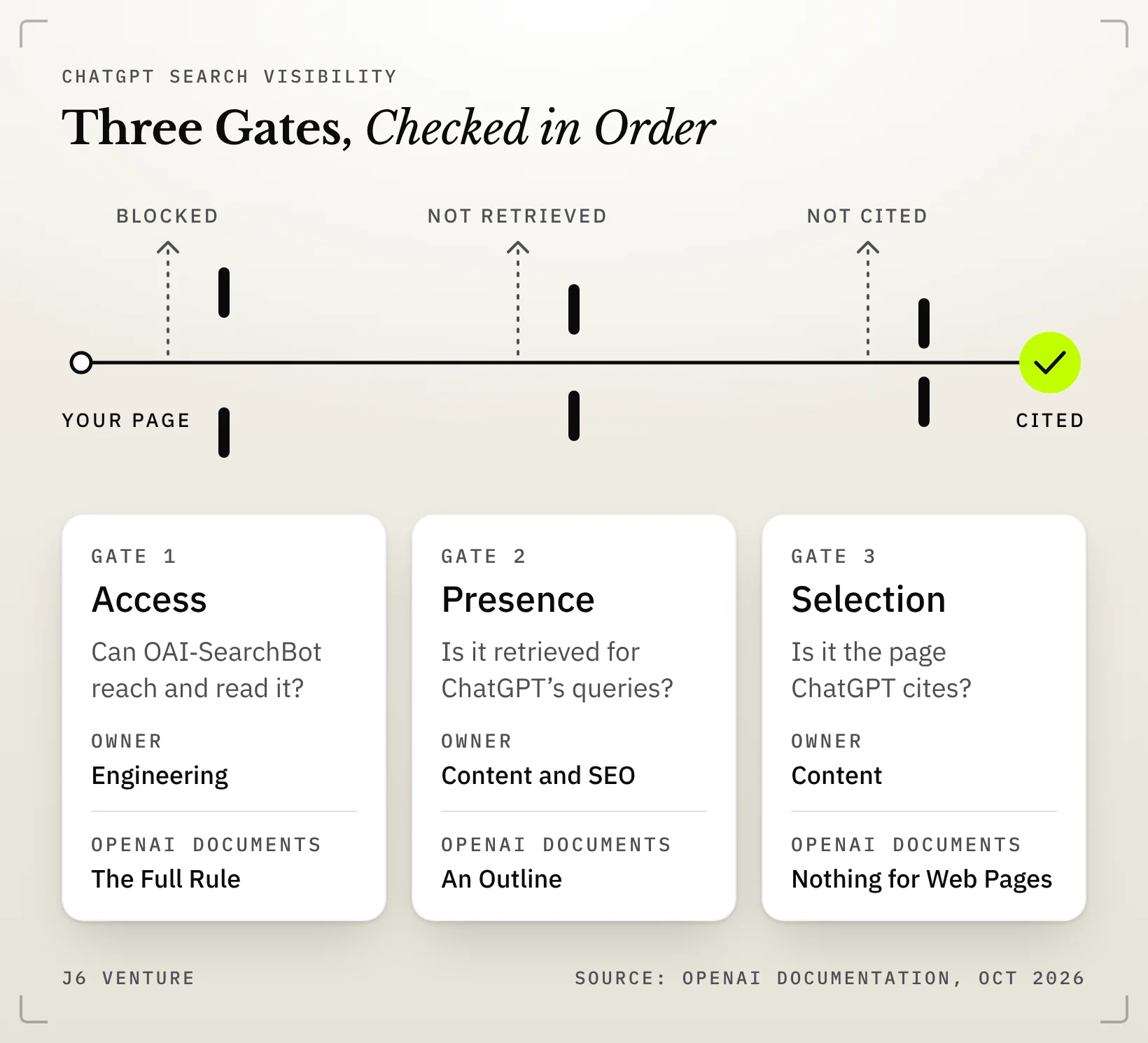
Nobody can give you a ranking formula. ChatGPT visibility is three separate problems: can OpenAI’s search crawler access your site, does ChatGPT’s search retrieve your page for the queries it actually runs, and does it choose to cite you. Check them in that order: a page that blocks OAI-SearchBot is excluded from search answers, and a page never retrieved cannot be cited. Only the first stage is fully documented by OpenAI.
Most advice on ranking in ChatGPT mixes these three problems together, so a team can end up rewriting content when the real blocker is a firewall, or tuning copy on a page that never gets retrieved. Separate them and each one has a clear owner and a clear next step:
- Access is a technical yes or no, owned by whoever runs your site and CDN.
- Presence is whether your pages exist in the places ChatGPT searches, for the queries it sends.
- Selection is whether, once retrieved, your page is the one it quotes.
This guide covers what is known about each stage and what to do about it. Every claim carries one of three labels, checked against OpenAI’s live documentation on October 8, 2026:
- OpenAI says: stated in OpenAI’s help center or crawler documentation, quoted and linked.
- Seen by third parties: observed by named outside researchers. Useful, unconfirmed by OpenAI, and liable to change.
- Unknown: neither OpenAI nor credible testing has settled it.
What “Ranking” Means in ChatGPT Search
ChatGPT search has no fixed list of ten positions. When a question would benefit from current information, or the user picks Search, ChatGPT searches the web, reads a set of sources, writes an answer, and can cite those sources inline and in a Sources panel. Ranking means being one of the pages it cites for your buyers’ questions.
OpenAI says: “ChatGPT ranks search results using multiple factors intended to help users find relevant, reliable information. Placement is not guaranteed.” (Searching the web with ChatGPT)
Unknown: what those factors are for web pages. OpenAI names relevance and reliability as goals and lists no factors for web results (it does name some for shopping merchants, covered in the special-case box below). Any list of “ChatGPT ranking factors” for web pages is someone’s inference.
| Stage | The question | What OpenAI documents | Who usually owns the fix |
|---|---|---|---|
| Access | Can OAI-SearchBot reach and read the page? | The eligibility rule, in full | Engineering or infrastructure |
| Presence | Does ChatGPT retrieve the page for the queries it runs? | How it rewrites queries; where it searches, in outline | Content and SEO |
| Selection | Does it cite your page over the others it retrieved? | Nothing for web pages | Content |
This guide covers answers that use search. Answers ChatGPT writes from training data alone follow different rules.
How to Optimize Your Website for ChatGPT
To optimize a website for ChatGPT search, make the changes below in stage order: access first, then presence, then selection. OpenAI documents most of the access changes; the others draw on its notes on query rewriting and its own index, outside studies, or J6’s own view, and each row says which.
| Change on your site | Stage | Evidence behind it |
|---|---|---|
| Allow OAI-SearchBot in robots.txt and at the CDN or firewall | Access | OpenAI says |
| Serve key content in the HTML, without JavaScript | Access | OpenAI says (describing its own index); seen by third parties |
| Keep pages under 4 MB | Access | Seen by third parties |
| Remove stray noindex tags from pages you want cited | Access | Implied: OpenAI names noindex as the tag that keeps even a link-only listing out of Atlas |
| Verify the site in Bing Webmaster Tools and submit your sitemap | Presence | A hedge; outside studies disagree on Bing’s share |
| Build pages for the queries ChatGPT rewrites to: comparisons, pricing, timelines | Presence | OpenAI says it rewrites queries |
| Link important pages from well-crawled ones and keep them shallow | Presence | OpenAI says (describing its own index) |
| Put the answer in the first sentence under the H1 | Selection | Seen by third parties |
| Date time-sensitive claims inside the text | Selection | J6’s inference from third-party cache findings |
| Get described accurately on the review sites, lists, and forums that keep appearing in your Sources | Selection | OpenAI says (product results only); unknown for B2B |
| On About and service pages, state what you sell, for whom, where, and how pricing works | Selection | Unknown; J6’s view |
Two items common in other checklists are missing on purpose: schema markup and an llms.txt file. Neither has evidence of an effect in ChatGPT search, as the claims table further down shows.
Stage 1, Access: Can OAI-SearchBot Reach You?
OpenAI says: “To make a website eligible for inclusion, allow OAI-Searchbot to crawl the site and confirm that the website host or content delivery network allows traffic from OpenAI’s published searchbot IP addresses.” That is the whole published eligibility rule, and the one stage with a documented checklist.
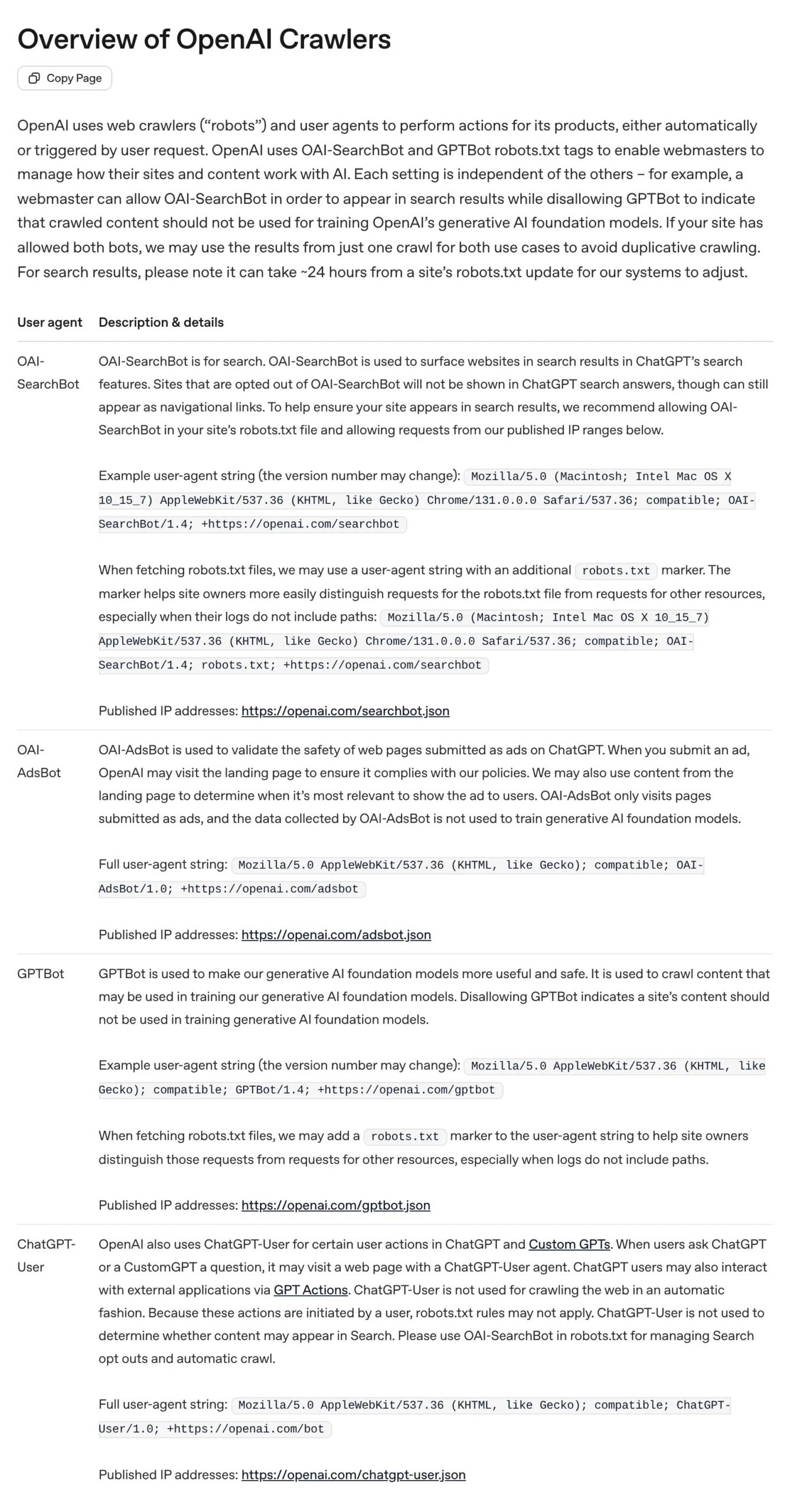
The easy mistake here is blocking the wrong bot, or the right one by accident. OpenAI runs separate crawlers for separate jobs (Overview of OpenAI Crawlers):
| Bot | Job, in OpenAI’s words | If you block it |
|---|---|---|
| OAI-SearchBot | “used to surface websites in search results in ChatGPT’s search features” | You “will not be shown in ChatGPT search answers, though can still appear as navigational links” |
| GPTBot | Crawls “content that may be used in training our generative AI foundation models” | Your content is opted out of training; OpenAI documents no effect on search eligibility |
| ChatGPT-User | Visits a page when a user’s request needs it; “not used to determine whether content may appear in Search” | Little: “robots.txt rules may not apply” to user-initiated visits |
What this means: search visibility and training are separate decisions. OpenAI says: “a webmaster can allow OAI-SearchBot in order to appear in search results while disallowing GPTBot to indicate that crawled content should not be used for training.” What to do: decide the training question on its own merits, and make sure no blanket “block AI bots” rule catches OAI-SearchBot.
Ask your developer to confirm five things:
- 1robots.txt does not block OAI-SearchBot, including through a catch-all
User-agent: *rule. - 2The CDN or firewall lets OpenAI’s published search IPs through. A clean robots.txt cannot override a firewall that returns 403, and bot-protection defaults can block it silently.
- 3Pages you want cited carry no stray noindex tag. OpenAI names noindex as the way to stop even a link-only listing in ChatGPT Atlas.
- 4Server logs show OAI-SearchBot requests from OpenAI’s IP ranges. Anyone can fake the user-agent name, so the IP check matters.
- 5Key content is in the HTML without JavaScript, on pages under 4 MB. OpenAI says content that “depends heavily on scripts or dynamic loading” may be missing from its index; RESONEO, an SEO agency whose study of ChatGPT’s retrieval was published in August 2026, reports that the robot ChatGPT uses to fetch pages does not run JavaScript (Search Engine Land). J6’s chapter Rendering for AI Crawlers covers how to test and fix this. Seen by third parties: RESONEO also found pages over 4 MB are rejected with an HTTP 400, and the model reads nothing on them.
- 1
After any robots.txt change, allow a day. OpenAI says: “it can take ~24 hours from a site’s robots.txt update for our systems to adjust.”
For your developer: robots.txt, log and IP checks
The snippets below cover checks 1 and 4. OpenAI publishes its search crawler’s IP ranges in searchbot.json. To keep a page out of link-only listings in ChatGPT Atlas as well, allow the crawl and use noindex (seen by third parties: RESONEO and Oncrawl found ChatGPT’s page cache ignored noindex, so this governs listings, with no guarantee for cached copies): OpenAI says “in order for our crawler to read a meta tag, it must be allowed to crawl the relevant page(s)” (Publishers and Developers FAQ).
Optional, for your developer. Snippet 1, if you decide to opt out of training, a minimal robots.txt that opens search and blocks GPTBot:
User-agent: OAI-SearchBot
Allow: /

User-agent: GPTBot
Disallow: /

User-agent: *
Allow: /
Snippet 2, count OAI-SearchBot requests by IP:
grep "OAI-SearchBot" access.log \
  | awk '{print $1}' \
  | sort | uniq -c | sort -rn | head
Snippet 3, download OpenAI’s list and check one IP against it (prints True or False):
curl -s https://openai.com/searchbot.json \
  -o searchbot.json

python3 - 172.182.193.81 <<'EOF'
import json, sys
from ipaddress import ip_address, ip_network
ip = ip_address(sys.argv[1])
data = json.load(open("searchbot.json"))
nets = [p.get("ipv4Prefix") or p.get("ipv6Prefix")
        for p in data["prefixes"]]
print(any(ip in ip_network(n) for n in nets))
EOF
Stage 2, Presence: Does ChatGPT Retrieve Your Page?
A crawlable page still has to turn up when ChatGPT searches. Two things decide that: where ChatGPT looks, and what it types.
Where ChatGPT Looks: Don’t Optimize for Bing Alone
Keep your site healthy in Bing, allow OAI-SearchBot, and put your effort into retrievability and answer quality. A plan built only around Bing rankings rests on thin evidence.
- OpenAI says ChatGPT search “leverages third-party search providers, as well as content provided directly by our partners” (launch post, October 2024), and separately describes “OpenAI’s indexed and cached web content.” Its help article links Microsoft’s and Shopify’s privacy policies as provider policies; it does not name Bing.
- Seen by third parties: RESONEO found only 1.5% of results from OpenAI’s own index in Bing’s top 20 for the same queries (study published August 2026). Studies favoring Bing exist, but the recent one we checked tested a single prompt (Search Engine Land, April 2026).
What to do: verify the site in Bing Webmaster Tools and submit your sitemap as a hedge, then spend the real effort on the next two sections. J6’s chapter Which Index Feeds ChatGPT, Claude and Perplexity covers the index question in depth.
AI engines repeat unsupported claims about each other. On October 6, 2026, Google’s AI Mode told US searchers that ChatGPT “uses Bing to browse the live web” and listed GPTBot among the crawlers “ChatGPT uses to crawl web content”; OpenAI names no search provider, and documents GPTBot as its training crawler. Check OpenAI’s own pages before acting on what any AI engine says about another.
What ChatGPT Types: Write for the Rewritten Query
ChatGPT often searches with different words than your buyer typed. OpenAI says that when it uses outside search providers, it "typically rewrites your query into one or more targeted queries." Its example: “what’s the latest on the development of drugs that target CCR8 for cancer?” becomes “CCR8 immunotherapy drug development 2025,” then “CHS-114 conference 2025.” It may also add location (“top restaurants San Francisco”) and, with memory on, details the user has shared.
What this means: in OpenAI’s examples, the query that reaches the index is shorter, names specific entities, and often carries a year. A page written only for the long conversational prompt can miss the searches ChatGPT actually runs. What to do: for each buyer question that matters, list the three to five queries a careful researcher would run, then check you have a page or a passage that answers each one.
Illustrative rewrite map (J6’s illustration; no ChatGPT output captured)
Buyer prompt: “Which SOC 2 compliance tool works for a 50-person startup?”
Likely rewrites: “SOC 2 compliance software startups 2026”, “[your product] vs [competitor] pricing”, “SOC 2 Type II timeline small company”.
Gap check: a comparison page, a pricing page that states prices in text, and a timeline passage with a date on it.
One more presence risk is pages ChatGPT’s index simply lacks. OpenAI says, describing its own index in its offline-search documentation, pages can be missing when “[t]he page is new, rarely accessed, or low-signal” or “[t]he site structure makes deeper pages harder to discover” (Offline web search). What to do: link your most important pages from pages that already get crawled and visited, and keep them shallow in your site structure.
Stage 3, Selection: Does ChatGPT Choose to Cite You?
Unknown: OpenAI publishes no selection factors for web pages. Everything in this section is either a third-party observation or J6’s own method, and labeled as such. Treat it as good practice with a plausible mechanism.
Put the answer directly under the H1. Seen by third parties: RESONEO found that in ChatGPT’s free Instant mode, the model sees a page’s title plus roughly the first 200 characters around its H1, and ignores the meta description. What this means: category labels, bylines, and tables of contents above your first sentence may be all ChatGPT reads. What to do: make the first sentence after the H1 state your answer. Keep the meta description anyway, since the Google-fed parts of ChatGPT’s retrieval still use it. These mechanisms change often, and RESONEO says so; this is cheap hygiene, with an unmeasured payoff.
Get your page opened, then cited. Seen by third parties: in RESONEO’s corpus, a page ChatGPT opened was cited 74% of the time, against 7% for a page only retrieved, and every open happened in Thinking mode. What this means: this is a correlation, since ChatGPT may open the pages it already expects to cite. Once a page is opened, it is read in full, so make sure the whole page answers in plain HTML.
Write in answer capsules (J6’s method). We structure key passages as capsules: the direct answer, the evidence beside it, and the condition that limits it, in two or three sentences. We do this because a passage that carries its own evidence still reads correctly when a model lifts it out of the page. No published test isolates its effect on ChatGPT citations.
Answer capsule
“ChatGPT search excludes sites that block OAI-SearchBot from its answers, though they can still appear as navigational links. OpenAI’s crawler documentation states this directly. Changes to robots.txt take about 24 hours to apply.”
Date your claims. Seen by third parties: RESONEO and Oncrawl documented ChatGPT serving cached copies of pages more than 90 days after fetching them. What to do: put the date inside the passage (“as of October 2026”), so a stale copy still tells the reader how old the claim is.
Watch which third-party sources keep appearing. For “best X” and comparison prompts, check whether review sites, lists, and forums dominate Sources; your prompt log will show which ones. OpenAI says its product results draw on “other third-party content” and reviews “from public websites”; for B2B software the weight of these sources is unknown. What to do: when the same third-party pages appear in Sources again and again for your target prompts, treat them as your clearest distribution opportunities, and make sure your product is described accurately there.
Make your site say who you are. Unknown: no published test shows that a clearer About page changes which pages ChatGPT cites. The case is a plausible mechanism nobody has measured: when a buyer asks ChatGPT what your company does, your own About and service pages are candidate sources, and if they are vague, the answer leans on other sites. What to do: on the About page and each service page, state in plain text what you sell, who it is for, where you operate, and how pricing works. If you sell locally, keep your company name, address, and phone number identical across your site and listings; that is local-SEO advice, and OpenAI does not say whether ChatGPT checks it.
Claims You’ll Read Elsewhere, Checked
| Claim | Verdict | Evidence |
|---|---|---|
| “ChatGPT uses Bing’s index” | Unconfirmed by OpenAI; outside studies find Bing one input among several | OpenAI says (providers plus own index, Bing not named); third parties disagree on Bing’s share |
| “Allow GPTBot so ChatGPT can find you” | Wrong bot: OAI-SearchBot controls search eligibility | OpenAI says |
| “Schema markup gets you cited” | No evidence of an effect in ChatGPT search; RESONEO saw structured data stripped from cached copies | Seen by third parties. Keep schema for Google, and put prices, specs, and authors in visible text too |
| “Bounce rate and time on page are AI ranking factors” | No evidence of an effect | OpenAI mentions neither; no published test found |
| “You need an llms.txt file” | No evidence of an effect | OpenAI’s crawler and publisher pages do not mention reading one |
| “Ranking in Google is enough” | Covers part of it: in RESONEO’s study published August 2026, paid Thinking mode drew mostly on Google results, while free modes drew mostly on OpenAI’s own index | Seen by third parties |
Three more claims from optimization checklists:
- “Use only one H1 per page”: no evidence that the number of H1s matters. OpenAI does not mention headings, and RESONEO’s Stage 3 finding concerns where the answer sits and says nothing about how many H1s a page has. For Google, John Mueller said a site will “rank perfectly fine with no H1 tags or with five H1 tags” (Search Engine Journal, 2019). Keep one clear H1 with the answer directly under it.
- “Keep your name, address, and phone identical everywhere”: no evidence of an effect in ChatGPT search. It is common local-SEO advice that OpenAI does not mention, and cheap to do.
- “Post on Reddit and Quora to get cited”: no published test found of posting’s effect on ChatGPT citations. OpenAI says product results draw on third-party content and reviews; for B2B pages the weight is unknown. Check which forums appear in your own Sources first.
Our read of this table: the documented facts are about access, and the confident tactics elsewhere rest on correlation or on no evidence at all.
How to Measure ChatGPT Search Visibility
Measure each stage separately, so a drop points to its cause.
Referral visits (presence and selection paying off). OpenAI says: “ChatGPT automatically includes the UTM parameter utm_source=chatgpt.com in referral URLs.” What to do: in GA4, open the Traffic acquisition report and filter Session source / medium for “chatgpt.com.” Treat the number as a floor: seen by third parties, RESONEO found pages ChatGPT opens on its own in Thinking mode carry no tag, so some ChatGPT visits will never show it.
Crawler requests (access). Track OAI-SearchBot and ChatGPT-User requests by week, with IPs checked against OpenAI’s published lists. Read them as proof of access only. Low counts do not mean you are invisible: RESONEO saw OAI-SearchBot nearly silent while OpenAI’s index kept serving results.
A prompt log (all three stages). Answers change between runs, so test each buyer prompt three to five times and log every run the same way. Record the mode too, because RESONEO found free and paid modes draw on different sources. Spot-check each citation: the link works, and the page supports the claim attributed to it. J6’s chapter Measuring AI Visibility covers how much answers shift and what that means for reporting.
| Field | What to record |
|---|---|
| Date, plan, mode, location | When you ran it, and on which plan (free, paid, logged out), mode, and location |
| Exact prompt and run number | The prompt word for word, and which of the three to five runs this is |
| Brand mentioned | Yes or no |
| Our URLs cited | Every URL of yours in the answer or Sources |
| Competitor URLs cited | Every competitor URL in the answer or Sources |
| Notes | Anything that changed between runs |
When visibility is weak, diagnose in order:
01Access Fails
Signs: robots.txt or firewall rules that block OAI-SearchBot, 403 responses to OpenAI IPs, or key content that appears only after JavaScript runs. Fix: the five developer checks, then wait about 24 hours.
02Presence Fails
Signs: across repeated runs, your domain never appears in Sources, even for questions you answer well. Fix: map buyer prompts to rewritten queries, fill the page gaps, and link those pages from well-crawled pages.
03Selection Fails
Signs: your URL appears in Sources while a competitor gets quoted. Fix: compare the first sentence and evidence on both pages, then rewrite yours answer-first with a dated claim and its source.
Diagnose in that order, but spend in this one (J6’s view; untested): fix access first, then selection on pages already appearing in Sources, because ChatGPT already retrieves them and only the page has to change, then presence for the questions where you never appear.
This Week vs This Quarter
This week (access and measurement):
- Developer confirms OAI-SearchBot is allowed in robots.txt and at the CDN
- Training decision for GPTBot made separately
- No stray noindex on pages you want cited
- GA4 Traffic acquisition report filtered to chatgpt.com
- Prompt log started with your ten most valuable buyer questions
This quarter (selection, then presence):
- First sentence after the H1 carries the answer on every money page
- Rewrite map for those ten questions, and pages for the gaps
- Important pages linked from well-crawled pages
- Accurate presence on the third-party pages that keep appearing in your Sources, and on your own About and service pages
- Monthly re-check of OpenAI’s crawler page and help articles
ChatGPT visibility is three separate problems. Access is documented and fixable this week. Presence depends on writing for the queries ChatGPT actually runs. Selection is where nobody has a formula, so answer first, show your evidence, and measure. If you want the access check and prompt log run on your site, talk to J6 Venture.
OpenAI documentation last checked: October 8, 2026.