An SEO visibility score summarizes how a website ranks across a defined set of keywords. Its formula and scale depend on the tool. To judge the number, identify the metric, compare the same keyword set and settings, and inspect which rankings drove the change before deciding what work to do.
A score becomes useful when it helps you choose an action. A rise might reflect better rankings for valuable searches, or a change to the keywords being measured. A fall might deserve a page review, or a more careful comparison. Start with what the number counts. Use the score to locate a change. Use the underlying keywords and pages to decide what to do.
What Is an SEO Visibility Score?
An SEO visibility score is a tool’s aggregate measure of ranking performance for the keywords it tracks. It can be expressed in points or as a percentage. Read it within the tool’s definition: it does not tell you, by itself, how many visitors arrived or whether those visitors became customers.
The tracked set matters. A strong campaign score can coexist with problems or opportunities elsewhere on the site, outside the tracked keywords. A campaign containing your brand name answers a different question from one containing non-branded searches. Non-branded queries omit your brand name, regardless of whether the searcher already knows your business. A national desktop view also describes a different search context from a local mobile view.
The label appears outside traditional SEO, too. AI tools may measure mentions or citations in generated answers, while app-store tools measure app discoverability. If your report concerns AI answers, use our guide to tracking brand mentions in AI search. The calculations below concern SEO ranking metrics.
How Is a Visibility Score Calculated?
There is no single visibility-score formula shared by every SEO tool. Advanced Web Ranking assigns ranking points; Semrush’s Visibility % uses a model based on click-through rate (CTR), the share of impressions that lead to clicks; Moz averages estimated CTRs. Their definitions determine the unit, ranking depth, and meaning of a high score.
A Public Example: 51 Points in Advanced Web Ranking
Advanced Web Ranking’s documentation assigns 30 points to position 1, 29 to position 2, and so on down to one point at position 30. Positions below 30 receive zero points.
Its published example follows a URL across three search engines:
| Search Engine in the Example | Ranking Position | Points |
|---|---|---|
| Engine 1 | 1 | 30 |
| Engine 2 | 10 | 21 |
| Engine 3 | 32 | 0 |
| Total | 51 |
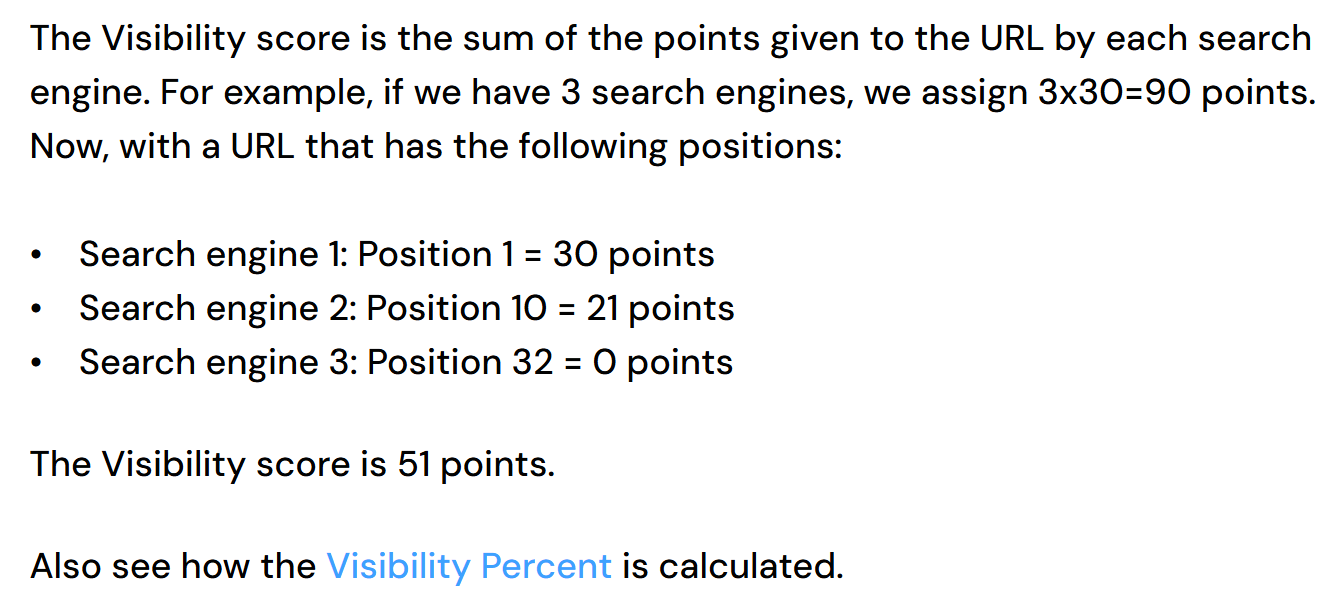
Advanced Web Ranking documentation, captured October 11, 2026. This is AWR’s teaching example; it is not a J6 campaign result. Open the full-size screenshot.
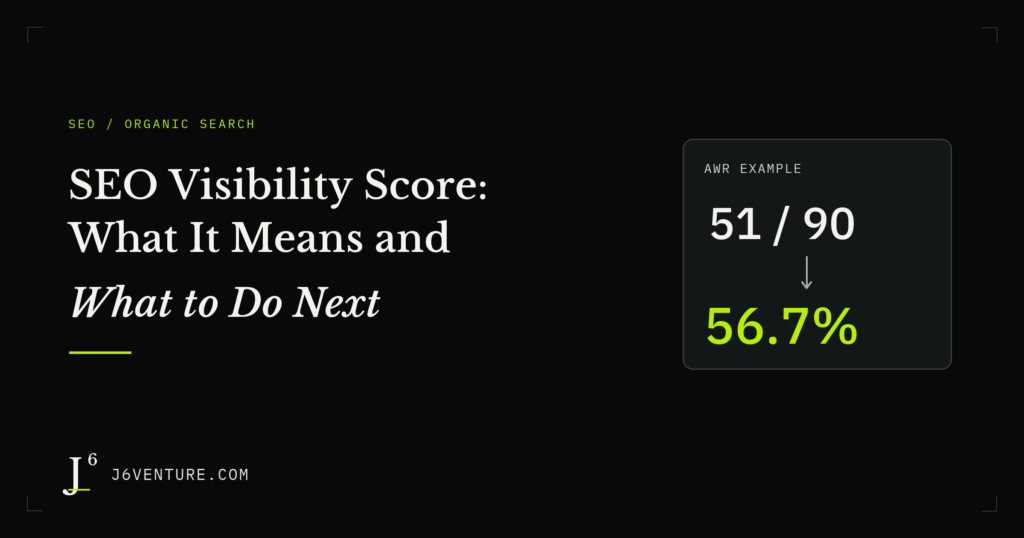
The total is 51 points. AWR’s separate Visibility Percentage formula divides the score by 30 times the number of search engines times the number of keywords. For one keyword across three engines:
51 ÷ (30 × 3 × 1) × 100 ≈ 56.7%.
This is our arithmetic using AWR’s documentation. It measures the share of available ranking points; it does not establish a share of searches, clicks, or customers. Position 32 earns zero points while still being a reported ranking. Check the tool’s cutoff before treating a zero as absence from search.
Why the Same Percentage Can Mean Different Things
An identical percentage can describe different ranking performance in each tool. Compare their definitions before comparing their scores.
| Tool and Metric | Documented Basis | How to Read It |
|---|---|---|
| AWR Visibility Score / Visibility Percentage | Points for positions 1 to 30; percentage relates those points to the project’s available points | Check whether the report shows points or the separate percentage |
| Semrush Position Tracking Visibility % | CTR-based measure for campaign keywords in Google’s top 100 | 100% means the tracked domain, subdomain, or URL ranks first for every campaign keyword |
| Moz Pro Search Visibility | Estimated CTRs added together and divided by the number of tracked keywords | Moz defines 0% as no pages ranking in the top 20; its benchmark guidance applies to this metric |
Sources: AWR’s percentage definition, Semrush’s Visibility % definition, and Moz’s Search Visibility documentation, checked October 11, 2026.
A comparison between tools needs a common underlying measure, such as matched keyword positions. Comparing their headline scores alone skips the definitions that make the numbers meaningful.
What Is a Good Visibility Score?
A useful benchmark comes from the same tool, metric, keyword set, and search settings. Compare your trend and relevant competitors under those conditions. A universal target such as 50% cannot account for the different scales, keyword difficulty, and purposes of the searches in your report.
Moz, for example, suggests roughly 35% to 45% for its Search Visibility metric and says non-branded campaigns rarely exceed the mid-40s. Semrush defines 100% Visibility as first place for every tracked keyword. Keep each benchmark within its tool and campaign context. Do not transfer it to another tool or a different keyword set.
For your report, make three comparisons:
- Your baseline: has the same group of keywords gained or lost visibility over comparable periods?
- Your search competitors: how do sites serving the same searches perform in the same campaign and settings?
- Your business priorities: is progress concentrated in searches that connect to an audience or problem you can serve?
Separate branded and non-branded searches where practical. Branded rankings show performance on searches naming your business; non-branded rankings show performance on searches that omit its name. Improving branded rankings alone does not establish stronger brand demand, and non-branded searchers may already know you. Inspect impressions and other evidence when investigating demand. Judge both groups against their purpose, then inspect important topics. A blended score can conceal a weak segment.
Why Can a High Score Hide Missed Search Demand?
A score that rewards performance across many keywords can look strong while the site misses a high-demand search. Check how the metric weights keywords before interpreting it as demand coverage. Search volume and commercial value then require separate judgment.
Semrush’s Position Tracking documentation gives a public example with:
- Ten keywords, each with 50 monthly searches.
- One keyword with 30,000 monthly searches.
- First positions for the ten smaller keywords, but no ranking for the large one.
Semrush explains that Visibility % would be high, while its volume-weighted Share of Voice would be low. The ten smaller terms represent 500 monthly searches combined; the single larger term represents 30,000. Semrush uses this teaching example to illustrate the weighting difference. These numbers do not forecast measured traffic.
The example changes how you read an encouraging report. Ask which searches the score rewards and which opportunities remain uncovered. Search volume describes potential demand. Business fit determines whether serving it is worth the work. A smaller query may match your service and buying audience more closely.
Use the three measures for different questions:
- Ranking coverage: how well do we rank across this tracked set?
- Search demand: how much search activity sits behind those terms, and does the metric weight it?
- Business fit: would serving those searches help people take an action worth supporting?
The visibility score answers only part of that decision.
What Should You Check When Your Visibility Score Changes?
First confirm that the measurement stayed comparable. Then identify the keywords and pages driving the movement, and choose an investigation supported by those details. Our suggested sequence helps you check whether a changed reporting set explains the movement before commissioning a content rewrite.
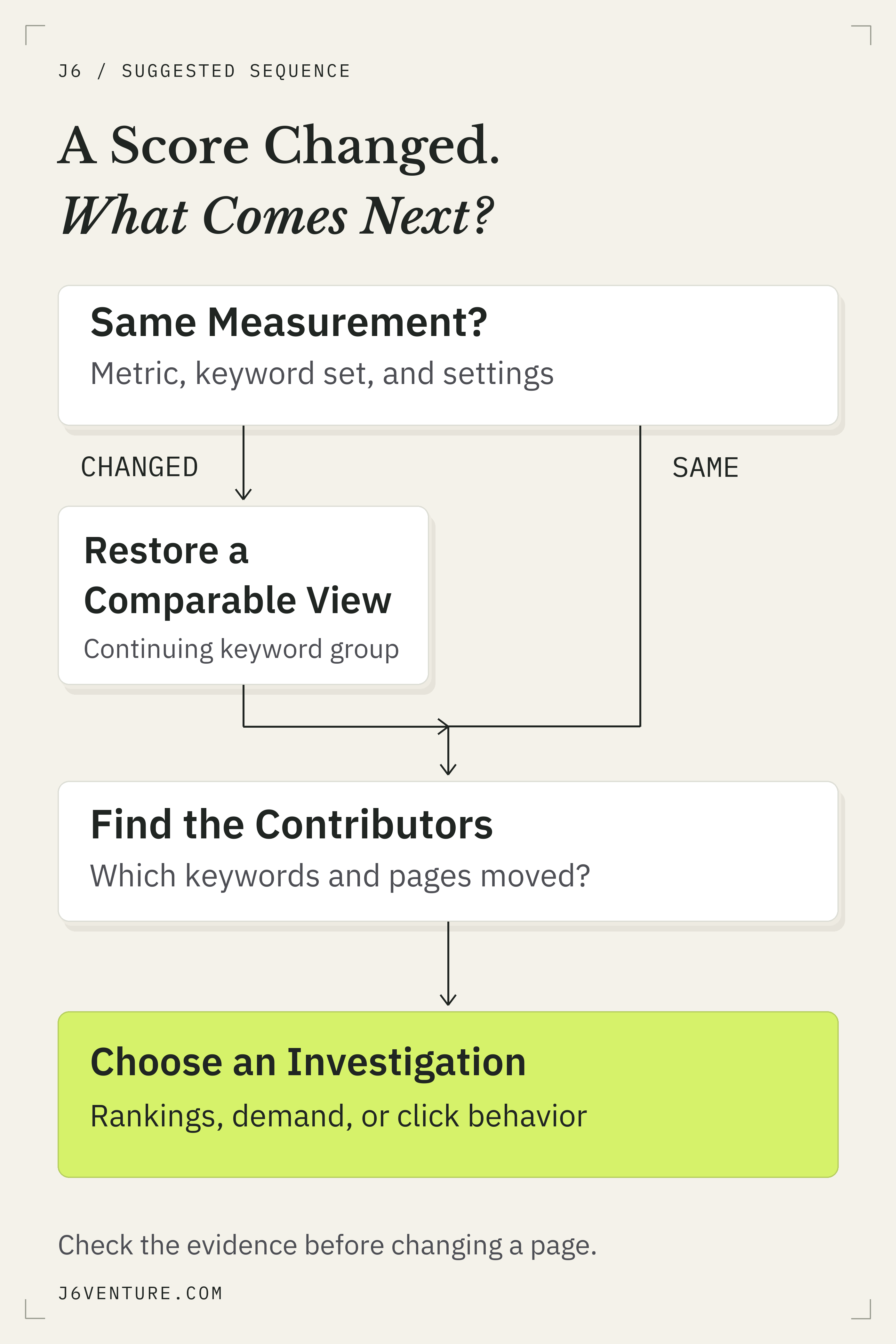
Confirm That You Are Comparing the Same Measurement
Check the report’s context before interpreting its trend:
- Tool and exact metric name, including points versus percentage.
- Keyword membership, tags, and filters.
- Domain, subdomain, folder, or individual URL being tracked.
- Search engine, country or location, device, and organic versus paid results.
- Comparison dates and relevant settings, such as local-pack tracking.
Moz explicitly warns that adding or removing keywords can change its Search Visibility score independently of site performance. It recommends labeling keywords so groups can be compared. Semrush records automatic notes when campaign keywords are added or deleted. Its Visibility % can also be influenced by local-pack tracking when that setting is configured.
Keep a continuing view of the existing keyword group and a separate view of newly added terms where the tool supports it. Record the change. A score increase caused solely by changing the tracked set does not demonstrate ranking improvement. Keep the change visible so the report remains useful for deciding what needs work.
Find the Keywords and Pages Behind the Change
Open the contributing rankings and identify the terms and URLs responsible for the movement. Check whether an important topic declined, whether the intended page still ranks, and whether a few terms explain much of the shift. Prioritize the searches and pages affected: a small movement on a commercially important term may deserve more attention than a larger movement elsewhere.
For the affected pages, compare reported impressions, clicks, and CTR in Google Search Console’s Performance report, keeping query, country, device, and dates aligned where possible. Search Console and a rank tracker observe different data, so their totals need not reconcile. Some query detail is unavailable in Search Console.
Our guide to checking your Google ranking covers the page-and-query inspection. Use the aggregate score to find where to look, then read the underlying result.
Choose the Next Action From the Evidence
Use the following as an investigation guide. Each row identifies a first action; none establishes the cause from the score alone.
| What You Observe | Evidence to Check | First Action and Remaining Question |
|---|---|---|
| The score changes when keywords are added or removed | Campaign notes and the continuing keyword group’s rankings | Restore a comparable view. Did existing rankings also move? |
| The same tracked group loses visibility | Affected terms, ranking URLs, and relevant page changes | Inspect the pages behind the loss. Check indexing or page relevance where the evidence points; the score does not identify which failed. |
| Modeled visibility holds, but clicks fall | Matching Search Console impressions and CTR, plus the current results page | Investigate demand and click behavior. Confirm the affected searches before changing content. |
| Visibility rises mainly on smaller searches | Keyword contributions, search volume, audience fit, and relevant outcomes | Decide whether the gains support the business. Higher-volume terms deserve consideration only when they fit the audience and offer. |
If the problem is traffic or lead quality after the ranking check, continue with SEO and website traffic. That decision needs evidence about visits and outcomes that a visibility score does not supply.
How Can You Improve the Search Performance Behind the Score?
Work on the ranking opportunities that matter within a relevant, consistently measured keyword set. The work to prioritize depends on the affected page and search intent. Changing the reporting set can raise a score without improving the site’s ability to serve those searches.
Choose work that matches what you found:
- A valuable page is absent: investigate its indexing eligibility and the tool’s ranking depth before commissioning a rewrite.
- The page ranks but misses the reader’s task: improve the answer, examples, or decision support that the search requires.
- Related pages do not connect readers to it: review relevant internal links and discovery paths.
- Stronger results serve the task better: compare their evidence, examples, decision support, and relevant references with your page before choosing further content or promotion work.
A particular edit may leave the score unchanged. After implementation, compare the same keyword group and record the observed result. Keep measured clicks and useful business actions alongside the modeled metric.
What Should Your Visibility Report Say?
A visibility report should connect the score to its measurement scope, the contributors to its change, and the next decision. Someone reading it should be able to tell whether the movement reflects comparable rankings and why the proposed work deserves attention.
Use this compact reporting record:
- Metric and source: exact tool, metric name, unit, and definition link.
- Scope: keyword group and filters, tracked site or URL, search engine, market, device, and dates.
- Movement: the change, any altered settings, and the keywords or pages driving it.
- Outcome check: relevant impressions, clicks, or business results checked separately, including what remains unknown.
- Decision: the next action, its owner, and the review date.
Open your latest SEO report and check whether it contains those details. Before approving budget or strategy changes, ask which tracked terms moved and whether those searches matter commercially. A number and an arrow are insufficient grounds for that decision. The useful result is a score you can explain and a decision you can defend.