More visits from Googlebot can leave you with the same problem: the product information your customers need is still out of date in search.
The useful question is which pages Google is reaching, when it reaches them, and what prevents it from reaching others. That question may lead to a server repair, a smaller URL inventory, better discovery, or an indexing investigation. It can also show that a dedicated crawl-budget project would be a poor use of your team's time.
Google has limited resources to explore the web. Its crawl budget describes the URLs it can and wants to crawl on a particular site. Optimization addresses the factors you can influence, including unnecessary URL variants and problems serving the content Google is trying to fetch.
In Google's crawling infrastructure, a site means a hostname, such as www.example.com. A separate hostname, such as docs.example.com, has its own budget. This matters when a report combines activity across several hosts: the combined chart may hide a problem affecting just one.
How Capacity and Demand Shape Crawling
Google's crawl-budget guide describes two elements:
- Crawl capacity: How much crawling the site can support without being overloaded, also constrained by Google's own finite resources. Response times, server errors, and rate limiting can affect this limit.
- Crawl demand: Which URLs Google wants to revisit or discover. Its assessment includes the site's inventory, update frequency, quality, relevance, and the popularity of URLs.
A faster server can help when serving capacity is constraining useful crawling. Extra capacity alone does not make Google want every page. Equally, a drop in requests does not establish a fault: the request mix and the pages being reached may have changed.
Google does not provide a numerical demand-times-capacity equation you can use to calculate a daily allowance. Observed request counts describe activity, with reporting limitations; they are not your site's fixed quota.
Why Crawling and Indexing Need Separate Checks
Crawling fetches a URL. Indexing analyzes content for inclusion in a search index. Google can fetch a page and still exclude it because of its instructions, duplication, content, or another indexing condition. Increasing requests does not resolve every exclusion.
Google's Page Indexing documentation distinguishes two particularly useful statuses:
- Discovered – currently not indexed: Google knows the URL but has not crawled it yet. This is a reason to investigate crawling, not a complete diagnosis of the cause.
- Crawled – currently not indexed: Google fetched the page but has not indexed it. The documentation says there is no need to resubmit it for crawling.
Some exclusions are appropriate. A duplicate URL can be excluded while its preferred version is indexed. First establish whether the URL itself should appear in search and whether the reported state is current enough to answer your question.
When Crawl Budget Work Deserves Priority
A dedicated project is most relevant when valuable new or changing pages are not being reached adequately and the site's size, URL inventory, or serving constraints make crawling a plausible concern.
Google gives three main audiences for its advanced guide: sites with roughly a million or more unique pages changing weekly, sites with 10,000 or more changing daily, and sites with a large share of URLs marked discovered but not indexed. The update conditions belong with those size examples. Ten thousand largely static pages do not automatically establish a crawl-budget problem.
For ordinary sites without large, rapidly changing inventories, Google recommends maintaining sitemaps and checking the Page Indexing report. If important pages are being fetched appropriately, investigate the actual remaining problem before commissioning a crawl project.
Define “appropriately” for your content. A news update and a stable glossary entry have different freshness needs. Record the business reason an update needs attention; do not turn that requirement into a claim that Google promises to meet it. A new page not appearing immediately is insufficient evidence of a crawl constraint.
Diagnose the Constraint in Four Checks
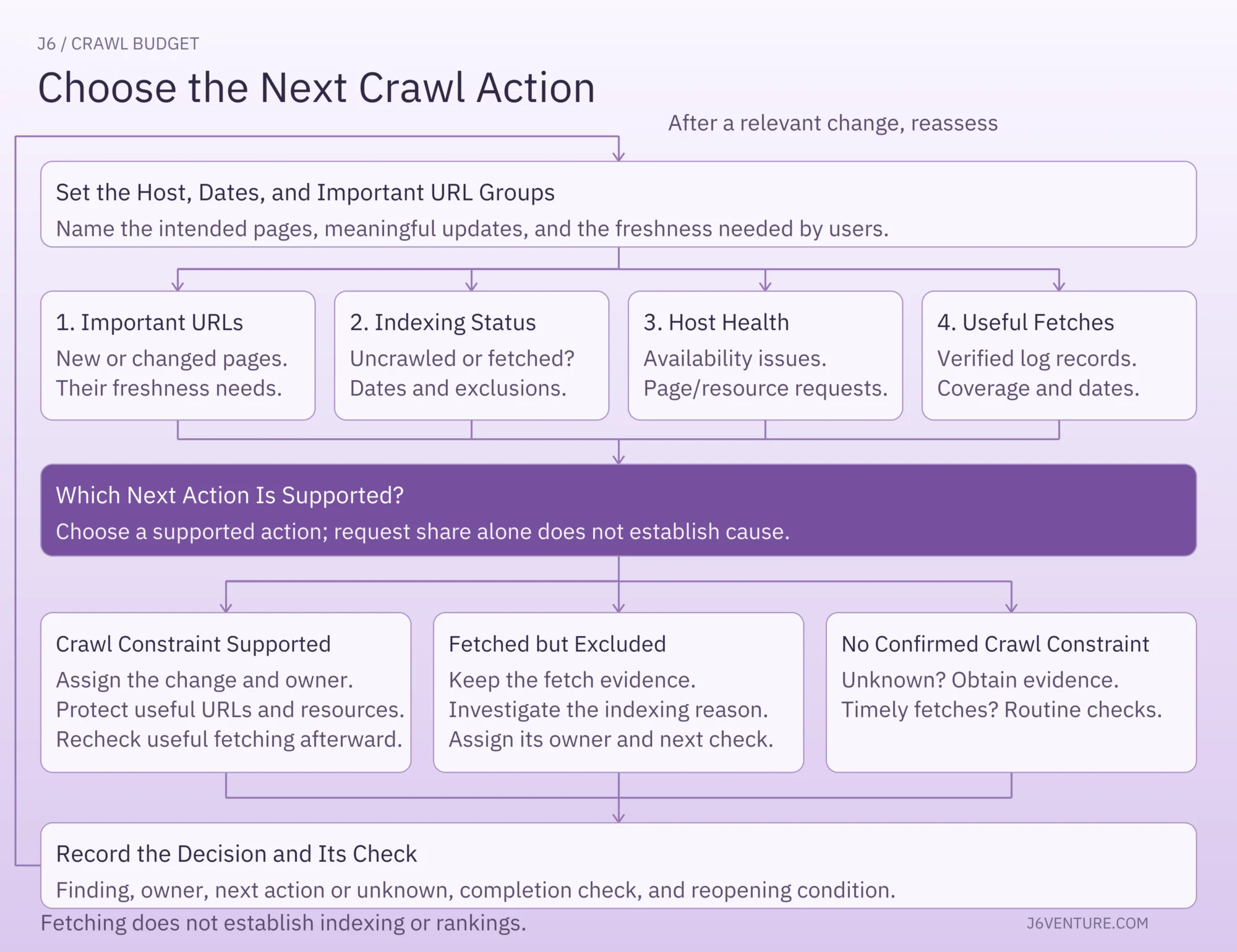
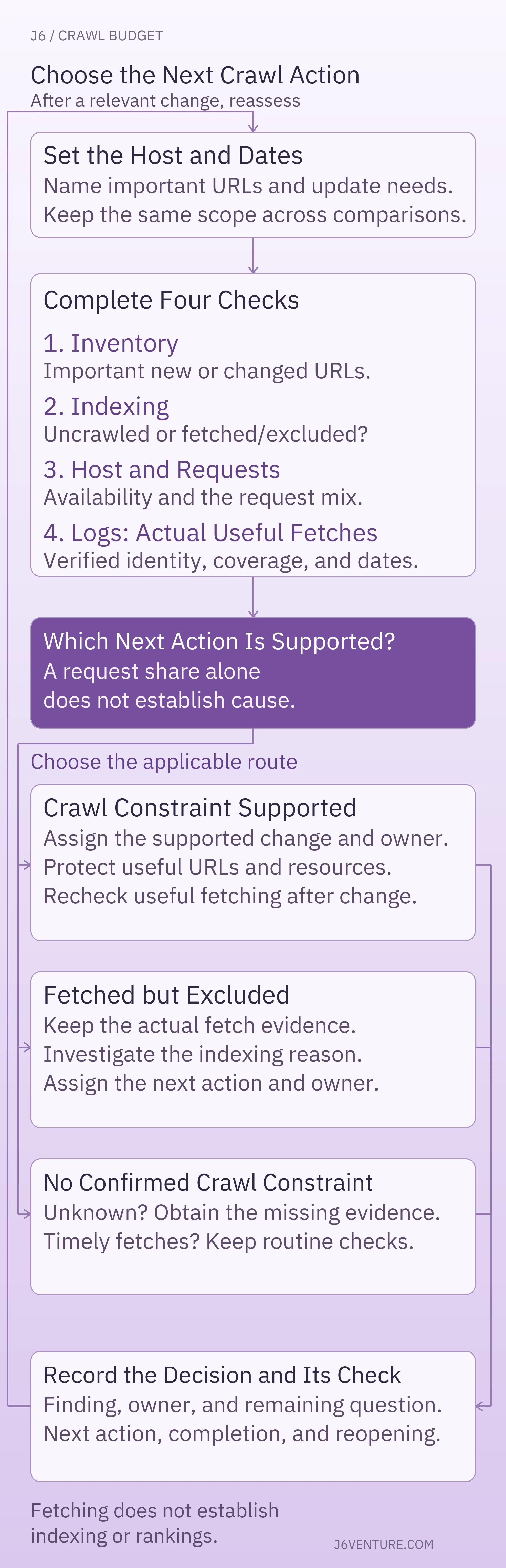
Keep the hostname, observation period, URL group, evidence source, finding, remaining question, and next owner together. Use one consistent group of important URLs throughout the investigation so that a changing denominator does not create an apparent improvement.
Check 1: Name the Important URLs and Their Update Needs
Start with pages whose discovery or freshness matters to users. Separate newly published pages from existing pages with meaningful changes. Record their preferred URLs and when the relevant content became available.
For an online catalog, you might distinguish product pages, useful category pages, and sorting variants. A sorting parameter can display the same products in another order, while a carefully maintained category page can answer a distinct shopping question. Both may contain filters; that does not make them equally expendable.
Use an export from your content management system (CMS), the system that publishes and manages the site's content, or from a product database or maintained inventory. This establishes the pages you intend to serve. An audit crawler can help find links, redirects, and duplicate patterns, but its own crawl is not a record of what Googlebot visited. A crawler's export can also omit pages it could not discover.
Choose a small set of important URLs to inspect individually alongside the group-level analysis. Record how they were selected. A few examples help explain a pattern; they do not establish that every page behaves identically.
Check 2: Separate Uncrawled Pages From Indexing Exclusions
In Search Console, open the property containing the page and enter its full URL in the inspection bar. Review the stored status and last-crawl information. Check the Page Indexing report for the broader exclusion pattern.
Ask whether the preferred page is known, has been fetched, is blocked, declares noindex, redirects elsewhere, or has been treated as an alternate. The right next step changes with the answer. An accidentally blocked product page needs an access correction; a fetched duplicate needs a canonicalization decision.
In the stored report's page-indexing details, record the reported reason, Last crawl, Page fetch, Crawl allowed?, and Indexing allowed? where available. Page fetch distinguishes successful retrieval from a fetching failure.
A canonical is the preferred version among duplicate or similar pages. Compare the User-declared canonical destination with the Google-selected canonical destination; the first records the site's preference, while the second records Google's choice. Google's URL Inspection guide explains these fields.
If Google selected another intended preferred URL, check that duplicate/preferred relationship before treating the alternate's exclusion as a fault. If access or indexing is unexpectedly disallowed, assign correction of the specific instruction. Missing fields remain unknown; they do not establish permission or exclusion.
Stored information can predate your latest change. A live URL test can help investigate current access, but it does not predict every indexing condition or Google's eventual canonical choice. Keep the stored date and current test result distinguishable.
If you cannot access the property, ask its owner for the relevant dated report. Mark missing evidence as unavailable. A guessed exclusion reason is not a safe basis for changing crawl controls.
Check 3: Examine Host Availability and the Request Mix
Open the relevant root-level Search Console property, then go to Settings → Crawl stats. The Crawl Stats documentation describes the report's controls and limitations. It is available for Domain properties and root-level URL-prefix properties, rather than an arbitrary subfolder property.
Check Host status and its availability details. Investigate reported problems with server connectivity, access to robots.txt, or DNS, the service that resolves a hostname to a server address. Use the response breakdown to find failures and their dates. Google's crawling troubleshooting guide also identifies Hostload exceeded as evidence that Google cannot fetch as many URLs as it discovered.
Then examine file type, crawl purpose, and Googlebot type. HTML is the page document; images, stylesheets, and scripts can generate separate resource requests. Page, resource, and advertising-crawler requests answer different questions. Discovery means the URL had not previously been crawled; refresh means a repeat crawl of a known URL.
Three limits prevent common misreadings:
- Requests are not unique pages. Repeated requests, resources, and individual server-side redirect hops can each contribute to totals.
- Examples are incomplete. A URL absent from an example list may still have been requested. The report can also omit some requests and count potential fetches not made when
robots.txtwas unavailable. - Averages can hide a group. Average response time covers fetched resources. A healthy overall figure does not rule out failures affecting one important page type.
Match the host and dates before comparing reports. A parent property can include child hosts, while the underlying crawl-budget scope is the hostname. A resource-heavy chart does not, by itself, justify blocking JavaScript or images that Google needs to understand pages.
Check 4: Compare Logs With Your Important URL Groups
Access logs record requests handled by your server or a content delivery network (CDN), which can serve cached pages before a request reaches the site's original server, called the origin. Logs can show the requested URL, time, response status, and other fields your setup records. Google's troubleshooting guide recommends them for specific URL or path crawl history; Crawl Stats is not a complete URL-by-URL history.
Ask the infrastructure owner for an appropriately scoped export. Establish these points before drawing conclusions:
- Which hostname, delivery layer, dates, and time zone does it cover?
- Could requests served by a cache or another layer be missing?
- Has the owner verified the crawler's identity, rather than relying only on a user-agent name that can be imitated?
- Which records represent HTML requests, resources, or another crawler?
- Are you counting requests, unique URLs, or important URLs fetched after a meaningful change?
An origin-server log can omit requests handled entirely by an upstream cache. Incomplete coverage cannot establish that Google never visited a URL. Ask the owner to resolve the coverage or identity gap before labeling the records verified Googlebot evidence.
Join the usable request records to your intended URL groups. Count unwanted repeat variants separately from useful preferred pages. For freshness, compare a successful retrieval of the intended page with its relevant publication or change time. A visit before an update does not establish that Google has seen the updated content.
Check the response outcome before counting a useful fetch. An error response or redirect-only request does not establish retrieval of the intended update. Have the infrastructure owner resolve which content version was served. A valid 304 can reuse Google's cached version, but the version must be current; neither 200 nor 304 alone proves that. Keep failed attempts and unresolved version questions separate from confirmed useful fetches.
Write a bounded finding: “These verified records contain no post-update fetch for these selected URLs during this period.” Add the known coverage limits. Avoid turning that observation into “Google will never crawl them” or “duplicates caused the delay.”
Match the Fix to What You Found
Treat the findings as inputs to a decision. Several causes can coexist. If the evidence does not distinguish them, assign the next investigation before changing the site.
| Supported Finding | Proportionate Next Action | What to Check |
|---|---|---|
| Important URLs are accidentally blocked or poorly linked. | Correct the access rule or provide appropriate crawlable links and sitemap entries. | The intended URLs are accessible and discoverable; then observe actual fetches. |
| Host failures coincide with missed useful crawling. | Have the infrastructure owner diagnose the serving constraint and propose a scoped repair. | Corrected responses, availability, and subsequent fetching of the affected important pages. |
| A generated URL pattern repeatedly exposes unwanted duplicate variants. | Correct its generation or discovery, consolidate genuine duplicates, or deliberately restrict unwanted crawling. | The pattern behaves as intended and valuable pages and required resources remain available. |
| The preferred pages were fetched but remain excluded. | Investigate the relevant indexing, canonical, or content condition. | The specific exclusion finding and its next action, without assuming that more requests will cure it. |
| Reports or logs do not establish what happened. | Obtain the missing dated evidence or resolve its scope. | A usable observation, or an explicit unresolved limitation with its owner. |
A faster server may support more crawling where serving capacity is binding. Google also says improved availability need not increase crawl budget when demand is limiting. Keep detailed response-time diagnosis in a TTFB investigation, and use a broader SEO audit when the problem crosses several systems.
Choose the Right Crawl or Indexing Control
Each control has a particular job. Choose it for that job before writing a rule:
Robots.txt controls fetching. It can keep Google from crawling deliberately unwanted URL spaces. It does not guarantee removal from the index, and a block can prevent Google from reading a page's noindex or canonical declaration. Do not combine controls on the assumption that Google can read a page it cannot fetch.
Noindex controls search inclusion when Google reads it. Google must access the instruction. It is not an immediate crawl-saving command or a way to allocate a fixed amount of budget to another page.
Canonical declarations express a preferred version of duplicate or very similar content. Google's canonicalization guidance describes strong signals, including redirects and canonical annotations, and the weaker sitemap signal. Google can select a different canonical; a declaration is not an instant block on duplicate fetches. Keep internal links and sitemap choices consistent with the intended version.
Redirects and removal responses describe what happened to the content. Redirect a moved page to its appropriate replacement. A permanently removed page without a suitable replacement can correctly return 404 or 410. Sending unrelated deleted URLs to the homepage merely to eliminate errors misrepresents their destination. A known removed URL can still be revisited.
Keep sitemaps current and use meaningful <lastmod> values for changed content. Shorten unnecessary redirect chains. Where supported correctly, an unchanged page's 304 Not Modified response lets Google reuse its cached version and saves serving resources. None of these supplies an indexing guarantee.
Preserve Useful Pages and Required Resources
Before restricting a URL pattern, identify examples it must preserve. These can include useful filtered landing pages, translated pages, product-detail URLs, and the CSS or JavaScript required to understand them.
A blanket “block every parameter” rule can catch content you want discovered. Test the proposed match against both unwanted URLs and protected examples. Keep any required index-removal task separate from the crawl restriction, and have the implementation owner choose a sequence that allows Google to read the relevant instructions.
Use a bounded rollout where possible, with an owner and a clear way to reverse the change. Do not repeatedly block and unblock directories merely to rotate Google's attention. JavaScript delivery failures need their own page-level rendering checks.
Work Through a Catalog Example
Read the Assumed Records
Everything below is fictional. No J6 or client site was tested, and no improvement is claimed.
Site and purpose: A catalog at www.catalog.example has 60,000 preferred public product and category URLs. Product information changes daily. The team wants important new products and meaningful updates fetched promptly enough to support its search freshness needs.
Important group: The owner identifies 1,200 URLs with meaningful new or changed content during an assumed period. A CMS export supplies each URL's change time. The team's two-day review trigger reflects its operational needs; it is not a Google deadline.
Evidence scope: Assume October 11–24, 2026 records from the delivery layer handling this host's public requests, in UTC. The infrastructure owner has verified Googlebot identity and confirmed coverage, including cached responses. Only the classified HTML requests are used in the following calculation.
HTML requests during October 11–24: 100,000 total.
- Duplicate sorting variants: 60,000 requests, or 60%.
- Preferred product pages: 10,000 requests, or 10%.
- Other HTML pages: 30,000 requests, or 30%.
These are requests, including repeats and attempts, not distinct pages. The site's 60,000 preferred public URLs describe its inventory and are a different count.
Important changed URLs: 1,200 distinct URLs.
- 800 have a confirmed successful retrieval of the intended page after their change time. Assume the infrastructure owner has checked the responses and content versions; a failed or redirect-only request does not qualify.
- 400 have no such retrieval recorded during the covered period and have crossed the team's review trigger.
The groups total 1,200. This split describes post-change coverage; it does not say how many of the 800 were fetched within two days. Check last-crawl and exclusion records for selected examples separately. The sorting-request pattern and missing useful fetches coexist in these assumed records; displacement has not been established.
Other observations: Assume no significant host-availability warning during this period. The developer confirms that a navigation component publishes crawlable links to multiple sorting orders of the same listings. Seventy-five curated filtered landing pages provide distinct useful answers and must remain discoverable. They are not classified with those duplicate sorting variants.
These records justify investigating the confirmed duplicate discovery pattern and the missed important updates. They do not establish a server-capacity shortage, prove that sorting requests displaced specific product requests, or explain every indexing exclusion.
Choose a Bounded First Change
SEO owner's decision: Start with the confirmed unwanted discovery mechanism in one catalog section. A low overall crawl count is not the reason for the change. The duplicate URL generation is observed, its lack of distinct search purpose is reviewed, and the implementation can preserve the useful pages.
Developer's action: Change the component's crawlable links to use the preferred listing URLs while preserving sorting functionality for visitors and the 75 curated landing pages. Review any duplicate sitemap entries and canonical inconsistencies within that same section. A broad robots block is not assumed necessary.
Implementation completion: Test that the affected component supplies the intended links and declarations, that direct product and curated-category URLs work, and that necessary rendering resources remain accessible. Record the release time and affected patterns. The implementation is not complete merely because a configuration was saved.
Rollback trigger: Restore the previous implementation if protected destinations become unavailable or required links/resources disappear. Assign the developer to that decision and the SEO owner to checking the protected examples.
If the developer could not establish the generation mechanism or protect useful pages, the first action would be further investigation. The large request share would not fill that evidence gap.
Set the Recheck and the Alternative Outcome
Planned comparison: Keep the hostname, log coverage, crawler classification, important-URL definitions, and change-time rules consistent. Set an initial 14-day review after release, then check whether Google has revisited the changed discovery paths. Fourteen days is a planned review point, not a promised response time. If the intervention has not been encountered, record that limit and retain the outstanding check.
Compare the unwanted request pattern and protected-page access. To assess freshness, use the same elapsed time after each meaningful change in both the before and after groups. For this team, measure the share of eligible important URLs successfully fetched within 48 hours of the change. Include only URLs with a full 48 hours of follow-up, record both group sizes, and apply the same successful-fetch rule. Treat new and updated pages separately where their mix differs.
The SEO owner would first calculate that 48-hour baseline from the original timestamps; the 800/1,200 coverage count is not that baseline. Apply the same rule to a comparable post-release group. Separately record whether the original backlog catches up. A larger cumulative fetched count after another 14 days does not, by itself, show faster crawling.
Account for different publishing volumes, unrelated outages, promotions, and other releases. A fall in sorting requests alone does not demonstrate that important products are being reached sooner. Even a better matched freshness result would not isolate this change as its sole cause.
Outcome still pending: The example contains no post-change records. The owner must record what happened, including no improvement or an inconclusive result. Indexing and subsequent search performance remain separate observations.
Alternative finding: Suppose instead the 400 selected URLs all have confirmed successful post-update Googlebot fetches within the team's review trigger, and the remaining complaint is exclusion from search. Preserve those fetch records. The SEO owner investigates the relevant indexing explanations, canonical choices, and content conditions. That result does not support diagnosing those URLs as uncrawled.
Measure Useful Crawling Before Closing the Work
Close the work against the question you opened. Keep the affected URLs, observed problem, change or investigation, owner, comparison period, and actual result in the record. If the cause remains unresolved, name the missing evidence and its next owner.
Useful progress can include fewer unwanted requests, corrected access or serving failures, and important content being fetched after it changes. Total requests may fall while the relevant crawling improves. Record indexing and business outcomes separately, with their own evidence.
If important content is already being reached and the evidence does not support a crawl constraint, keep the routine discovery and indexing checks and direct the team's effort to the remaining problem. That is a completed decision, too.
Reopen it when important content stops being reached as needed, serving problems appear, or the publishing pace or URL inventory changes enough to warrant another check.