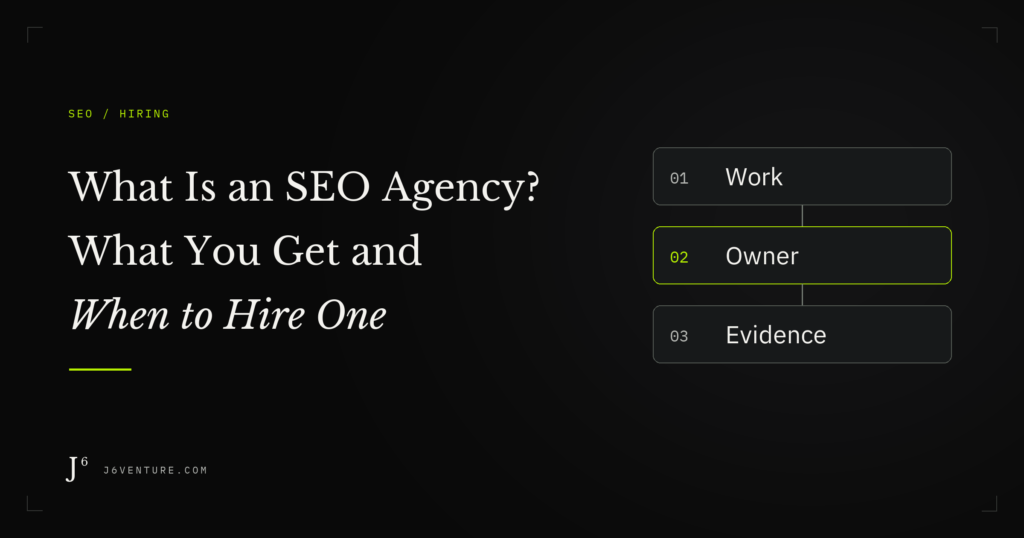
An SEO agency is a company you hire to improve your visibility in unpaid search results through research, technical work, content, and related services. Hire one when you need coordinated skills and have a way to implement its recommendations. Before signing, agree on the problem, deliverables, responsibilities, and evidence you will use to judge the work.
What Is an SEO Agency?
An SEO agency provides search engine optimization services to other businesses. Its job is to help relevant people discover your website through search and reach pages that answer their needs. The engagement can include advice, execution, or both, depending on the scope you buy.
Which part of the work do we need someone else to own? Answering that question helps you choose the right scope and provider.
That distinction affects what arrives. A technical audit may produce recommendations for your developers. A content engagement may include research and briefs, finished articles, or publishing. The phrase “full-service SEO” needs a written explanation of which responsibilities the agency accepts.
You pay for expertise and delivery. Google does not charge for inclusion in organic results, and buying Google advertising does not improve organic placement. Its guidance on hiring an SEO makes that separation explicit.
An agency is accountable for its agreed work. Rankings, leads, and revenue also depend on factors outside its control.
What Does an SEO Agency Do?
SEO agencies can investigate search demand, diagnose website problems, improve pages, support content production, pursue relevant links, and measure progress. Choose the mix around the problem your website needs to solve.
Research and Priorities
Research connects the audience you serve with the searches they make. The agency should examine search results, existing pages, competitors, and available performance data, then explain which opportunities deserve attention.
Useful research identifies which pages to improve, create, combine, or leave alone, with a business reason for each priority.
Technical SEO
Technical work examines whether search engines can access and interpret important pages, alongside issues in site structure and implementation. Google lists redirects, JavaScript, hosting, and error pages among areas where an SEO may provide development advice in its hiring guidance.
Clarify whether the agency diagnoses problems, writes development tickets, makes changes, or checks fixes after release. An audit and an implemented repair are different deliverables, with different staffing requirements.
Content and On-Page SEO
This work can include choosing a page’s purpose, preparing briefs, improving titles and headings, editing existing copy, adding internal links, and producing content. Agree on what “content included” covers before comparing proposals.
Your team may supply product knowledge, review accuracy, and approve messaging. Judge finished pages by whether they answer the buyer’s question as well as meet the agreed production scope.
Link Earning and Outreach
An engagement may include creating useful material and contacting relevant publishers or organizations that might reference it. Ask what the agency will create, whom it will approach, and how it will report the work.
Require an explanation of how links are obtained and any payments involved so you can assess relevance, quality, and risk.
Local SEO When Location Matters
For a business serving particular locations, scope may include location pages and maintaining accurate business information. Google’s SEO guidance for AI features also identifies up-to-date Business Profile information among relevant fundamentals.
Buy local work when geography affects how customers find and choose you. Confirm which locations and assets are covered, and who approves changes to addresses, hours, and service details. Detailed local execution deserves its own plan.
Reporting and Recommendations
Reporting should connect completed work with what happened on the affected pages and what the team should do next. It can include search visibility, relevant visits, inquiries, and other outcomes appropriate to the assignment.
Reports should distinguish work awaiting approval, changes already live, and results still being observed. Ask the agency to explain what those findings mean for your next decision.
What Should You Receive From an SEO Agency?
You should receive the deliverables agreed in your scope, with enough detail to evaluate their relevance and use them. We recommend defining each commitment through its purpose, output, owner, and completion check. The check should establish both that work was delivered and that it addresses the stated problem.
Match Each Deliverable to a Business Problem
Use this compact scope matrix as a starting point. These are our suggested buying criteria; adapt them to the work you commission.
| Problem to Address | Work to Receive | Ownership and Completion Check |
|---|---|---|
| Unclear page priorities | Research with recommended page actions | Agency explains audience fit and reasoning; your lead approves priorities. |
| Important pages face a technical obstacle | Diagnosis, affected URLs, and actionable repair instructions | Named developer implements; agency checks the relevant live behavior. |
| A page fails to answer a buyer’s question | Brief or finished revision, as contracted | Agency and subject expert check the answer; named publisher puts it live. |
| Relevant content is difficult to find on the site | Internal-link recommendations or implemented links | Agreed editor makes changes; agency checks destinations and context. |
| Reports do not support decisions | Page-level findings and proposed next actions | Agency explains evidence; business owner decides priorities and budget. |
A live check can establish that the assigned change shipped. It does not establish that the change was a good priority or increased sales. Keep two questions in the review: Was the agreed work done? Was it useful for the problem we chose?
A technically correct repair can deserve approval before its search effects become clear. Equally, a polished report can deserve rejection when it never addresses the issue commissioned.
Agree Who Implements the Work and How You Check It
Ask who researches, writes, implements, and checks the work, including any subcontractors. Name your approval owner too. Confirm which people you can speak with, who supervises outside contributors, and who resolves a missed or inadequate deliverable.
For a development recommendation, request the affected pages, reason for the change, implementation instructions, and an observable acceptance check. Your developer should be able to act without reconstructing the diagnosis from a tool export.
Set a route for blocked work. When access, technical capacity, or approvals are missing, identify who resolves the dependency and whether the scope or delivery date changes. Paying for recurring recommendations while the implementation queue grows deserves an explicit decision.
When Should You Hire an SEO Agency?
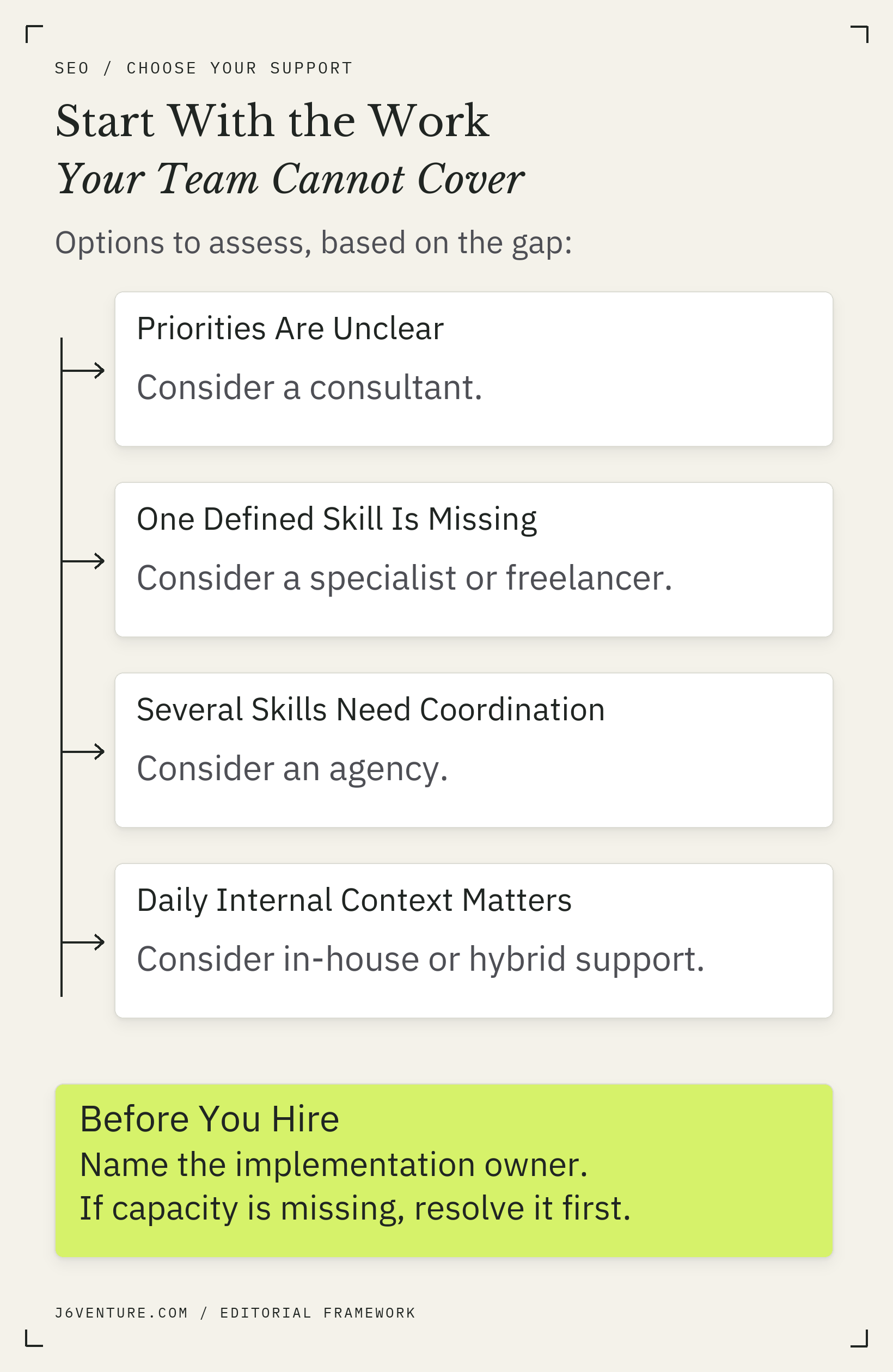
Consider an agency when the work requires several skills, your team needs help coordinating them, and someone can approve and implement the plan. Choose the arrangement around your missing capability and available capacity. The agency model is one option alongside specialist help, internal hiring, or a combined team.
When an Agency Fits
An agency can fit when you need coordinated research, technical support, content, and reporting without recruiting each role separately. Check who will perform the work, how much access you have to those people, and whether their experience matches your situation.
A redesign or new website is a useful time to consider SEO support. Google recommends involving an SEO early in these projects so search considerations can inform the build. Existing websites can also benefit from specialist help. (Google’s hiring guidance)
Before engaging, confirm that your team can provide the information and approvals required. Outsourcing production still leaves business decisions with someone who understands your customers and offer.
When a Consultant, Freelancer, In-House Team, or Hybrid Fits Better
Use these as starting points for a staffing discussion:
- Consultant: You need diagnosis, direction, or independent review, and have people available to execute. Confirm whether implementation is also offered.
- Freelancer: You have a defined assignment and can manage the surrounding work. Check the individual’s skills and capacity for that assignment.
- In-house team: You need sustained involvement in product, engineering, or marketing decisions, and have enough ongoing work to justify the roles.
- Hybrid: Internal staff retain business context and implementation ownership while external specialists fill skill or capacity gaps.
These labels overlap. A consultant may implement; a freelancer may advise; an agency may offer only a narrow specialty. Compare the named people and responsibilities behind the label.
If the missing capability is writing, our guide to what an SEO copywriter owns helps separate that role from the rest of the SEO workload.
When to Delay Hiring
Delay a broad engagement if you cannot yet explain the audience you serve, the desired outcome, or who can implement recommendations. A small diagnostic project may still help establish those answers.
Postpone work whose prerequisites you cannot fund. Content production needs knowledgeable review; development recommendations need development capacity. Buying either without those inputs can leave useful work unfinished.
If the unresolved question is whether search deserves investment at all, first assess which SEO benefits are worth funding. That decision should shape the scope you seek.
A Public Example: Apply Google’s Advice Before Hiring
Google’s hiring guidance provides a public example of how to turn general advice into a buying decision. It recommends considering an audit’s scope, granting read-only Search Console access at that stage, and examining the work involved and realistic improvement estimates. The application below is J6’s interpretation of that guidance.
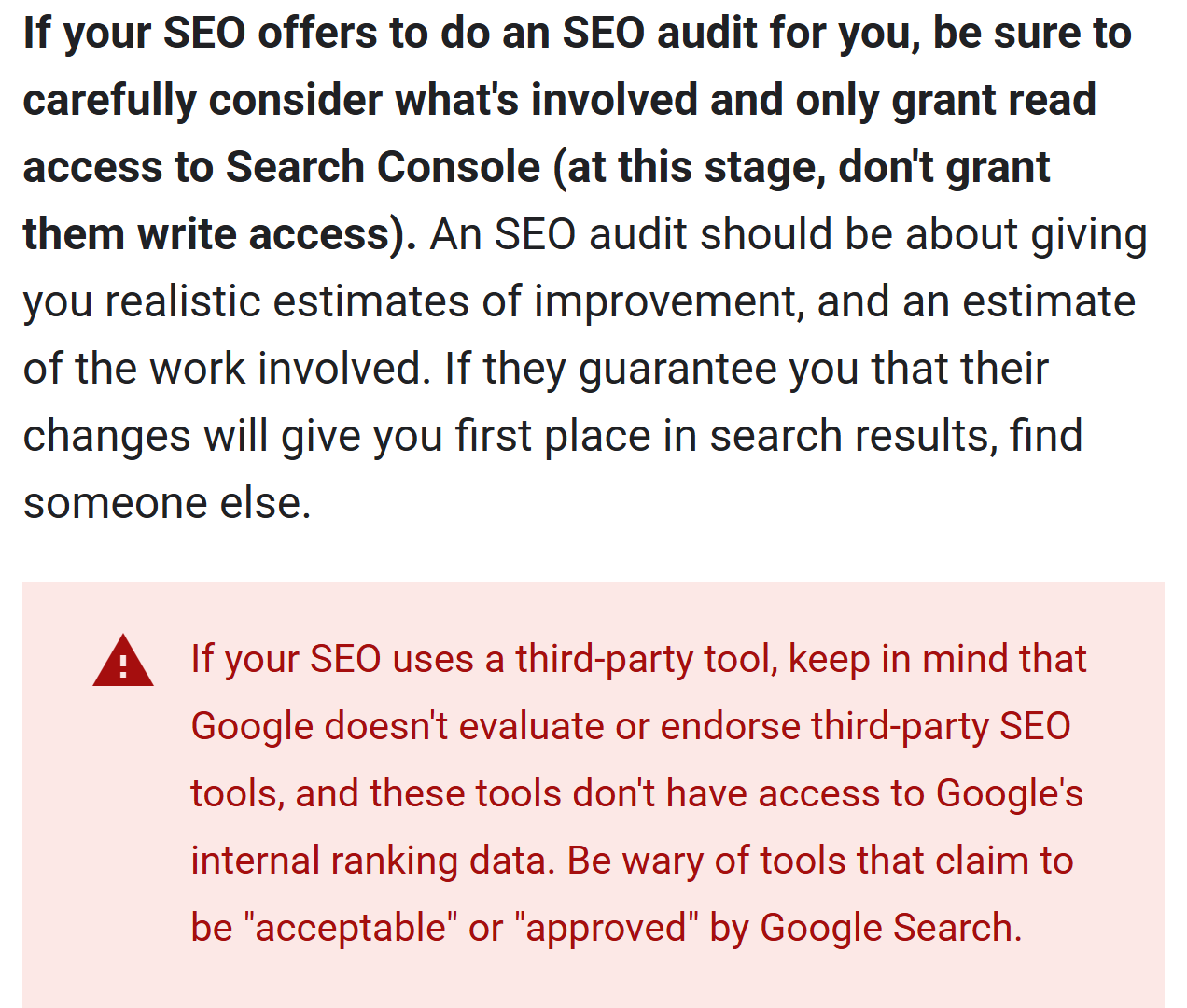
Start with the decision: Which problems deserve action, and can your team implement the repairs? Ask for an audit that answers those questions.
Agree on access. Give read access for the audit. Your account administrator can authorize wider permissions when the implementation scope requires them.
Check the reasoning. Ask the provider to explain an important finding, its expected benefit, and the effort involved, using relevant documentation and evidence from your site.
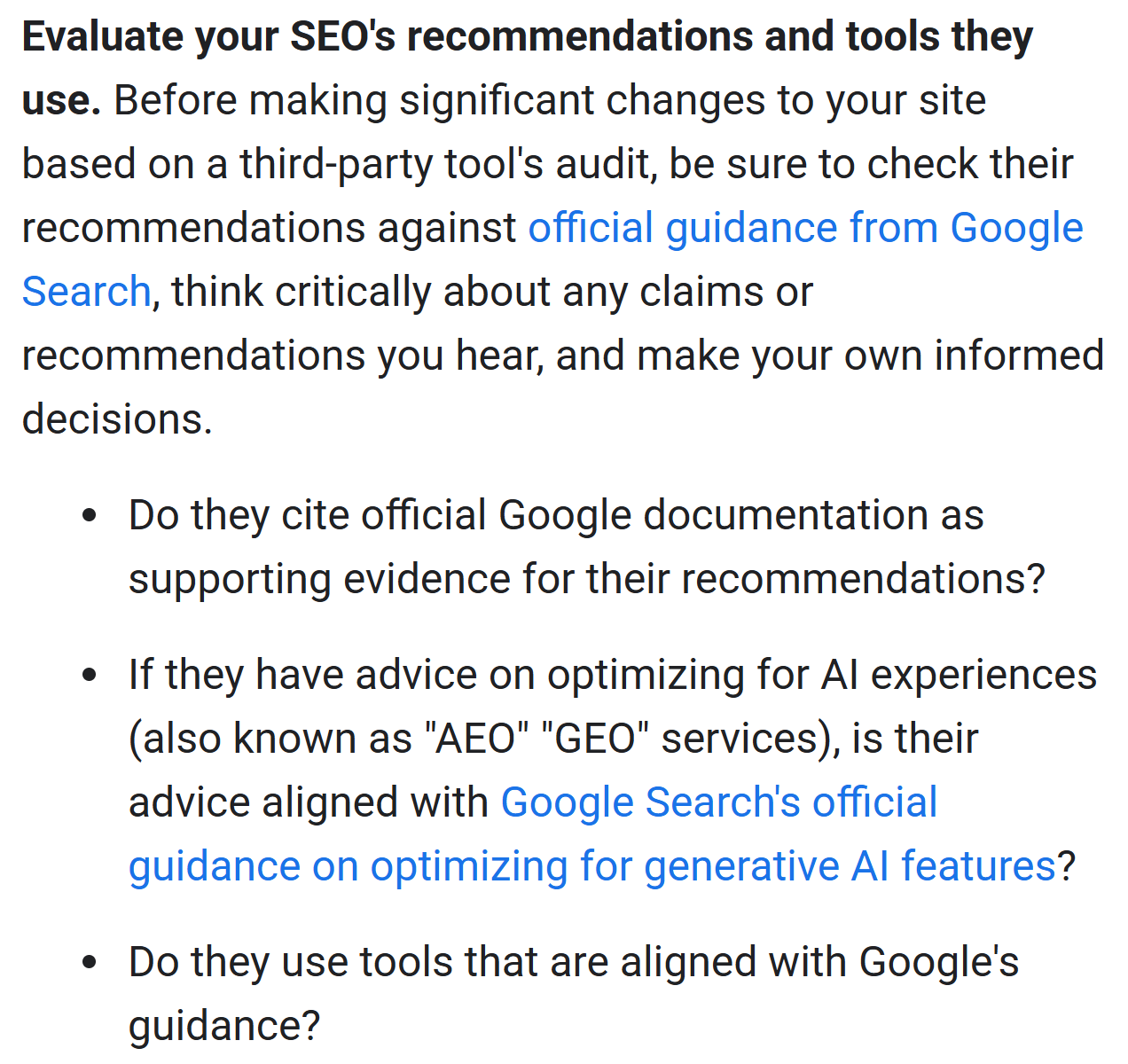
Before accepting a finding, check whether the handoff answers four questions:
- Which URLs are affected?
- What needs to change, and why?
- Who can release the change?
- What observable result will confirm the repair?
A concrete acceptance test from public documentation: Google’s noindex documentation explains that the directive can appear in a robots meta tag or an HTTP response header. Once Google processes it, the page is excluded from Google Search results. Applying that documented behavior, a repair brief for an unintended noindex would identify the affected URL and where the directive appears. The business owner must first confirm that the page should be public and eligible for search.
The assigned developer removes the unintended directive. The verifier checks the live response and rendered page for both possible locations. If the unwanted directive remains, the repair fails acceptance. If it is absent, that particular implementation check passes. This does not establish that Google has recrawled the page, indexed it, or improved its ranking. Other indexing conditions may remain.
Make the hiring decision from the handoff. Request clarification if the finding leaves any of the four questions unanswered. When your developers can release the repair, a consulting scope covering diagnosis and verification may be enough. When execution requires several skills you lack, ask an agency to price those responsibilities explicitly. When nobody can release changes, resolve that capacity gap before commissioning continuing audits.
What Does an SEO Agency Cost?
The cost depends on the work, the people involved, and which responsibilities are included. Compare proposals using the same scope and assumptions. A fee for recommendations is difficult to compare with a fee that includes development, writing, publishing, and verification. For a usable budget, request three separate line items for the same assignment:
- The agency’s fee and included deliverables.
- Your implementation and approval costs.
- Recurring maintenance and refresh costs.
Project, Retainer, and Hourly Arrangements
Each arrangement suits a different way of defining the assignment:
- Project fee: Agree on a bounded deliverable, such as an audit or a defined set of page revisions. Specify acceptance, revisions, and exclusions.
- Retainer: Buy ongoing capacity or an agreed recurring scope. Establish how priorities change, what happens to blocked work, and how you review continuation.
- Hourly arrangement: Pay for time spent. Agree on estimates, reporting, and the point at which additional hours need approval.
Evaluate quality separately from the charging model. Request written quotes against your requirements rather than choosing from a generic price range. Ask what changes the price: additional sites, locations, languages, pages, implementation, or specialist involvement.
Include the Cost of Getting Recommendations Live
Your working budget should include external fees and the internal effort needed to use the service. Account for development, subject-expert review, design, publishing, measurement setup, and maintenance where the proposed work needs them.
Ask who pays for tools or outside production, and whether those costs continue after the engagement. Include expected content refreshes and recurring technical checks in the discussion.
Compare proposals by identifying what reaches the live website and what remains your team’s responsibility. A smaller fee can still suit you when internal capacity is available. The same arrangement can become impractical when every recommendation needs an unfunded specialist.
What Should You Check Before Signing?
Check relevant experience, the people assigned, the implementation agreement, reporting, access, and exit arrangements. Request explanations of material tactics and claims. Google’s hiring guidance recommends interviews, reference checks, and transparent explanations of proposed changes; your contract discussions should turn those checks into clear commitments.
Relevant Evidence and References
Read case studies for context before treating a headline result as evidence of fit. Ask what changed, over what period, from which baseline, and with what contribution from the client’s team. Separate the agency’s role from a result achieved by several teams.
Useful follow-up questions include:
- Did the assignment involve a similar website, audience, and business model?
- Which deliverables and implementation responsibilities belonged to the agency?
- What constraints or unsuccessful approaches changed the plan?
- Can a reference explain whether recommendations were usable and communication helped move work forward?
A relevant case can help you assess experience. Its uplift is not a forecast for your website. Missing detail is a reason to ask a question before drawing a conclusion about either competence or results.
Access, Ownership, and Exit Terms
We recommend keeping business-controlled administration of your domain, website, and measurement accounts. Give the provider permissions appropriate to the agreed task, and record who can change or revoke them.
Agree on the assets you receive and can continue using: copy, briefs, reports, source files, configurations, and documented changes. Clarify licenses and dependencies for agency-provided tools or dashboards.
Before signing, establish the notice period, handover responsibilities, unfinished-work treatment, and access removal process. Ask whether your team will retain usable records after the relationship ends. Record those terms in the agreement.
Ranking Guarantees and AI Visibility Claims
Google’s hiring guidance warns about ranking guarantees, special-relationship claims, and link schemes. Use those warnings alongside practical checks on how the provider works.
Apply the same scrutiny to AI-search packages. Google’s documentation says established SEO fundamentals remain relevant to AI Overviews and AI Mode, and a page must be indexed and eligible to appear in Search with a snippet to qualify as a supporting link. There are no additional technical requirements. Eligibility does not guarantee selection. (Google’s AI features guidance)
Ask which platform the service targets, what work changes, and how reported appearances are measured. Evidence about Google’s features cannot establish a promise about every AI platform. A package name such as AEO or GEO still needs a clear scope and credible measurement.
How Do You Know Whether the Agency Is Doing Useful Work?
Review delivery, the quality of decisions, and progress toward the page’s intended outcome. These answer different questions. A completed revision shows delivery; its connection to a diagnosed need explains why it was chosen; subsequent search and business evidence helps you decide whether to continue, improve, or redirect the effort.
We suggest asking four questions at each agreed review:
- What changed? Identify the pages or systems affected and when the work went live.
- Why was it worth doing? Connect the action to the original problem and explain why it took priority.
- What happened afterward? Examine relevant queries, visits, or business outcomes, with the limitations of the comparison stated.
- What happens next? Agree on the next action, owner, and review point.
Reassess completed work when the evidence repeatedly fails to support its rationale. Positive traffic also deserves scrutiny if it attracts people your business cannot serve.
Search effects and commercial outcomes can develop on different timelines. Our guide to how long SEO takes to work explains how to decide whether to wait, fix a blockage, or change direction. A delay in outcomes should still come with an explanation and a review point.
Choose Your First Scope of Work
Begin with the smallest coherent scope that addresses your priority and leaves you able to judge the work. For the unintended noindex example above, that could be: identify the affected page and directive, confirm that the page should appear in search, remove the directive, and check the live response and rendered page.
If your developer can implement the fix, commission diagnosis and verification from the provider. If you need the agency to implement it too, include that responsibility in the quote. Agree separately who will monitor subsequent indexing; passing the repair check establishes that the directive was removed. This gives you a concrete first assignment before deciding whether broader support is useful.
Send prospective providers the same short brief:
- The business problem and pages or areas affected.
- The audience and outcome the work should serve.
- What your team can research, approve, implement, and maintain.
- What you need the provider to deliver and verify.
- The evidence and review point you will use to decide what follows.
Ask each provider to explain its proposed scope against that brief, including exclusions and dependencies. You can then compare whether its people and commitments fit the work your business needs.
The first useful agency decision is deciding what someone must own. Once that is clear, the service model, budget, and review become easier to judge.