Go to a statistic: Search Clicks · First-Year Rankings · Page Experience
A convincing number can make a weak plan sound certain. “Most pages get no traffic” can become a reason to stop publishing. “Older pages dominate” can become an excuse to wait. Neither decision follows from the statistic alone.
The studies below help you ask better questions about clicks, content, keywords, links, performance, and local customers. Some measure US behavior; others provide broader context. Their observation periods range from 2023 to September 2026. A recent page update does not make every number a recent measurement.
SEO statistics summarize measurements or estimates related to search visibility and behavior. A study might count searches, pages, keywords, people, or website origins. Those units answer different questions.
For example, the percentage of keywords with low estimated demand tells you how common those keywords are in a database. It does not tell you what percentage of searches they receive. A small number of popular terms can account for many searches.
Before borrowing a number, identify the claim you want it to support. A finding about how people use Google can justify examining your search traffic. Forecasting next quarter's revenue requires evidence about your audience, pages, conversions, costs, and sales cycle. An industry statistic supplies only part of that picture.
Search Behavior and AI Summary Statistics
Clicks on Traditional Results and AI Sources
8% versus 15%: In Pew Research Center's analysis, users followed a traditional search-result link on 8% of visits to Google results pages classified as having an AI summary, compared with 15% of visits to pages without one.
1%: Users followed a link within an AI summary on 1% of visits to pages with summaries. Being cited and receiving a visit were separate outcomes in this study.
Pew used browsing data from 900 US adults during March 1 to 31, 2025. The dataset contained 68,879 unique Google searches.
Researchers reconstructed the results during April 7 to 17, 2025, rather than recording the exact results each person saw in March. They compared the next visited URL with first-page results and up to three summary-source URLs. The summaries could have changed between those periods.
The 8% and 15% figures differ by 7 percentage points. They describe different observed groups of search pages. They do not establish how much adding a summary would reduce clicks on an otherwise identical query.
Planning implication: If your educational pages receive fewer visits, check whether the affected queries and search results changed before revising the content. Record whether people saw the page in search, saw it cited in a summary, visited it, or took an action such as requesting a demo. These observations do not provide a universal traffic-loss percentage for your site.
Searches Without Clicks and Open-Web Clicks
58.5%: In SparkToro and Datos' 2024 study, 58.5% of tracked US Google searches ended without a click on the presented results. This included ending the session or performing another search.
360 clicks per 1,000 searches: The same study reported 360 clicks to the open web per 1,000 US Google searches. Its open-web measure excluded clicks to Google-owned properties and clicks on Google paid ads. The linked page's URL reverses the US/EU labels; the figures here follow its article body.
The combined mobile and desktop observations covered January through May 2024, using Datos' multi-million-device clickstream panel, which tracks browsing activity from participating devices. The exact number of searches included in this analysis was not disclosed. Coverage of mobile iOS devices was minimal, Google app and voice Assistant searches were excluded, and ad blocking could affect paid-versus-organic click counts.
The two figures are not complementary slices of one pie. One counts searches without result clicks. The other counts qualifying clicks, and a search can generate multiple clicks. “360 clicks per 1,000 searches” does not mean 36% of searches produced an organic website visit.
Planning implication: A keyword's search count cannot be treated as the number of visits available to your page. Examine what the results already provide, which pages people might still need to open, and what your page helps them do. A search without a click may have satisfied the user or led to another search; the statistic alone does not tell you which.
Ranking and Organic Visibility Statistics
Pages With Zero Estimated Search Traffic
96.55%: Ahrefs' study published in December 2023 found that 96.55% of approximately 14 billion pages in its Content Explorer index had zero estimated organic Google traffic.
This was a selected tool index, not a census of every page on the internet. The retrieved study does not specify a country-specific sample. Ahrefs estimated monthly traffic using its keyword data and acknowledged that untracked, infrequently searched queries could send visits its estimates missed. The exact data snapshot and traffic-estimation window were not disclosed in the retrieved article.
Planning implication: Publishing a page does not establish that people can find it through search. Check whether a proposed page serves an actual question, whether search is a plausible discovery route, and how you will assess it after publication. For an existing page, use your own evidence before declaring it receives no traffic or removing it. A zero estimate in a third-party tool is insufficient for that decision.
New Pages Reaching the Top 10
6.11%: In Ahrefs' 2025 ranking study, 6.11% of a group of 2 million URLs containing English-language content from October 2023 reached Google's top 10 within one year.
A group of pages followed over time is called a cohort. The worked example below compares this cohort with another, differently selected group in the same article. The geography of these one-year ranking cohorts was not explicitly stated; they should not be relabeled as US-only research.
Planning implication: Allow for uncertainty when planning content whose value depends on rankings. Agree which relevant queries, visits, or inquiries you will examine for your pages, and set a review date. The study's cohort rate is not the probability that your next page will rank, and it does not set a universal deadline for success.
The Age of Top-Ranking Pages
72.9%: In a separate part of that Ahrefs study, 72.9% of top-10 pages across 1.3 million sampled US keywords were more than three years old.
Age was based on when Ahrefs' crawler first saw the URL. That date need not equal its publication date. The exact search-results snapshot date was not stated. The sample describes pages already ranking in the top 10; it does not follow every old and new page to establish what caused success.
Planning implication: Review existing pages that still answer a customer question alongside proposals for new ones. An older page may have accumulated content, links, recognition, and revisions. The age statistic does not isolate those contributions or prove that waiting three years improves a page. Preserve that work and investigate what a new or existing page needs to serve its reader.
Keyword, Link, and Site Performance Statistics
Low-Volume Keywords
Almost 93%: In its long-tail keyword guide updated May 27, 2026, Ahrefs says almost 93% of the keywords in its US database have fewer than 10 estimated searches per month. The underlying extraction date and volume-estimation period were not disclosed.
This describes the number of distinct keywords in that database. It does not mean 93% of searches are for those terms. Low volume also does not establish low competition, buying intent, or a need for a separate page.
Planning implication: Evaluate the question behind a low-volume term and the related questions a page can answer. Several variations may belong in one resource. A narrow question with a genuine buyer need can deserve attention, but its business fit still needs evidence. Our guide to zero-search-volume keywords in SaaS develops that selection problem.
Backlinks and Search Traffic
Reported association: Ahrefs' 2023 traffic study found an association between referring domains and estimated search traffic. A referring domain is a distinct website linking to a page. The researchers explicitly say the relationship does not prove causality.
Pages may attract links because people already discover and value them. Other differences between pages can also affect both traffic and links. The study cannot tell you that acquiring a particular number of links will produce a particular traffic increase.
Planning implication: For a proposed link, ask whether the linking page reaches your intended audience and gives them a reason to open your resource. The observed association supplies no quota of links to buy and no guaranteed return from a campaign. Our link-building mistakes guide addresses placement decisions in more depth.
Origins With Good Core Web Vitals
55.9%: Google's September 2026 Chrome UX Report release, published October 13, reported good Core Web Vitals for 55.9% of 18,376,044 eligible origins in its standard series.
An origin is a web-address grouping such as https://example.com, defined by its protocol, hostname, and port. Core Web Vitals assess loading, responsiveness, and visual stability. This figure concerns eligible origins in a global sample of participating Chrome users' experiences, rather than individual pages or all US websites.
The CrUX methodology has user and site eligibility requirements. Its browser coverage includes desktop Chrome and Chrome on Android, with exclusions including Chrome on iOS. The release also provides a separate experimental series including soft navigations, where content changes without a full page load. We use the standard series here so those measurements remain distinct.
Planning implication: Check the experience of people using your important pages before prioritizing performance work. A global prevalence figure cannot diagnose your site or tell you which template needs repair. Passing Core Web Vitals also does not establish a particular ranking or conversion gain.
What US Consumers Say About Local Reviews
41%: In BrightLocal's 2026 survey of 1,002 US adults, 41% said they always read reviews when browsing for businesses.
The report was published February 11, 2026. The exact fieldwork dates were not disclosed in the retrieved methodology. This is self-reported consumer behavior, not a measurement of local search traffic, review-driven sales, or mobile-only activity.
Planning implication: If you serve local customers, consider what they need to evaluate your business after discovering it. Accurate information, relevant customer experiences, and responses that answer customer questions belong in that assessment. The survey does not establish how much reviews will raise your rankings or sales. A national software company and a neighborhood service business may have different reasons to use this finding.
How to Choose a Statistic for Your Plan
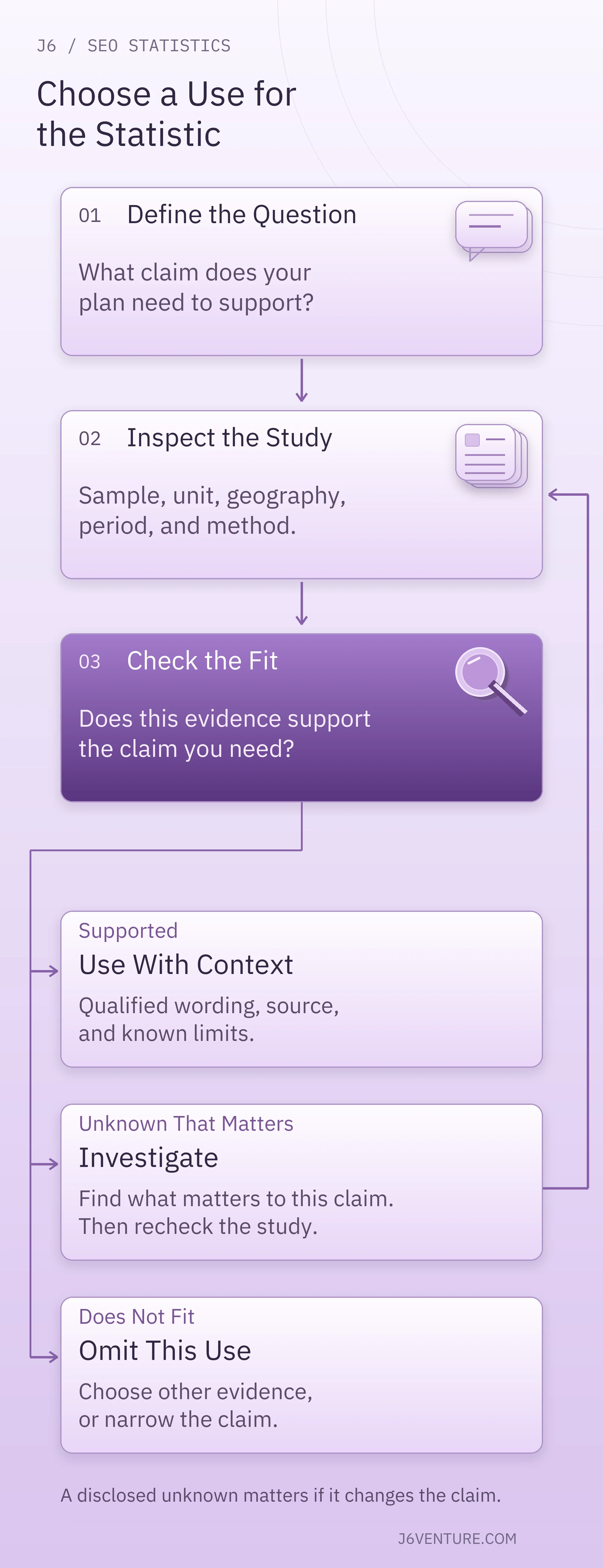
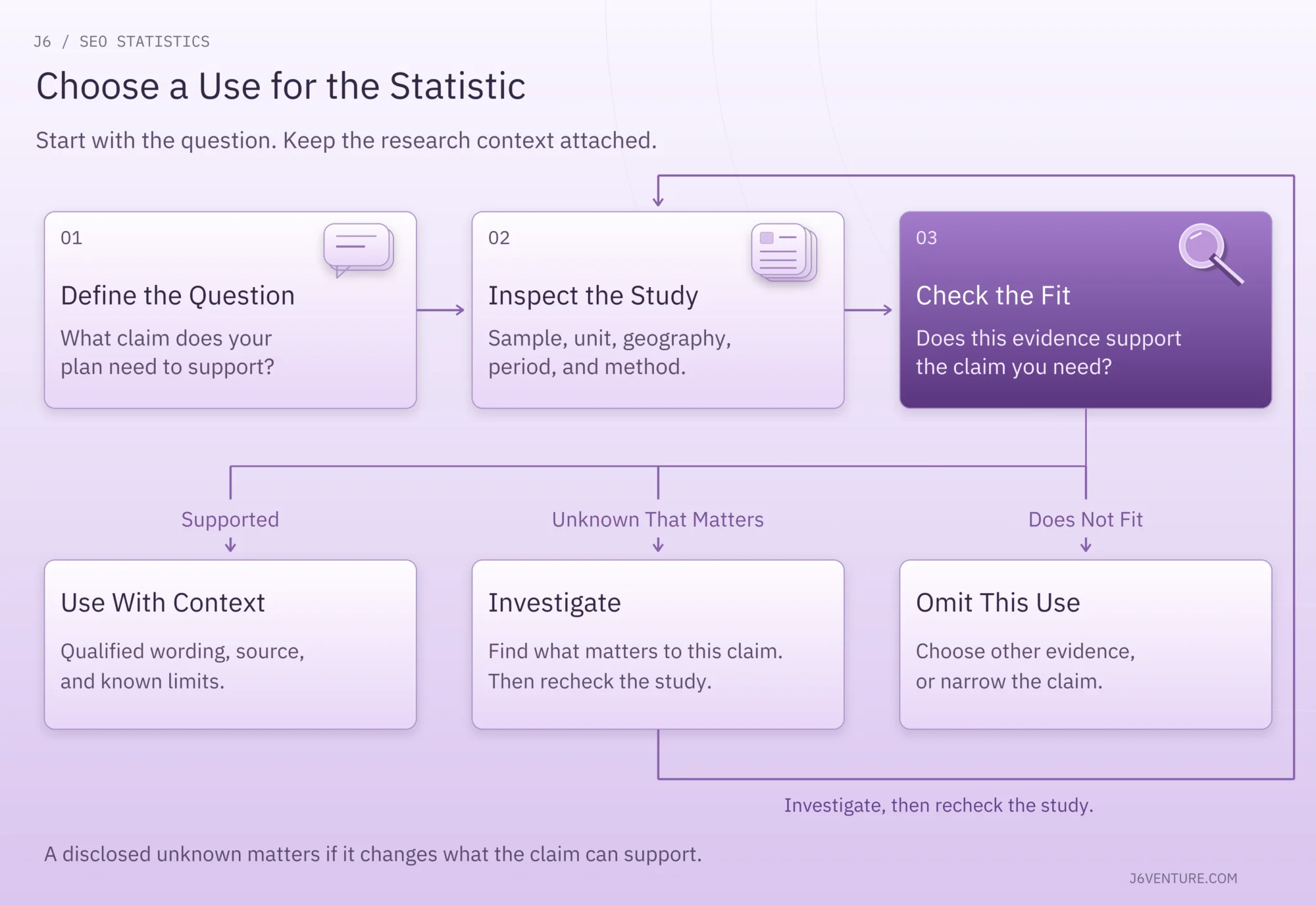
Use these checks before putting a figure into a brief, forecast, presentation, or article:
- Write the question. “Should we expect a new English-language resource to rank quickly?” gives you something to assess. “Find an impressive SEO number” does not tell you what the evidence needs to establish.
- Open the original study. Read the passage containing the figure and its methods. Record who or what was counted, the geography, observation period, publication date, and relevant exclusions. Mark an undisclosed field unknown.
- Identify the kind of finding. Observations describe recorded behavior; surveys describe respondents' answers; tool estimates model a quantity. Forecasts project future outcomes under assumptions. Reaching a forecast's target year does not turn its prediction into an observed result.
- Check the fit. Does the sample answer your question? An unknown field may prevent a US-specific claim while still allowing a clearly qualified statement about the sampled pages. Do not broaden the wording to hide a mismatch.
- Choose the use and the next check. Use a supported, qualified statement as context. Investigate missing evidence that matters to your claim. Omit the figure from that use if it does not fit, or narrow the question and reassess. Identify what you still need from your own business before setting a target.
A source note should make the decision easy to revisit. If you cannot trace a figure beyond a chain of roundups, leave that claim out until you have adequate evidence. When studies give different numbers, compare the populations, dates, definitions, and methods before treating the difference as a change over time.
A Worked Example of Choosing a Ranking Statistic
Illustrative planning question: A US software marketing team is considering an English-language educational resource. A draft presentation says, “New pages have only a 1.74% chance of reaching Google's top 10, so publishing another resource is unlikely to work.” The team wants a defensible statement about ranking uncertainty, rather than a forecast disguised as a statistic.
Inspect the original source. The Ahrefs article published May 15, 2025 reports two groups:
| Group | Pages Included | Reached the Top 10 Within One Year |
|---|---|---|
| September 2023 cohort | 1 million random URLs seen by Ahrefs' crawler | 1.74% |
| October 2023 cohort | 2 million URLs filtered to nonempty English content | 6.11% |
Check the fit. The English-content group is closer to the team's proposed resource. It still contains a mix of pages and sites, and the research does not identify it as a US-only cohort. The two groups use different selection rules; their results do not demonstrate that ranking became easier from September to October.
Make the decision. Remove the 1.74% universal-chance claim and its conclusion that another resource is unlikely to work. Retain the filtered cohort as background evidence that quick ranking should not be assumed.
Completed Source Note
- Research statement: Among 2 million nonempty English-content URLs in Ahrefs' October 2023 cohort, 6.11% reached Google's top 10 within one year. This is a descriptive result for that cohort; the report does not specify the rank-check geography.
- Purpose: Put first-year ranking uncertainty into an English-language content plan.
- Source and dates: Ahrefs' May 15, 2025 ranking study, checked October 25, 2026; October 2023 cohort followed for one year. Exact rank-check geography and detailed observation dates remain undisclosed.
- Population and method: 2 million URLs filtered to nonempty English content; a tool-observed cohort, not a controlled test or an estimate of this team's future success.
- Use decision: Cite this cohort result as background. It does not establish a success probability for our proposed resource. The misleading universal-chance statement has been removed; the resource proposal remains unapproved in this illustration.
- Our planning implication and owner: Before deciding whether to commission the resource, the marketing lead must assess whether readers need its answer, what competing pages provide, which visits or inquiries would justify the effort, and the acceptable effort. This is the team's proposed work, separate from the Ahrefs finding.
- Review trigger: Recheck the original source before reusing the statement in another plan, or if a newer comparable study becomes available. If the question changes to US-specific ranking rates, obtain appropriate geographic evidence first.
What to Record Before You Share a Number
Keep a short record of the question, qualified statement, original source, research period, population and method, and use limitation. Add an owner and review trigger when the number will inform ongoing work. Preserve unknowns that change what you can claim.
Choose the statistic because it helps answer a real question. Then specify the observation you need from your own audience or pages to make the next decision. That is how a research finding earns its place in a marketing plan.