A polished author biography can sit above an unsupported promise. A small business with little online recognition can publish a clear, accurate explanation of its services. The useful question is what readers have good reason to trust on this particular page.
E-E-A-T describes qualities that can help establish whether content deserves trust: relevant experience, suitable knowledge or skill, recognition as a source on the subject, and accuracy, honesty, safety, and reliability. Their importance depends on what the page helps someone do. A product-use account and instructions for handling a dangerous repair need different support.
Google’s people-first content guidance puts trust first and explains that content does not necessarily need to demonstrate every aspect. There is no requirement to give the four letters equal space on a page.
Experience and Expertise Answer Different Questions
Experience asks what the creator has encountered or done. Expertise asks whether they have the knowledge or skill the subject requires. They can overlap, but one does not automatically establish the other.
A person who has used a scheduling app can describe the steps they tried and the limitations they encountered. Their experience does not establish that the app will improve every customer’s productivity. A technically knowledgeable writer can accurately explain a documented feature without claiming to have tested it.
Make the basis clear. “The documentation lists this feature” and “we tested this feature” describe different work. A first-person sentence or screenshot cannot make an unperformed test real.
Required expertise also varies. Practical experience may support a useful account of living with a condition. Advice about choosing a treatment can require relevant professional expertise and dependable medical evidence. The reader’s decision changes what support is appropriate.
Authority and Trust Depend on the Subject
Authoritativeness concerns recognition as a go-to source for a topic. Trustworthiness concerns whether readers can reasonably rely on the page. Being well known in one field does not establish authority in another, and an impressive reputation does not make an unsupported statement accurate.
A business can be the appropriate source for its own opening hours or offered services. An independent assessment of its performance needs a different basis. A company-controlled social profile can clarify identity, but it is still the company describing itself.
Google’s Search Quality Evaluator Guidelines, section 3.3.5, explain that small businesses and ordinary creators may have little reputation information online. That absence alone does not establish good or bad quality. Look at the useful content, relevant evidence, and other context available.
Building topical authority through supported answers involves the site’s broader coverage. The review here asks whether one page gives people suitable reasons to rely on what it says.
How Does E-E-A-T Relate to Google Rankings?
E-E-A-T itself is not a specific ranking factor. Google says its systems use a mix of factors that can identify aspects of it. Human quality raters evaluate search results to help assess those systems; an individual rater does not directly set your page’s ranking.
Those distinctions come from Google’s explanation of E-E-A-T and quality raters. They leave no public Google E-E-A-T score to increase by adding a biography, citation, or badge.
A tool may give its own assessment. Read what it measures before treating its suggestions as work your page needs. A domain authority metric or checklist percentage cannot establish whether a particular claim is true.
Correcting an unsupported promise is a meaningful editorial improvement. A later traffic increase would not, by itself, prove that the correction caused it. Nor does a decline diagnose an “E-E-A-T penalty.” Search performance also involves the other components of SEO, the query, and competing results.
Use the review below to improve the page’s usefulness and support. Keep rankings, AI citations, and business results as separate outcomes to observe, with their causes unresolved unless you have stronger evidence.
Review Your Page in Five Steps
Start with one identified page and the reader’s decision. Then examine its useful content, important claims, responsible creator, and relevant reputation. The result can be a correction, a request for evidence, or a reason to leave a sound passage unchanged. These steps are an editorial application of Google’s guidance, not a Google scoring formula.
Step 1: Identify the Reader's Task and the Risk of Getting It Wrong
Write down what someone should be able to understand or do after using the page. “Learn about our company” is usually too broad to guide a useful inspection. “Decide whether our five-page website redesign service includes the work they need” gives you something concrete to check.
Next, identify the plausible consequence of a wrong answer. Could someone waste an afternoon, misunderstand a purchase, expose sensitive information, or make a seriously harmful health or financial decision?
Google uses Your Money or Your Life, or YMYL, for topics that could significantly affect people’s health, financial stability, safety, or broader welfare. The guidelines’ discussion of YMYL and experience distinguishes the specific topic and purpose, including helpful lived experience and advice that requires expertise. An industry label alone does not settle the question.
Record the consequence and the knowledge needed to address it. If the page gives consequential advice outside the creator’s competence, involve an appropriate qualified contributor or remove that advice while the gap remains unresolved. Adding a credential elsewhere on the site cannot supply the missing work.
Step 2: Check Whether the Main Content Helps Complete That Task
Read the page as someone arriving without your background knowledge. Try the task it promises to support. On a service page, can you tell what is offered, what is excluded, and what to do next? On a tutorial, can you follow the instructions and recognize the expected result?
Identify where the page stops helping. It might omit a necessary step, hide a condition, or make a broad claim without explaining the offer. Correct that substantive gap before spending the review on decorative credibility elements.
Google’s main-content guidance includes text, media, tools, and other material that helps a page achieve its purpose. A detailed biography does not repair an incomplete tutorial or a broken calculator.
Keep one specific observation: the unanswered question, the failed action, or the condition a reader could miss. That gives the writer or page owner a defined problem to fix.
Step 3: Match Important Claims to Suitable Evidence
Copy the exact statements that materially affect the reader’s decision. Check each against the underlying work or source, including its scope and limitations. A respected publisher’s name is useful context; the source still needs to support the statement you made.
Scroll sideways if any columns are off-screen.
| Claim on the Page | Evidence to Examine | Important Limit |
|---|---|---|
| “We tested these products.” | Actual test records, methods, conditions, and relevant results | A documentation review does not establish hands-on testing. |
| “This service includes two revision rounds.” | Current approved service terms or scope | Offered terms do not establish delivery quality or competence. |
| “Customers achieve this result.” | Relevant customer records and the conditions behind the result | A general industry study does not establish this business’s effect. |
| “Reviewed by a specialist.” | Genuine review work, relevant competence, scope, and findings | A name or badge does not establish that a review happened. |
For a product review, Google’s guidance on explaining how content was produced discusses methods, results, and evidence of the work. Describe the work you performed and what it establishes. Do not manufacture experience to match a checklist.
AI assistance does not answer this evidence question for you. Verify the resulting claims and describe production methods where readers would reasonably expect that explanation. A human byline alone is not proof of accuracy. If your wider process needs clearer research and approval responsibilities, use a defined AI content workflow.
Mark each important claim as supported within stated limits, needing a narrower statement, or requiring evidence you do not yet have. Keep uncertain work visible.
Step 4: Check Who Is Responsible and What Others Say
Identify who created the content and who readers can contact when accountability matters. The right presentation depends on the page. An organization may be responsible for its service information; an article may reasonably need a named author and relevant background. Legitimate usernames can be appropriate in community discussions.
Google encourages accurate authorship information where readers expect it. It does not require every page to carry an individual headshot, degree, or lengthy biography. Do not invent a specialist or imply a review that never happened.
Check reputation in the relevant subject. Search the creator or business name, inspect who controls each source, and read the account itself. A company’s profile on another platform remains self-controlled information. Independent customer experiences or relevant expert recognition can supply different evidence, subject to their credibility and detail.
Assess reputation evidence by the substance and credibility of the accounts. An isolated minor-service complaint differs from convincing evidence of serious misconduct. A star count or little reputation information cannot settle the judgment on its own. Record what the material supports and what it leaves unknown.
Where a page handles money or sensitive information, also examine whether readers receive appropriate contact, support, and transaction information. A secure connection does not verify the page’s claims.
Step 5: Choose a Proportionate Change and Define Completion
Choose the action that addresses the gap you found. Keep a supported statement. Narrow an overbroad one. Correct an inaccurate passage, obtain missing relevant evidence, or remove a claim that the current record cannot support.
For each selected change, identify who owns it and what you will inspect afterward. For example: “The service owner confirms the offered revision allowance; the editor updates the passage; a second reader compares the saved wording with those terms.” That closes a defined wording task. It does not certify the business’s ability to deliver.
For a claim needing specialist judgment, define the review question and retain the findings. Until that work is complete, keep the claim appropriately limited or out of the page. Recording a future review date does not make the current claim supported.
Decide what would reopen a retained statement, such as changed terms, new contradictory evidence, or a new use of the claim. This avoids rewriting sound content merely to make it look recently updated.
A Worked E-E-A-T Review of a Fictional Service Page
A service page can accurately describe its offer while leaving competence or results unverified. This example shows those separate judgments. The business, page excerpts, records, and decisions below are invented for teaching. They are not a J6 client case, an actual audit, or evidence of business results.
Start With the Page and Its Available Records
Assume a small web-design studio has a page intended to help a business owner decide whether its brochure-site redesign offer fits their needs and then inquire. In this example, a brochure site means an informational business website; the offered functions still need to be specified.
The fictional page opens with “Unlock your next stage of growth.” It also says “Our redesign doubles your inquiries in 30 days,” links to general material about usability, and displays an “Expert Reviewed” badge. It does not explain the service scope.
The reviewer has these fictional inputs:
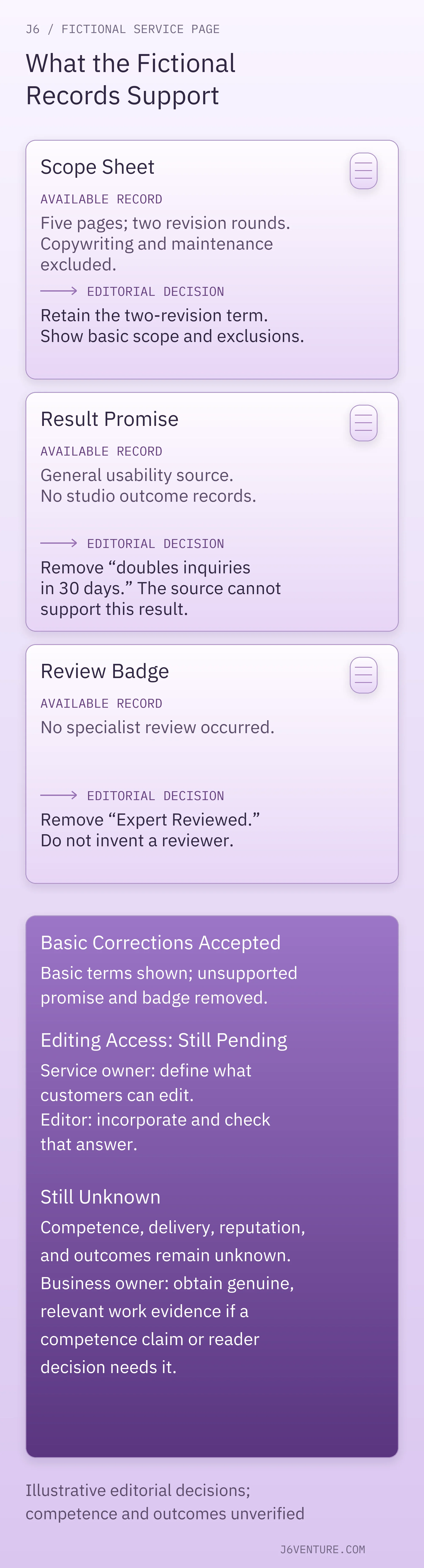
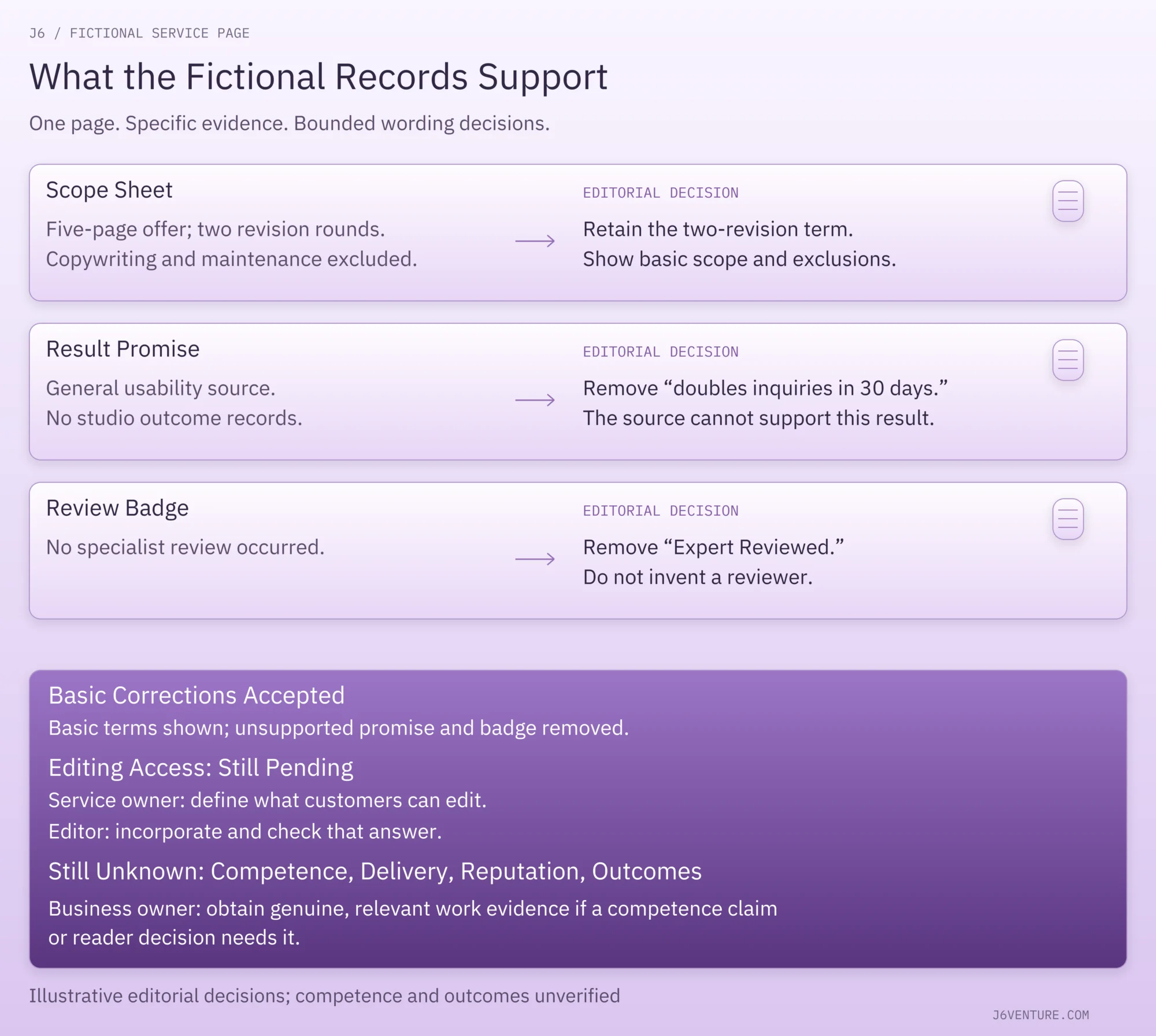
- A signed, current scope sheet offers a five-page brochure-site redesign, editing access, two revision rounds, and a handover call. Copywriting and ongoing maintenance are excluded.
- A lower passage already correctly says that the offer includes two revision rounds.
- No customer outcome records substantiate the inquiry promise. The general usability source does not measure this studio’s service or establish the promised result and timeline.
- No specialist review took place. The company’s identity and inquiry contact are accurate in the supplied records.
- No work samples, portfolio, or independently verified delivery records are supplied. There is also no substantial independent reputation information in this fictional record.
The scope sheet supports what the studio offers. It cannot demonstrate design competence, actual delivery, or a client outcome. Those distinctions control the decisions that follow.
Decide What Stays and What Changes
Keep the supported term. The two-revision statement matches the scope sheet. There is no reason to replace it with a vague claim or add a personal credential to substantiate that offered allowance.
Make the main answer useful. Replace the growth slogan as the lead explanation with the deliverables, exclusions, and inquiry route. The reader can compare the basic deliverables and exclusions with their project.
“Editing access” still needs clarification: what will the customer be able to change? The service owner must explain that before the editor can close this information gap. Clarifying the offer would not demonstrate the quality of the future service.
Remove the unsupported result promise. The general usability material cannot establish that this studio doubles inquiries within 30 days. Even a prestigious source would need to support that exact assertion. The editor removes the promise rather than replacing it with another unverified improvement claim.
If the studio later wants to publish a customer result, its owner must supply legitimate underlying records, permission where needed, and relevant conditions. A result observed for one client would still need its own limits; it would not establish a universal guarantee.
Remove the unsupported review badge. No review occurred. A future specialist review would require an appropriate reviewer, a defined question to assess, and a record of the work. The editor does not invent a reviewer to keep the decoration.
Keep responsibility accurate and reputation unresolved. The company can identify itself as responsible for its service page and provide the supplied inquiry contact. A fabricated individual author would add no dependable evidence. The missing independent reputation does not establish either excellence or misconduct.
Leave competence unverified. The business owner owns the task of obtaining genuine, relevant work evidence if the page makes a competence claim or readers need that assurance to choose the service. The current records do not justify presenting the studio as a proven specialist. A truthful scope description is a narrower result.
Check the Revised Passage Against the Records
The editor prepares this interim corrected wording, using only the fictional scope and contact information. The service owner still needs to define what “editing access” permits; this passage is not a complete answer to that question:
Five-Page Brochure-Site Redesign
Our redesign offer includes five pages, editing access, two revision rounds, and a handover call. Copywriting and ongoing maintenance are excluded. Contact our studio with your current site and the pages you need so we can discuss whether the offered scope fits your project.
Before closing the editing-access question, the service owner must specify what customers can change, and the editor must incorporate and check that explanation. No editing capability has been verified in this example.
A second reader checks the interim passage against the scope sheet, confirms that the two-revision term remains accurate, and verifies removal of the inquiry guarantee and unsupported review badge. The company identity and contact match the supplied records. No personal author credential or completed specialist review is implied.
The resulting fictional decision note is:
- Editorial correction accepted: the identified wording matches the offered terms; the basic offered terms and exclusions are visible; the unsupported promise and badge are removed.
- Clarification still pending: the service owner must define what “editing access” lets customers change; the editor then incorporates and checks that explanation. Matching the scope sheet alone does not close this reader question.
- Still unverified: competence, actual delivery quality, and independent reputation. The business owner supplies genuine relevant work evidence if a proposed competence claim or the reader’s decision needs it. No whole-page trust certification is granted.
- Outcomes not measured: reader response, inquiries, rankings, and revenue. The wording review supplies no result for any of these.
- Reopen when: offered terms change, contrary evidence appears, or the business proposes a new experience, competence, review, or result claim.
Finish With a Clear Decision About Your Page
An E-E-A-T review should leave you able to explain what readers can reasonably rely on and why. Choose one page and complete this decision record:
- Page, reader task, and risk: [URL]; [what the reader needs to do]; [consequence of a wrong answer].
- Claim or missing information: [exact wording or unanswered question].
- Evidence and limit: [record or source]; [what it supports and what it cannot establish].
- Decision: [keep, correct, remove, or hold]; [reason].
- Owner and completion proof: [person responsible]; [specific saved change, evidence, or review to inspect].
- Pending questions and reopening trigger: [what remains unknown and who will resolve it]; [change or new evidence that would require another look].
Ask someone who was not involved in creating the page to try its intended task and challenge what remains unclear. Record what they can and cannot establish. An implemented correction, a useful reader experience, and a search or business result are separate observations.
Start with the passage that could most mislead your reader. Make its promise fit the evidence, and leave the unanswered questions honest.