SEO makes more sense when it is split into fixed jobs instead of treated as one vague channel. Instead of one blended discipline, search engine optimization becomes easier to understand when you separate the components of SEO by responsibility: on page work clarifies meaning, technical work supports access, and off page work builds outside trust. That framework helps SEO beginners sort common tasks into the right bucket, see how organic search performance is shaped, and avoid mixing diagnosis with execution.
- On page SEO defines what a page is about through content, headings, metadata, and other page SEO signals that clarify relevance.
- Off page SEO builds outside trust through signals beyond the site itself, helping search engines judge credibility.
- Technical SEO helps search engines access, crawl, and use the site reliably so pages can appear and work well.
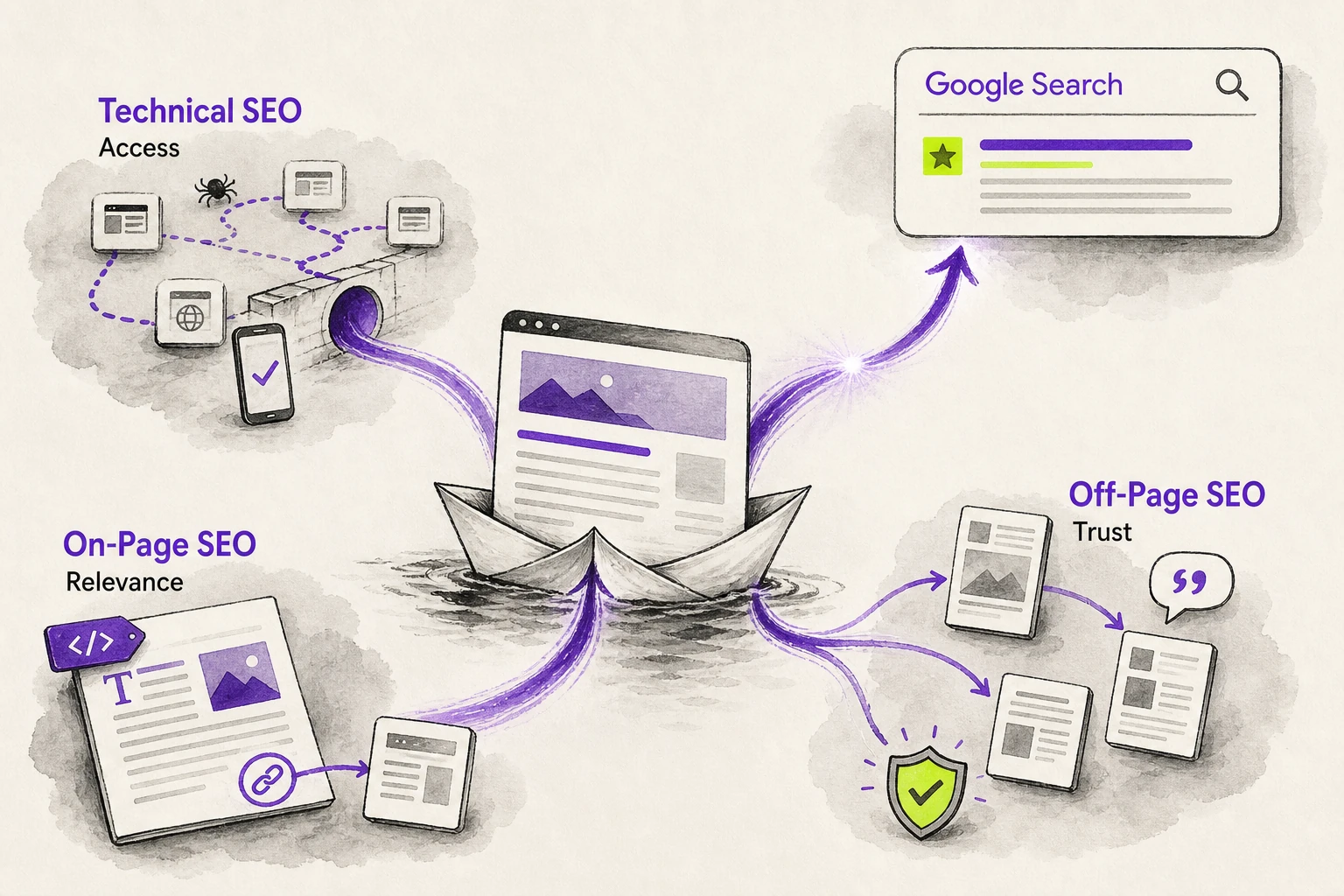
What SEO Is Trying to Influence in Google Search
SEO is trying to influence whether the right web pages can appear in Google Search for the terms people use. In practical terms, that means improving a page's chance of being found, interpreted correctly, and surfaced on search engine results pages when its topic matches real search behavior.
The work happens before the click. Search engine results are shaped by whether a page can be discovered, whether its meaning is clear, and whether it seems trustworthy enough to earn a place in search results. That is the shared goal behind all three SEO components, even though each one affects a different part of that process.
How On-Page, Off-Page, and Technical SEO Each Support Rankings
The three pillars support rankings in different ways, so comparing them side by side is more useful than treating SEO as one blended task. On Page SEO explains meaning, technical SEO supports access and usability, and off page SEO adds outside trust that search engine algorithms can weigh together.
| Pillar | Core job | Primary diagnostic signals | Example symptom |
|---|---|---|---|
| On page SEO | Clarifies what the page should rank for | Unclear topic focus, weak headings, mismatched metadata, thin on page signals | A page ranks for the wrong terms or struggles to match search intent |
| Off page SEO | Builds trust the site cannot claim for itself | Few quality mentions, weak authority signals, limited outside validation | The page is relevant but has trouble competing against stronger trusted sites |
| Technical SEO | Makes the page reachable, crawlable, and usable | Poor crawling, indexing issues, slow delivery, weak site access | The page may be strong on content but is hard to find or serve reliably |
How the Three Components Work Together in an Effective SEO Strategy
The three parts work like a dependency chain, not a pile of separate tactics. An effective SEO strategy usually starts by making sure search systems can reach the page, then making the page understandable, and then strengthening the outside signals that support search rankings and organic traffic.
- Technical SEO comes first because access is the floor. If a page cannot be crawled or indexed, the rest of the work has little to build on.
- On Page work comes next because meaning shapes relevance. Clear structure, content, and context tell search systems what the page deserves to rank for.
- Off Page work adds trust after the page is accessible and understandable. That trust can support stronger performance, but it cannot fully rescue a weak foundation.
- A practical key takeaways SEO rule is this: fix access problems first, clarify meaning second, and build trust third.
That order is a practical heuristic, not a universal law, but it gives beginners a cleaner way to evaluate problems. With the system in place, the next step is to look at on-page SEO first and see how relevance is actually created on the page.
On-Page SEO Tells Search Engines What Your Page Deserves to Rank For
Once a site can be reached, on page SEO gives search engines the meaning they need to evaluate a page. In plain terms, this page SEO layer helps search engines understand what the page is about, which search intent it matches, and why it may be relevant for a specific query on your site or in other search engines.
- Content quality and headings align the page with the topic, user need, and relevant keywords.
- Title tags clarify the main subject and shape how the result appears in search.
- Meta descriptions support snippet writing and click appeal, even though they are not the core ranking signal.
- Structured data adds clearer meaning to page elements when it fits the content.
- internal links connect related pages and reinforce context across SEO elements that stay under site control.
How Optimized Content, Title Tags, and Meta Description Improve Relevance
Relevance gets stronger when the page sends one clear message instead of several partial ones. Optimized content does the heavy lifting by aligning the page with the topic, the likely search queries, and the user intent behind them. That gives search engines a more stable basis for matching the page to what people are actually looking for and shapes the way search engines match pages to queries.
The supporting elements matter because they confirm that message. A page title, usually surfaced as the title link in results, helps clarify the main topic and affects how the result is presented. A meta description plays a different role. Google’s documentation says snippets are mainly created from page content, and it may use the meta description tag to generate a snippet, which means the meta description is best treated as snippet support and click appeal, not a direct ranking factor.
That distinction keeps the strategy cleaner. Write the core page for clarity first, then use the meta description to summarize the page honestly for the results-page. Because snippets are query-dependent, search engines may rewrite or ignore the written meta description when a different passage better matches the search.
- Optimized content aligns the page with the topic, primary keywords, and search intent.
- The page title signals the main subject and influences search-result appeal.
- The meta description summarizes the page for the snippet and can improve click appeal, but it should not be treated as a direct ranking lever.
Internal Links Help Search Engines Find Context, Not Just Pages
Many beginners treat internal links as simple navigation, but their real value is contextual. Relevant internal links help search engines connect related topics, understand which important pages sit higher in the site’s hierarchy, and see how supporting pages reinforce a broader subject. In plain language, they show how ideas belong together, not just where one URL leads next.
This is also why internal and external links belong in different parts of the SEO model. External links point outward, while internal links stay under the site’s control and help shape relationships between pages. When website visitors use them, users navigate more easily toward deeper resources. At the same time, search engines get clearer signals about topic clusters, page priority, and how one section supports another.
What Breaks When On-Page SEO Leaves Search Engines Guessing
Weak on page signals create a diagnosis problem before they create a ranking problem. When page SEO elements point in different directions, search engines have to infer what the page is for instead of reading a clear answer.
Off-Page SEO Builds the Trust Your Site Cannot Claim for Itself
On-page work can make a page clear, but clarity alone does not prove that anyone else trusts it. Off Page SEO is the part of SEO that depends on signals beyond your site, showing that other sources recognize your content, brand, or business. In simpler terms, it helps search engines see that your page SEO is not just well-written, but also supported by attention and recognition outside your own pages.
- Backlinks and mentions show that other websites or people refer to your content in a relevant context.
- Reviews, citations, and other reputation signals show that a business is recognized beyond its own site.
- These Off Page tactics are SEO tactics that can raise a website's authority, while weak outside trust can hold back relevant pages even when on-site work is solid.
Why Backlinks, External Links, and Mentions Help Search Engines Trust Your Site
A site can describe its own value all day, but that is still self-description. Trust grows when other websites point to it, reference it, or discuss it in a context that matches the topic. That is why backlinks, external links, and mentions sit inside off-page work: they act as outside validation that search engines can read as a sign of credibility.
A backlink is a link from another site to your page. In plain language, it is one of the clearest ways another publisher signals that your page is worth sending readers to. Mentions can help too, especially when a brand or page is discussed alongside a relevant subject, because they add context that your site is part of a wider conversation rather than standing alone.
- Backlinks pass third-party validation because another source chose to reference your page.
- External links matter more when they come from relevant pages and fit naturally with the topic being discussed.
- Mentions add trust when they connect your brand to a real subject, audience, or industry context.
- This does not make every link a guaranteed ranking factor advantage. The stronger pattern is relevance and source fit, not raw volume.
Why Reviews, Citations, and Reputation Matter for Off-Page SEO Trust
Links are only part of the picture. Off page SEO also includes reviews, citations, and broader reputation signals because search engines look for signs that a business is known beyond its own content. Put simply, these signals help confirm that the brand behind the page exists in the real world and is recognized by other people and platforms.
That matters most when search results need confidence in the business, not just the page text. In local SEO especially, consistent citations, visible reviews, and a credible reputation can support trust in local search results. They do not replace page SEO, but they help search engines separate a well-optimized page from a business that also looks established outside its own website.
- Reviews show public feedback and can reinforce that customers have real experience with the business.
- Citations show that core business details appear across external profiles or directories in a consistent way.
- Reputation signals pull the wider picture together, including how often a brand is referenced and how trustworthy it appears in search results.
What Breaks When Off-Page SEO Fails to Build Trust
Sometimes the page is relevant, the topic match is clear, and rankings still stall. That is often the sign of an off page SEO ceiling: the own site is making the claim, but outside sources are not reinforcing it.
Technical SEO Makes Your Site Discoverable, Usable, and Indexable
Even when relevance and trust are in place, content and authority still depend on a more basic condition: search engines need to reach, process, and serve the page correctly first. Technical SEO is the part of SEO that governs those technical aspects, including whether search engines crawl the site reliably, whether pages can be indexed, and whether the page stays usable after it is found. In simpler terms, technical optimization handles access before performance. If that layer breaks, strong writing and strong backlinks cannot do much because the page never competes cleanly in search.
- Crawlability and indexing, which determine whether important pages can appear at all
- Server and access issues, such as blocked resources or invalid responses that interrupt discovery
- Canonicalization and sitemaps, which help search engines understand which pages matter
- Page speed and mobile experience, which shape whether the visit feels usable after discovery
Crawlability and Indexing Decide Whether Your Pages Can Appear at All
Before a page can rank, search engine bots need to reach it and search engine crawlers need to process it in a way that allows indexing. Crawlability is about access, while indexing is about inclusion. Put simply, one answers whether the page can be reached and rendered, and the other answers whether it is eligible to appear in search results.
That is why early technical checks matter more than cosmetic SEO fixes. A page can have strong copy and a clean URL structure, but if it carries a noindex directive, returns the wrong status code, or blocks key CSS and JavaScript files, the page may never fully enter the system. Structured data can add clarity after access works, but it does not rescue a page that cannot be crawled or indexed.
- Run a site: search to see whether important pages are already in the index
- Use URL Inspection in Search Console to check how a specific page is seen and whether it can be indexed
- Review noindex directives so important pages are not excluded by accident
- Confirm that the page returns a valid status code and is not blocked from crawling
- Check canonicals and sitemap inclusion when key pages are missing
- Make sure essential resources remain accessible so the page can render properly
How Site Speed and Mobile Friendliness Affect the Page Experience After Discovery
Discovery is only the first win. Once a page is found, page speed and mobile friendliness shape whether the visit actually works for the person who lands on it. In technical SEO terms, these are post-discovery experience factors. In plain language, they affect whether the page feels quick, stable, and usable after search has already done its job.
This part of the work is diagnostic, not a race to memorize scores. PageSpeed Insights helps check performance on mobile and desktop; the Core Web Vitals report shows field data across pages, and Lighthouse gives an in-browser audit for deeper review. Those tools help teams find friction points rather than chase a single number. They also help explain why mobile friendliness belongs in technical SEO: the page has to function well on smaller screens, and supporting details such as compatibility with screen readers can improve usable access.
- Use PageSpeed Insights to review page speed on mobile and desktop pages
- Use the Core Web Vitals report to spot broader patterns in real-world performance
- Use Lighthouse to audit page-level issues inside the browser
- Treat mobile friendliness as a usability check, not just a design preference
What Breaks When Technical SEO Keeps Pages out of Search
Sometimes the clearest SEO problem is not weak relevance or weak authority. It is exclusion.
What Beginners Should Prioritize First Across the 3 Components of SEO
Once the three components of SEO make sense, the next question is order. Beginners usually get the best results by checking access first, meaning second, and authority third, because later work depends on earlier layers already functioning.
01If important pages are missing from search or cannot be indexed, start with technical SEO.
Access is blocked, so search systems cannot reliably use the page.
Check crawlability and indexation before changing content.
02If pages can appear but attract the wrong searches, move to on-page SEO.
Visibility exists, but relevance signals are mixed.
Tighten page-level alignment across the title, heading, content, and internal links.
03If pages are crawlable, indexed, and clearly targeted but still lose on competitive terms, off-page SEO becomes the next lever.
The page is understandable, but it still needs stronger outside trust signals.
Pursue ethical authority-building only after the site can be found and understood.
That sequence keeps the components of SEO in working order instead of treating every task as equally urgent.
Fix Technical Blockers First if Search Engines Cannot Reach or Index Your Site
A page cannot rank if search engines cannot reliably reach, crawl, or index it. In plain terms, this is the first gate. Before changing copy or building links, confirm that Google Search Console, a site: search, and similar checks in Bing Webmaster Tools show that important URLs can actually enter Google Search.
- Run a site: search and use Search Console to confirm whether important pages are indexed.
- Check URL Inspection or high-level Page Indexing views to see whether a URL is crawlable and indexable.
- Look for obvious blockers, such as a noindex directive or an important page missing from the sitemap.
- Review broad usability and performance signals in Search Console or PageSpeed Insights to spot pages that may need closer technical review.
- Hand off persistent server errors or hosting and DNS availability problems to technical specialists.
- Hand off robots.txt restrictions you do not understand.
- Hand off redirect loops, redirect chains, and sitewide canonical or HTTP issues.
- Hand off major migrations or template-level technical changes.
- Hand off performance problems that clearly need code, image, script, or rendering fixes.
Some technical checks are beginner-safe, but deeper infrastructure issues usually are not. If the page cannot be reached or indexed, technical work stays first until that blocker is resolved.
Strengthen On-Page SEO Next if Pages Rank for the Wrong Terms
When a page is indexed but shows up for the wrong searches, the issue is usually on page relevance rather than access. That means the system can see the page, but the signals on individual web pages are still too loose or mixed to guide matching well.
- The page is indexed and can already appear in search results.
- It gets impressions, but they come from vague variants or the wrong queries.
- The title, H1, and body content are not tightly aligned to the same intent.
- Internal links do not clearly reinforce the topic or importance of those web pages.
That is usually the point to tighten on page SEO. Sharpening page SEO across titles, headings, copy, and internal links gives on page signals a clearer job, especially on individual web pages that already have some visibility.
Build Off-Page Authority After the Site Can Be Found and Understood
Off-page work matters most after the basics are stable. If the page is crawlable, indexed, and clearly about the right topic, but it still struggles on competitive keywords, authority is more likely to be the missing piece.
- The site can be found in search, and important pages are already indexed.
- The page topic and search intent are clear from the content and internal signals.
- Comparable pages are competing on the same terms, but stronger outside trust still seems to separate them.
- Any next step should stay ethical and within spam-policy boundaries, rather than chasing manipulative link tactics.
For beginners, that usually means saving authority work for third place in the sequence. Start with technical first, on-page second, and off-page third so each layer supports the one after it.