Domain Authority, or DA, is Moz's 1–100 estimate of a domain's comparative likelihood of ranking in search results. Its calculation uses link-profile data, including linking root domains: the separate websites linking to yours. Ten links from one website are ten backlinks but one linking root domain.
Moz describes DA as a comparative metric, not a Google ranking factor. It is useful for investigating how your site's link profile compares with relevant competing sites. A whole-domain score cannot tell you whether a particular page answers a buyer's question well or whether a visitor will contact you.
For example, a supplier could have a modest DA and an excellent answer to one specialized purchasing question. The score alone cannot decide whether that page should be improved, promoted or replaced. You need to inspect the page and the search task.
DA, DR, and Authority Score Are Different
SEO tools use different models. Keep their names attached to their numbers.
Scroll sideways if any columns are off-screen.
| Metric | What the provider describes | How to use it here |
|---|---|---|
| Moz Domain Authority, DA | Comparative ranking potential informed by its link index and model | Keep a consistent DA history for your domain and relevant peers. |
| Ahrefs Domain Rating, DR | Relative strength of a website's backlink profile in Ahrefs' database | Compare DR with DR; do not substitute it for a missing DA reading. |
| Semrush Authority Score, AS | A compound measure incorporating backlink strength, estimated organic traffic, and spam-pattern signals | Read its components; traffic is already an input, not independent proof that your work produced traffic. |
The definitions come from Moz, Ahrefs and Semrush. Their scales do not make the scores interchangeable. DA 25 and DR 40 are not two measurements you can average, and neither automatically beats another site's AS 30.
Step 1: Establish a Comparable Starting Point
Use Moz Link Explorer to check your domain. Moz describes account-based access to its tools; available reports and allowances depend on the offer you can access. You do not need to buy several competing subscriptions to begin this record.
For this DA baseline, use a whole root domain, such as example.com, rather than one resource address, such as example.com/checklist. Save the resource URL separately for the task. Compare peers at the same whole-domain scope, keeping single-page link reports separate.
Save the returned report or screenshot with the date, domain, and scope used. Record DA and any relevant linking-domain or link observations you can actually inspect. If a field is unavailable, write “unknown”; another provider's number is not a replacement.
Next, identify the page or resource you want this work to support. Write down its audience and job: for example, helping a warehouse supervisor inspect a packing station. Open the resource and check whether it delivers that help. A dashboard can reveal link observations; it cannot establish that a checklist is accurate or usable.
Keep the saved baseline small enough to repeat: provider, metric, domain scope, date, relevant peer domains, supported resource, and the link evidence behind your task choice. J6's Authority Benchmarking Tool can help organize a comparison. The decisions about work and its results still require evidence from your actual pages and records.
Choose Peers for One Search Goal
Search the question you want your resource to answer in your intended market. Inspect the pages appearing for it and select a few domains competing for the same audience and task. A small specialist supplier and a national news publisher may appear together, but that does not make the publisher a useful operational benchmark for the supplier.
Record why each chosen peer is relevant. Check their domain-level DA using the same provider and scope on the same date as your own domain. Repeat that method at your next review.
There is no universal DA 20, 30 or 40 that every site should reach. A peer's score supplies context for investigating its resources and references. It does not become the number your page must reach before it can rank, or a score that guarantees you will overtake it.
Step 2: Choose One Feasible Improvement Task
Start with the constraint you can observe. A site with nothing useful to cite needs different work from a site whose strong resource has scarcely reached the relevant audience.
Scroll sideways if any columns are off-screen.
| Starting evidence | First task | What counts as completed work |
|---|---|---|
| The intended audience lacks a useful reference on your site | Create or improve one resource that answers a specific recurring question | The resource is published, checked and usable; a link has not yet been earned. |
| A useful resource exists, with a plausible relevant publication to approach | Make one tailored editorial introduction | The resource and publisher fit have been checked and the introduction sent; publication remains the editor's choice. |
| A previously useful editorial link leads to missing or wrong content | Verify the source and destination, then restore the appropriate resource or correct the route | The relevant destination works and the change is documented; vendor-score recovery remains unproven. |
These are ways to improve or expose resources and links that could strengthen the profile DA measures. They do not assign a number of points to each task. Choose work you can complete and inspect before expanding the campaign.
Create a Resource Worth Referencing
Choose one question your audience repeatedly needs help answering. Gather the material your business can support: an expert's explanation, a reproducible method, original measurements, a usable template, or a worked calculation. Make the resource specific enough that another author can reference it for a clear reason.
A warehouse packing-station checklist, for instance, should explain what to inspect and how to record a finding. “Use good packaging” gives a publisher little to cite. Clear inspection fields, explanations of their purpose and a dated review by an appropriately knowledgeable person create a more useful reference.
Have someone unfamiliar with the draft try the task. Record where they get stuck, correct the resource and identify who will maintain it. A full topical-authority plan is a separate decision from making this one resource work.
Introduce an Existing Resource to Relevant Publishers
Find a publication already serving the resource's intended reader. Read the relevant article or editorial guidance and identify the specific question your resource helps answer. Check that the resource is accessible, current enough for that use, and clear about its evidence.
Then send a concise introduction to the appropriate editorial contact. Explain the reader problem, the useful part of the resource, and where the publisher can inspect it. Leave the decision to reference it with the editor. A sent message is completed outreach, not an acquired backlink.
A 'followed' link is common shorthand for an ordinary link without a qualifier such as nofollow or sponsored. A reciprocal arrangement means agreeing to exchange links.
Keep the introduction free of demands for ranking credit or promises to exchange links in return. Ordinary editorial links and two sites naturally referencing each other are not automatically spam; the purpose and arrangement matter.
Google treats links created primarily to manipulate rankings as link spam. Advertising and sponsorship can be legitimate when links are appropriately qualified, but a paid promotion is not a promise of ranking benefit.
Keep source relevance and editorial legitimacy in view. The high-quality backlinks guide covers the fuller placement decision; you do not need to rebuild a prospect-scoring system before making one well-founded introduction.
Check a Valuable Link That No Longer Works
If a saved report or known referring page suggests a valuable link has been lost or broken, visit the actual source. Confirm that the reference still exists, inspect its destination and establish what the reader was meant to find. A tool's “lost” label alone cannot tell you which repair is appropriate.
If your original resource was removed accidentally, restoring it may solve the problem. If its address changed, a redirect to the genuinely equivalent resource may be appropriate. If the publisher entered a wrong URL, explain the specific correction to them. Ask your site owner or developer to implement routing changes when needed.
Do not send an unrelated old URL to a sales page simply to retain a link. Verify the repaired path as a reader would use it, and keep the before-and-after addresses and reason for the change. The useful result is a working, relevant reference; any subsequent DA movement needs its own observation.
Step 3: Recheck the Work, Links, and Outcomes Separately
Assign a review date when you plan the task, based on when you can reasonably inspect the work and gather useful observations. That date is a management choice, not a prediction of when Moz will update or your score will rise.
Keep four parts of the record separate:
- Work: what you published, corrected, or sent, with a date and evidence of completion.
- Observed links: the actual referring page, destination and context, plus what the provider's report currently shows.
- Metric: a new DA observation using the same scope and method, with comparable peer checks.
- Useful outcomes: relevant search visits, referral activity, resource use, or inquiries, where your own records support them.
You might need Moz for the score and link report, a browser to inspect the reference, and your existing analytics or inquiry records for outcomes.
Technical fixes and internal links may help people or search engines reach a resource. Their purpose should be stated directly. Installing analytics, changing an internal link or making a page faster does not carry an established automatic DA-point award in the provider definition.
Decide What a Changed or Unchanged Score Calls For
If the new reading uses a different scope or provider, correct the comparison before diagnosing progress. If a previously useful reference is broken, investigate that actual path. If an editor replies without citing the resource, assess the relevance of their feedback; their response is not evidence of an acquired link.
When a useful link is visible but DA stays flat, check whether the provider's report shows it. Keep the observation honest if it does not. The live link, the provider record, and the score are separate facts; their difference does not establish the cause or a promised processing delay.
Moz describes possible score movement through link changes, shifts in other sites, index changes, and model changes. A falling score alone does not prove a penalty or lost useful links. Inspect the supporting records before commissioning more acquisition work.
If DA rises while relevant visits or inquiries do not, inspect the supported page and audience fit. A higher number cannot establish that the resource reached suitable buyers. Equally, a useful referral can matter while DA stays unchanged. Decide the next task from the evidence you have, keeping unknown causes unresolved.
A Worked Example With a Flat DA Score
Everything in this example is fictional, including the business, search observations, scores, dates, and results. It demonstrates a decision record, not J6 campaign performance or a typical time to improve DA.
The Starting Evidence and Chosen Action
A small US packaging supplier has a free packing-station inspection checklist built from its staff's practical guidance. Its intended reader is a warehouse supervisor. The resource should help that person inspect the station and, where appropriate, reach the supplier's packaging consultation page.
At the starting check, its Moz DA is 18. Two small suppliers appearing in its hypothetical target search set have DA 22 and 26. All three readings use Moz, the same domain scope and the same observation date. These peers share the buyer, market and resource task; their scores are context, not ranking requirements.
The checklist already works, and three relevant trade publications cover packing workflows. The saved link report shows no editorial reference to this checklist. That report does not establish that no such link exists anywhere.
Because the existing checklist is usable and a suitable publication serves its audience, the owner chooses to test one tailored introduction before creating another resource. The task is complete when the owner has checked the publication's fit, verified and dated the checklist, and sent the introduction. Whether an editor cites it remains outside the owner's control.
The Review and Next Decision
The owner chooses a review one month later. This interval belongs to the fictional plan; it is not a recommended Moz refresh period.
Scroll sideways if any columns are off-screen.
| Record | Illustrative observation | What it supports |
|---|---|---|
| Work | Checklist checked and introduction sent | The chosen task was completed. |
| Link | Publication voluntarily cites the checklist; the source and working destination are inspected | An actual relevant reference exists. |
| Provider and score | Saved report does not yet show that reference; DA remains 18 | The record does not explain why the score stayed flat. |
| Referral activity | Twelve visits carry the publication's agreed source tag, a tracking label on its link, in the analytics record | This example can identify those visits; it does not establish all referral activity or SEO lift. |
| Inquiry outcome | No consultation requests are recorded from those twelve visits | No inquiry outcome is demonstrated for this observed group. |
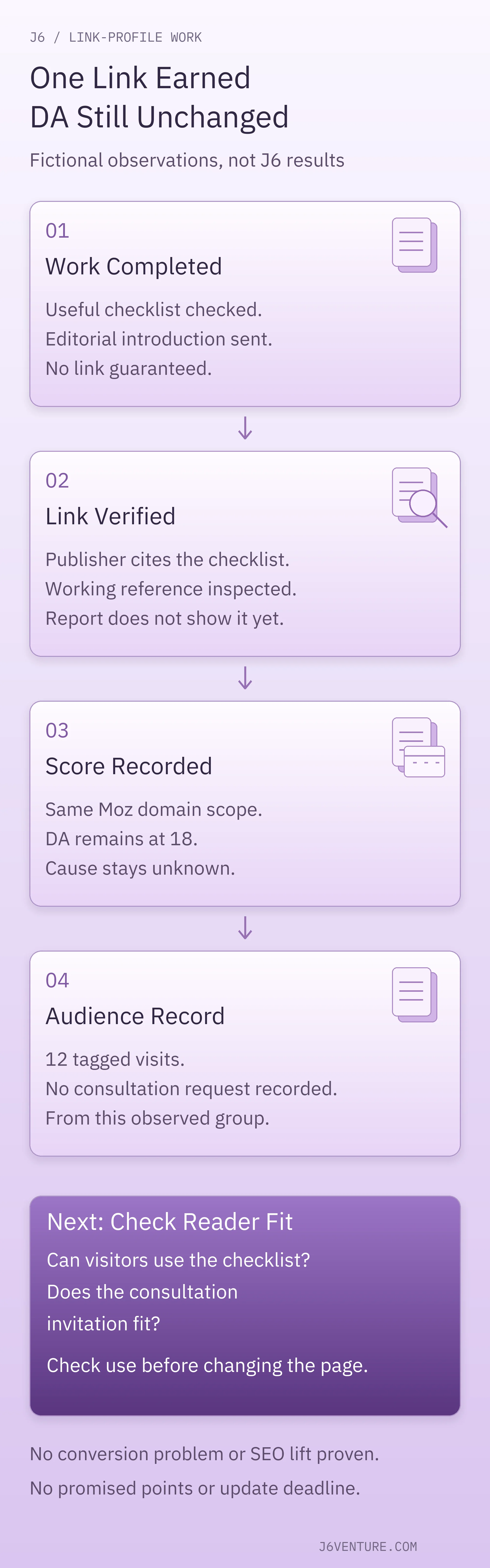
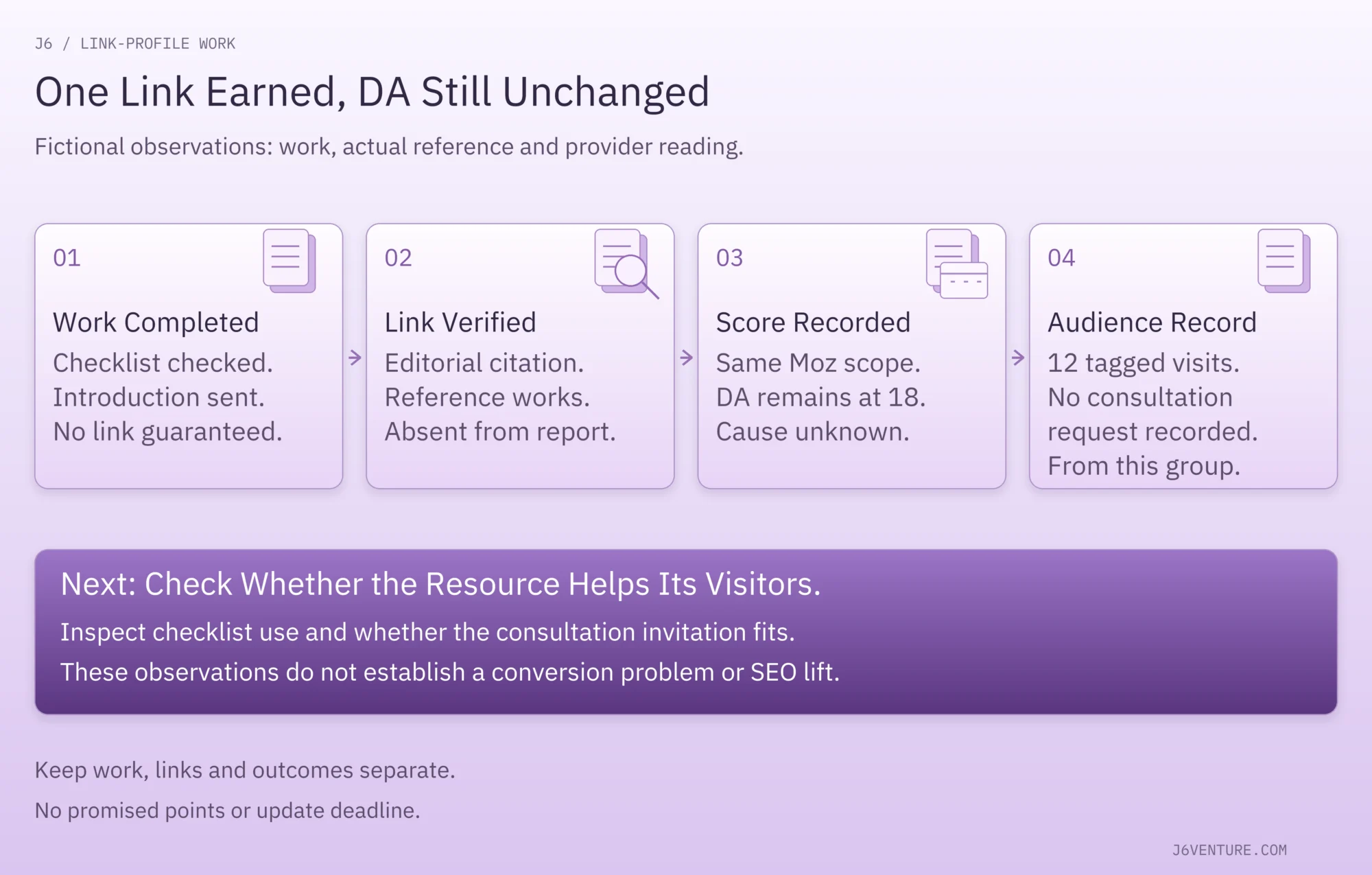
Those observations do not establish a conversion problem or a causal SEO effect. The next task is to check whether those visitors can use the checklist and whether the consultation invitation fits their immediate need. The owner keeps the useful reference and schedules a later comparison with the saved provider records. Buying additional links merely because DA stayed at 18 would not follow from this evidence.
Avoid Shortcuts That Confuse Scores With Progress
A package promising a particular DA score within a deadline needs a separate examination of what will actually be delivered. Ask which resources, publications and link arrangements are involved, who chooses the placement, and what evidence will demonstrate useful work. A score target does not establish better rankings, suitable visitors or revenue.
Google's policies distinguish ranking manipulation from appropriately qualified advertising. Paid links should use the appropriate qualification, such as sponsored; Google's outbound-link guidance explains sponsored and nofollow attributes. Do not treat an offer of “guaranteed followed links” as equivalent to an editor voluntarily finding your resource useful.
A Toxic-Link Flag Does Not Automatically Call for Disavowal
A vendor's toxicity label, low DA, one strange incoming link, or a score decline does not by itself justify submitting a disavow file to Google.
Google's guidance requires both a considerable number of spammy, artificial, or low-quality incoming links and those links having caused, or being likely to cause, a manual action against the site. Most sites do not need the tool, and incorrect use can harm Search performance.
If you have a relevant manual action or credible evidence of policy-violating link schemes undertaken by your business or a hired provider, take the actual records to your responsible SEO/Search Console owner or a qualified specialist. Assess the evidence and removal options before a disavow decision. An unrelated manual action does not establish that these links caused it.
Where Google's relevant conditions apply, its guidance says to try removing offending links first. A Google submission is not a documented way to raise Moz DA. Keep a vendor-score concern separate from a Google-policy intervention.
Your Checklist for the Next Improvement Cycle
Use this short record before assigning more work:
- Starting point: provider, metric, domain scope, observation date and relevant peers, with the saved report.
- Constraint: the specific missing resource, exposure gap, or broken reference the evidence supports.
- Task and owner: one feasible action, its link-earning or repair rationale, and what counts as completion.
- Next evidence: a direct link check, provider observation, and useful audience outcome, recorded separately.
- Review date: when you will inspect the work and decide what to do next; no promised score deadline.
- Next decision: continue, improve the resource, repair the path, or change the audience approach, with a stated reason. Escalate credible link-policy concerns with the actual records.
Open the resource you want to support and identify its current constraint. If it is not yet useful enough to reference, improve it. If it already answers a real question, choose one suitable place to introduce it. Your next review should tell you what happened and what work follows, even if the DA number has not moved.