A high domain score can make an irrelevant page look like a good prospect. You still need to know who reads that page, why they would follow its link, and what the publisher expects in return.
That investigation can end with a useful pitch, a request for more information, or a decision to spend your effort elsewhere. You do not need to predict how much “authority” a link will transfer to make a reasoned choice.
A backlink is a link from another website to yours. Its quality depends on the particular connection: the referring page, the people it serves, the linked destination, and how the link came to be there.
There are several judgments to make. A reference can help a reader find a useful resource. An advertisement can bring suitable visitors when its terms make commercial sense. An independently chosen reference can give an editor's readers a reason to trust your work. These benefits need evidence appropriate to each claim.
Search value is another question. Google describes links as a signal for understanding page relevance and discovering pages. Its ranking-systems guide says link-analysis systems, including the evolved PageRank system, help it understand pages and their usefulness for a query. Neither document lets you calculate the ranking gain from a prospective placement.
Start With the External Page and Its Readers
Open the proposed referring page before committing to outreach. If it has not been written, ask for the proposed subject, intended audience, and examples of comparable work from that publication. An unknown future page is a different kind of prospect from an existing resource you can inspect.
Read enough surrounding material to establish its purpose. A page about planning a conference budget could reasonably reference an event-cost worksheet. A general business page containing an unrelated insertion needs a more convincing explanation, even when its domain is well known.
Read the Reason for the Reference
Identify what the destination contributes. It might provide original data behind a claim, a tool the reader can use, detailed instructions, a relevant service, or an authoritative source document. Follow the proposed link yourself and check that the destination delivers that help.
A source link to research should reach the research or its useful explanation. A link promising a template should reach a page where readers can understand and access it. Sending everyone to your homepage can lose the reason they clicked.
Read the anchor text, which is the clickable wording, together with its sentence. Google's guidance favors descriptive, reasonably concise wording relevant to the source and destination. It also explains that surrounding words provide context. There is no need to make every publisher use an identical commercial keyword.
For a potential placement, the editor's reason for referencing you matters more than your preferred anchor. If you cannot identify a reader question your destination answers, improve the proposed contribution or look for a better-matched opportunity.
Identify the Publisher and the Relationship
Establish who runs the publication and who decides what appears. Look for a stated editorial purpose, identifiable people or organization, relevant recent work, and a credible way to contact them. These observations help you investigate the source; a missing byline alone does not prove that a page is deceptive.
Then establish the proposed relationship. Is the publisher considering an unsolicited resource? Are you a genuine member or partner eligible for a listing? Is it offering advertising? Does an intermediary control the site? Ask which decisions remain with the publisher, including whether to cite you at all.
Those distinctions change the opportunity. A partner directory may be useful because it helps readers find eligible organizations. It does not become an independent editorial endorsement merely because it sits on another domain. An editor who considers your research can also decline it or cite a different source.
Avoid presenting a paid insertion as an earned recommendation. Before paying, establish what is being purchased, how the relationship will be represented, and which link attributes will be used. A supplier's label of “editorial” does not answer those questions.
Use Metrics to Investigate a Prospect
SEO research tools can help you sort a large prospect list and identify questions worth asking. Read what a column measures before using it to reject a source. A domain-wide score, a page's estimated search visits, and actual referrals to your business describe different things.
What a Domain Score Actually Measures
Ahrefs defines Domain Rating as the relative strength of a website's backlink profile compared with other sites in its database, on a 100-point scale. The company also explicitly warns against judging a linking website on site-wide authority alone.
That score describes a domain's backlink profile. It does not establish whether a particular article is accurate, whether its readers need your resource, or whether a proposed link is an advertisement. Other providers' authority metrics have their own definitions; do not treat similarly named scores as interchangeable.
Use a strong score as one reason to investigate, alongside the actual page and publishing arrangement. If a highly rated domain offers an unrelated insertion with no useful reader connection, the score does not supply the missing reason for the reference.
Low Estimated Traffic Leaves a Question Open
If a tool estimates visits from organic search, that figure does not measure a publication's entire audience. Readers might arrive through a newsletter, direct visits, a professional association, or another channel. A new page can also have little search history available for assessment.
An estimate of zero therefore leaves questions open. Ask what evidence supports the proposed audience: a relevant publication archive, newsletter readership information, a defined membership, or other information the publisher can substantiate. Keep a publisher's claims separate from independently observed results.
An unknown audience is also not evidence of a valuable one. If suitable reach matters to your decision and no credible support is available, keep the prospect unresolved or lower its priority. You can explain that choice without assigning a universal minimum traffic or domain score.
Check What Kind of Link Is Being Offered
A visible reference, a clickable link, and Google's treatment of that link are separate observations. For an existing placement, right-click the reference on the external referring page and choose Inspect in a desktop browser. Find its <a> element; if a nested element is selected, look for the enclosing <a> line.
Before a proposed placement exists, ask the publisher about its intended destination and qualification, then check the actual markup if it is published.
This illustrative markup shows what to recognize; it is not the SBA link or a verified prospect:
<a href="https://example.com/worksheet"
   rel="sponsored">Budget worksheet</a>
The href value is the destination. Here, rel="sponsored" identifies the relationship, and “Budget worksheet” is the visible wording. A link can have multiple values, such as rel="ugc nofollow"; read each value present. If the markup is unclear, ask a developer or the publisher to confirm those specific details.
Google's documentation recommends ordinary crawlable links using an <a> element with an href. A clickable visual element alone does not establish that Google's crawler can reliably extract its destination.
Google's link-qualification guidance explains the relevant attributes:
| What You See | What to Establish |
|---|---|
| An ordinary link with no special relationship value | Check the destination and context. Ordinary links do not require a special dofollow attribute.Absence of nofollow does not promise ranking credit. |
rel="sponsored" |
This marks advertisements or paid placements. Evaluate the advertising opportunity on its actual audience, terms, and outcomes. |
rel="ugc" |
This identifies user-generated links, such as forum posts or comments. It does not establish an independent editorial recommendation. |
rel="nofollow" |
Use this when other relationship values do not apply. It tells Google the publisher would prefer no association with, or crawling of, the destination through that link. Google also accepts this qualification for paid links. |
Google says links with these attributes will generally not be followed, while noting that their destination pages can be discovered and crawled through other means. The attribute is not a statement that people cannot click the link or find the destination useful.
Its spam policies distinguish advertising from buying links for ranking manipulation. Paid advertising and sponsorship links are allowed when appropriately qualified with sponsored or nofollow. Buying ranking credit, exchanging goods for unqualified ranking links, and automated link creation raise different policy concerns.
If an offer depends on payment for a link that passes ranking credit, a promise of relevance or a high domain score does not resolve that concern. Keep a legitimate advertising proposal separate from an earned-link pitch. For problems in an existing campaign, the link-building mistakes guide explains the different corrective jobs.
What a Real Resource Link Can Show You
The SBA's Resource Partners page lists organizations that help small businesses. To check one particular reference:
- Open the SBA Resource Partners page. Under “Veterans Business Outreach Centers (VBOC),” find “Find your local Veterans Business Outreach Center,” then the Southeast region's South Carolina entry.
- Follow that listing's link to The Citadel. On October 25, 2026, it resolved to The Citadel's VBOC program page. Read the service description and relationship disclosure.
The destination explains support for transitioning service members, veterans, and military spouses starting, buying, or growing a business. It also discloses partial funding through a cooperative agreement with the SBA.
The reason for this reference is understandable: a reader looking for relevant local business support can reach the organization providing it. The named program and disclosed relationship explain more than the .gov and .edu domains alone.
This observation does not establish the link's ranking effect, referral volume, or commercial return. We have not verified its link attributes here. Nor is the listing a general opportunity for an unrelated company to acquire a government backlink. Its usefulness rests on the particular service and partnership.
Apply that reasoning to a prospect: identify the publisher's reason for sending its readers to you, and establish whether your organization or resource actually qualifies. A prestigious domain extension cannot supply an absent relationship or reader benefit.
Work Through a Prospect With Conflicting Signals
The following is an illustrative assessment, not a reported J6 campaign or a measured link result. Assume an event-planning software business already offers a useful conference-budget worksheet. Its marketing coordinator finds a recent budgeting guide in a small events-industry publication.
The team is deciding whether to spend time on a tailored resource pitch. It is not buying a link or commissioning a new asset.
What You Know Before Contacting the Publisher
The guide addresses event organizers comparing venue costs. It explains budget categories but provides no reusable worksheet. The business's existing destination explains its worksheet, offers access to it, and states its assumptions. The proposed reference would help a reader apply that part of the guide.
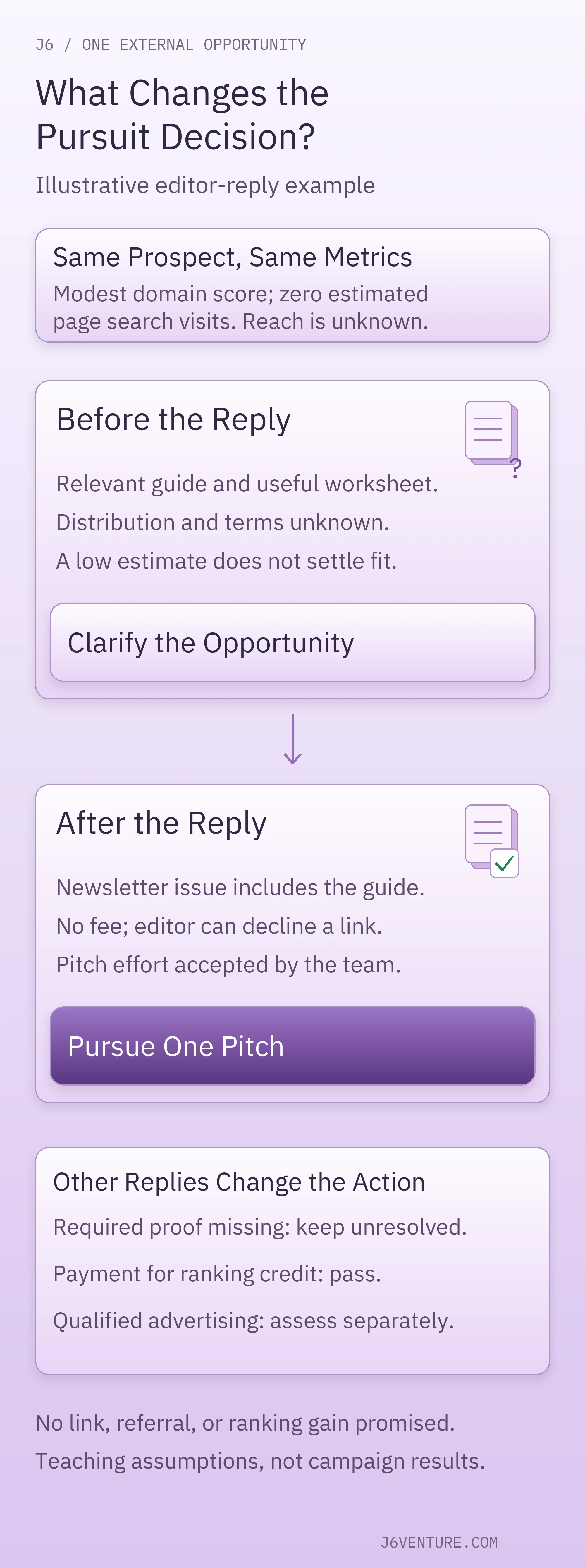
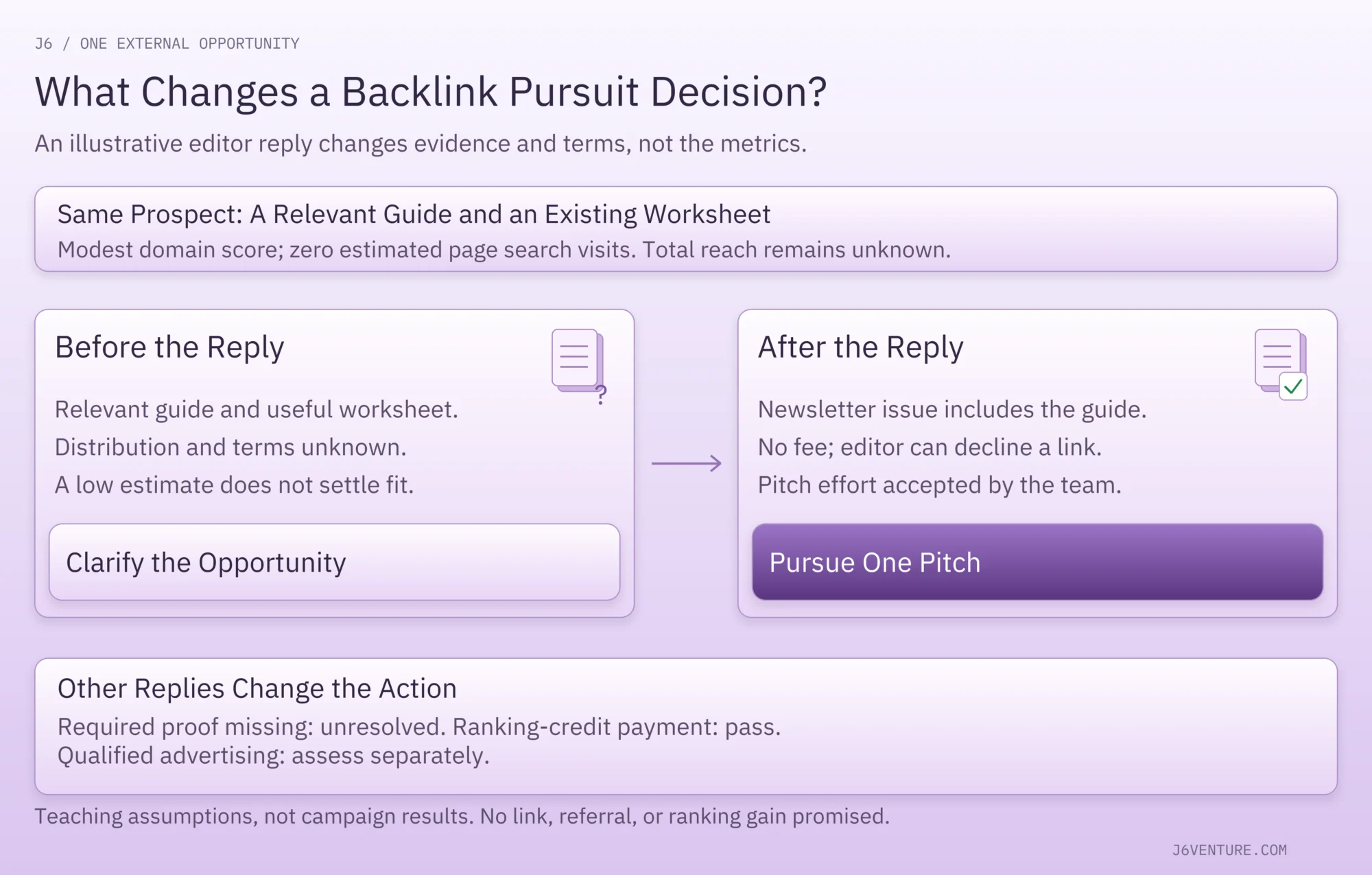
A research tool shows a modest domain score and no estimated organic traffic for the referring page. Those observations do not establish the guide's total readership. The publication names an editor, publishes relevant work, and states that it distributes a newsletter, but the team has not yet substantiated that distribution.
Current decision: clarify the opportunity before investing further effort. There is a plausible reference reason and a relevant destination. Audience support and editorial terms remain unresolved; the low estimate does not answer either question.
A focused question is: “Can you share a recent newsletter issue containing this guide and explain how you consider suggested resources, including any inclusion fee or link conditions?”
What the Publisher's Reply Changes
For this teaching example, assume the editor confirms that the guide appears in its events newsletter and supplies a recent issue containing it. The issue corroborates the guide's inclusion in that newsletter. It does not establish how many people received or read it, subscriber engagement, or future referrals. The editor considers resources on their usefulness, charges no inclusion fee, and retains the choice of whether and how to link.
The reply resolves the proposed relationship: this is an editorial resource pitch with no guaranteed placement. The team already has a suitable worksheet and accepts that a short, tailored pitch may receive no link. Its marketing lead confirms that this effort fits the allocated outreach budget.
Decision: pursue one tailored pitch. The justification is a specific reader use, an existing suitable destination, a guide included in a recent newsletter issue, and acceptable editorial terms. There is no predicted ranking increase or promised visitor count in that decision.
If the reply instead offered a paid insertion on condition that it pass ranking credit, the team would pass on that offer. A separately qualified advertisement would require its own audience and commercial assessment. If the editor supplied no audience information and the team required that evidence, the prospect would remain unresolved.
Record the Pursuit Decision
The completed note for this illustration is:
- Decision and owner: the marketing lead approves the coordinator spending the allocated outreach time on one tailored pitch. The lead accepts the unknown audience size because this is one pitch using an existing resource.
- Publisher and reader: an events-industry publication; organizers using its conference-budget guide.
- Reason to reference us: the existing worksheet helps readers apply the guide's venue-budget discussion.
- Audience evidence: a recent newsletter issue includes the guide. Subscriber engagement and likely referrals remain unknown.
- Control and terms: no inclusion fee; the editor decides whether to publish a link and chooses its wording. A pitch does not secure placement.
- Metric interpretation: modest domain score and zero estimated page search traffic do not override the observed fit or establish likely search value.
- Next action: send the resource with a short explanation of its reader use, then record the response. If published, check the actual destination, surrounding claim, and relationship attributes.
- Unresolved outcome: whether it will be linked, attract suitable visitors, or contribute to later search performance.
Use these same fields for your next prospect; replace this example's assumptions with observed evidence and keep unknowns visible. The conditions above are assumed for the example. On a real prospect, an unanswered question remains unanswered until evidence or an acceptable business decision resolves it.
Find More Opportunities With a Reason to Reference You
Start with something you can substantiate and a publisher whose readers would use it. That gives your outreach a purpose beyond requesting a backlink.
- Original research: identify publications discussing the question your data answers. Offer the finding with its method and limits so an editor can judge whether to cite it.
- Tools or templates: look for relevant guides where the resource helps readers complete an actual task.
- Genuine expertise: respond to a reporter or editor's specific question with a supported contribution.
An existing mention can also justify a courteous request for a useful destination link. Membership and partner pages can provide relevant references when your organization genuinely meets their criteria. These routes produce candidates to assess; none guarantees a link or makes every resulting placement high quality.
Avoid buying a list of websites as a substitute for checking the actual opportunity. The right publisher, resource, relationship, and effort will differ between businesses. There is no universal price or number of backlinks that completes the work.
Keep the Link and Its Outcomes Separate
If a reference is published, retain its URL and the reason it was pursued. Confirm that the actual page, destination, wording, and relationship match what you assessed. That establishes what was delivered or earned.
Later, referrals can show that people arrived through the link when your analytics captures them. Relevant inquiries or sales need their own evidence. A change in rankings or search traffic can occur alongside other changes; the existence of a new backlink alone does not establish that it caused the movement. The SEO traffic guide helps you interpret the wider search trend.
For your next prospect, name the reader benefit, identify the publisher's control and terms, and write down what the available evidence can support. Pursue the opportunity when those conditions justify the effort. Ask for missing information when it changes the decision, and pass when the offer does not fit. A clear reason for the reference is a more useful starting point than an unexplained quality label.