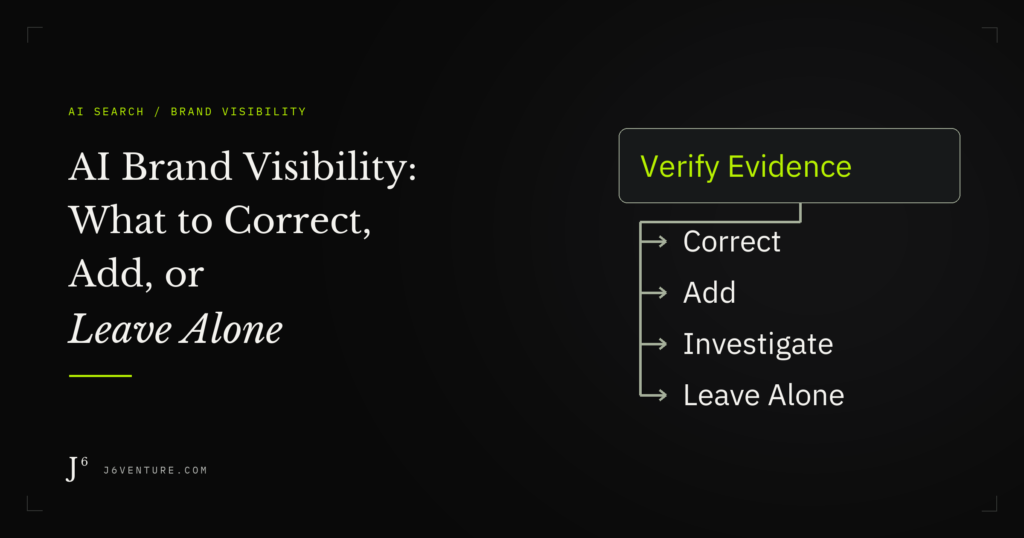
Start with a buyer-relevant problem you can verify: an inaccurate business fact, missing information needed to choose your offering, or an outdated external source. Match the change to that evidence. If your information is correct or your business does not fit the request, further investigation or no change may be the right decision.
A marketing team can finish a week of AI visibility work with more pages, more mentions, and no clearer answer to why any of it mattered.
The useful starting point is a decision someone could get wrong. Can a buyer establish whether your service covers their market? Does a recommendation preserve the limits of your plan? Is a cited comparison describing an old version of your product?
Every proposed fix should name the buyer problem it resolves. Monitoring records what appeared. Diagnosis checks whether it creates a buyer problem. The next action may be a correction, an addition, further investigation, or no change.
What Does Useful AI Brand Visibility Look Like?
Useful AI brand visibility means your business appears in a relevant answer with a description that helps the intended buyer understand its fit. Being named, being linked as a source, and being recommended are separate observations. Inspect the surrounding claim and the buyer’s requirements before treating any appearance as a success.
A recommendation for a market you do not serve can create a misleading impression. A citation to a useful explanation may help readers without recommending your product. Choose the observation that matters to your goal: accurate understanding, a suitable shortlist, a relevant visit, or a qualified inquiry.
Separate Being Named From Being Accurately Recommended
Use these distinctions when reviewing a saved answer:
- Mention: the answer identifies the brand or a recognized product name.
- Citation: the answer presents a source associated with a claim. Inspect the linked page and passage.
- Recommendation: the answer proposes the business as an option for the stated need.
- Accuracy: the description matches the relevant product, plan, market, and date.
These can overlap. A recommendation can contain an inaccurate price; an accurate mention can be irrelevant to the buyer’s constraints. Keep both findings visible instead of reducing them to one positive or negative label.
Our guide to tracking brand mentions in AI search covers saving answers and counting appearances.
Start With a Buyer Question Worth Acting On
Choose a question tied to an audience your business can serve. Identify what the answer prevents that buyer from understanding: eligibility, a limitation, or a comparison. A broad category mention alone gives you little reason to commission another page.
Ask the person responsible for the offering which requirement changes a sale or disqualifies a prospect. Use that knowledge to choose the question; use current records to substantiate the facts you publish. A commercially important constraint deserves attention even when its search volume is small or unknown.
Check Whether Your Business Actually Fits the Request
Compare the request with the offering before interpreting an omission. Check the buyer’s use case, geography, budget, required capabilities, and any eligibility conditions.
A question seeking a product with no paid subscription places a different requirement on the answer from one seeking an inexpensive paid product. A free trial also differs from continuing free access. Preserve those distinctions when checking fit.
If your product fails a material requirement, record why the question is a poor target. Preserve the requirement; choose a different buyer question only when your offering genuinely fits it.
Identify What the Answer Establishes and What Remains Unknown
A captured omission establishes that the brand was absent from that response. It does not identify a crawl failure, a content gap, or a lack of independent coverage. A linked source gives you something to inspect; it does not reveal every input used to generate the answer.
Write two short notes before choosing a remedy:
- 1Observed: the exact description, omission, or qualification in the saved answer.
- 2Still to establish: the fact needed to justify a change, such as whether the cited page contains outdated information.
Name the surface, question, and collection date. If you have only one answer, retain that limitation. Repetition can make an issue worth investigating, but it still cannot disclose the system’s hidden reasoning.
Correct Business Facts That Could Mislead a Buyer
Correct a business fact when you can show that the published statement conflicts with the applicable, authoritative information. Identify the exact passage and its owner before assigning the work. The correction should preserve conditions such as plan, location, and effective date, and give the buyer a reliable answer to the disputed question.
Useful candidates include prices, included capabilities, service areas, supported integrations, availability, and eligibility. Choose according to the possible buyer consequence. An incorrect requirement that could rule your business out deserves a different response from an inconsequential wording variation.
Check the Product, Plan, Market, and Date Before Calling It Wrong
Put the disputed statement beside the official record. Before declaring a contradiction, check:
- Are both passages about the same product and version?
- Does the feature belong to the base plan, an allowance, or a separate purchase?
- Do geography, contract terms, or eligibility change the answer?
- Was one statement accurate on its publication date but superseded later?
- Does the source make the qualification clear elsewhere on the page?
Save the source URL, relevant passage, and check date. If official pages disagree, resolve the product fact with its owner before choosing which wording to publish.
The result should be a small correction brief: the existing claim, supported replacement, required qualification, and affected page.
Decide Whether the Correction Belongs on Your Site or Elsewhere
If your own page contains the error, assign it to the person who controls that page and have the product or service owner confirm the replacement. Check the published result, including tables, FAQs, or structured fields that repeat the same fact.
If an independent page contains the error, prepare a factual correction request for its publisher. Include the passage, the current supporting source, and the relevant date. The publisher controls its editorial decision; a request is still pending until the public page changes.
Do not rewrite a correct owned page to compensate for an unrelated external error. You may need to clarify genuinely ambiguous wording, but first demonstrate what a reader could misunderstand. A difference between your preferred description and an independent review is not automatically a factual mistake.
Add Information That Helps a Buyer Decide
Add information when a relevant buyer question remains unanswered or difficult to resolve from the available pages. The useful addition supplies substantiated detail: a capability, condition, limitation, comparison, or demonstration. More text earns its place only when it helps someone make a decision they could not make confidently before.
Google’s guidance for generative AI search emphasizes valuable, non-commodity content and clear organization. It also says there is no requirement to break content into tiny pieces or write in a special way for its generative search features. Clear paragraphs and tables should serve the reader’s task.
Find the Unanswered Decision Behind the Content Gap
Replace “we need an AI-friendly page” with a concrete question. Can the buyer tell what the plan includes, which requirement it meets, what it excludes, and where that claim comes from?
Build the answer from evidence you can stand behind:
- Current product documentation for supported capabilities and limits.
- A dated demonstration showing the task being completed.
- A comparison using the same conditions for each option.
- First-hand experience whose author, circumstances, and result can be identified.
If the existing information already answers the question, check whether the problem is discovery or ambiguous presentation. A descriptive link or a qualification beside the relevant claim may be enough. Do not manufacture a gap because the content plan needs another article.
A useful format is a buyer question followed by the entitlement and its qualification. Using the public Ahrefs example checked on October 10, 2026:
- Buyer question: does my paid plan include the Brand Radar capability I need?
- Included access: custom-prompt allowances are included with paid Ahrefs Lite plans and above.
- Separate access: the AI Visibility Index has separate pricing.
- Evidence: the current official product page, checked for the applicable plan before a purchase.
The official page already supplies this distinction. A comparison that collapses the capabilities into one cost claim should preserve it so buyers can check their plan and intended use.
Decide Whether to Improve a Page or Create One
Improve an existing page when it already serves the buyer’s job and the missing detail belongs there. Consider a separate page when the reader needs a materially different answer that would overwhelm or distract from the original purpose.
Write the intended reader outcome for both pages. If they would repeat the same explanation for the same decision, rethink the split. The distinction between a keyword and a page’s reader job helps keep related wording together without producing competing URLs.
External coverage also needs a reason to exist. Contribute a substantiated finding to a publication whose readers need it, or correct a demonstrable factual error. A missing mention in one AI answer does not establish that publishing more references to the brand will solve the problem.
Know When to Investigate or Leave It Alone
Investigation is appropriate when a missing fact could change the action. No action is appropriate when the evidence supports keeping the information as it is or shows that the offering does not fit the request. Give an investigation a question and an endpoint; give a no-action decision a reason that another person can inspect.
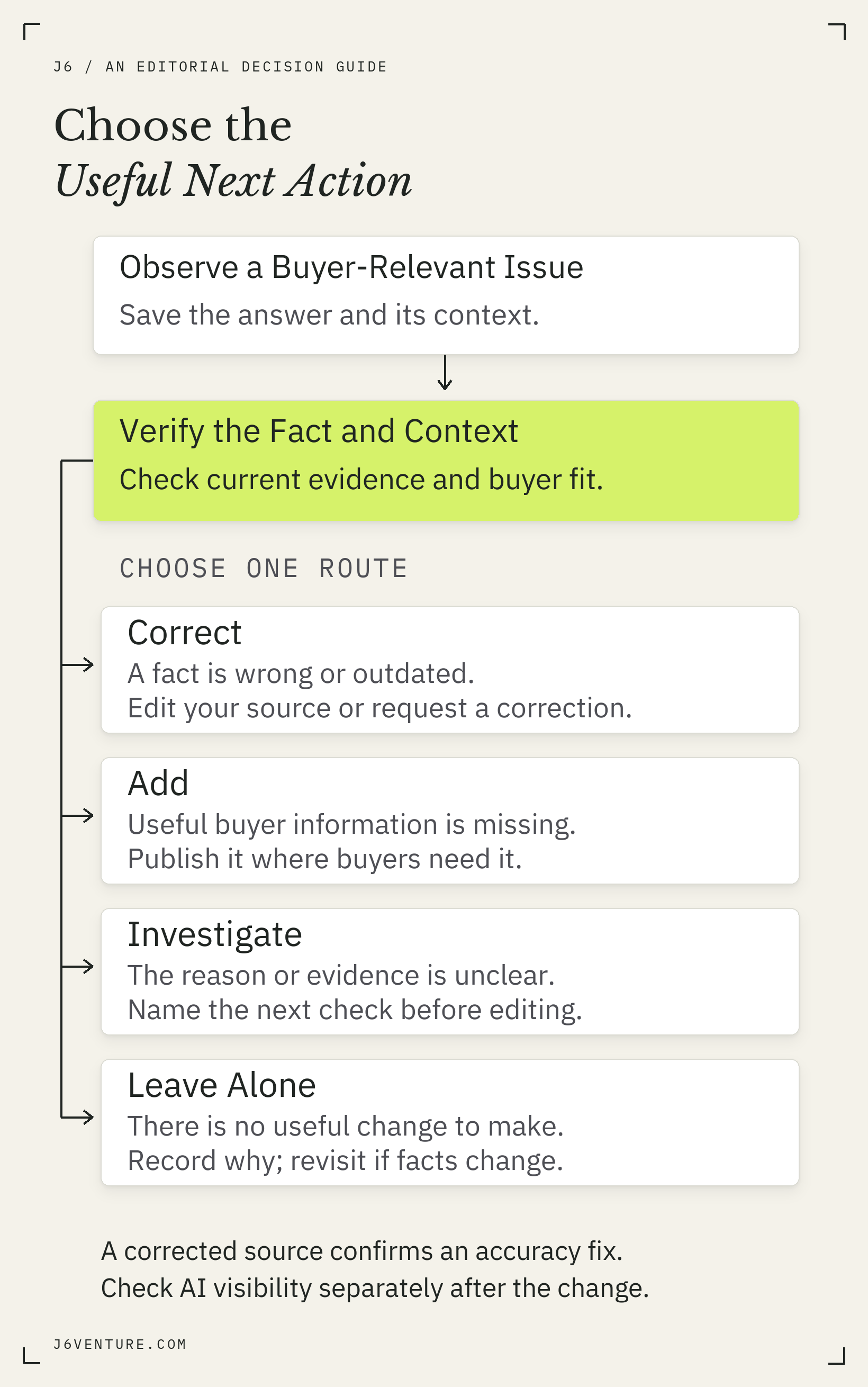
Choose a task from the evidence available. Completing it and improving an AI answer are separate outcomes.
When the Source Is Correct but the AI Answer Is Wrong
An incorrect AI answer does not automatically mean your website needs changing. Preserve the correct source and save the mismatch. Inspect whether the cited passage supports that claim, whether the page changed since the answer was collected, and whether the issue recurs under comparable checks.
A clarification is worth considering if the page itself is ambiguous. If it is already clear, assign a bounded investigation rather than a speculative rewrite. Where the platform offers a feedback mechanism, reporting the mismatch is another possible action; acceptance or correction is not assured.
Technical concerns belong in this investigation only when there is relevant evidence. A verified access problem deserves repair. An unexplained omission does not establish one. Our ChatGPT search guide covers the platform-specific access and retrieval checks.
When to Gather More Evidence and When to Take No Action
Use a short investigation brief: “Check this fact because its answer will determine this decision.” Name the source or record to inspect, the person responsible, and the review date.
For example, whether an allowance requires a paid plan can change a buyer’s eligibility decision. Once the applicable terms are clear, the investigation can close. Repeatedly collecting more responses without naming the unresolved fact leaves the task open indefinitely.
Leave the page alone when its relevant information is accurate and clear, or when the proposed edit exists only to force an unsuitable recommendation. Retain the observation so a future change in the product, source, or buyer requirement can justify reopening it.
Work Through a Public Example Before Choosing a Fix
In a Google AI Mode answer collected for J6’s tracking guide on October 10, 2026, Ahrefs Brand Radar appeared within a group described as adding no extra cost to existing SEO tools. That framing required a product-level check.
The question asked which tools a small marketing team could use to track brand mentions in AI search. It ran in a signed-in session with US/English parameters; actual location effects and personalization were not verified. This retained response describes that check only; later answers may differ.
Trace the Answer Back to the Available Evidence
At our October 10 check, the official Ahrefs Brand Radar page distinguished custom-prompt allowances included with paid Ahrefs Lite plans and above from separately priced AI Visibility Index access. A broad no-extra-cost description could lead a reader to assume that the required capability is included without checking which access they need.
The supported finding is narrow: the AI answer’s cost framing needed qualification. It does not establish that every Brand Radar feature costs extra, that the official page was misleading, or that Ahrefs should rewrite it.
The buyer needs to check which capability their plan includes.
Compare the Possible Actions and Explain the Choice
Consider the work implied by that finding:
| Possible Action | Evidence Check | Decision |
|---|---|---|
| Rewrite the official pricing explanation | Does it already distinguish the included allowance from separately priced access? | Preserve the distinction where it is already clear; this response alone supplies no reason to rewrite it. |
| Clarify a guide that repeats the broad cost claim | Does the guide omit the same qualification? | Correct that guide if it does, using the applicable product terms. |
| Buy more coverage to make the brand appear | The brand already appears in this answer. | The observed problem supplies no case for a visibility campaign. |
| Investigate the answer mismatch | The answer and current official terms differ in scope. | Retain both records and check the relevant product and plan before relying on the answer. |
We checked and documented the distinction in J6’s guide. We did not edit Ahrefs’ website, change Google’s answer, or measure a visibility improvement.
Choose the Next Task Your Team Can Complete
Use four questions to choose a manageable task:
- Buyer impact: could the error change eligibility, expected cost, capability fit, or service availability? A wording preference usually has a smaller consequence.
- Evidence: what supports the finding, and what remains unknown?
- Control: who can make or request the change?
- Effort: what is the smallest task that resolves the problem?
Use the answers to explain your priority. No numerical score or forecast of rankings or returns is implied.
Compare Competing Issues by Buyer Impact, Evidence, Control, and Effort
These three separate public observations illustrate different routes. They are not one business’s backlog, and we have not tested the proposed changes.
| Public Observation | Decision Risk | Route |
|---|---|---|
| Ahrefs access/pricing qualification is missing from the retained answer | Buyer assumes a capability is included | Preserve a Correct Source: qualify a comparison if needed. |
| AI Mode recommends schema and prescribed short answers within a framework described as standard and proven | Team treats optional Google tactics as prerequisites | Correct Internal Guidance: revise a brief that makes them mandatory. |
| Edelman says up to 90% of visibility-driving citations can come from earned media | Team turns a broad percentage into a spending rule | Investigate Before Spending: find the supporting study. |
The second observation came from our October 10, 2026 AI Mode query, “improve brand visibility in AI search.” Google’s official guide says its generative search features require neither special schema markup nor breaking content into tiny pieces. Retain schema and formatting that serve supported search features or readers; this guidance concerns Google.
The Edelman article provides no population, platforms, or calculation behind its percentage. Investigate its applicability before using it to allocate budget; the missing method does not establish that earned media lacks value.
A team facing these decisions could assign the work as follows:
Ahrefs: Preserve the Source; Qualify a Comparison if Needed
The comparison editor checks the current terms and corrects any ambiguous passage they control. Ahrefs owns its already clear product page.
Completion means the comparison separates the included allowance from paid index access, with its source recorded. If no owned comparison repeats the ambiguity, close the task with no edit. Reopen when the terms change or a buyer identifies an unresolved entitlement question.
Google Advice: If a Brief Makes These Tactics Mandatory, Correct It
The SEO lead reviews the brief’s schema and short-answer instructions against Google’s guidance. The captured answer itself establishes no eligibility requirement. Preserve instructions justified by reader needs or supported search features.
Completion means each retained instruction has a valid purpose and none presents these tactics as Google AI eligibility prerequisites. Check before commissioning the affected work; reopen if official requirements change.
Earned-Media Figure: Resolve Whether It Can Support the Pending Budget Decision
The communications or research lead seeks the original study to establish whether the percentage applies to this business. Obtaining it remains outside their control.
Cap the assignment at locating or requesting the source and reviewing the engines, dates, sample, denominator, and method before the actual budget decision deadline. If those details remain unavailable, close the investigation as insufficient for this quantitative justification. Evaluate PR using other evidenced goals. Reopen if the underlying study becomes available.
Priority follows the decision at risk. If a Google-specific formatting project is about to be commissioned, correct that brief first. If the PR allocation is due first, resolve whether the statistic can support it before the deadline. Preserve the accurate Ahrefs source in either case.
Define Completion and Decide What to Check Again
Write the assignment so another person can verify it:
Your Next Assignment
- Problem: the exact passage or unanswered buyer question.
- Evidence: the source, relevant qualification, and check date.
- Action and owner: who will correct, add, or investigate what.
- Completion: the observable result, such as a corrected published passage or a resolved eligibility question.
- Follow-up: what answer or business outcome to review, when, and what finding would change the next decision.
A corrected source establishes that the information changed. A later AI response may still differ, and a changed response alone cannot isolate the reason. Keep source completion, AI-answer observations, and qualified visits or inquiries separate.
Bring one buyer question, one saved answer, and the relevant source to your next content review. Choose the smallest useful task the evidence supports. A good AI visibility assignment ends with a checkable result, even while its effect on AI recommendations remains unknown.