A keyword in SEO is a label for the topic and user intent a page is meant to answer, not a phrase to repeat mechanically. It points search engines toward the page’s subject, and several related searches can often map to the same keyword when they share the same underlying need.
What a Keyword Is in SEO and Why It Signals Intent
Most beginners start with the wrong model. They treat a keyword as a phrase to repeat when, in search engine optimization, it works more like a label for the topic and need a page is meant to answer. In plain language, a keyword in SEO points search engines toward the subject of the page and the user intent behind it. That is why SEO keywords are better understood as words and phrases connected by meaning, not as a mechanical script. Put simply, the rule is one topic, one intent center: if several related searches point to the same need, one page can answer them without repeating the same wording. Measures such as keyword difficulty, keyword search volume, SEO tools, and tracking keyword performance can help later, but at the definition stage, the better answer to what is keyword in SEO is still the same: it names a topic-intent cluster a page should cover clearly.
How a Primary Keyword Clarifies a Page's Main Topic
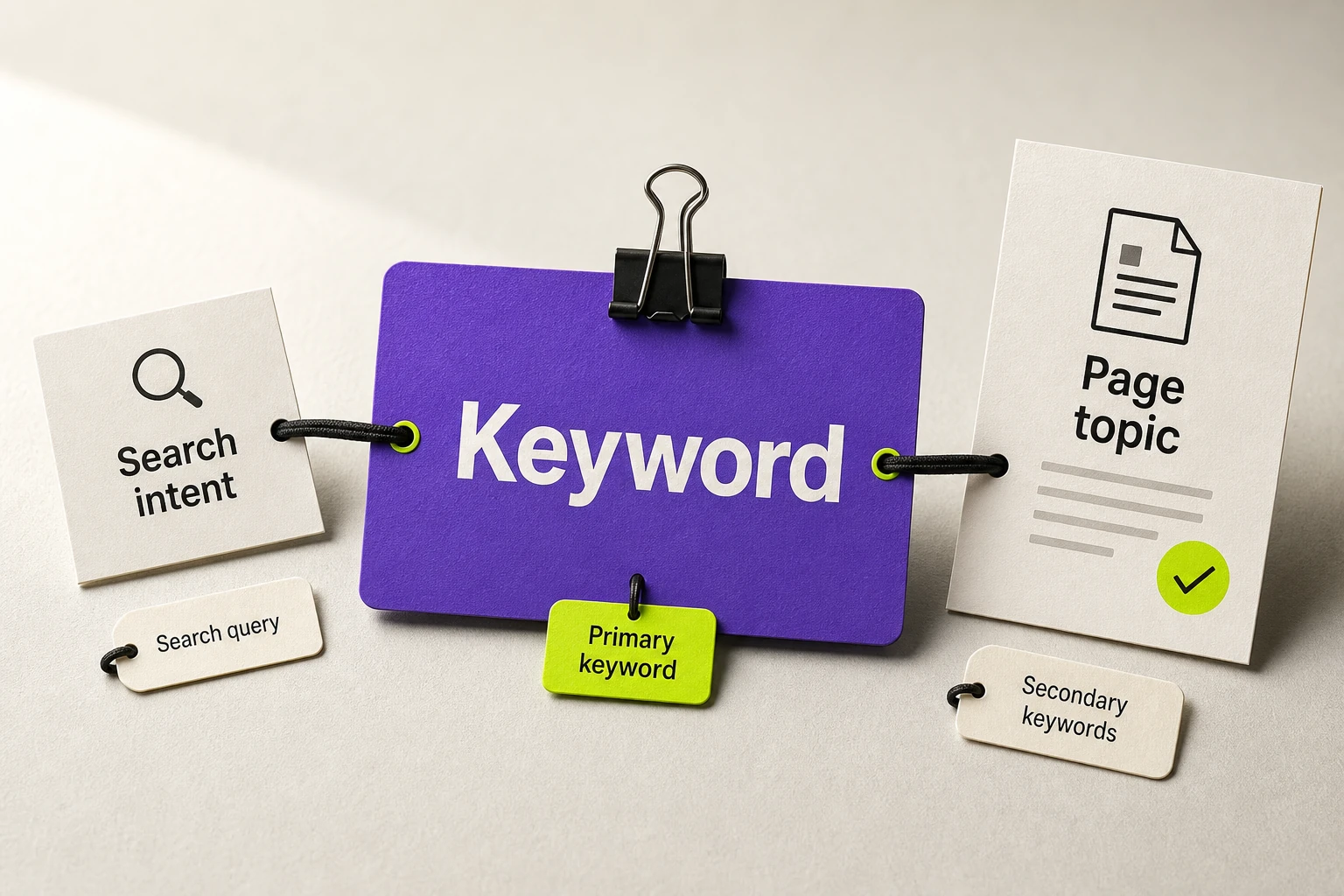
Pages get clearer when every major choice pulls in the same direction. A simple focus rule helps: use one primary keyword as the page's decision-making center, then test whether the title, headings, examples, and supporting points all serve one main outcome. That does not mean every line repeats the same term. It means the page stays coherent. A unique primary keyword keeps the page from drifting into nearby topics and makes it easier to judge what belongs on the page and what does not.
- Focus: The primary keyword helps the writer choose one central subject, so the page does not wander across several loosely related ideas.
- Alignment: The primary keyword keeps the content tied to the same user intent, which makes the page more coherent from the opening to the final supporting point.
- Outcome: The primary keyword clarifies what the visitor should get by the end, whether that is an answer, an explanation, or the next sensible step.
A Keyword Is Not the Same Thing as a Search Query
Beginners usually make one costly mistake early: they treat every phrase typed into the Google Search bar as a separate page idea. That model breaks as soon as people search in real language. A search query is the exact wording a person enters, while a keyword is the broader SEO label used to organize a page around a shared intent. The practical rule is simple: several phrasings can point to the same keyword when people search for the same outcome, which is why one page can often serve those close variations through the same landing pages, even if Google Search Console or Google Analytics show multiple query versions.
| Dimension | Keyword | Search query |
|---|---|---|
| What it is | An editorial SEO label for the page's main topic and intent | The exact words a user types |
| Intent | Groups searches that point to the same underlying need | Shows one specific expression of that need |
| Variability | Usually stable enough to guide one page | Can vary widely across wording, order, and detail |
| Editorial use | Helps shape page focus, headings, and coverage | Helps reveal how people search in real language |
| Example | "beginner seo keyword" as the page target | "what is a keyword in seo" or "seo keyword meaning for beginners" as search query variations |
Where Secondary Keywords Fit Once the Main Topic Is Clear
Once the main topic is set, the next decision is page scope. Secondary keywords belong on the same page only when they strengthen the main answer instead of pulling it into a different job. A useful way to judge that choice is a three-part test: check intent overlap, check the user goal, and then check whether one page can cover the scope cleanly. If any one of those breaks, the terms may look close on the surface but usually deserve separation.
- Check intent overlap. Start with meaning, not wording. If related keywords describe the same need in slightly different language, they can support one page. If the terms point to different meanings, different stages of need, or different expectations about what the page should deliver, the overlap is too weak to group them.
- Check the user goal. Ask what a reader using each phrase is actually trying to accomplish. When secondary keywords and related keywords all lead to one answer path, grouping them makes sense. When one phrase suggests learning, another suggests comparing, and another suggests taking action, the page begins to serve too many jobs at once.
- Check page scope. The same page should be able to cover the topic clearly without becoming unfocused. If adding a term would require a different promise, a different explanation, or a separate structure to satisfy the reader well, that is usually a sign the topic has split and should not be forced onto one page.
How Search Engine Algorithms Use Keywords to Match Intent With Pages
Search systems do not reward pages simply because they repeat a phrase. Search engine algorithms use keywords as one signal inside a broader relevance check: the query suggests what the searcher wants, and the page has to show enough evidence that it can satisfy that need. That evidence comes from several places at once. The language on the page signals topic, the surrounding context in headings and related terms clarifies what the page is really about, and the topical coverage shows whether the page answers the request in a complete enough way to count as relevant content rather than a loose mention.
This is the mental model beginners need: a keyword helps define the page's target, but the system still compares the page with the intent behind the search. When search engine algorithms evaluate that fit, they are not looking for one repeated phrase so much as a pattern of alignment between query, language, and scope. That is why pages can appear in search results for more than one close wording, and why weak pages can miss search engine results pages even when they use keywords exactly. Good SEO, then, is not mechanical repetition. It is building a page whose language and coverage make it a credible match for the need behind the search, which is what ultimately supports search ranking, search engine results, and broader search engine rankings.
Keyword Types Show How Broad, Specific, or Ready to Act a Search Is
Once a reader understands that search systems match pages to intent, the next question becomes practical: what kind of intent does a keyword actually signal? A simple decision rule helps. Classify the term on three dimensions: scope, specificity, and expected next action. Those differences should shape the kind of page created to meet the search.
| Keyword type | Scope | Likely intent | Recommended page goal |
|---|---|---|---|
| Short-tail keywords | Broad | Explore a topic in general terms | Define a broad topic hub or high-level category page |
| Long-tail keywords | Narrow | Solve a specific need | Create a focused page that answers one clear problem |
| Branded keywords | Brand-specific | Reach a known company, product, or site | Help the searcher navigate to an official or brand-specific destination |
| Informational keywords | Can be broad or narrow | Learn, compare, or understand | Publish an explainer, guide, or blog post |
| Transactional keywords | Usually specific | Act, buy, sign up, or request | Build a page designed for conversion or the next concrete step |
That framework keeps beginners from treating all terms as equal. These types of keywords are less about wording alone than about page expectation, and the next sections show how breadth, specificity, and action readiness change what a good SEO target looks like.
Short Tail Keywords Cast a Wide Net
Broad phrases can attract attention quickly, but they also leave more room for mixed expectations. Short tail keywords often carry high search volume because many different searchers use them, yet that same breadth makes intent harder to read. A page targeting short tail keywords may know the topic area, but it often cannot predict whether the visitor wants a definition, a comparison, a tool, or a product. That is why search volume alone is a weak decision rule. High search volume can show that a topic matters, but broad terms usually work better for mapping a topic space or framing a category-level page than for briefing one precise page. The wider the term, the weaker the page expectation.
Long-Tail Keywords Match More Specific Search Intent
Precision changes the job of the page. Long tail keywords usually follow a more specific keyword pattern that makes search intent easier to interpret, which is why they often fit beginner SEO better than broad phrases. When a page is built around long tail keywords, it can answer one clearer question, meet one clearer expectation, and attract targeted traffic that is closer to qualified traffic. The total search traffic may be smaller than a broad term attracts, but the organic traffic is often more targeted traffic because the need is narrower. For a new site or a beginner writer, that creates a usable decision rule: start with the specific keyword that best matches the page goal, then build for clarity rather than raw reach.
How Branded, Informational, and Transactional Keywords Signal Search Goals
Some keywords tell a reader how broad a topic is. Others tell a marketer what the page must do next. Branded, informational, and transactional labels are useful because they connect the term directly to a page objective, which makes performance easier to judge.
| Keyword category | What it signals | Best page objective | Simple KPI |
|---|---|---|---|
| Branded | The searcher already knows the name or destination | Help the visitor reach the right brand, product, or company page quickly | Branded clicks or navigational visits |
| Informational | The searcher wants explanation, comparison, or instruction | Teach clearly with a guide, explainer, FAQ, or blog post | Engaged visits, time on page, or scroll depth |
| Transactional | The searcher is close to taking action | Support signup, purchase, booking, or request completion | Conversions or conversion rate |
The KPI should follow the page's job. If the term is branded, the main question is whether searchers reached the right destination quickly, so navigational visits or branded clicks make sense. If the term is informational, the page succeeds by helping the reader learn, compare, or finish the explanation, so engagement signals are the better measure. If the term is transactional, the page is supposed to move the visitor to a concrete next step, which is why conversions matter more than attention alone.
This is the operating rule: keyword type affects page goal before it affects copy. If a term is informational, the page should teach. If it is transactional, the page should reduce friction and help the next step happen. If it is branded, the page should confirm that the searcher has reached the right place. With that taxonomy in place, the next step is to choose keywords by page goal, specificity, and intent instead of by volume alone.
How Beginners Can Choose and Use Keywords Without Guesswork
Once keyword types and intent are clear, the real beginner problem is execution. Many pages fail because the writer picks a phrase first and asks what to do with it later. A better keyword strategy runs in the opposite order: start with the page goal, check the target audience, choose the level of specificity the page can actually serve, then test the idea with data.
- 1Start with a seed topic tied to one page purpose.
- 2Expand the topic by researching keywords with a tool that surfaces related options.
- 3Filter the options by relevance, intent match, and feasibility.
- 4Choose one primary target and a small set of support terms that fit the same need.
- 5Use Google Trends as a final check for timing and regional context before publishing.
- 6Place terms where they clarify the page, then use keywords naturally in the copy rather than forcing repetition.
That sequence keeps keyword choice connected to content strategy and, by extension, to a practical content marketing strategy. Tools help, but they do not decide the page for you. The next steps turn that workflow into a set of decisions a beginner can reuse.
How to Choose the Best Keywords for Your Topic and Goal
Volume can be useful, but it is a weak first filter. For beginners, the stronger rule is simpler: judge a term by whether one page can use it to do one job for one reader. The best keywords usually keep the page focused, match the promise of the content, and give a newer site a realistic chance to compete.
- Purpose: Check whether the term matches the page's main job. If the page is explanatory, sales-oriented target keywords may pull the content off course.
- Intent Match: Ask whether the likely search intent matches what the page will actually deliver. Strong SEO keywords work when the page meets the reader's next step, and right SEO keywords do more than echo the topic name.
- Specificity: Prefer relevant keywords that are narrow enough to prevent topic drift. A broad phrase can attract attention, but it may weaken keyword relevance if the page answers only part of the need.
- Page Fit: Test whether one page can satisfy the search without splitting into separate pages. If two ideas need different answers, they are probably not the same keyword target.
- Feasibility: Judge whether the competition level is realistic for a beginner page. The right keywords are often more specific because they ask the page to solve a clearer problem.
- Variation Control: Keep close variations only if they support the same intent. If two phrases pull toward different outcomes, they are competing target keywords, not support terms.
That creates a usable decision rule: choose the term that best matches the page's purpose before choosing the one that merely looks largest. That is how beginners find the best keywords that are also usable.
How Keyword Research Tools Turn Topic Ideas Into Usable Search Terms
A vague topic is hard to publish well because it gives the writer no workable options. This is where keyword research tools earn their place. They do not decide intent, but they do turn a rough idea into search terms the writer can inspect, compare, and reduce into a usable keyword list.
- 1Start with a seed keyword that reflects the page goal. This first phrase is only a starting point, not a commitment.
- 2Enter that term into Google Keyword Planner to discover new keyword ideas and review search estimates or forecasts. For beginners, that is enough to widen the field without drowning in data.
- 3If using Semrush, use Keyword Magic Tool to generate keyword suggestions and filter them into a cleaner list. Then use Keyword Overview as a quick check on the term's main metrics and SERP context.
- 4Compare the options against the checklist from the previous section. The useful question is not which phrase is biggest, but which one creates the clearest page.
- 5Keep only the terms that support the same reader need. At that point, the raw output from keyword research becomes a smaller keyword list built around one primary term and a few close support phrases.
The decision rule stays the same across the verified workflow: use Google Keyword Planner and the named Semrush tools to widen and organize the options, then make the final choice based on page fit. Data informs the decision. It does not replace it. A free keyword research tool is not part of this verified workflow.
How Google Trends Helps You Compare Interest and Timing
Search demand changes over time, and static tools do not always show that well. Google Trends adds a different kind of signal. It does not report absolute monthly search volume. Instead, it shows search trends as relative interest, normalized by time and location, so a writer can compare momentum, seasonality, and regional patterns before finalizing a term.
- Use Google Trends to compare terms that seem equally strong on paper but may rise or fall at different times.
- Treat its values as scaled comparison data, commonly shown on a 0 to 100 range, rather than as raw search volume.
- Remember that two places can show similar scores without having the same monthly search volume or the same number of searches overall.
- Pay attention when a lower search volume term shows stronger recent movement. A lower search volume phrase can still be the better choice if it matches the page and the timing.
- Use the tool to discover popular keywords in context, not to claim exact counts.
That distinction matters because trend data refines judgment. It should not overrule relevance, but it can prevent a beginner from treating old demand data as a final answer.
How to Place Keywords Naturally in Titles, Headings, and Meta Descriptions
Placement is where many beginners drift back into guesswork. After the keyword is chosen, the job is simple: make the page topic easy to recognize in the places readers and search engines actually use as signals. Good keyword placement clarifies the page. It should never make the writing sound mechanical.
- Title Tags: Put the main term, or a close natural variation, in the title when it honestly describes the page. Keep title tags descriptive and concise rather than forcing every variation into one line.
- table_headers|Headings: Use headings to reinforce structure and topic coverage. Good headings support keyword placement by clarifying sections, not by repeating the same phrase in every subhead.
- table_headers|Meta Descriptions: Write meta descriptions for clarity, context, and click value. Google can generate snippets from page content, and displayed text may be truncated, so fixed character rules are a poor editing standard.
- table_headers|Body Copy: Add keywords in your content only where they help the reader understand the topic. Natural keyword usage is usually enough when the page is tightly focused.
- table_headers|Image Alt Text: Use image alt text only when it truthfully describes the image in context. It is descriptive text, not a spare slot for extra keywords.
- table_headers|Final Pass: Read the page aloud and listen for friction. If the phrase sounds inserted, revise the sentence rather than defending the keyword usage.
This is the operating rule: keywords naturally support readability, relevance, and structure. When they do not, the workflow has broken, and the next section shows the habits that usually cause that break.
Keyword Mistakes That Make Beginner SEO Harder Than It Needs to Be
Beginners usually go wrong at the same moment: they stop treating a keyword as a clue about intent and start treating it as something to pack into a page. That shift sounds small, but it changes the work. Instead of asking what the reader is trying to find, the page starts chasing visible signals that make the copy weaker and the topic less clear.