Google AI Overviews can answer questions correctly, but they can also invent details, misread sources, or lose important conditions. An accuracy percentage from a study cannot tell you whether the answer in front of you is dependable. Before using it in a decision or a published claim, check the material facts against suitable sources and keep the limits those sources establish.
On October 10, 2026, we searched for “is the Google AI Overview accurate.” The overview presented a 91% accuracy figure and used a reported search volume to estimate errors worldwide. Following the evidence changed what we would put in a business brief: the percentage needed its study context, and the global error count lacked the inputs needed to establish it.
Is Google AI Overview Accurate Enough to Use?
An AI Overview can help you get oriented and find sources. Before relying on a particular fact, check the evidence for that fact and whether it applies to your intended use. A correct detail elsewhere in the answer does not validate the sentence you plan to repeat.
Google describes AI Overviews as generated snapshots with links for further reading and explicitly acknowledges that they can make mistakes. Its guidance on generative AI’s limitations explains that generated answers can invent information or misunderstand language.
Source checking also needs context. A source may describe an earlier product version. A summary may drop the population a statistic describes. An answer may combine a supported fact with a conclusion that needs additional evidence. Our example below demonstrates that last distinction without attempting to measure how often it happens.
Accuracy, Source Support, and Relevance Are Different Checks
Ask three questions about each claim that matters to your decision:
- Is it correct? Does suitable evidence establish the fact?
- Does the citation support it? Does the linked passage establish the claim as written, including its conditions?
- Does it apply here? Is the date, population, product, or situation relevant to the use you have in mind?
These checks can produce different answers. A fact can be true even when the attached link fails to support it. A well-supported study finding can still be unsuitable as an estimate for a different population. Treat a citation as somewhere to investigate; opening it is the beginning of the check.
What the 91% Accuracy Figure Measures
In Oumi’s analysis, about 91% of 1,609 assessed Gemini 3 AI Overviews answered the target question correctly. The study used challenging factual questions from SimpleQA in early 2026. Correctness concerned the question asked; it did not certify every additional detail in the overview.
The researchers reported that 39% of the same assessed overviews were both correct on the target question and fully supported by the cited material under their method. A claim lacking source support can still be true. The two percentages measure different things.
The Study Sample and Its Limits
The analysis included an overview only when every citation linked to a specific text fragment the researchers could retrieve. It judged support against that retrieved context, using automated judgments with a small manual check. Oumi could not know whether Google had used other page text or additional sources.
Oumi also reports Google’s objection that the benchmark does not represent ordinary searches. The results describe the assessed sample; they do not establish the probability that your next answer will be correct or supply a current, universal accuracy rate.
A Public Example: Checking an AI Overview About Accuracy
Checking this answer leads to two different editorial decisions: retain the study finding with its scope, and withhold the global error estimate. The issue is what the evidence permits us to conclude. We did not run a new accuracy benchmark or establish Google’s real-world error rate.
What the Answer Said
Our October 10 search returned the phrase “accurate about 91% of the time.” The expanded overview also extrapolated an error rate across a reported five trillion annual Google searches to claim tens of millions of errors each hour.
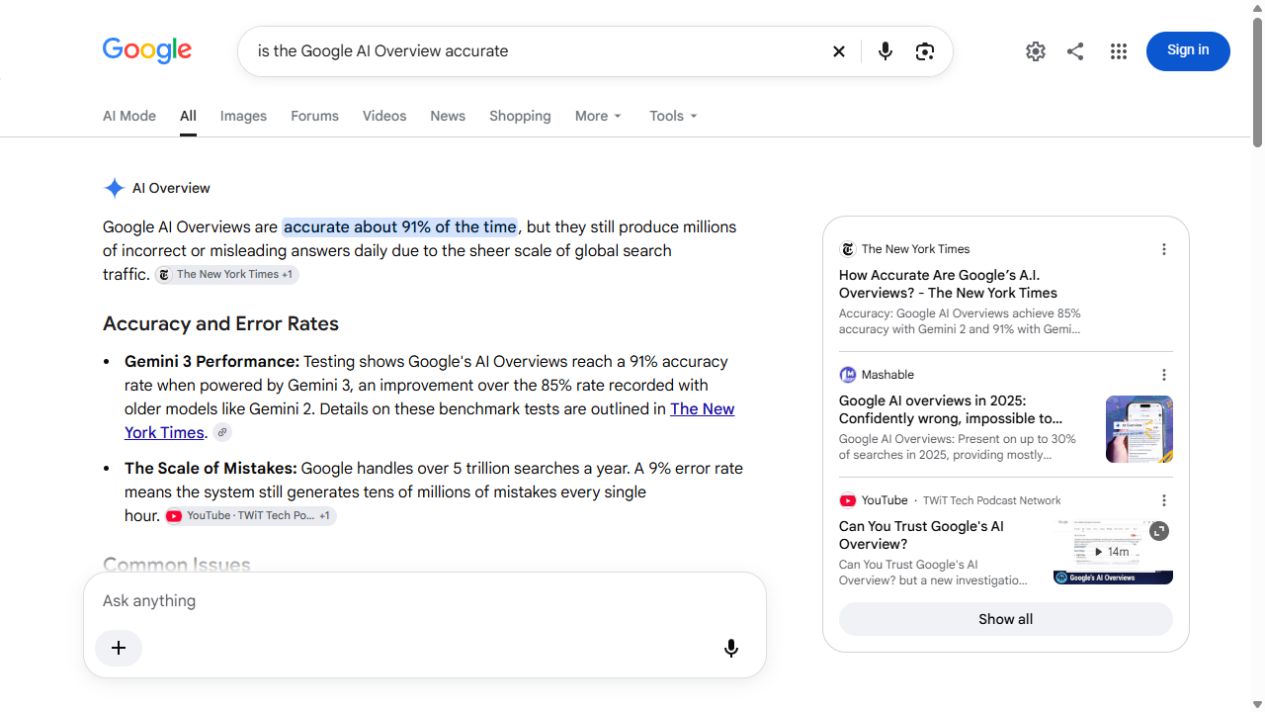
Public search captured October 10, 2026, signed out, with US and English search parameters. Google reported the physical location as unknown. This is one observed answer; another search may differ. Open the full-size capture.
What the Original Study Supports
The source check separates a reported result from the broader conclusions built around it:
| Claim in the Answer | Evidence Check | Decision |
|---|---|---|
| The overview presents 91% as general accuracy. | Oumi’s Findings section says: “Of the AI Overviews powered by Gemini 3 we were able to assess, about 91% contained the correct answer.” The next explanation defines correctness as answering the target question. Its figure identifies 1,609 assessed overviews. | Keep the finding, with the sample, timing, and metric attached. |
| The overview estimates errors per hour using total Google searches. | The study does not supply a representative error rate across real search traffic. Google’s AI Overview help page says Overviews appear when its systems consider them useful, so total searches are not the count of Overviews. | Hold the global estimate. It also needs the share of searches showing an Overview. |
The arithmetic could be internally consistent while the extrapolation remains unsupported. We have not established a lower error count, either. Replacing one missing input with a guess would leave the same problem.
What We Would Use in a Business Brief
Suggested Wording
Oumi reported about 91% target-question correctness in a selected early-2026 sample of Google AI Overviews. That finding does not establish a universal accuracy rate. Check the evidence for any claim you intend to rely on.
This proposed revision preserves the useful result and removes the unsupported generalization.
How to Check an AI Overview Before Using It
Our suggested approach is to identify the claims material to your use, follow their sources, inspect their conditions, and decide what the evidence supports. Apply it to every claim your conclusion depends on. You can leave incidental details unchecked, but your verdict must remain limited to what you examined.
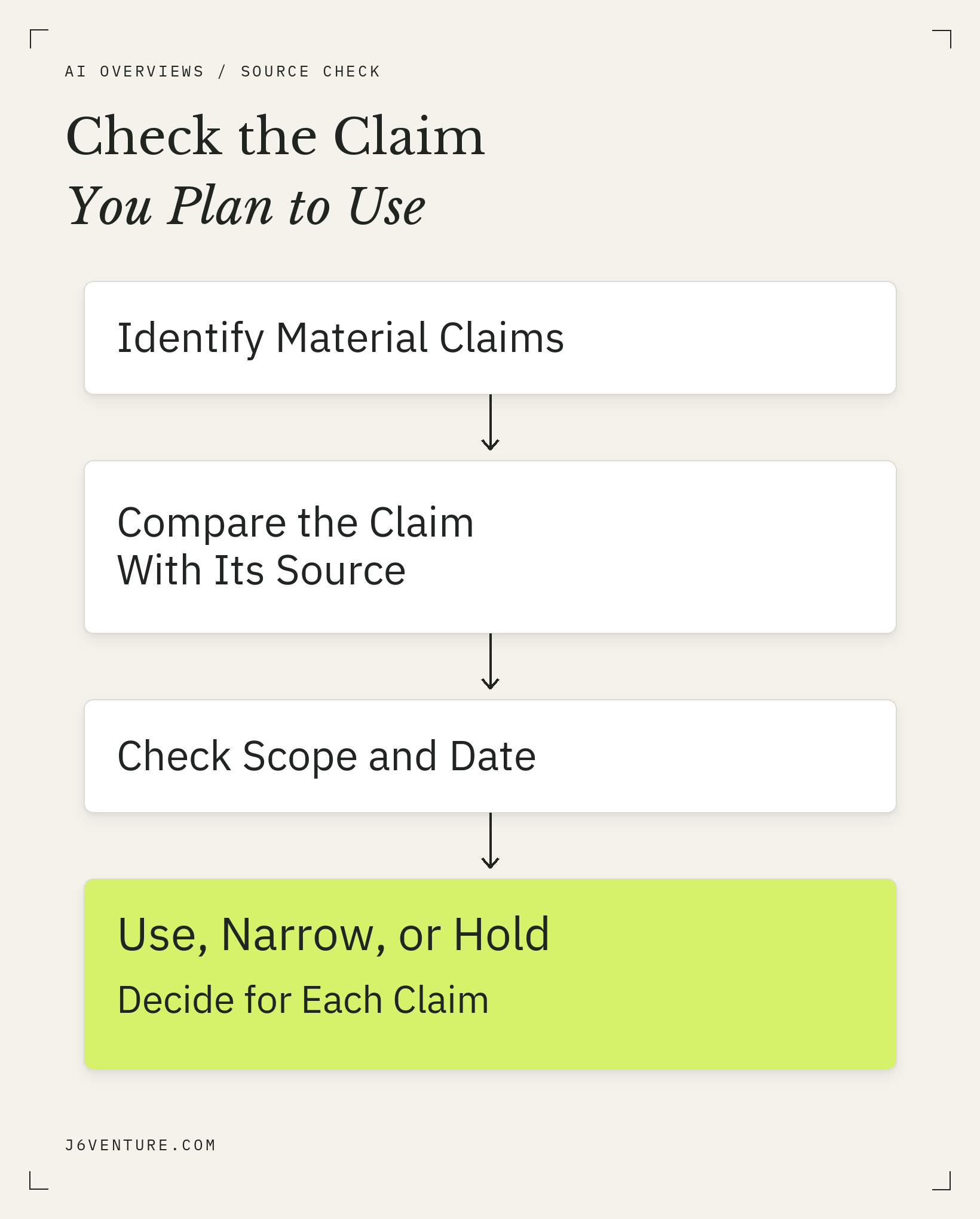
Apply the decision to each checked claim. Replace contradicted claims using verified evidence, and recheck outdated information before using it.
1. Identify the Claims Your Decision Depends On
Start with the sentence you are about to put in a brief, tell a colleague, or use to choose an action. Separate its fact from its conclusion.
In our example, the study percentage is one claim. Applying it to worldwide search traffic is another. Confirming that the percentage appears in a study does not settle the second claim.
Ask what would change your decision if it were wrong. A detail used to orient your reading needs a different level of checking from a number used to justify a budget or a statement published under your company’s name. For consequential decisions, use the relevant authoritative source or qualified person; this checking method does not replace their judgment.
2. Open the Source and Find the Relevant Passage
Follow the citation and locate the passage that supports the material claim. Read enough surrounding text to understand what it includes and excludes. A highlighted fragment can omit the qualification you need.
For a study, look at the original results and methods. For a product capability, prefer the vendor’s current documentation. A page that mentions the same topic may still fail to support the specific statement.
Check important information in more than one suitable place, as Google recommends. Inspect where each account obtained its information. Three summaries of Oumi’s analysis still trace back to one measurement; their agreement does not independently validate the study or its extrapolation.
If the cited page cannot be opened, look for an accessible original or another authoritative source that establishes the claim. Until then, mark the material claim unresolved.
3. Check the Date, Scope, and Missing Conditions
Compare the claim with the source on the details that can change its meaning:
- Date: Does it describe the current situation or a historical observation?
- Population: Which people, queries, pages, or products were examined?
- Measure: What counted as correct, successful, or supported?
- Conditions: What exclusions, dependencies, or exceptions qualify the result?
The decisive question in our example is what the 91% describes. Restoring its population and definition changes a broad product claim into a statement about one study. A newer publication date alone would not solve that scope problem.
An answer about a past product version can be accurately quoted and still be unsuitable for choosing what to buy today. If currency affects your decision, find a current authoritative record before using the claim.
4. Decide What to Use, Narrow, or Hold
Write down the action warranted by the check. Our suggested outcomes keep missing evidence separate from contradictory evidence:
| What You Found | What to Do |
|---|---|
| Suitable evidence supports the claim and applies to your use. | Use the checked claim with any necessary qualification and source. |
| Evidence supports a narrower date, population, or conclusion. | Rewrite the claim within that scope. |
| Suitable evidence contradicts the claim. | Replace it with the verified information, or remove it if the correct answer remains unresolved. |
| The information is outdated for your decision. | Check a current authoritative source before proceeding. |
| The material claim remains unsupported or unverifiable. | Hold it out of the decision or document, and record what evidence is missing. |
Use a claim when suitable evidence supports it for your intended purpose and you have preserved its relevant limits. If a material conflict remains unresolved, record what evidence would settle it and hold the affected claim. Do not keep asking different AI tools until one gives a reassuring answer.
What to Do When the Answer Is Wrong or Unclear
Report a concrete mismatch when you can show one, and keep your own work grounded in the checked sources. Feedback is a way to flag the issue; it does not supply the missing evidence or guarantee when the answer will change. A later different answer also does not, by itself, show your report caused the change.
Report the Problem With the Supporting Evidence
Google’s current feedback instructions describe a thumbs-down control below the overview, followed by Report a problem, a category, optional details, and Submit. A three-dot menu offers another route. The interface may vary.
Describe the particular claim, link the source, and explain the missing condition or contradiction. For our example, the useful feedback would identify the missing study scope. Google says submitted feedback includes the latest query and its search results.
If the problem concerns your company’s description, the next task may be to inspect the underlying source. Our guide to correcting AI brand visibility problems covers that separate decision.
Use Web Results When You Need to Read Sources Directly
Google’s help page says the Web filter displays text-based links without features such as AI Overviews. Use it when you want to examine source pages directly. The pages still need evaluation; their presence in ordinary results does not validate their claims.
AI Mode is a separate conversational search experience. Asking a follow-up there may help exploration, but a second generated answer is not an independent source check. Our AI SEO introduction covers the broader distinction between using AI for work and improving search visibility.
Keep the Evidence With the Claim You Use
Save the supporting passage, its source, the date checked, and the scope of the statement you keep. A colleague should be able to trace your conclusion without reconstructing the search. This is especially useful when an AI answer changes between visits.
For the example above, the completed record is short:
- Claim retained: Oumi reported about 91% target-question correctness in its selected early-2026 sample.
- Source and passage: Oumi’s Findings section, checked October 10, 2026. The exact sentence appears in our source-check table above; save it with the definition of correctness and the figure identifying 1,609 assessed overviews.
- Limit retained: The assessed sample does not establish current accuracy across all searches.
- Claim held: The worldwide hourly error estimate, because the required traffic-wide inputs were not established.
If you publish the checked statement, keep its qualifications near the number. Our guide to optimizing content for AI Overviews addresses how to make useful page content clearer; it cannot promise how an AI system will summarize it.
Choose the next claim you intend to use and trace it to its evidence. The result you need is a statement you can support, with a clear boundary around what remains unknown.