AI SEO means using AI to assist search optimization, or improving your visibility in AI-powered search. For your first AI-assisted task, choose a recurring problem with evidence you can supply and an output you can check. Try it on a small piece of work, review the result, and include corrections when judging whether it helped.
Start with work where a bad answer is cheap to catch and easy to reject. Choose a task you already understand well enough to judge. Comparing possible internal links is one example: an assistant suggests connections, and you decide whether each destination helps the reader. Diagnosing a traffic decline without the underlying data gives you much less to check.
What Is AI SEO?
AI SEO has two common meanings: using AI in the work of SEO, and making content discoverable in AI search experiences. They can overlap, but they call for different actions. Before choosing a tool or changing a page, identify which outcome you want.
Using AI to Help With SEO Work
An AI assistant can help organize keyword ideas, compare supplied pages, suggest edits, or summarize exported performance data. In these tasks, AI supports the research or production process. The result still needs evaluation against the original question and source material.
For example, grouping a supplied query list can make a planning discussion easier. It does not establish that each group deserves a new page. Search intent, existing content, and business relevance still determine what you publish.
Helping Your Content Appear in AI Search
The second meaning concerns visibility in experiences such as Google’s AI features and ChatGPT search. You may encounter labels including generative engine optimization (GEO) and answer engine optimization (AEO). Ask what work the label describes and which search experience it addresses.
For Google, the foundations include accessible pages and useful, original content. Its generative AI search guidance says there is no ideal page length, required content “chunking,” or special schema needed for generative AI search. Those are Google-specific statements; other services have their own documentation.
If visibility in ChatGPT is your immediate goal, our ChatGPT search guide addresses that work. The first-task approach here concerns using AI to help you do SEO.
Where Can AI Help With SEO?
Useful starting tasks involve organizing information, comparing material, or proposing a bounded change. The key is knowing which part of the job you are delegating. A list of suggestions, a verified diagnosis, and a publication-ready edit require different evidence and checks.
Keyword Research and Content Planning
Give the assistant a query export and ask it to group searches by the answer people appear to need. Require it to show which supplied rows support each group. When a query has two plausible interpretations, flag the ambiguity and leave the assignment open until further evidence resolves it.
Keep generated ideas separate from measured demand. A phrase suggested by a model has no established search volume merely because it sounds plausible. If a connected tool supplies volume or performance figures, inspect the source, date range, and market. Then check whether the proposed topic overlaps a page you already have.
Reviewing and Improving Existing Content
Ask for a narrow review: identify an unexplained term, compare a paragraph with its cited source, or propose a clearer title that preserves the page’s promise. Supply the current text and the facts the revision must preserve. This gives you a concrete before-and-after comparison.
For publication, check whether the edit changes meaning, drops a condition, or introduces an unsupported claim. Google’s guidance on AI-generated content emphasizes accuracy and review, including titles, descriptions, structured data, and image alt text. Producing more copy does not resolve a missing source or an unclear reader need.
Investigating Technical Issues and Performance Data
AI can help sort a crawl export into issue types or summarize changes in supplied Search Console rows. Ask it to preserve the relevant URLs and figures so you can trace each observation back to the data.
For a page that lost impressions, inspect indexing, query mix, implementation dates, and sitewide movement through a focused SEO audit. Let AI summarize the evidence. Require approval before consequential site changes, including redirects and deletions.
How to Choose Your First AI SEO Task
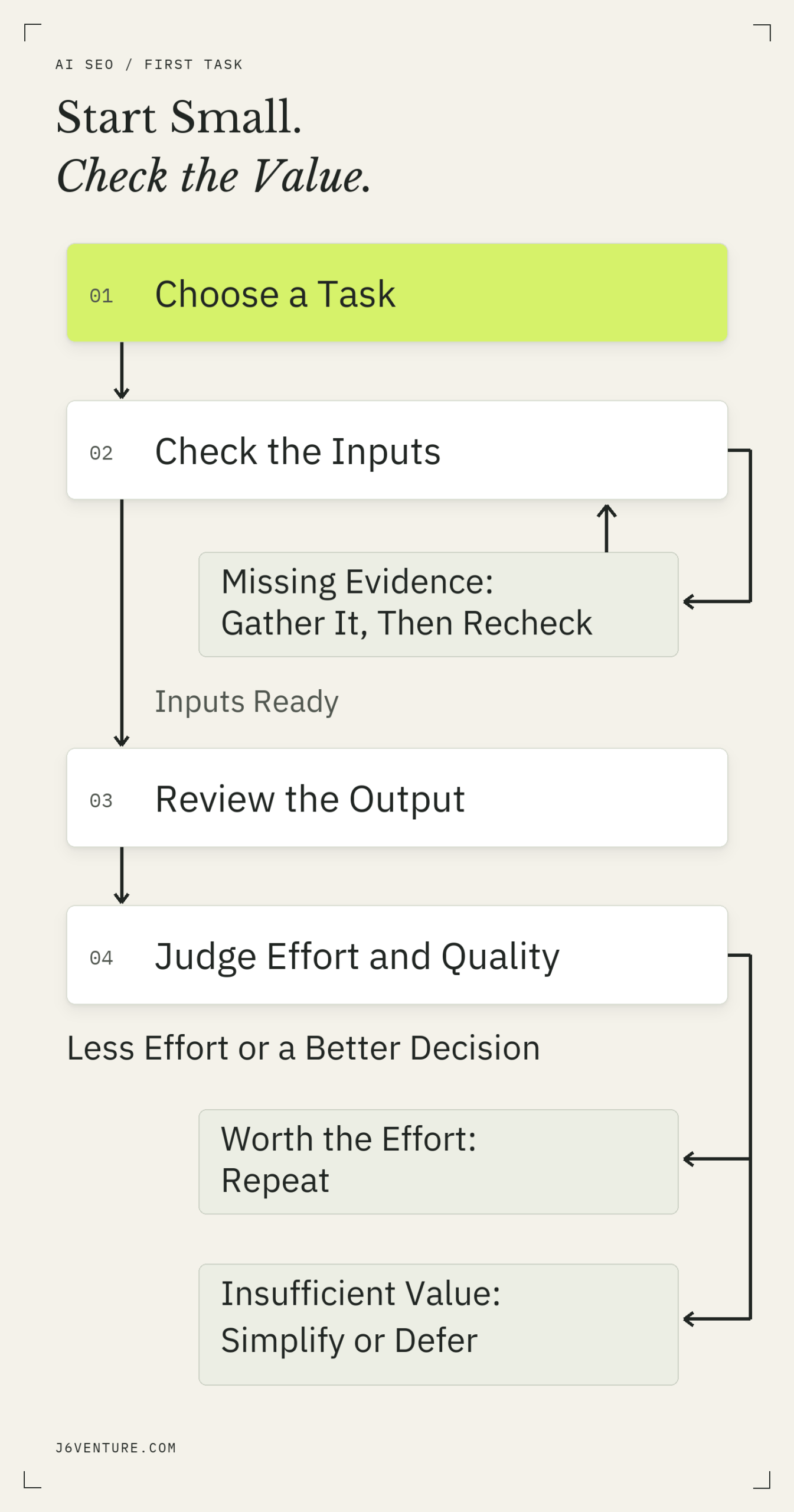
Choose work with a clear finish line, accessible inputs, and an affordable review. Our suggested selection method weighs the evidence, checking effort, and consequences of error. A trial earns another run when it reduces total effort or improves the decision enough to justify the extra work.
Start With a Specific Problem
“Use AI for SEO” leaves the assistant to choose both the problem and the solution. “Find useful internal links for this article using these three destination pages” defines an inspectable job. You know which pages it may use and what a finished recommendation should contain.
Work worth repeating should support a page, audience, or decision you care about. A technically tidy task on an irrelevant page can consume time without advancing a useful priority.
Compare the Evidence, Review Effort, and Cost of Error
Make “affordable review” concrete: can a knowledgeable person trace each recommendation to its source, check the full output with less effort than recreating it, and accept the downside of an error that slips through? If checking takes longer, name the quality improvement that would justify that cost.
Choosing a First Task
| Possible Task | Evidence and Checks | Our Starting Decision |
|---|---|---|
| Suggest links among a small set of known pages | Full page text and existing links; check destination fit, anchor wording, and duplication. | Worth a supervised trial when finding connections is a recurring chore. |
| Group a query export for discussion | Actual queries and metrics; inspect ambiguous groups and existing page ownership. | Try it for organization. Keep page-creation decisions separate. |
| Explain a traffic decline from a chart alone | The chart lacks query, indexing, implementation, and comparison context. | A poor first task: gather evidence before asking for a diagnosis. |
| Automatically merge or redirect weak pages | Content, intent, links, traffic history, technical checks, and a rollback plan. | A poor first task for automation: require explicit review before implementation. |
Compare the consequences of accepting an error. An unsuitable draft link can be discarded before publication. A bad redirect can affect people and search engines immediately. Ease of generating the recommendation tells you little about the care needed to approve it.
When Doing It Yourself Is Simpler
If you know the destination and need to add one link, opening the editor may be faster than preparing an AI request. The assistant becomes more interesting when you repeatedly compare material, need a second reading, or have enough candidates that organizing them is burdensome.
Avoid expanding a simple chore merely to create a use for AI. Decide what improvement would justify the setup before running it.
Give AI the Evidence It Needs
Supply the material needed for the decision and ask the assistant to identify what it used. A title establishes a broad topic; the full article lets you inspect the explanation. A query export with metrics brings performance observations that neither supplies.
What the AI Has Actually Read
A pasted URL does not by itself establish that the assistant opened the page. Check that the tool retrieved the content, or supply the relevant text yourself. For link recommendations, include the source article’s existing hyperlinks as well as the destination content. Plain text with links removed can hide duplication.
Ask for the exact source passage and destination section supporting each suggestion. If either is missing, investigate before accepting it. For an initial trial, use non-sensitive material you have permission to use.
Check the retrieved version and source date. A retrieval can return a menu, an excerpt, or an older copy; the model’s fluent answer tells you nothing about that freshness. Require the relevant page body, and retrieve missing material or narrow the request.
What the Available Evidence Can Support
Page text can support an assessment of topic and reader fit. It cannot establish a page’s traffic, conversion rate, or likely ranking gain. A CMS copy confirms what was retrieved from the content system; a separate live check confirms what visitors can access.
Our example limited the assistant to editorial connections between four supplied pages. It received no performance data.
Worked Example: Check AI-Suggested Internal Links
We ran one bounded recommendation task on October 9, 2026, using four published J6 articles. The assistant proposed two links and declined an additional link to a destination already linked twice. We then assessed the recommendations against the source paragraphs and destination content.
The Public Pages, Reader Need, and Task
The source was our explanation of keywords in SEO. Its reader is learning how search terms relate to page focus. The three allowed destinations covered keyword search, SEO-friendly URLs, and semantic SEO.
We supplied the four complete article bodies, including hyperlinks, retrieved through WordPress. We asked for up to three contextual links, allowing fewer or none. Each recommendation needed an exact source passage, proposed wording, a destination, a reader benefit, and a duplication check. The assistant had no browsing or editing permission for this task.
This is a demonstration using our public pages. It is one run with a selected candidate set, rather than a sitewide audit or a comparison of AI products.
The AI’s Suggestions and Our Checks
The first suggestion used this existing passage:
For a new URL, use a readable, descriptive slug. Selecting a different keyword does not require changing an established URL.

The assistant proposed linking “readable, descriptive slug” to our SEO-friendly URL article. We checked that the destination explains slugs, includes URL examples, and discusses when an existing address should change. It supplies the next detail a beginner might need without expanding the keyword article into a URL tutorial.
The second suggestion would follow this source paragraph:
Read the text aloud. If repeating the phrase makes a sentence awkward, rewrite the sentence. Google’s spam policies identify unnatural repetition used to manipulate rankings as keyword stuffing. A density target gives you no substitute for a clear answer.
The assistant proposed adding this sentence:
To improve an explanation beyond keyword placement, use our semantic SEO editing walkthrough to find unclear connections and missing conditions.
The destination contains that guidance. We then checked whether this paragraph needed the extra handoff.
Which Recommendations Earn a Place on the Page?
Our Editorial Decisions
| Candidate | What We Found | Decision for This Example |
|---|---|---|
| SEO-friendly URL article | The existing sentence introduces a slug; the destination explains that exact subject. No link to it was present in the supplied body. | Accept the proposed anchor while preserving the caution about changing established URLs. |
| Semantic SEO article | The content fits, but the suggestion adds a broader editing detour after a paragraph already complete on keyword repetition. | Leave it out of this small edit. A relevant destination need not be added at every plausible opportunity. |
| Keyword-search article | The assistant found two existing contextual links and proposed no third link. | Keep that restraint. The source already provides a route to the different meaning of keyword search. |
Both suggestions matched relevant destination content. Our choice was editorial: the URL link gives an existing term a destination without changing the paragraph; the semantic SEO suggestion introduces a new action, reviewing missing connections. That handoff could suit a deeper editing section. For this introductory passage, we kept the smaller intervention.
Google’s link guidance supports descriptive, concise anchors and contextual links to helpful resources. It does not decide this particular placement for us. The surrounding paragraph and the reader’s next question determine whether we want the link.

The Finished Recommendation and Its Limits
The approved editorial recommendation for this demonstration is one linked phrase, with the original wording preserved:
For a new URL, use a readable, descriptive slug. Selecting a different keyword does not require changing an established URL.
This recommendation has not been applied to the source article as part of the demonstration. We have no measured ranking, traffic, or navigation improvement to report. The completed work is a checked edit proposal: one suggestion retained, another omitted, and an existing handoff left alone.
Did AI Save Work After Checking and Corrections?
Judge the effort needed to reach an acceptable result. Include preparing inputs, waiting for the output, reading it, verifying it, and making corrections. A quickly generated recommendation can still take longer to approve than the original task would have taken manually.
Compare the Effort Needed for a Usable Result
For a recurring task, record the time and quality of a normal manual attempt, then an AI-assisted attempt with comparable scope. Agree what counts as acceptable before comparing them: correct destination, useful context, appropriate anchor, and no unnecessary duplication for this example.
Count your active work separately from unattended waiting. A tool can take longer overall while requiring less attention, which may still suit your workflow. Avoid treating a second attempt on the same pages as a fair comparison: you have already learned the material. Use similar tasks and keep the review standard consistent before deciding that the approach is worth repeating.
We did not run a timed manual comparison for the demonstration, so we cannot claim a saving. We still retrieved and read four articles and evaluated both suggestions. The assistant provided a shortlist and identified existing links; whether that assistance justified the setup remains unmeasured.
Your trial can end with a decision to continue, narrow the task, or do it manually. If preparing the inputs takes longer than the chore itself, try reusing a maintained source set on a later task. If review keeps uncovering unsupported recommendations, improve the inputs or choose work that is easier to check.
Separate Task Efficiency From SEO Results
Keep three questions separate: did the work become easier or produce a better decision, did the resulting website change help search performance, and did that performance support the business? Evaluate each with evidence suited to that outcome.
If you later publish the change, record what went live and assess the page against its intended purpose. A link-editing trial should not be presented as proof that AI increased rankings. Checking an AI answer for a brand mention addresses a separate question about visibility.
Your First AI SEO Task: Inputs, Checks, and a Finish Line
Choose one task you understand well enough to evaluate. Before opening the assistant, complete this short brief:
- Problem: What recurring piece of work needs help, and why does it matter?
- Inputs: Which pages, records, or sources will the assistant receive?
- Output: What concrete recommendation or edit should it return?
- Checks: What will you verify before accepting it?
- Finish line: What makes the output usable, and when would you reject it?
For a link trial, adapt this request. It is a shortened version of the instructions used in our demonstration:
Using the source article and destination pages supplied below, propose up to three useful contextual links. Return none if no link earns its place. For each, give the exact source passage, proposed anchor or sentence, destination URL, reader benefit, and existing-link check. Use only these pages. Identify missing evidence, preserve the original meaning, and do not estimate ranking gains.
Run the small task and judge the finished work. Repeat it when the effort or decision quality justifies doing so, and expand only as far as you can maintain that review standard.
Your first useful AI task should leave you with a decision you can explain and work you are willing to use.