Conductor, seoClarity, BrightEdge, and Semrush Enterprise are shared-platform candidates. Ahrefs Enterprise, Botify, Lumar, and Screaming Frog SEO Spider can suit research or technical jobs within a broader stack. Shortlist the exact package against your workload, user access, and data-delivery requirements, then request evidence for anything still unproven.
A platform can cover your feature checklist and still leave a purchase-blocking question unanswered: can one brand’s team see another brand’s data? Can the required output reach the system where your analysts work? What does that access cost in the package being quoted?
This is a documentation-based comparison, researched October 23, 2026. We selected recognizable candidates spanning shared SEO work, research, and technical investigation. It is a bounded sample, with no ranked winner or claim that J6 trialed these products. Published features and starting prices help identify candidates; your requirements, demonstration, and contract establish buying fit.
What Should Enterprise SEO Software Help You Do?
Enterprise SEO software should help people complete search-related work across the brands, markets, sites, and systems they manage. The requirement might be shared research and content planning, coordinated technical monitoring, or supplying consistent data to an existing reporting system. A large page count alone does not describe that work.
A shared platform may reduce the number of places teams must consult or exchange work. A specialist may fill a particular gap while your current analytics, reporting, and task systems continue doing their jobs. Neither arrangement is automatically preferable.
Start with the output you cannot reliably produce today. “Deliver the agreed US keyword and landing-page data to our warehouse every week” is specific enough to evaluate. A warehouse is a database used to combine information from different systems. “We need better enterprise reporting” still leaves the required data, people, and destination undefined.
Keep source meanings visible. Your analytics records, a vendor’s estimated competitor traffic, a crawler’s page observations, and server logs answer different questions. Buying one interface does not make those measures interchangeable. Our guide to enterprise SEO reporting explains how to interpret the resulting evidence across business units.
Compare Four Shared Enterprise SEO Platforms
These four candidates document capabilities spanning several SEO jobs. The comparison identifies reasons to investigate them and the proof that still belongs in your evaluation.
| Platform | Reason to Investigate | What to Confirm |
|---|---|---|
| Conductor | Cross-brand research, content, and reporting work, with analytics connections and APIs | Account access during provisioning; the quoted combination of products and consumption allowances |
| seoClarity | Rankings, research/content, and technical work with data-delivery options | Current package, add-ons, and API entitlement; a public starting price is not a complete quote |
| BrightEdge | Analytics-connected search reporting and downstream data through Connect | Exact exported data and modules; CMS functionality described for Autopilot must be scoped separately |
| Semrush Enterprise | Shared SEO work across business units, workspaces, and large-site crawling | Separate Enterprise product and custom limits; workspace and guest access must match your organization |
For example, if weekly delivery to BigQuery is mandatory, start by requesting a scoped demonstration from seoClarity: its integrations page names that destination. Retain a sample containing your required fields and periods before treating the route as suitable.
Conductor, BrightEdge, or Semrush Enterprise can remain candidates through a documented API or custom integration, with the specific route still to be demonstrated. This orders the evidence request; it does not prove that seoClarity alone can meet the requirement.
Conductor
Conductor’s enterprise offering describes cross-domain reporting, custom segmentation, analytics integrations, and APIs for business-intelligence workflows. An API is a software interface through which another system requests or exchanges data. This makes Conductor worth investigating when content, research, and reporting teams need a shared working environment.
Its enterprise page describes flexible, consumption-based packaging. Ask which products, data operations, and allowances the quote includes, and how consumption is measured. Request the fields, historical periods, and reports you can extract at the required frequency.
Access configuration also deserves its own check. Conductor’s documented automatic-provisioning behavior illustrates why a read-only role and a brand boundary need separate questions; we examine that example below.
seoClarity
seoClarity’s pricing page separates Rankings, Research & Content, Technical SEO, and Enterprise packages. At retrieval, Enterprise started at US$4,500 per month, with custom scope. The page describes support for global teams and multiple domains, combining ranking, content, and technical capabilities.
That scope can suit a team evaluating consolidation across those jobs. Its integrations page also names warehouse and reporting destinations including BigQuery, Snowflake, and Looker, with API or file-based data delivery.
Request a current list of what the package includes. The pricing page combines new package cards with older Core-package wording, including an example of paid API access. Confirm which API access, delivery, history, and limits apply to the actual Enterprise quote. Automation, monitoring, ArcAI, and services can affect scope and cost; list the included modules in the quote.
BrightEdge
BrightEdge documents Google and Adobe analytics integrations and a Connect API for bringing search data into business reporting. Its integration page describes Google Analytics integration as standard for customers and names downstream applications such as Domo and Salesforce Marketing Cloud.
Investigate it when your buying requirement includes analytics-connected search work and delivery into established reporting processes. Ask for an actual export of the required fields and periods into your intended destination. For the named connection, check data coverage, setup effort, and your package’s API allowance.
The same page discusses CMS integration in relation to Autopilot. If the purchase includes changes to website content, identify that module, the permitted actions, and the approval process explicitly. We found no numeric platform price in the official pages reviewed; obtain a scoped quote before making a commercial comparison.
Semrush Enterprise
Semrush Enterprise SEO describes cross-unit data, content briefs, audits, reporting, and workspaces aligned with teams and resources. It also documents JavaScript rendering and large-site crawling. These are relevant capabilities when several teams need a shared SEO environment.
Keep this product separate from standard Semrush subscriptions. The Enterprise pricing section describes custom pricing, unlimited projects with custom limits, custom integrations/API, and enterprise governance. Unlimited projects does not mean unlimited crawl pages, tracked keywords, API consumption, or seats.
The SEO page also describes role-based access and free guest users. Have the vendor demonstrate what a guest or brand-specific user can view, export, and change in the package offered. Include the required SEO modules and any separately needed AI products in writing; an Enterprise label does not settle module inclusion.
When a Specialist Tool Fits the Missing Job
A specialist belongs on the shortlist when its specific output fills a requirement your existing setup cannot meet. These four options have different jobs and operating requirements; they are not interchangeable substitutes for the shared platforms above.
Ahrefs Enterprise
Ahrefs Enterprise is worth evaluating for competitor, keyword, and backlink research with expanded access management and data use. Its pricing page listed US$1,499 per month with an annual commitment at retrieval, plus custom allowances and enterprise controls.
API access is also listed on lower plans. Compare their allowances before paying for Enterprise controls or higher limits.
Distinguish API rows per request, monthly integration units, export allowances, and additional users.
- A request-size limit concerns how much one response can return.
- A monthly allowance concerns consumption over the billing period.
Ask which operations count against that allowance and what update frequency applies to each required data feed in the quoted package. Choose the edition from the required access and workload, with unresolved terms confirmed in the quote.
Botify
Botify’s current SiteCrawler and LogAnalyzer address different technical evidence. Crawls inspect pages and their relationships; server or CDN logs record requests reaching that infrastructure. The products document JavaScript crawling and log ingestion respectively.
Consider Botify when those technical investigations are the missing job, and arrange access to the necessary logs before judging the proposed setup. Ask for included crawl/rendering volume, log retention, refresh, and exports. The reviewed product pages gave no numeric subscription price or complete access/usage allowances. A bot request in a log records a request to the infrastructure; successful content retrieval, indexing, and AI-answer citation require separate evidence.
Lumar
Lumar’s technical SEO offering describes Analyze, Monitor, Protect, and Impact for analysis, monitoring, pre-publication checks, and stakeholder reporting. Its integrations page names analytics, warehouse, log, and development-system connections, alongside a GraphQL API.
This makes it a candidate when an existing stack needs a technical-health or development-facing capability. Select the relevant applications and show the required handoff. Its pricing page offers tailored packaging; the retrieved material gave no dollar price or exact API, role, and crawl allowances. Confirm those details for the applications you need, including implementation ownership.
Screaming Frog SEO Spider
Screaming Frog SEO Spider suits a practitioner-controlled desktop crawl and export workflow. Its US pricing page displayed US$279 per user per year at retrieval. The free crawl limit is 500 URLs; the licensed maximum depends on allocated memory and storage. Log File Analyser is a separate product.
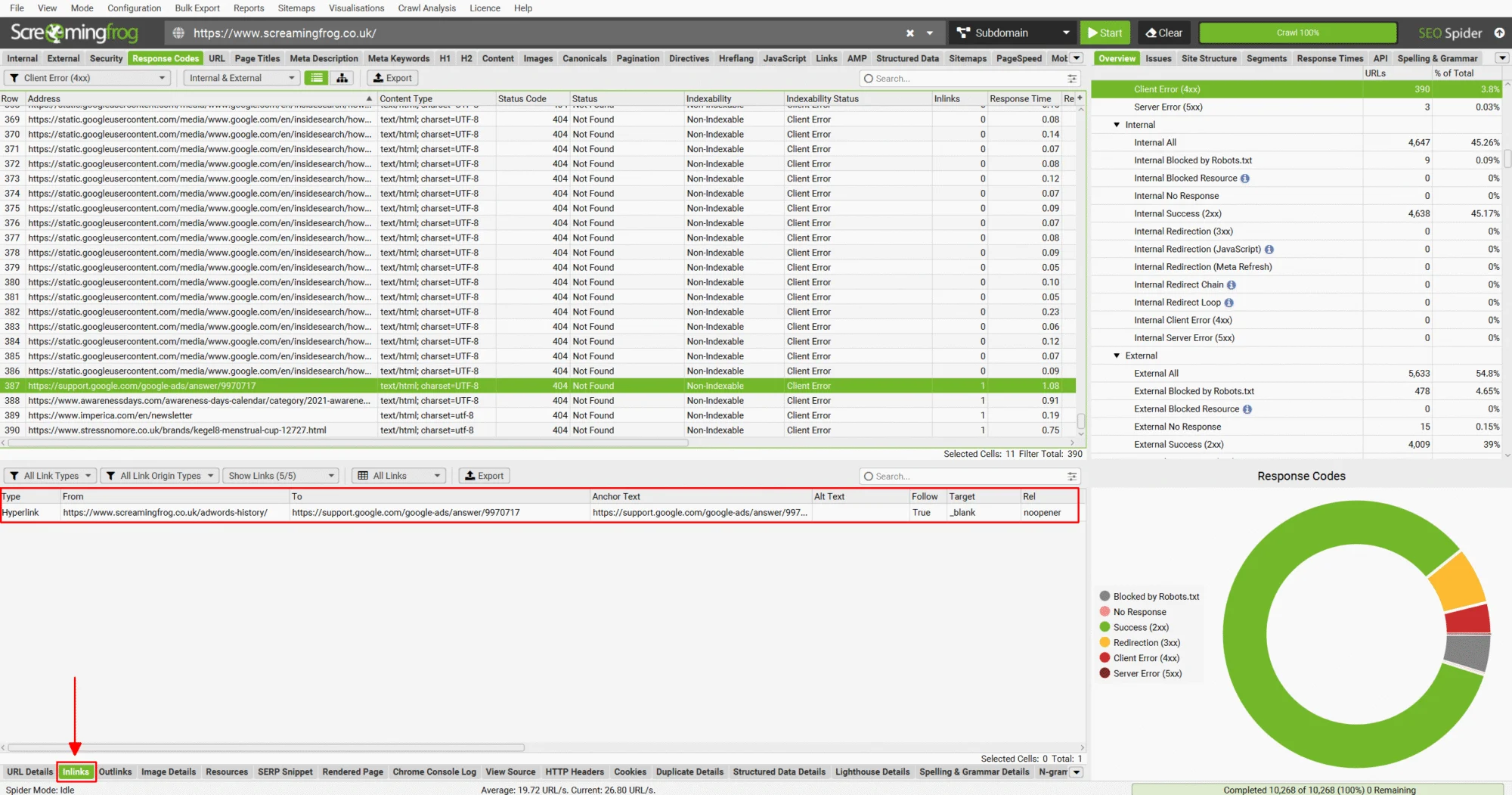
The official getting-started guide shows a concrete handoff: select Response Codes → Client Error (4xx), choose a URL, and inspect Inlinks, the pages linking to it. Bulk Export → Client Error 4XX In Links exports the source links for investigation. This gives a buyer an output to request, such as a file identifying affected source pages, without assuming the tool has explained the cause or approved a repair.
The vendor’s published screenshot below shows a selected 404 URL and its referring page in the lower Inlinks pane. It is documentation, not a crawl J6 ran. The guide and controls were retrieved October 23, 2026; the evaluation owner should recheck them before a later demonstration or after an interface change.
Read Conductor’s SSO Example Before Assuming Access Is Restricted
Conductor’s SSO documentation makes the distinction concrete. Single sign-on, or SSO, lets an organization use its identity system to authenticate people. Authentication checks who a user is; permissions determine what that person can do or access.
The documentation says optional auto-provisioning creates a profile when an authorized user signs in. Those users receive read-only permissions by default and access to all Conductor platform accounts associated with the organization. Account access can then be changed.
Read-only therefore answers an editing question, while the account configuration answers which data the user can see. If Brand A staff must have no access to Brand B accounts, that requirement needs an explicit provisioning and account-access arrangement. The documented default is a configuration consideration, not proof of a product flaw or an account setup we tested.
For that buyer, the useful demonstration is specific: provision an agreed test user, show the permitted Brand A view and export, then show that the user cannot access Brand B data. Include direct account access as well as a filtered report. Have the identity and platform administrators explain how the restriction remains effective for new users. This requirement follows from the buyer’s organization; other buyers may legitimately allow shared access.
Run the Same Enterprise Acceptance Exercise
Use a small exercise with your actual requirements before comparing demonstrations. Set the conditions first so an impressive demonstration cannot silently redefine success.
Here is an illustrative buying situation, not a client case or completed vendor trial. A company has two US brands. Its central SEO team needs shared research and reporting; each brand’s users must remain restricted to their own brand. Analysts already work in a BigQuery warehouse and need agreed keyword/landing-page data delivered weekly. Technical specialists already supply crawl findings, so replacing that capability is optional.
The buyer must supply the actual domains, keyword/market/device combinations, refresh requirement, required history, and permitted users. One combination might be a named query tracked on Google in the US on mobile; adding desktop or another market can create additional tracked combinations under the vendor’s counting rules. The existing reporting specification defines the fields the analysts need; this exercise checks whether a package can supply them. Detailed technical diagnosis remains a separate job.
Give each plausible platform the same requirements and ask for these outputs:
| Buyer Question | Demonstration and Evidence to Retain | Who Evaluates It |
|---|---|---|
| Can the quoted package cover our workload? | Show the agreed domains, market/device set, refresh, and history. Retain the package allowances and any excluded scope. | SEO lead and vendor |
| Will the required data reach our warehouse? | Deliver a sample with the agreed fields and periods. Compare it with the source; record missing records, transformations, refresh, and failure handling. | Data owner |
| Will brand access stay restricted? | Use agreed test users to check permitted and prohibited views, exports, and changes, including newly provisioned users. Retain role/account settings and observed results. | Identity/platform administrator and brand owner |
| Can someone operate the connection? | Name who sets up credentials, maintains the integration, and responds to failures; retain the proposed handoff and support scope. | Implementation owner |
An integration may be native, use an API, or rely on another connecting service. State the actual source, destination, and direction. An inbound analytics connection does not by itself prove that all required data can be exported to a warehouse. The data owner should define acceptable coverage and freshness before assessing the sample.
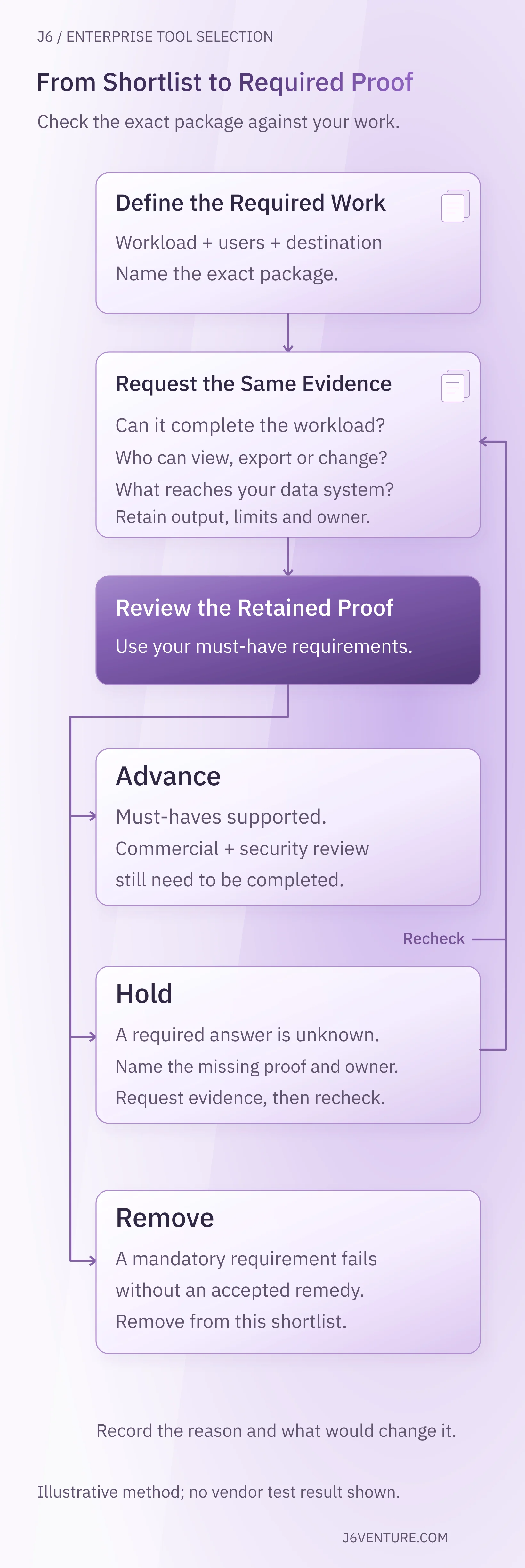
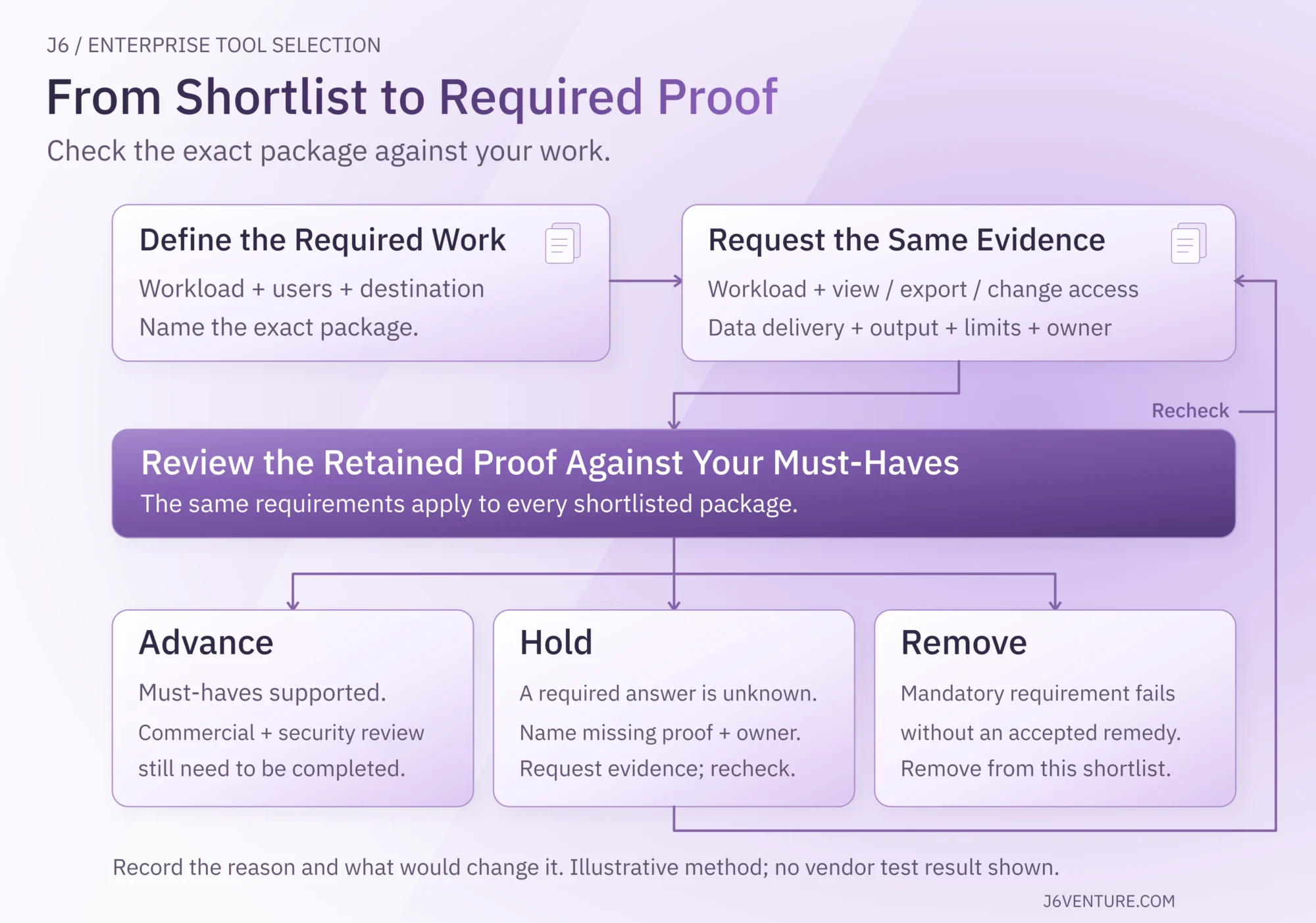
Record each mandatory requirement as supported, failed, or unknown, with the retained evidence. “Supported” means the demonstration and package terms meet the agreed condition; it does not demonstrate every future workload or implementation outcome. Unknown means the proof has not been supplied or resolved, not that the capability is absent.
For the illustrative company, broad feature coverage plus an unresolved Brand B access boundary means hold the package pending access evidence. If the configured test user is correctly restricted and the required weekly data sample and terms meet the agreed conditions, advance to commercial and security review. Those reviews still need completion. If a mandatory restriction fails and there is no accepted remedy, remove that package from the current shortlist.
A demonstrated configuration or revised package that satisfies the restriction can change the hold or removal decision. A missing field in the promised warehouse output can change an apparent advance back to hold. These are conditional buying judgments; no named vendor has been assigned a fictional pass or failure.
An existing specialist can remain in place throughout. If your missing requirement is only a crawl export, the shared-platform evaluation may add unnecessary work. A separate local or AI-search requirement may need its own specialist evaluation; it does not automatically justify every adjacent module.
Compare the Package and Working Cost
Ask vendors to price the same workload and term. Include domains, markets, engines/devices, tracking frequency, crawl/rendering allowances, required applications, users, API/export usage, history, and support. Specify implementation, training, connector maintenance, and any services needed to produce the agreed output.
Keep unlike units separate. A per-user annual license, a monthly starting floor, and a custom enterprise quote cannot be compared as complete costs. Unlimited rows per request does not settle monthly consumption; unlimited crawl pages can still depend on resources. Check taxes and currency at purchase, along with minimum commitment, renewal changes, and cancellation terms.
For the two-brand company, request a quote that explicitly covers the restricted-user setup and weekly warehouse delivery. If that requires an extra module, connecting service, or internal development, identify its cost and owner. Leave unpriced work visible until resolved.
Request the data you can retain or export when the contract ends, the available format, and any associated fees. A useful quote comparison shows what will be paid, what work remains internal, and what is still unknown.
Record the Shortlist Decision
Finish with a decision someone else can inspect: the candidate and exact package, the requirement that justifies considering it, the evidence retained, any unresolved mandatory condition, and who will obtain the next answer. Set a review trigger, such as receipt of the missing permission demonstration or a revised quote.
In the illustrative company, a promising platform can remain on hold for one access question. That is a complete evaluation outcome at that stage. Advancing it requires the missing proof; buying it requires the remaining commercial, security, and implementation decisions.
Keep the existing setup when it already completes the required work. Add a specialist for a defined gap. Evaluate a shared platform when the joint work across teams and systems warrants it. The shortlist becomes defensible through those specific reasons and retained evidence.
If you need help turning an unclear software requirement into a focused evaluation, talk to J6 Venture. Bring the work you cannot complete, the users who need access, and the systems that must receive the output.