SEO, short for search engine optimization, helps search engines find and understand your pages and helps people discover useful content through search. You can finish a course and still hesitate over the first page you need to improve. The missing piece may be practice, feedback, or a specific skill the course never promised to teach.
Before choosing a course, finish this sentence: “I need to be able to ___.” For example:
- Explain why a page answers a particular search question.
- Build a keyword map: a list showing which searches each existing or planned page should answer.
- Investigate an indexing problem, such as a search engine not storing a page for possible inclusion in its results.
A specific task gives you a reason to choose one course over another.
These recommendations compare publicly available provider descriptions, checked October 25, 2026. We reviewed curricula, access statements, workload, and assessment details. We did not complete these courses or compare their teaching effectiveness. The practice suggestions below are ours unless identified as provider coursework. These small exercises can expose learning gaps; they do not establish professional competence.
Scroll sideways if any columns are off-screen.
| Course or Learning Option | Consider It For | Cost and Time Basis | Practice or Credential Evidence |
|---|---|---|---|
| Ahrefs SEO Course for Beginners | A first foundation before choosing a specialty | Free, no signup; two hours of video time | Fourteen lessons; this course page does not advertise a certificate or assessed project |
| Keyword Research Essentials with Semrush | Turning keywords into a page plan after learning the basics | Free course; check access to the demonstrated software; no precise total time established; allow time for practice | Keyword-mapping worksheet, walkthroughs, and a final test for its certificate |
| UC Davis SEO Specialization on Coursera | A beginner-level sequence with a consulting project | Paid access; current price requires checking. Provider’s program estimate: two months at ten hours a week | Five courses, including a capstone with a keyword map, report, and presentation |
| Moz SEO Essentials Certification | A structured foundation with tasks and exams | Displayed price $595; provider-estimated total of approximately eight hours; standard material access for one year | Six parts, section tasks/quizzes/exams, and a final certification exam |
| Wix Technical SEO | A foundational technical knowledge gap | Hub lists one hour seven minutes of module video time; price/access entitlement not established by the reviewed page | Completion exam and record of completion; explicitly not its forthcoming SEO certification |
| HubSpot AEO Fundamentals | An optional addition for search and AI-answer visibility work | Free certification course; account required; two hours twenty minutes of listed course time | Seven lessons and nineteen videos; not the older SEO course some lists still describe |
Video lengths, program estimates, and total commitments use different bases. Add time to pause, practice, and revisit mistakes. The table does not rank course quality or establish an all-in US checkout price. Follow the provider links in the profiles for the current offer.
Start With the Work You Can Already Do
Your job title alone cannot place you. A marketing manager can be new to SEO; a junior specialist may already know enough to skip an introduction.
Use a small piece of work to place yourself:
- Starting from scratch: You cannot yet explain how a search question connects to a useful page. Choose a foundation and apply one lesson to a page you control.
- Ready for application: You understand the basics, including search intent: what someone is trying to accomplish with a search. But you get stuck producing something specific, such as a keyword-to-page map or a useful report. Look for instruction that demonstrates that output.
- Closing a specialist gap: You already perform routine work and can name what you cannot diagnose or implement. Choose the relevant module or specialist resource instead of repeating an entire foundation.
Then write a short learning brief: the task, what you can already do, your weekly study time, the site or sample you can use, and the help you need. “Learn SEO” is too broad to distinguish two otherwise credible courses. “Explain three keyword-to-page choices to my manager” gives you something to compare against the syllabus.
If you need someone to check your reasoning, include that requirement. Videos, quizzes, a downloadable template, and individual feedback are different forms of help. Do not assume that a course with a certificate includes review of your own website.
Which SEO Course Fits Your Next Task?
Ahrefs for a First Foundation
Ahrefs’ SEO Course for Beginners is a sensible first option when you need a compact introduction without a signup. Its fourteen lessons cover search basics, keyword research, on-page SEO, link building, and technical fundamentals. The provider lists five modules and two hours of video.
That breadth helps someone understand how the pieces connect before choosing a specialty. It is less useful as a substitute for a detailed reporting program or a specialist technical investigation: those are not dedicated modules in this course’s displayed breakdown.
Suggested practice: Take one page you are allowed to work on, or inspect a public page without changing it. Describe the question it answers, why that question matters to its reader, and one improvement you can justify from the lesson. Keep the reason beside the proposed change; a rewritten title alone does not show your thinking.
The specific course page does not advertise an assessed project or certificate. Its separate certification navigation does not establish a credential for this course. Free viewing also does not mean every demonstrated Ahrefs software feature is free.
Semrush for a Keyword-to-Page Plan
Keyword Research Essentials with Semrush targets people who have mastered SEO basics. It is the more direct fit when your immediate difficulty is organizing research into a page plan.
The syllabus moves from broad starting terms to keyword lists, clustering (grouping related searches), mapping them to pages, tracking, and AI prompt research. Walkthroughs use a dog-shirt business and demonstrate choosing between existing and new pages. A downloadable keyword-mapping template lets learners follow the work. The final section directs learners to pass a test for the certificate.
Suggested practice: Adapt the mapping worksheet to a few pages on your own or an explicitly hypothetical site. Record why each question belongs on its proposed page and what still needs checking. The provider page does not establish that your completed map will be graded.
The course is free, but the demonstrations use Semrush tools. Check that your account can perform the relevant tasks before planning a software-dependent exercise. Allow time to work through the relevant lessons and practice; a single precise completion time was not established.
UC Davis for a Structured Consulting Project
The University of California, Davis SEO Specialization on Coursera suits a learner who wants a longer sequence and a substantial project rather than a quick answer to one tool question.
The five-course program progresses through introductory SEO, fundamentals, website optimization, advanced content/social tactics, and a capstone. The provider recommends the listed order because later work builds on earlier courses. Its displayed estimate is two months at ten hours a week; your schedule and practice needs may differ.
The capstone is a concrete differentiator. Its listed outcomes include an SEO pitch, a competitive analysis and keyword map, followed by a report and client presentation. That is provider-described coursework, unlike the suggested exercises elsewhere in this article. It does not establish how much individual feedback you will receive or how well you will perform it.
Check the enrollment terms carefully. The page shows “Enroll for free,” while its FAQ says the program cannot be taken free and describes paid access and possible financial aid. No exact current price was established in our review. Confirm the selected plan, access period, renewal terms, and any software needed for assignments.
Despite “Google” appearing in course names, this is the UC Davis offering on Coursera, not evidence of a Google-issued SEO qualification. The specialization does not normally carry university credit; an institution may choose to accept it under its own rules.
Moz for Fundamentals With Exams
Moz SEO Essentials Certification offers six parts covering fundamentals, keyword strategy, on-page work, links, reporting, and a final exam. Its page displays $595 and estimates approximately eight hours total, with standard material access for one year from purchase. Promotional access can differ.
Consider it when that defined sequence, assessment, and access period justify the price for your needs. This comparison has not established superior learning outcomes over free options. It provides a different commitment from browsing free videos: the provider specifies a sequence of section work and a final certification requirement.
The applied demonstrations use Moz tools. Moz says a subscription is not required to get value because the underlying ideas transfer to other toolsets. That does not establish that every hands-on Moz exercise can be performed free. It also warns that software interfaces may differ from the lessons.
Before paying, ask what access and assessment you receive and whether any feedback covers your own work.
Wix for a Specific Knowledge Gap
Wix’s Technical SEO course, led by Aleyda Solis, is a focused option when you need technical foundations. Technical SEO examines whether a site’s setup lets search engines reach, process, and index its pages. For example, has a setting accidentally told search engines to exclude a public page from search?
The course introduces controls for access and indexing, site performance, and an audit. It says you do not need to be a developer.
The course hub lists one hour seven minutes for this module. It also lets you choose other topics, such as Search Console or reporting, without treating the whole collection as one mandatory course. Some hub offerings explicitly concern Wix Studio implementation; check the individual module if you work on another platform.
The technical course has a completion exam: fifteen questions, twelve correct answers required, and twenty-five minutes allowed. Its FAQ distinguishes a record of completion from an SEO certification, which it describes as coming later. Do not treat them as the same credential.
Suggested practice: Inspect a practice page and explain one issue you would investigate, such as a search-exclusion setting, and what evidence would confirm it.
Begin with observation; changing live site controls requires appropriate knowledge and permission. The reviewed page did not establish a price or entitlement to every learning feature; login is offered to save progress. Check access before relying on it for a deadline. No individually reviewed audit was established.
HubSpot for an AI Search Supplement
HubSpot’s AEO Fundamentals covers answer engine optimization (AEO): preparing content for discovery and use in AI-generated answers. Its syllabus addresses search strategy, content planning, AI citations, and measurement. It lists seven lessons, nineteen videos, and two hours twenty minutes, with free certification-course access through an Academy account.
This is a relevant supplement when your next task includes how content appears in AI answers. It need not be everyone’s first course. Compare its specific curriculum with your gap rather than assuming an AI label replaces technical or search fundamentals.
A current identity check matters here: the older HubSpot SEO-training URL opened this AEO course when we reviewed it. Older summaries of an SEO certification should not be used as its current syllabus or workload.
Suggested practice: Use one existing page to identify a clear reader question and the evidence supporting its answer. Record what you would change and what you cannot establish about AI visibility. AI citations are not guaranteed, and we did not establish that HubSpot will grade your page.
Check the Full Commitment Before Enrolling
Compare the commitment you will actually make, including tuition, tool access, study time, practice, and any feedback you require.
For paid learning, confirm whether the charge is a one-time purchase or a recurring subscription, when access ends, what renews, and the cancellation/refund terms. Confirm the currency, taxes, and final checkout total.
For free learning, check the work you can do without buying software. If a lesson uses a paid report, ask whether sample data, a permitted alternative, or temporary access lets you complete the exercise. Do not start an unnecessary subscription just to follow a video.
Ask a precise feedback question: “Will someone review my completed keyword map, or does assessment consist of quizzes and exams?” We did not establish an entitlement to individual project feedback across these options. If that support is essential, get an answer before committing.
Finally, separate three things: watching the material, passing the provider’s assessment, and applying the ideas to your situation. A course may help with all three, but a credential alone cannot establish the last one. This comparison does not measure employer recognition or employment outcomes.
Try the Method With One Learner Example
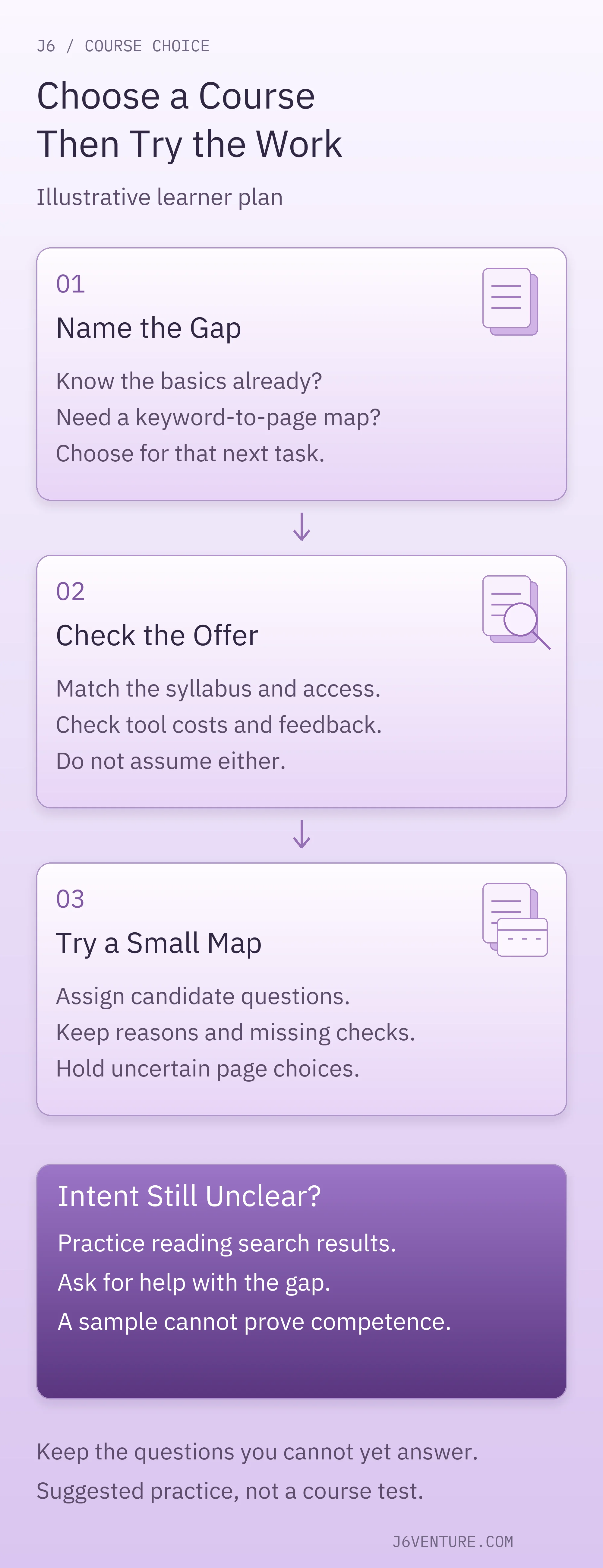
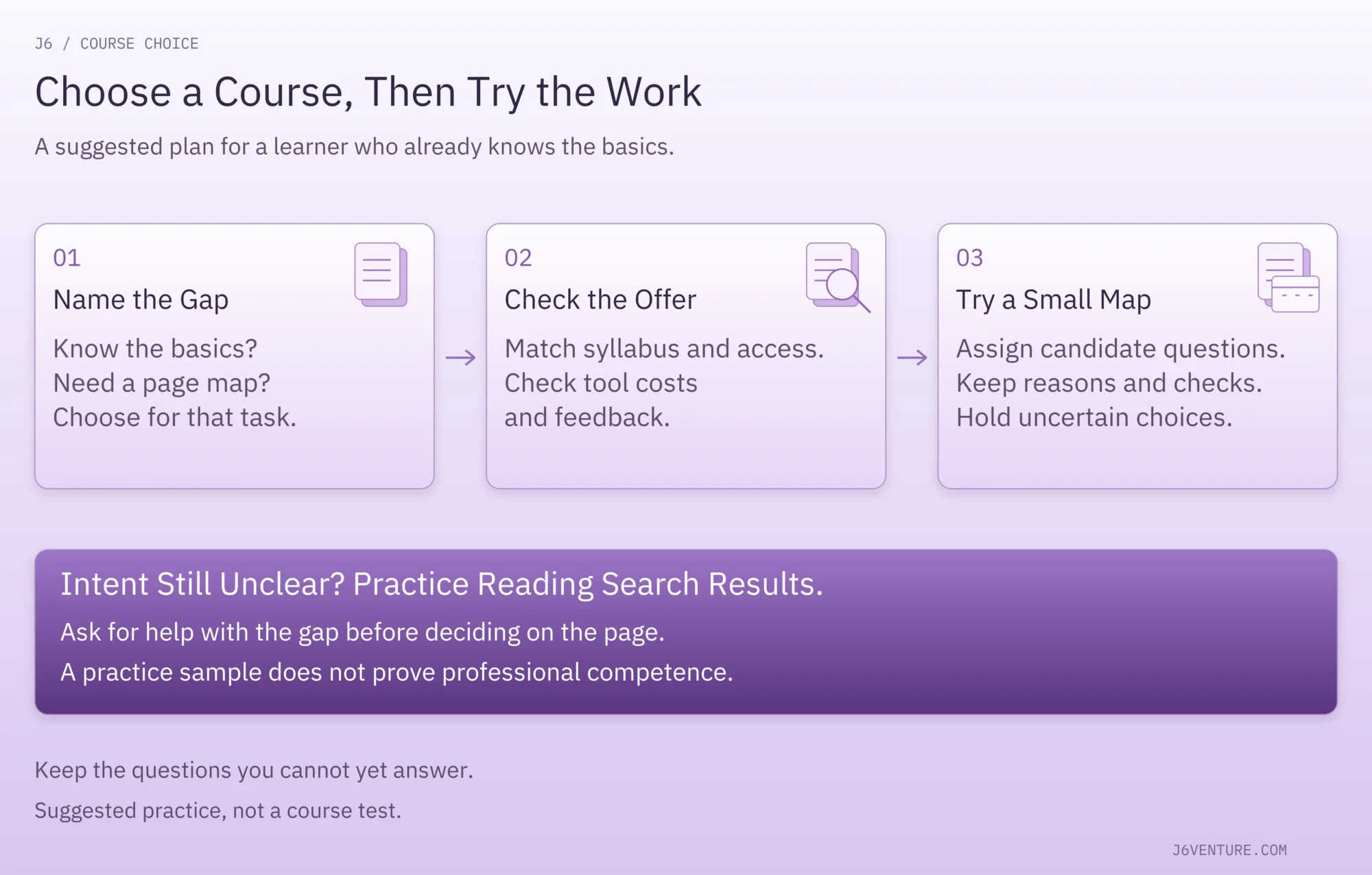
Consider an illustrative junior marketer at a maintenance-software company. This is a teaching example, not a J6 client result or a completed course test.
They can explain basic search intent but struggle to assign candidate topics to pages without creating near-duplicates. They have four hours a week for learning and practice. Their immediate deliverable is a small page map their manager can discuss, not a certification requirement.
For this example only, assume the company already provides the Semrush access needed for the chosen walkthroughs. Readers without that access must resolve the tool requirement or choose a different exercise before following this route.
Choose the Course and Practice Output
Start by matching that task to the documented teaching. Semrush’s keyword course demonstrates clustering, existing-versus-new page choices, and mapping in a worksheet. That is a direct reason to start there. Ahrefs is broader introductory learning they may partly repeat; UC Davis is a longer project sequence; Moz offers a wider foundation with exams.
As an illustrative four-hour week, reserve one hour for relevant lessons, two for attempting the map, and one for discussing questions. This is our suggested allocation, not a provider workload estimate. Start with the lessons on clustering and page mapping. This is a suggested learning sequence within the example, not a promise that watching two lessons completes the course or earns its certificate.
The learner’s output should show a candidate question, a proposed destination, the reason for that choice, and the evidence still missing. The following questions and pages are invented. They are not researched keywords, verified search demand, or recommendations for a real company.
Scroll sideways if any columns are off-screen.
| Illustrative Candidate Question | Proposed Destination | Reason and Missing Check |
|---|---|---|
| What can maintenance scheduling software do? | Existing product overview | The question concerns the product’s function. Check actual search results and whether the page answers it before adopting the mapping. |
| How much does this maintenance product cost? | Existing pricing page | Cost information belongs where this product’s current terms can be checked. Confirm that those terms are complete and accurate. |
| How do property managers schedule preventive maintenance? | Hold the page decision | Could require an educational guide or a specialist use-case page. The wording alone does not establish intent, product fit, or the need for a new page. |
The held decision is useful work. It tells the manager which question needs research instead of hiding a guess inside a finished-looking spreadsheet.
Check the Sample and Find the Next Gap
Review the map with these questions:
- Can the learner explain each destination using the reader’s question and the actual page content?
- Can they identify what evidence would change the choice?
- Have they separated known product facts from assumptions about search demand or intent?
- Can they explain why one decision is still on hold?
If the third row is unresolved because they cannot interpret search results, that is the next skill to practice. Another certificate will not answer that specific question on its own. If the problem is uncertainty about the product, they need an answer from the product owner before more SEO study will help.
Ask a manager or experienced colleague to challenge the reasoning if available; this is not an included Semrush feedback service. Their comments may reveal another gap. Keep the unresolved questions with the map so the next learning session addresses a specific gap.
When a Course Is Not the Right Next Step
If you already know the work and need a reference or one missing topic, LearningSEO.io may be more suitable than another broad course. It is a free, self-directed roadmap linking community resources across fundamentals, execution, specialisms, and advanced topics. It is not a bounded certification program with a fixed completion time or verified individual feedback.
For deeper technical study, Blue Array’s Technical SEO Certification was also reviewed. Its page says new sign-ups are temporarily paused while content is refreshed. It is not an immediate-start recommendation; current price and reopening were not established. We have not verified an advanced technical program as a universal next step here.
A course also cannot replace permission to practice on a site, access to required data, or a qualified person to review work when you need that support. Identify that missing condition before adding more lessons.
Make Your First Course Choice
Write down one task, choose the offer whose current syllabus addresses it, and check that you can access the lessons and tools. Put both a study session and a small practice session on your calendar.
Keep what you produce, including the unanswered questions. After that first attempt, decide whether to continue the course, repeat a relevant lesson, or ask for feedback on a specific gap. Use the work and remaining questions to choose what to study next.