
Useful SaaS blogs include ChartMogul for subscription metrics, For Entrepreneurs for business economics, Kalungi for customer research, Userpilot for activation, SaaStr for founder and sales leadership questions, and Growth Unhinged for explaining product value to prospective buyers. Choose a starting article that addresses your current question, check its assumptions and access, and leave with a next action.
A long reading list can leave you with plenty of advice and no clearer decision. A founder trying to understand customer losses needs a different starting point from a product manager investigating onboarding or a CEO hiring a sales leader.
Give each source a job. Read to understand a term, work through a method, or examine another operator’s experience. That makes it easier to choose what deserves attention and recognize when you have learned enough to move forward.
Choose Your Starting Blog by the Question You Have
These six publications cover different parts of running a software-as-a-service business. Their order is a way to find a useful starting point; it is not an overall quality ranking.
| Your Current Question | Start With | A Specific First Read | What You Can Work On |
|---|---|---|---|
| What does our customer-retention number measure? | ChartMogul | Customer retention rate (logo retention) | Define the customers and period your number includes |
| How do acquisition spending and recurring revenue fit together? | For Entrepreneurs | SaaS Metrics 2.0 | List the economic assumptions your business needs to examine |
| What should we learn from existing customers before changing our message? | Kalungi | How to Conduct B2B SaaS Customer Discovery Interviews | Prepare questions about actual buying and usage experiences |
| Are new users reaching meaningful product value? | Userpilot | User Activation for SaaS | Distinguish setup actions from signs that the user has received value |
| What should we examine when hiring a sales leader? | SaaStr | The Top 10 Mistakes I See In The CRO / VP of Sales Hiring Process | Draft role-specific interview questions and evidence to seek |
| How can customer evidence help us explain what the product is for and who it helps? | Growth Unhinged | How to build an AI brain for your positioning | Sketch how research, drafting, and testing would connect |
SaaS Metrics 2.0 is a substantial reference essay. For the acquisition-spending question above, start with its section “The SaaS P&L / Cash Flow Trough.” If recurring revenue is unfamiliar, read the opening “What’s so different about SaaS?” explanation first.
Choose the question closest to the work you need to do. If none fits, write your question before searching the wider archives. You do not need to subscribe to every publication to use one good article.
How We Chose These Six SaaS Blogs
We inspected the linked public articles and available archives on October 21 and 22, 2026. Each pick needed a distinct reader job, a publicly readable starting article, a next action, and clear limits on applying the advice.
This is an editorial selection, not a traffic league table, an exhaustive review of every SaaS publication, or a test of business results.
The six starting pages in the table were readable without a paid login when checked. Access can differ elsewhere in the same publication. Growth Unhinged, for example, has public articles and subscriber-only material; another post we inspected stopped at a paid-subscriber notice. A readable homepage does not establish that every linked article is free.
Publication dates need interpretation, too. An older essay can explain a durable business mechanism, while a recent post can still rely on a specific sample or company situation. Check the underlying assumptions before borrowing a benchmark, buying a tool, or changing how your team works.
Six SaaS Blogs and Where to Start Reading
ChartMogul for Understanding Subscription Metrics
ChartMogul’s publication is useful when a discussion needs clearer definitions of recurring revenue, retention, or subscription performance. Its wider resources include a dedicated SaaS metrics library, where the linked customer-retention read now lives.
That starting page distinguishes retaining customers from retaining revenue. It explains logo retention, shows a calculation using the original customer group, and contrasts it with gross and net revenue retention. This is a helpful first stop when two people use “retention” to mean different things.
Try this after reading: write a short definition beside your own retention report. Name the starting group, the period, and whether you are counting customers or money. A growing total customer count does not, by itself, describe how many customers stayed from an earlier group.
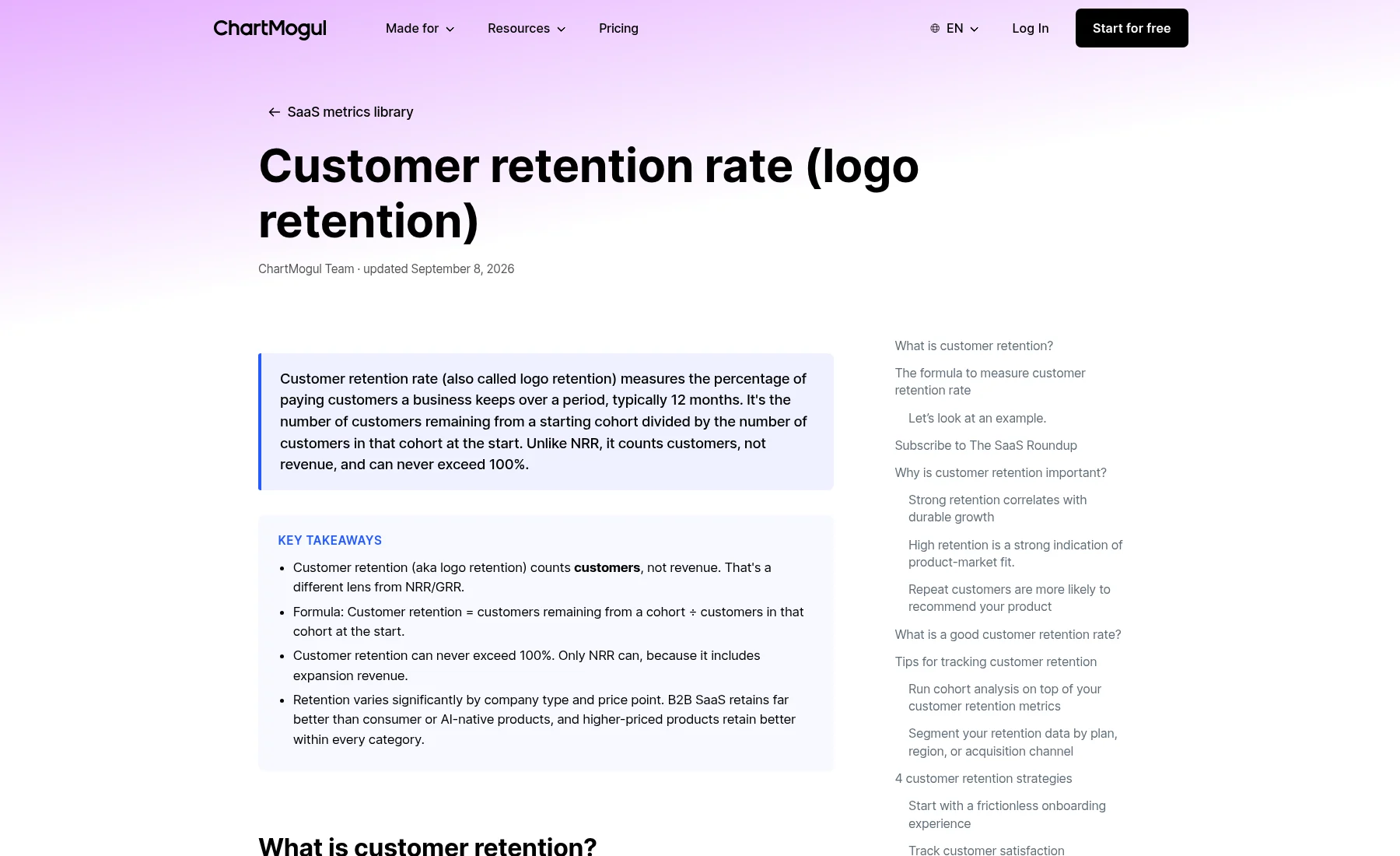
ChartMogul sells subscription analytics, and its resources include product material as well as educational explanations. Use the definition and inspect the underlying report before adopting a benchmark. A comparison across businesses needs compatible customer types, periods, and metric definitions; a published association does not prove what caused your own result.
For Entrepreneurs for SaaS Business Economics
David Skok’s For Entrepreneurs is a starting point for understanding how a subscription business works financially. Its resource paths cover metrics, sales and marketing, product-led growth, fundraising, and team building.
The detailed SaaS Metrics 2.0 essay connects acquiring, retaining, and monetizing customers. It explains why paying to acquire a customer now while collecting revenue over time can create a cash-flow problem. Customer acquisition cost and lifetime value become parts of a business model rather than isolated dashboard labels.
Try this after reading: list what your own model would need to know: acquisition spending, gross margin, customer behavior over time, payment timing, and the assumptions behind any lifetime-value estimate. Mark what is measured and what is still an estimate.
This is a substantial reference essay, originally published in 2013, with later modifications. Its illustrative numbers, growth assumptions, and rules of thumb should be read in that context. A novice may need to pause at unfamiliar terms; an experienced finance or growth lead can examine where the model fits, or fails to fit, their own business. The article is not a current benchmark for every SaaS company.
Kalungi for Customer Research and Marketing Planning
Kalungi’s blog is worth exploring when you need a structured way to investigate a B2B SaaS marketing question. The inspected archive includes customer, product-feedback, and pricing-interview material alongside other marketing guidance.
Lamar Hendrikse’s How to Conduct B2B SaaS Customer Discovery Interviews is a concrete entry point. Its sections examine the customer’s role, the circumstances around switching, current value and frustration, the wider software environment, pricing perceptions, and the buying group.
The article distinguishes asking for a general opinion from investigating an experience that happened. A customer’s account of what prompted a switch can supply different evidence from their answer to a hypothetical “Would you buy this?” question.
Try this after reading: choose a customer question you cannot yet answer and draft a few prompts about actual events. Record who you need to hear from and what their relationship to the product lets them know.
Kalungi is an agency, and the article describes its approach to interviewing existing customers. A founder with no customers cannot adopt that recruitment situation unchanged. Its proposed interview lengths and counts are suggestions within that approach, not universal standards or a guarantee that the resulting sample represents a market.
Userpilot for Activation and Product Adoption
Userpilot’s blog is relevant when product and customer-facing teams need to think through onboarding, activation, and adoption. Its activation article provides a useful distinction between completing setup, experiencing product value, and developing repeated use.
The starting read asks teams to define activation around a particular user and use case. Connecting an account, importing data, or completing a checklist might make value possible without showing that the person has received it. That distinction can change which events a team decides to examine.
Try this after reading: sketch one user’s intended task. Label the setup actions, an action that might show the user has received value, and the later behavior you would need to observe. Treat this as a hypothesis to investigate, with an explicit time window and user group.
Userpilot sells product analytics and engagement software, and the article uses product examples. Its conceptual guidance does not require you to buy that platform. It also includes benchmark and revenue-impact claims. Do not assume a higher measured activation rate caused higher revenue, or compare two activation percentages without checking whether they count the same event and population.
SaaStr for Founder and Sales Leadership Decisions
SaaStr’s article archive offers founder and operator perspectives on topics including sales, hiring, fundraising, and scaling. It is useful when you want an experienced author’s view of a decision, including the reasons behind a forceful opinion.
Jason Lemkin’s The Top 10 Mistakes I See In The CRO / VP of Sales Hiring Process illustrates that style. The post questions whether a candidate understands the product, wants to do the selling work required, and can perform the role the company needs. It is a concrete counterweight to judging someone mainly by a previous employer’s name.
Try this after reading: turn one concern into an interview question or work discussion. For example, ask a candidate how they would learn your product and participate in selling at your current stage. Decide what evidence you would look for in their answer and references.
Read the post as Lemkin’s authored hiring perspective. Some of its judgments are emphatic; they are not validated screening rules for every company or candidate. A role at an early company may differ substantially from a large sales organization, so establish the work you need done before borrowing a hiring rule.
Growth Unhinged for Positioning and Go-to-Market Ideas
Kyle Poyar’s Growth Unhinged includes material on marketing, pricing, product-led growth, and selling. Its positioning articles explore how prospective buyers understand what a product is for and why it fits their problem. Commentary and other operators’ accounts show how a business question becomes a sequence of work.
The public starting article is Melissa Kwan’s account of repositioning eWebinar. It describes gathering customer and company material, organizing that context in an AI project, drafting messaging, testing it with people, and revising the language across different touchpoints.
Try this after reading: sketch which inputs you have, which claims need support, who could test a draft, and where accepted wording would need to stay consistent. You can learn from that sequence without reproducing the author’s AI setup.
This is a reported company experience, not a controlled test or a J6 result. Its business outcomes do not establish that AI or a particular wording change caused them, or predict what another company will achieve. The publication also includes sponsorship and paid content. Check the specific article’s access and disclosures; the publicly readable example does not make the whole archive free.
Match the Reading to What You Already Know
Your learning readiness depends on the question. An experienced marketer can be new to subscription finance, while an early founder may already understand onboarding deeply. Company size, funding stage, or software budget does not decide which explanation you need first.
If the vocabulary is unfamiliar, start with a definition and a worked explanation. ChartMogul’s customer-retention page can clarify what a metric counts; For Entrepreneurs can then supply broader economic context when that is the missing piece. You do not have to read a long reference essay from beginning to end to answer one question.
If you understand the concept but need to do the work, look for a method: the interview sections in Kalungi or the persona-and-event thinking in Userpilot. If you need another operator’s perspective, examine a specific SaaStr or Growth Unhinged account and identify the conditions behind it.
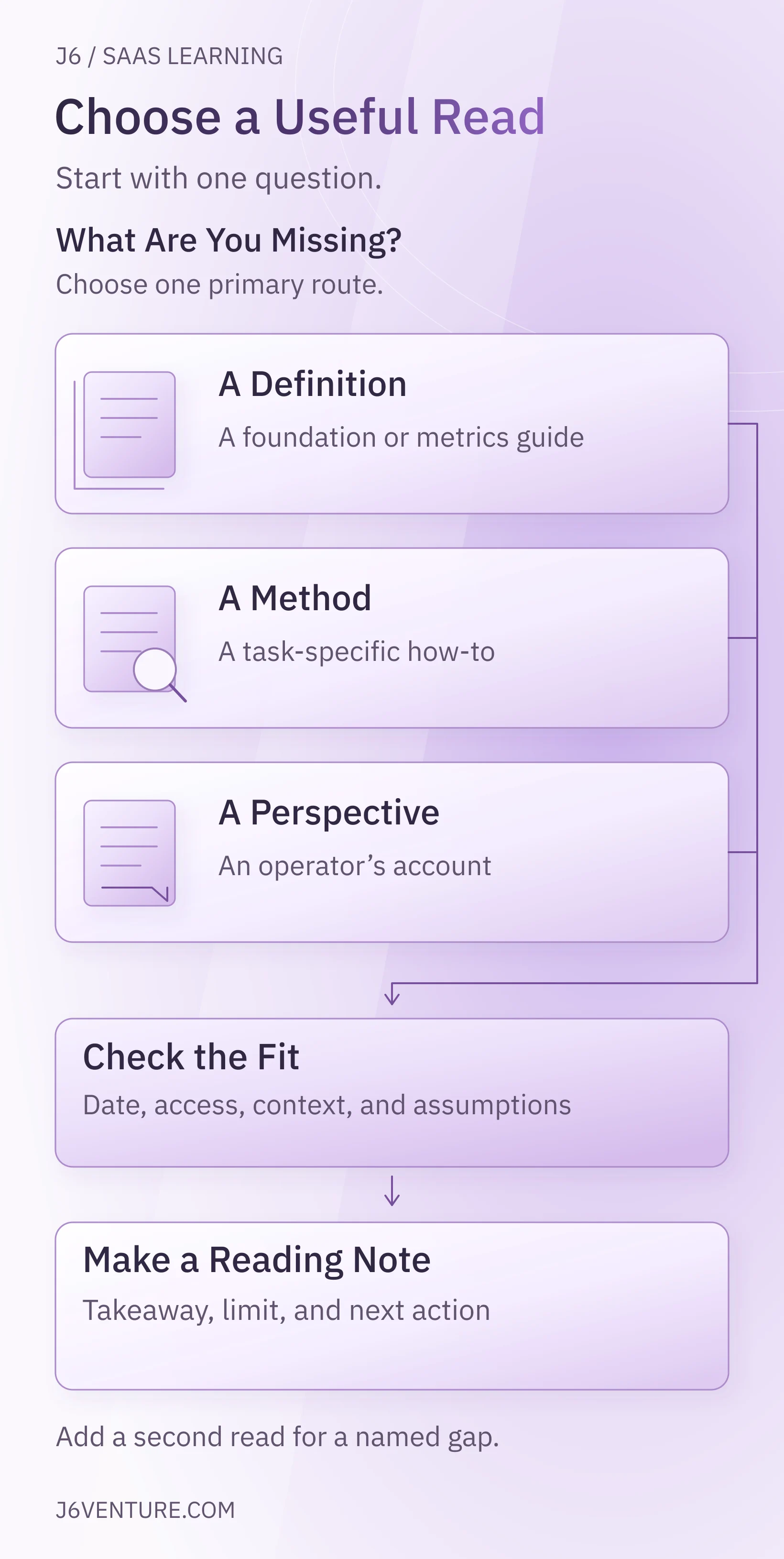
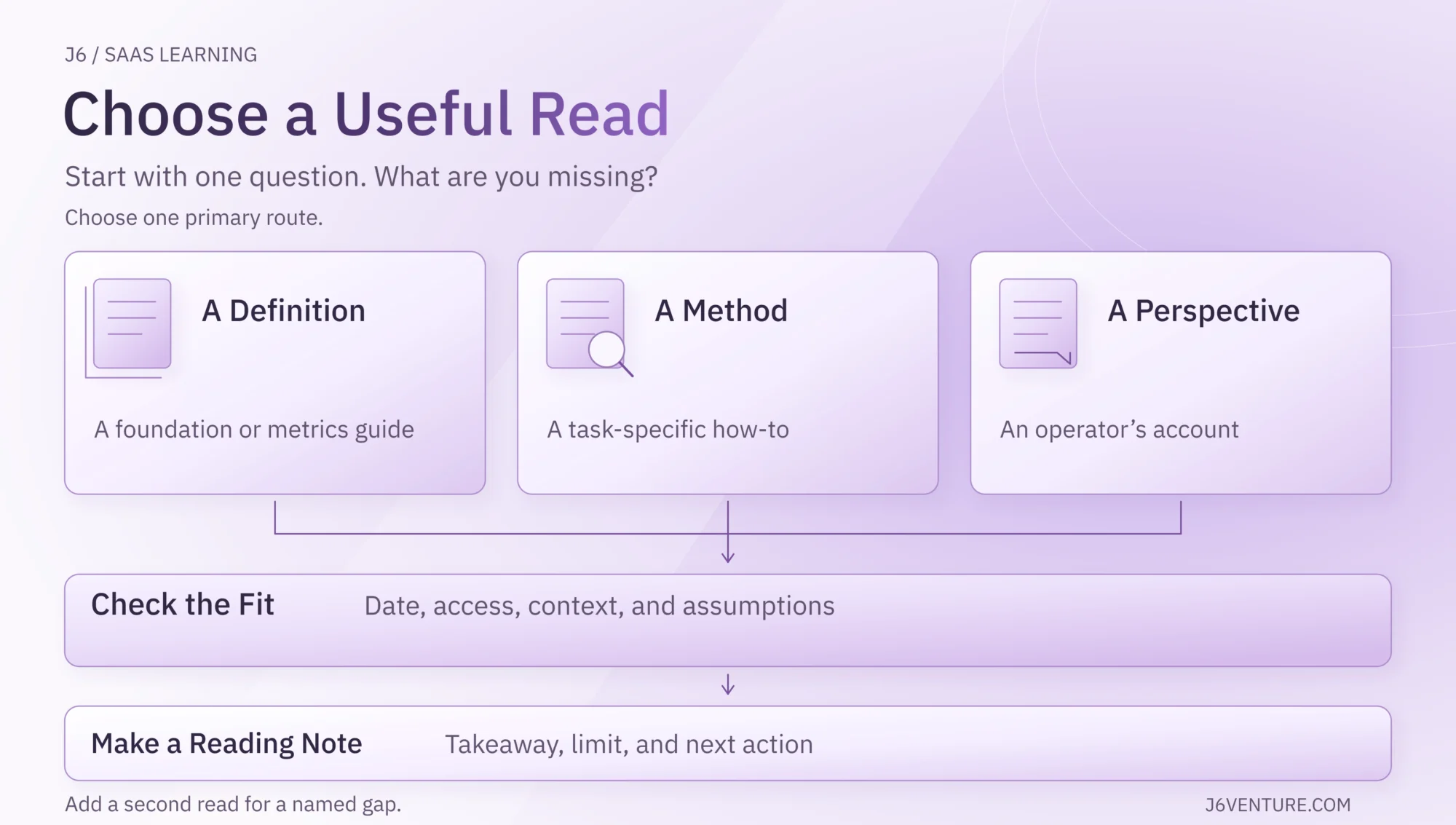
A second source should close a named gap. Add one when you still need a definition, a practical method, relevant evidence, or an alternative explanation. If one read already supports a qualified next action, it can be enough. A second subscription is not automatically a better learning plan.
When advice conflicts, compare the question, business model, customer group, definitions, period, assumptions, and evidence behind it. The authors may be addressing different situations. If the disagreement still matters to your decision, record what remains uncertain and seek the evidence needed to resolve it; agreement between more blogs is not proof.
Worked Example: Choose Two Reads for a Positioning Question
Consider an illustrative self-service SaaS company with existing customers. Its founder hears prospects struggle to explain what the product does. The decision is what customer evidence should inform a revised message before the team uses it more widely. The cause of the confusion has not yet been established.
The founder has two possible reading gaps:
- Missing customer evidence: begin with Kalungi’s discovery-interview article. Use its past-event and role questions to plan what to learn from existing customers. Their answers can inform the work, but may not represent prospects who never chose the product.
- Evidence exists, but its use is unclear: begin with Kwan’s Growth Unhinged account. Examine how customer material fed drafting and human feedback. Her reported sequence can suggest a work plan; her results are not a forecast for this company.
Suppose the founder has customer notes but cannot trace proposed homepage claims back to them. The reported positioning account is the closer first read. Kalungi becomes a useful complement only if the notes lack the buying or usage context needed to understand them. If that gap is already covered, the founder can stop after the first read.
A small reading note could look like this. The entries describe planned work, not completed research:
| Field | Illustrative Entry |
|---|---|
| Decision | What customer evidence should support the revised product message? |
| Input available | Existing notes; their connection to proposed claims is unclear |
| Idea from the first read | Organize the source material before treating a draft as finished |
| Adaptation | Link each proposed claim to a dated note and its context, then check whether the note supports the claim as written or leaves a condition unproved |
| Remaining gap | Do the notes explain what customers were trying to change and why? |
| Complement, if needed | Use Kalungi’s prompts to plan follow-up questions about actual experiences |
| Next action and owner | Founder reviews the notes, marks unsupported claims, and plans the missing conversations |
The immediate output is a clearer account of what supports the message and what is missing. If evidence is absent, pause the claim and gather it before presenting it as established. Customer material also needs appropriate permission and handling; an example’s use of an AI project is not permission to upload private records into one.
If the two sources seem to disagree, check what each was trying to accomplish. An existing-customer interview method and a reported positioning project answer different parts of the work. Neither supplies a universal interview count, a diagnosis of this company’s problem, or proof that the revised message will sell. Relevant prospect feedback would still be needed to assess whether prospects understand a proposed message.
Make Your Reading List Earn Its Place
Start with one question and one primary read. Keep a short note of the source, the useful idea, its conditions, what you still need to know, and the next action. Add a complementary read when you can name the missing contribution.
Keep a source that repeatedly helps with work you do. Defer one that is thoughtful but irrelevant to your current question. Revisit older advice when a changed business model, definition, or new evidence affects its application. There is no need to turn all six publications into a daily reading obligation.
Finish with a better-supported decision, a draft work product, or a clearer question for your team. Reading can get you to that point; your own evidence and execution determine what happens next.
If your question is how to turn your company’s expertise into content for buyers, J6’s guide to building a connected SaaS inbound journey addresses that separate task.