SaaS marketing challenges often come down to a few practical questions: Are we reaching the right buyers? Do they understand the product’s value? Can we turn their interest into paying customers at a sustainable cost? And are customers getting the value they expected? Choosing what to fix can be difficult when time is limited and different systems tell different stories. Start with the problem you’re seeing, check the evidence, and decide what needs attention first.
A SaaS marketing metric flags a symptom. Finding its cause takes comparable evidence. A campaign can deliver more leads while sales receives fewer suitable opportunities. Check which accounts arrived, what they needed, and where they stopped progressing.
The worked example below follows a 40% fall in qualified opportunities and shows why that decline alone cannot identify a demo-page problem. Use the closing decision brief to turn the investigation into a task with an owner and a review rule.
Why SaaS Marketing Challenges Need Different Responses
SaaS marketing connects a promise made before purchase with the value customers experience afterward. Buyers may need to understand the workflow, assess the effort of switching, and justify a continuing payment. A marketing response should address the uncertainty that is preventing progress for the audience you can serve.
That uncertainty depends on how the software is bought. A self-serve user might need a clear task to try and an understandable upgrade boundary. A sales-assisted account may need implementation information, a technical evaluation, and approval from several people. A partner selling software under its own brand needs a different explanation again.
A longer sales process is therefore one possible context, rather than a defining feature of every SaaS business. A free trial is also one evaluation route; demos, documentation, and customer accounts can help buyers assess software.
Marketing can improve targeting, expectations, buying information, and customer education. Product capability, implementation, support, and the customer’s own resources also affect what happens. Assigning the entire acquisition-to-retention journey to a campaign obscures those responsibilities. For the wider content and follow-up system, use the separate guide to building a connected SaaS inbound journey.
Six SaaS Marketing Challenges and What to Check
These six challenges provide a way to organize an investigation. Similar symptoms can have different causes: a low demo rate might reflect unsuitable visitors, an unclear offer, a broken form, or a buying task that does not require a demo yet. Use the checks to narrow the explanation before assigning work.
1. Reaching Buyers Who Need What You Sell
An audience problem arises when respondents need something the product cannot suitably provide, or suitable buyers cannot find the offer. Traffic and lead counts do not distinguish those situations.
Write down the target account’s job, necessary capabilities, buying constraints, and route to purchase. Compare those requirements with recent inquiries and sales rejection reasons. Two healthcare companies could need different workflows, deployment arrangements, or procurement support; an industry label alone cannot establish fit.
Check the combination of campaign promise, responding account, and qualification reason. A free template may attract useful future readers as well as people who will never need the software. Give each group an appropriate route; a download by itself does not establish readiness for a sales conversation.
If unsuitable inquiries cluster around a particular promise, inspect the targeting and page wording together. If suitable buyers arrive but cannot explain the offer, investigate positioning next. If observations are too few, speak with relevant prospects and record unanswered questions before expanding. Detailed SaaS SEO mistake diagnosis belongs to its own guide.
2. Explaining Why Your Product Fits
Positioning becomes a challenge when buyers cannot connect the product to their situation or justify switching. Clear feature descriptions can still leave that decision unresolved.
Ask what the buyer does today, where that arrangement becomes costly or difficult, and what would have to be true for a change to make sense. The alternative may be an existing vendor, a spreadsheet, a manual process, or postponing the project. Explain the relevant difference with evidence the buyer can inspect.
In HiringThing’s public account of its 2023 experience, partners brand and resell its applicant tracking system. The company explains that customer case studies and reviews often cannot be used for the HiringThing brand, limiting the proof available for partner-facing positioning.
This historical, self-reported account provides no measured lift attributable to the messaging. It illustrates why audience, value explanation, and usable proof must fit the sales model; it cannot establish what your buyers need.
Choose proof for the question at hand: a workflow demonstration, an implementation explanation, or a customer story that answers a buying question. A claim about security or a required integration needs its own supporting evidence.
3. Acquiring Customers at a Sustainable Cost
Acquisition becomes difficult when the cost of winning suitable customers cannot be supported by the value and cash flow those relationships generate. A cheaper click or lead can still produce a more expensive paying customer if fewer suitable accounts progress.
Stripe’s CAC guidance defines customer acquisition cost using acquisition-related sales and marketing costs divided by new paying customers. Trial sign-ups and marketing-qualified leads are different denominators. The same guidance highlights timing differences when spending and the resulting customers fall in different periods.
Before comparing channels, check:
- Included costs: advertising, production, acquisition staff, tools, and other allocated acquisition expenses.
- Customer definition: a new paying customer, counted consistently across the comparison.
- Timing: enough time for the relevant sales motion to produce customers.
- Customer mix: comparable segments, plans, and sales involvement.
Agree the acceptable acquisition cost and recovery horizon with finance using your margins, cash constraints, and observed retention. A universal SaaS ratio cannot settle that decision for your company.
If a channel’s qualified prospects progress but its costs have increased, test a bounded change in reach, creative, or allocation. If cheap inquiries seldom fit, investigate acquisition quality first. A change in reporting, or a group of inquiries without enough time to become customers, calls for a measurement check before a spending verdict.
4. Moving Buying Interest Through the Sales Process
An unanswered buying question, unmet requirement, or failed handoff can stall sales. Identify the obstacle before adding another nurture sequence.
Separate requested demos, held demos, qualified opportunities, and customers. HubSpot’s lifecycle documentation distinguishes marketing-qualified leads, sales-qualified leads, and opportunities, while allowing companies to customize stages. Agree your own operational criteria and record when an account reaches each stage.
Review stalled or rejected accounts with sales. Look for the actual obstacle: unclear scope or price, a missing stakeholder, migration effort, procurement questions, slow follow-up, or a required capability the product lacks. A CRM stage count identifies where to look; the account record and conversation help explain what happened.
Match the response to the finding. Explain the evaluation and expected next step on a demo page when that expectation is unclear. Supply approved implementation or security material when the relevant team has it. Give an unassigned inquiry a named response owner. Escalate an unmet requirement to product or the responsible specialist; do not imply that additional content will satisfy it.
5. Helping Customers Reach and Recognize Value
Marketing can support adoption and retention by explaining how to begin and when a capability is useful. Product, implementation, and support performance require collaboration with other teams.
Define a meaningful first-use event with product and customer success. For example, a workflow tool might treat completion of a useful workflow as an early milestone. Logging in or opening an email does not establish that the customer accomplished the job, and an early milestone does not prove later retention.
Compare the promise in acquisition materials with onboarding questions, product events, support records, and cancellation reasons. Review people who do and do not reach the milestone. A missing instruction suggests an educational response; an unavailable integration or recurring failure needs a different owner. Investigate payment failures separately from cancellations by customers who no longer need the software.
HiringThing describes customer education, newsletters, and nurture campaigns in its public account. Those are concrete customer-marketing activities, without evidence that they independently caused a retention improvement. Use an educational message when it addresses an observed need, then check the relevant behavior and later customer outcome. Expansion messages should likewise reflect a suitable additional need and the customer’s current experience.
6. Making Decisions With Evidence From Different Systems
Conflicting dashboards can consume a small team’s capacity and trigger disconnected fixes. Agree the outcome, connect the supporting records, and name the person responsible for the next decision.
Start with what each tool can show. A spreadsheet can join account-level counts and dated reasons. A CRM can retain agreed lifecycle stages and follow-up records. Amplitude’s funnel documentation explains how selected events, their order, and the conversion window determine the funnel being measured. These documentation checks were made on October 19, 2026; they are not an authenticated test of a paid account.
Connect those records through appropriate account or user identifiers before comparing them. A dashboard of sessions, a CRM of accounts, and a billing total are measuring different units. Attribution allocates credit under the chosen rules; it does not show how much revenue would disappear if a campaign had never run.
Capacity matters when selecting the response. HiringThing’s account describes repurposing content within a small team. In a different context, a buyer question already answered by an approved resource may need better placement or follow-up, while an unanswered implementation concern needs specialist input. Choose the work supported by the evidence and the people available to carry it through.
The evidence needed changes with the decision: fit records help investigate targeting, buying conversations help explain sales friction, and product or billing records help examine customer outcomes. A similar headline metric can call for a different check and a different owner.
Diagnose One Challenge in Four Steps
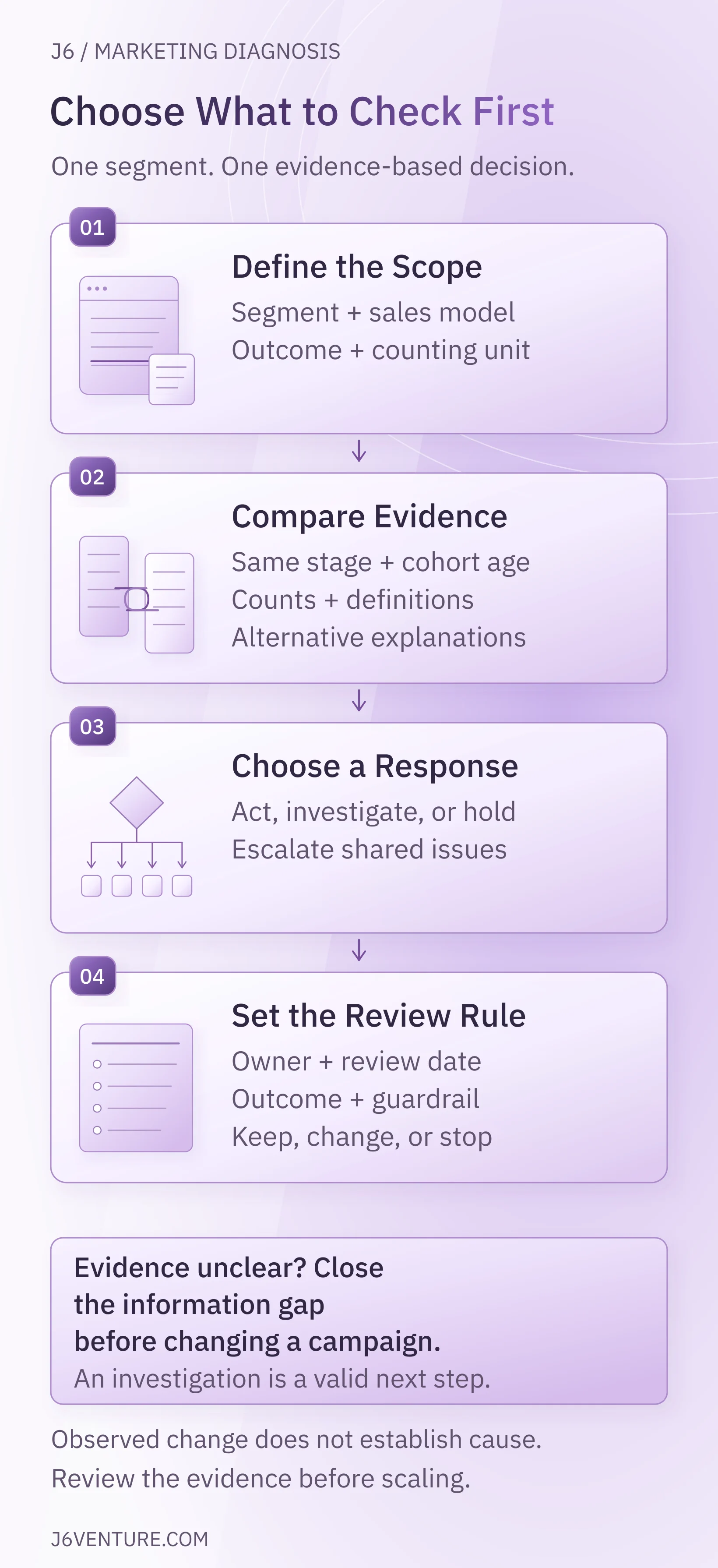
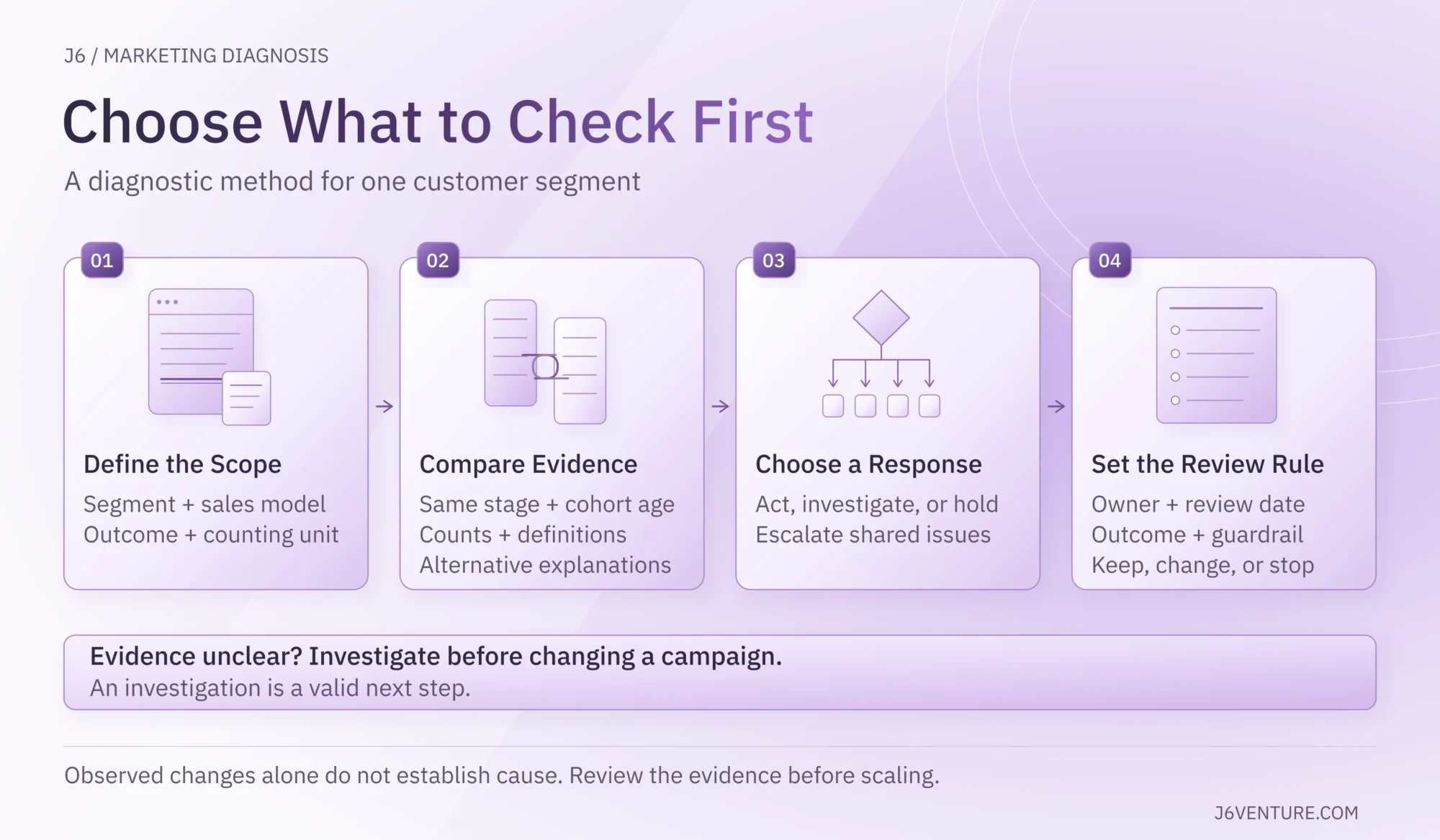
Use this four-step method to move from an observed problem to an owned decision. It is a suggested diagnostic aid, not a validated scoring model. It can end with a targeted change, an investigation, an escalation, or a reason to keep the current approach while gathering evidence.
1. Define the Segment and the Decision
Name the customer segment, sales motion, observed outcome, and decision under consideration. “Our paid demo campaign attracts more accounts, but fewer become qualified opportunities” gives the team something to inspect. “Marketing is underperforming” leaves the subject undefined.
Choose the counting unit and the operational meaning of each stage. Account-level sales opportunities should not be compared directly with user-level trial events. Record the question you need answered, such as whether to change targeting, repair the next step, or investigate follow-up.
2. Check Comparable Evidence
Compare groups entering under consistent definitions and give each the same time to progress. For a sales process, that may mean following each account for a fixed number of days after its inquiry. Two calendar-month totals can contain accounts with different amounts of time to progress.
Check tracking, duplicate records, changed qualification rules, and missing follow-up before interpreting a difference. Break out relevant segments or sources where the counts permit it. Keep at least two plausible explanations in view and name the observation that would distinguish them.
3. Choose an Action or an Investigation
Select the response that addresses the supported explanation. That might be revising a misleading campaign promise, answering a documented buying question, correcting measurement, or asking product to assess a requirement.
When several issues remain, weigh their commercial importance, evidence quality, urgency, dependencies, and available capacity. The largest percentage drop is not automatically the best first project. A serious later-stage issue may deserve attention while an earlier-stage comparison is still being checked.
State the current uncertainty. An investigation is complete when it answers the specified question or identifies what evidence is still unavailable; launching a campaign is not its completion condition.
4. Set an Owner and a Review Rule
Give one person responsibility for the next decision and name the collaborators needed. Record the proposed change or check, the work or spend limit, the result sought, and a downstream guardrail such as suitable opportunities or customer outcomes. Set a time limit for diagnosis so the investigation does not become an open-ended project.
Assign a review date that allows the observation window to mature. Decide in advance what would justify continuing, revising, reducing, or stopping the work. If the evidence is inconclusive, record whether to extend observation within an agreed limit or close the test without a causal conclusion.
Worked Example: More Leads, Fewer Qualified Opportunities
The following numbers are illustrative, not J6 campaign results or SaaS benchmarks. They show how to use the same four steps before choosing a website redesign. The example assumes a US B2B workflow product with a sales-assisted demo process and consistent qualification rules.
1. Define the Segment and the Decision
The marketing lead sees inquiry volume rise and qualified opportunities fall. The proposed response is to redesign the demo page. The decision is whether the available evidence supports that project or points to a different first check.
The unit is a unique inquiring account. Each entry cohort, meaning a group of accounts entering during a defined period, is observed for 45 days after each account’s inquiry. A target-fit account must meet the same defined workflow and capability requirements in both cohorts.
2. Check Comparable Evidence
Assume the team has checked duplicate accounts, missing records, stage definitions, and equal observation time. The stages below are nested: every opportunity shown belongs to the held-demo group, and every held demo shown belongs to the target-fit group in that entry cohort.
| Account-Level Stage, Within 45 Days | Cohort A | Cohort B |
|---|---|---|
| All inquiring accounts | 200 | 300 |
| Of those, accounts meeting target-fit criteria | 100 | 60 |
| Of those fit accounts, accounts with a held demo | 60 | 36 |
| Of those demo accounts, accounts accepted as qualified opportunities | 30 | 18 |
Inquiry volume rises 50%, from 200 to 300. Qualified opportunities fall 40%, from 30 to 18.
The target-fit share falls from 100/200 = 50% to 60/300 = 20%. Within the target-fit group, the observed held-demo proportion is 60% in both cohorts. Among those demo accounts, the observed opportunity proportion is 50% in both.
Those equal observed proportions do not prove that the underlying conversion rates are unchanged. They do show that the aggregate decline is not enough to establish a demo-page problem. The mix of responding accounts deserves investigation.
3. Choose an Action or an Investigation
First, inspect source campaigns, promises, and rejection reasons for the increase in unsuitable accounts. The aggregate table cannot identify which campaign produced that mix or establish why it changed.
If those records corroborate a promise attracting an unsupported use case, test a more accurate targeting or qualification change. If the audit instead uncovers inconsistent qualification, repair the comparison before changing campaigns. If suitable accounts describe a demo-page obstacle, investigate that separately; this table does not rule one out.
4. Set an Owner and a Review Rule
The marketing lead owns the source-and-fit investigation. Sales checks why accounts were accepted or rejected; operations checks that the inquiry, demo, and opportunity records belong to the same accounts. Limit this investigation to two working days, a chosen constraint for the illustration.
By that deadline, the lead returns a one-page comparison naming the sources of unsuitable inquiries, their recorded rejection reasons, and any missing records. It ends with one of three decisions:
- Reliable records corroborate a misleading promise: select a targeting or qualification revision as the proposed next project, with the supporting accounts identified.
- Reliable records contradict the misleading-promise explanation: close that specific explanation and name the different check the evidence supports.
- The evidence is inconclusive or qualification is inconsistent: keep the targeting explanation unresolved. Identify the missing information or records to reclassify. Allow one additional working day only if a named person can complete the check and rerun the comparison; otherwise close the investigation with the limitation recorded and defer the redesign decision.
This completes the diagnostic assignment. A subsequent campaign test is a separate decision requiring its own objective and effort or spend limit before launch. Its follow-up should use equally mature cohorts and review suitable-account and opportunity counts alongside cost. An improved fit percentage alone could conceal a collapse in useful volume. No campaign test or post-change outcome is assumed here.
Finish With One Decision Your Team Can Carry Out
Finish with one completed decision brief that your team can reuse for the next marketing question. It should explain the problem, distinguish a plausible cause from an established fact, and assign the next check or change to a responsible person.
Reusable SaaS Marketing Decision Brief
- Segment and sales motion: Who is affected, and how do they buy?
- Observed problem: What changed, using which unit, definition, and time window?
- Possible explanations: Which alternatives remain, and what would distinguish them?
- Next action: What will be changed, investigated, escalated, or left unchanged, and why?
- Accountable owner: Who makes the next decision, with which collaborators and work limit?
- Review rule: When will the evidence be mature, which outcome and guardrail matter, and what supports continuing, changing, or stopping?
Choose one live marketing question and fill in that brief with the records you already have. If a field needed for the decision cannot be completed, make the missing check the next task. If the evidence supports action, give the team a defined piece of work and a date to return to the result.