
ChatGPT ads are paid placements displayed separately from ChatGPT’s answers. Eligible US advertisers can start through OpenAI Ads Manager, define an offer and campaign goal, and prepare delivery controls and measurement before launch. Read the first results in order: check whether reporting has caught up, investigate measurement discrepancies, then compare qualified outcomes with the test’s spending allowance. Early clicks alone cannot establish acquisition success.
Your first ChatGPT ad can generate clicks before the dashboard shows what they cost. A website visit carrying your campaign tags can also come from an ad-review crawler. Start with a clear understanding of the paid placement, the business action you want, and the exposure you are prepared to fund. The software example is hypothetical, and the setup instructions come from public documentation. J6 has not run the campaign or inspected your account.
Product and control details were checked against official documentation on October 23, 2026. The marketer responsible for launch should recheck the linked guidance before enabling delivery and after interface changes.
What Are ChatGPT Ads?
ChatGPT ads let businesses pay for eligible advertising exposure within ChatGPT. An ad carries its own creative and destination, and the advertising system selects among eligible ads using relevance and other signals. The purchase does not give an advertiser control over ChatGPT’s organic answer.
Where the Paid Placement Appears
OpenAI’s advertiser basics describes an ad below a ChatGPT response, containing the advertiser’s name, logo, headline, description, image, and landing page. Its consumer FAQ also describes tests of visual ads during image generation. A tested format may reach only some eligible accounts or conversations.
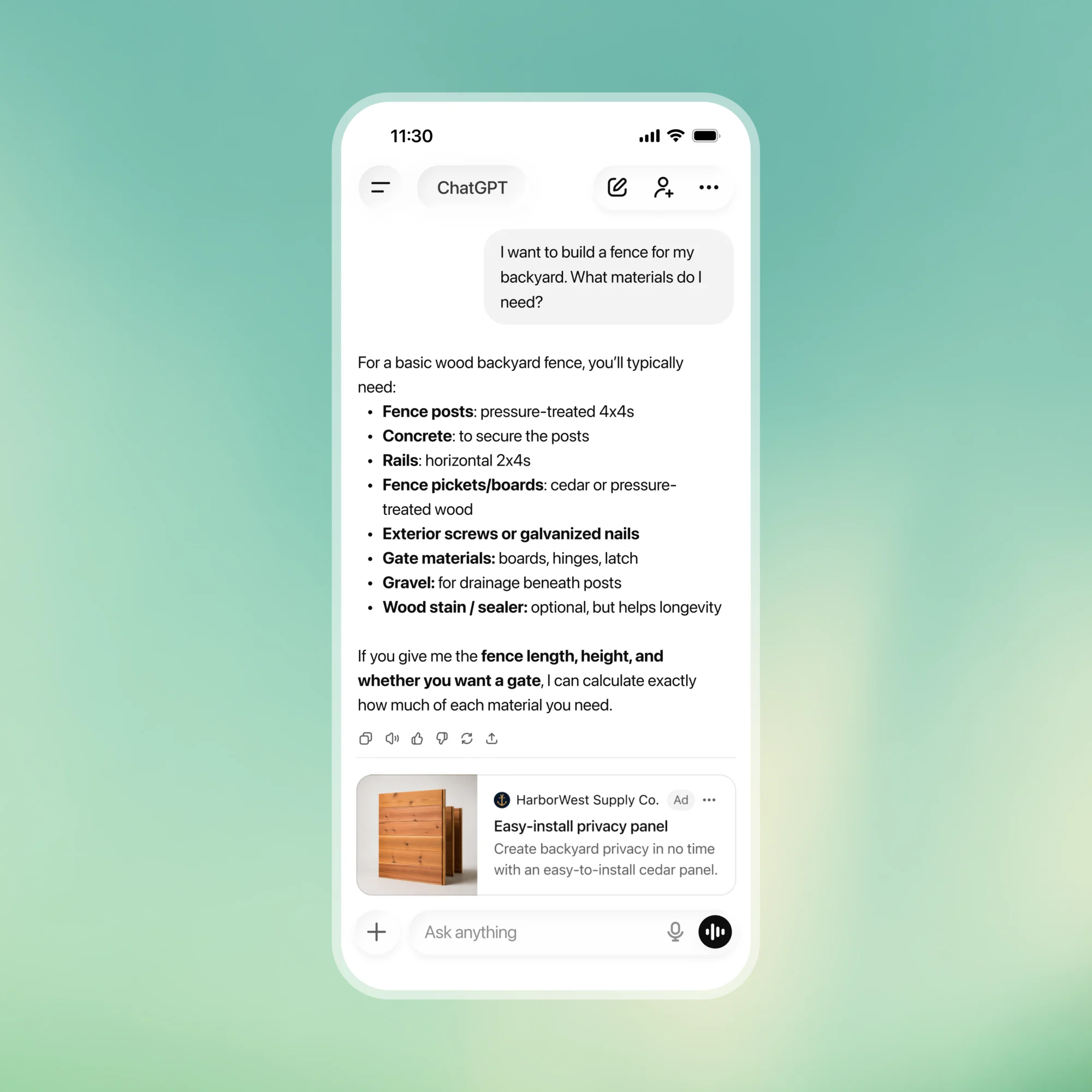
The OpenAI-published illustration shows a conversation about fencing followed by a separately labeled ad. It demonstrates the presentation concept. It supplies no evidence of this advertiser’s actual delivery, cost, or results.
If your objective is to have a business appear in the answer itself, that belongs to the separate work of organic ChatGPT search visibility. Paid placement does not purchase an organic recommendation, citation, or OpenAI endorsement.
Who Can See Ads and What Advertisers Can Learn
The current ads FAQ says ads may appear for Free and Go users. It excludes Plus, Pro, Business, Enterprise, and Edu accounts, accounts identified as belonging to people under 18, and Temporary Chats. Audience exposure remains subject to eligibility and rollout. The total ChatGPT user base therefore overstates the audience you should assume your ads can reach.
Ad selection can use the current conversation and, when personalization is enabled, select signals from the user’s broader ChatGPT experience. Advertisers receive aggregated performance information; they do not receive users’ private chat histories or memories. If a person chooses to message an advertiser directly, the advertiser can see those messages.
Viewer-plan rules and advertiser eligibility answer different questions. A potential customer’s plan affects whether they may see an ad. Your business’s location and account readiness affect the advertising route. Check the current US self-service availability and legal-entity requirement, as well as the policies applicable to your offer. Consumer ad controls are explained in the same FAQ.
Step 1: Define the Offer and Outcome You Want to Test
Write down what you want someone to do after the ad, and what would make that action useful to the business. A click, a trial registration, and a suitable customer are different outcomes.
For example, a software team could count a trial as qualified when the business fits its customer criteria and completes a meaningful setup task. That definition belongs to the business. Installing a conversion pixel does not supply it automatically.
Decide the test’s funding allowance, review point, and conditions for pausing before launch. A planning allowance is a business decision; configure the available campaign and account controls to support it. A delayed spend report is an unsuitable way to enforce a precise live stopping point.
Turn a Buyer Situation Into an Ad and Landing Page
Illustrative offer used throughout this article: scheduling software for US repair businesses coordinating multiple technicians. Assume the product offers a shared job calendar, technician availability, and a trial. The product is hypothetical.
The buyer situation is practical: a dispatcher is replacing spreadsheet schedules and needs to rearrange jobs when a technician becomes unavailable. A relevant ad might describe a shared scheduling view and invite the reader to explore the trial. Its landing page should explain those features, who the product serves, the trial conditions, and the next action.
Keep the promise consistent across the ad and page. A claim such as “halve your scheduling costs” would require evidence the example does not have. Describe the shared calendar and technician availability used in this example.
Define the example’s qualified trial as a US repair business with at least 10 technicians that creates its first team schedule. The illustration uses this business-defined fit-and-activation criterion. A qualified trial remains distinct from a purchase. The team must be able to inspect that outcome in its own records.
Keep Geographic Controls Separate From Context Hints
Context hints describe conversations or needs where an ad might be relevant. For this example, useful descriptions could include “replacing spreadsheet job schedules” or “coordinating changing technician availability.” The official targeting guide explains that hints are not exact-match keywords and do not guarantee a particular conversation will trigger an ad.
Set geographic restrictions through the applicable targeting controls. Writing “US repair companies” in a hint does not substitute for restricting geography. Other documented controls and eligibility conditions also affect delivery.
This is a test of a specific offer and audience situation. It is not evidence that ChatGPT users who discuss scheduling will all see the ad or that the platform will identify the business’s qualified-trial criteria for you.
Step 2: Choose How to Buy and Limit Delivery
The campaign goal, billing event, bid, and budget each control something different. Keep those meanings separate when comparing an offer, a dashboard, and your own acquisition costs.
Separate the Goal, Billing Event, Bid, and Budget
| Choice | What It Means | Consequence for the Test |
|---|---|---|
| Objective | The outcome delivery is optimized toward, such as impressions, clicks, or a supported conversion action | A traffic objective seeks clicks; it does not establish that those clicks become qualified trials. |
| Billing event | The activity you pay for under the selected buying route | The documented conversion-optimized click-billing route charges for valid clicks while seeking conversions. |
| Bid strategy | How bids are supplied or adjusted | A fixed bid differs from the automated strategies described in the developer documentation; inspect the available compatible option. |
| Maximum CPC bid | The maximum cost-per-click bid supplied for a fixed click-bidding configuration | It is an input to buying, and does not forecast the average CPC or the number of clicks available. |
| Budget and account limit | Configured spending controls with their applicable period and scope | Campaign and account controls apply separately; verify their actual settings before delivery. |
For the illustration, the team chooses a Clicks objective for a bounded traffic test and measures trial starts and qualification separately. Assume a fixed CPC configuration is available and it sets a $4 maximum bid. Choose the objective that fits your own test. A conversion objective requires suitable event setup and its own eligibility checks.
The team sets a $250 total planning allowance and a provisional $100 allowance per qualified trial. These are hypothetical business inputs. They are not OpenAI minimums, recommended budgets, or proof that this offer can acquire customers at those amounts. Before launch, the team must translate its exposure limit into the actual available spending controls, schedule, and monitoring responsibilities.
The advertiser basics recommends a starting maximum CPC bid of $3 to $5 USD for CPC campaigns. That is guidance for a bid input. It is not an observed average cost, a minimum test budget, or a forecast of customer acquisition cost. CPM means cost per thousand impressions and describes a different billing unit.
OpenAI’s bidding and budgets documentation also describes automated Maximize Results strategies with specific objective and budget compatibility. Do not assume every strategy requires you to supply a fixed maximum bid. Its documented conversion click-billing route seeks a supported standard event while billing valid clicks; eligibility and other available buying options must be checked for the selected route.
In the documented API, a daily campaign budget limits spending per day; a lifetime budget sets a total campaign limit and supports fixed bidding. Maximize Results requires a daily budget. Account spend-limit windows cover a date range across campaigns and are available only to some accounts. Check which controls your buying route exposes and confirm their period and amount before launch.
Use the Documented US Setup Route Before Launch
OpenAI lists the United States as available for self-service Ads Manager. The legal entity advertising and being billed must be based in a listed country. An account may still need billing, verification, or other launch requirements after registration.
Use the official account setup guide at ads.openai.com. It offers a route that skips ad creation during signup. Review country, currency, and time zone carefully where shown: the guide says these cannot be changed after account creation. Complete the required billing, verification, and account steps, and use the existing account’s invitations for teammates.
The quickstart describes campaign, ad group, and ad structure. The campaign carries the objective and budget; ad groups organize related ads and context hints; ads contain the creative and landing page. Guided creation and bulk upload are documented routes, with different limitations.
Finish measurement preparation in Step 3 before enabling delivery. The quickstart warns against publishing a first campaign merely to reveal scheduling settings. Ads can start running after approval when the other requirements are met. Paused resources shown in API examples do not establish that the guided signup flow is paused.
Confirm the intended status, schedule, targeting, and spending controls. If the campaign is not ready, keep delivery off and verify that state. Account creation and creative approval do not mean the whole test is ready.
Step 3: Make the First Reports Comparable
Before launch, choose the action to measure, connect the supported conversion measurement, and test that the intended event is received. OpenAI provides a Measurement Pixel and server-side measurement documentation. Follow the relevant consent and implementation requirements. If the same event is sent through browser and server integrations, the documented deduplication method matters.
Maintain a separate business definition of qualification in your own records. A platform conversion can represent a configured event; it does not by itself establish customer fit, revenue, or a result caused solely by the ad.
Record the report period, account time zone, relevant conversion attribution settings, and qualification cutoff. Attribution settings determine which ad interactions receive credit for an action, including possible click-through and view-through credit. A platform total should not be treated automatically as a count of people who clicked and then became qualified leads.
Check Freshness and Measurement Before Calculating Costs
CTR is clicks divided by impressions, usually expressed as a percentage. In Ads Manager, the current basics and quickstart describe impressions, clicks, and CTR refreshing approximately every 15 minutes. Spend can lag by 7 to 8 hours. Clicks alongside a displayed zero may still carry costs that have not appeared yet.
The API reporting guide separately describes recent delivery metrics becoming available within minutes, cost measures updating later, and conversion processing occurring daily. It says to allow at least one day for conversion data to appear. That processing expectation leaves the sales cycle and later outcomes unresolved; it cannot guarantee complete results the following morning.
Use compatible periods and processing states. The API guide warns that dividing fresh click counts into spend that has not caught up can disagree with the returned CPC. Use the relevant reported cost metric and reconcile its reporting basis before judging it.
Website analytics introduce another issue: OpenAI says ad-review crawlers may visit submitted landing pages with tracking parameters. Analytics tools can classify those visits as paid traffic even though they are not billable ad clicks. Different visit and click units, repeated visits, reporting times, and review traffic all need consideration. A difference between two counters does not identify its cause.
A Worked Example: From Early Clicks to a Bounded Decision
The following figures are entirely illustrative. The scheduling-software team uses the offer and qualified-trial definition above. Its account time zone is America/New_York, and the final example report covers October 12 to 18, 2026, with qualification assessed at noon on October 22. These dates define the records used in the calculation. Choosing a useful test duration or sample requires separate judgment.
Wait When the Cost Report Is Still Incomplete
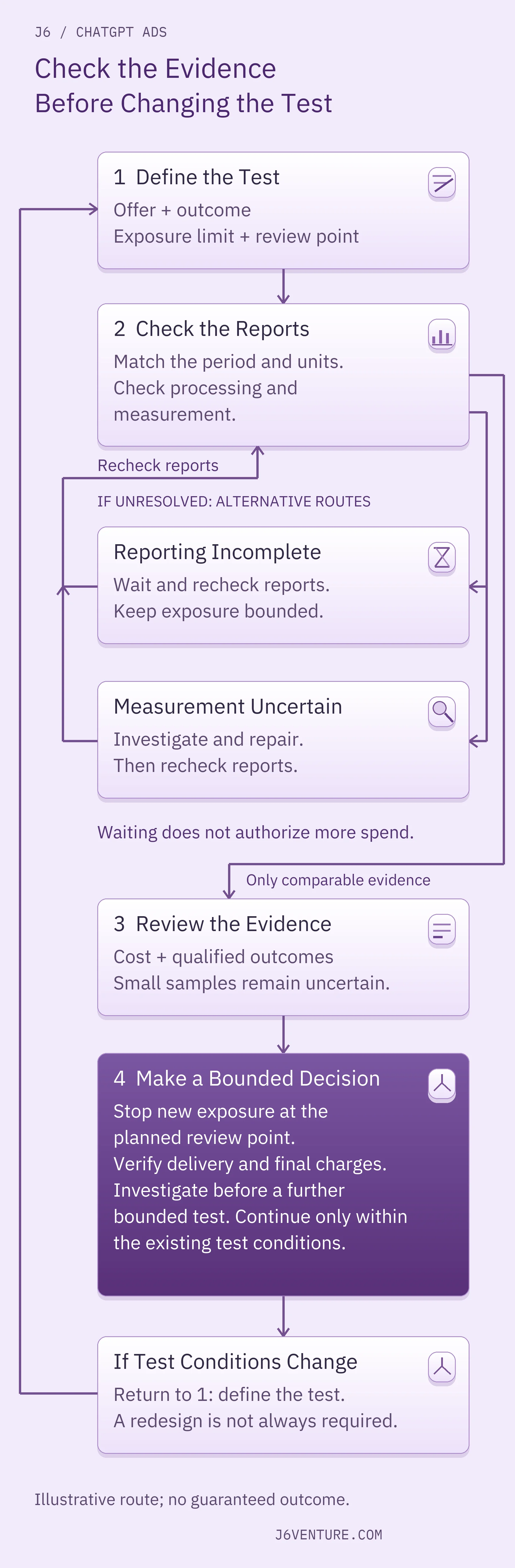
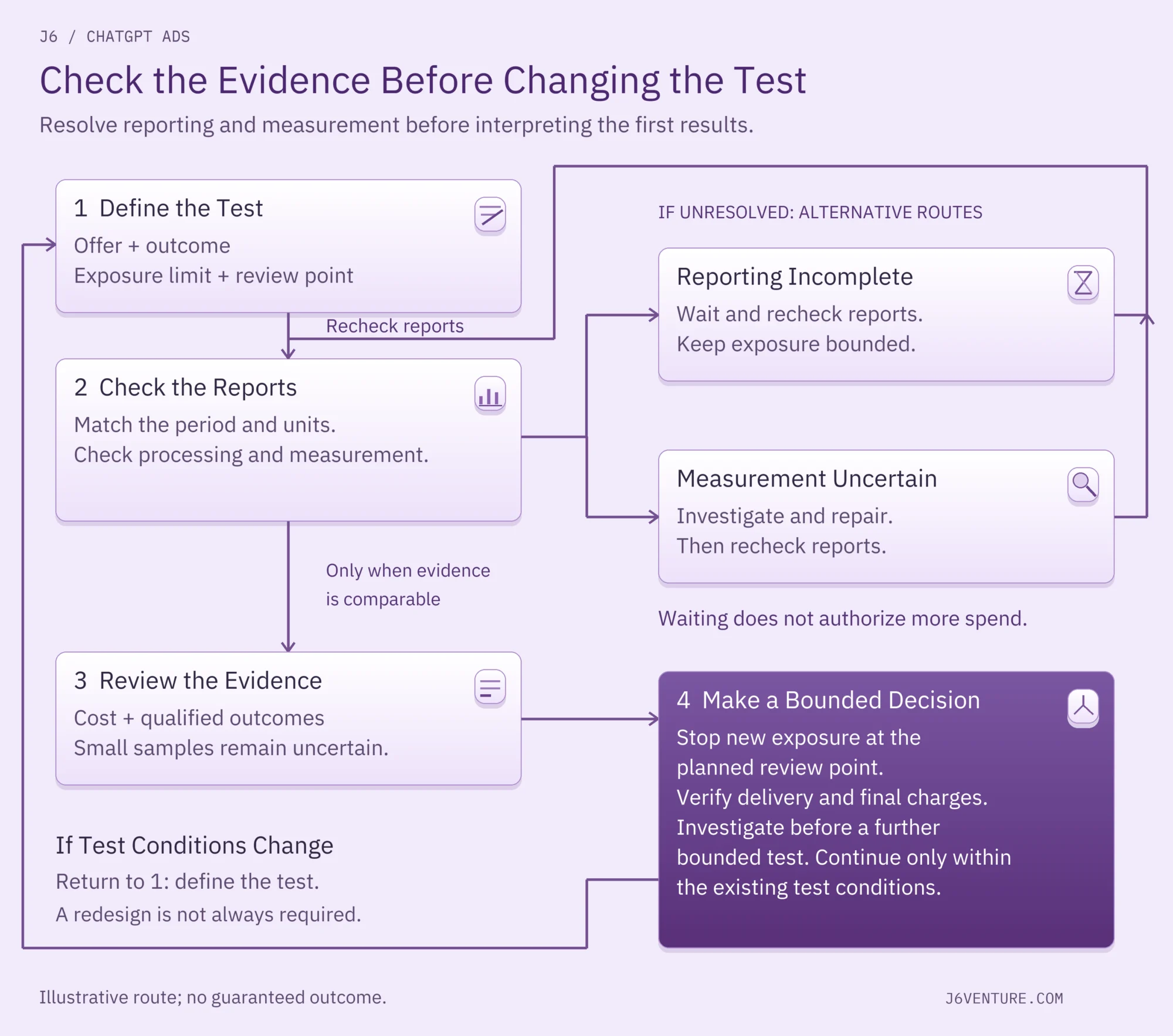
Two hours after the hypothetical launch, Ads Manager shows 18 clicks and $0 spend. The team cannot calculate a meaningful zero-dollar CPC from that snapshot because the official reporting guidance allows cost to arrive later.
Its next action is to confirm delivery status and the configured exposure controls, retain the snapshot, and recheck after the relevant cost processing. Waiting for reporting does not authorize extra spending. If the team cannot keep exposure within its intended allowance while reports lag, it should pause delivery and verify the status while reconciling the data.
The test remains open for measurement. The team has learned that activity is appearing; it has not learned what that activity costs or whether it produces suitable trials.
Investigate a Traffic or Conversion Mismatch
Suppose website analytics shows 27 campaign-tagged visits while the ad report shows 18 clicks. Some tagged traffic could come from landing-page review before launch, and visits are not the same unit as valid ad clicks.
The team should align periods and time zones, inspect how its analytics classifies the visits, and check relevant first-party records for review activity and repeat visits. It cannot label the nine-visit difference “nine bots,” conclude that nine clicks went unbilled, or use 27 as the billable-click denominator.
If trial events also fail to match the intended action, test the event definition and collection path. Check duplicate handling where browser and server both send the event. Resolve a demonstrable tracking problem before using that count to assess acquisition. Until the discrepancy is explained, the team cannot judge advertising performance from those counts.
Use Qualified Outcomes Without Overreading a Small Sample
Assume cost processing is complete for the stated report period. Ads Manager shows $250 spent and 100 valid clicks. The team’s own records match six trial starts to that click-associated cohort using its chosen tracking method. At the qualification cutoff, two meet the predefined business-fit and activation criteria; the other four have not yet qualified.
| Illustrative Measure | Calculation | What the Result Describes |
|---|---|---|
| Average CPC | $250 ÷ 100 = $2.50 | Media cost per valid click for the matched period |
| Cost per matched trial start | $250 ÷ 6 = $41.67 | Spend per tracked trial start under the example’s matching method |
| Cost per currently qualified trial | $250 ÷ 2 = $125 | Spend per trial meeting the business criteria at the stated cutoff |
The $4 maximum bid, $2.50 average CPC, and $125 qualified-trial cost describe different parts of the test. None is a cost per paying customer. The two qualified outcomes also do not establish how many additional customers the ads caused.
The team has reached its $250 planning allowance. Its next action is to stop new exposure in accordance with the configured controls, verify delivery status, and reconcile any remaining charges. It should not infer that the final total was capped at precisely $250 merely because a delayed report displayed that amount. Here, $250 is a stipulated settled input for the calculation.
At this cutoff, $125 exceeds the team’s illustrative $100 planning allowance per qualified trial. Hold expansion. Check whether measurement is dependable, why only two trials currently meet the criteria, and whether the four remaining trials need more time or lack fit. They have not all been rejected.
Two qualified trials are too little evidence for a stable acquisition-cost estimate or a verdict that the channel has failed. Qualification can change as the cohort develops. Before restarting a justified follow-up test, define its question, the changes to make, and the exposure authorized. A low CPC alone supplies no reason to scale.
Decide What Your Next Test Needs to Establish
For the hypothetical scheduling-software case, the decision record at the cutoff reads:
- Offer and buying route: a scheduling-software trial for US repair businesses; Clicks objective with the assumed fixed CPC route and a $4 maximum bid.
- Spending basis: $250 settled illustrative spend against the $250 planning allowance. Verify actual delivery status and reconcile any remaining charges before further exposure.
- Report basis: October 12 to 18 in America/New_York; qualification checked at noon on October 22.
- Business evidence: six matched trial starts; two currently meet the 10-technician and first-team-schedule criteria; four have not yet qualified.
- Decision and owner: hold new exposure. Assign the team’s marketer to verify delivery is off and coordinate the measurement and qualification checks.
- Review condition: review when those checks are complete. A further funded test needs a stated question, any changes to make, and a new bounded authorization.
Complete the same record for your own offer. A later test might examine a revised landing-page explanation or a better-matched buyer situation; choose it to answer the remaining question.
ChatGPT ads provide a paid route to eligible conversations. Your first useful result is knowing what the available evidence supports: wait for a particular processing check, repair a measurement fault, or make a constrained business decision. Keep the decision separate from organic visibility, conversion credit, and sales outcomes the records do not yet support.