SEO for software companies helps relevant buyers find and understand a product or service through unpaid search. Choose priorities by connecting a buyer’s question to a useful page, credible proof, and an action your business can fulfill, whether that is using the product, evaluating a platform, or discussing a development project.
Publishing more can be the wrong next SEO investment for a software company.
If relevant prospects already reach your product page but cannot tell whether it fits their workflow, another broad educational article leaves that buying question unresolved. Improving the existing page may deserve the next slot.
Choose priorities by how buyers evaluate and buy your offer.
What Does SEO for Software Companies Involve?
SEO for a software company combines demand research, useful pages, technical access, internal linking, and earned visibility. Its commercial purpose is to connect people you can serve with an appropriate next step. That requires understanding the sale as well as the search.
Google’s SEO Starter Guide describes helping search engines understand content and helping people find and decide whether to visit a site. For a software business, the destination could be a product page, an integration, documentation, a comparison, or a service page. A blog is one possible format.
For example, someone searching for a way to send spreadsheet updates into Slack may need a working integration and its limitations. Someone looking for legacy modernization services needs to understand delivery capability, comparable experience, and how a project would begin. Both searches concern software, but the useful answers differ.
An initial SEO investment needs three things:
- An audience with a question your offer can answer. Use customer language, sales conversations, support requests, and search evidence to establish the connection.
- Something useful to publish or improve. A page needs enough substance to help the visitor complete a task or make a decision.
- Capacity to deliver and follow through. Writing, product checks, engineering, measurement, and maintenance all consume resources.
If the offer is unclear or the team cannot substantiate it, resolve that gap before scaling production. The benefits and investment conditions of SEO help with the wider budget decision.
Start With How Your Buyer Chooses and Buys
Three common buying routes help explain why software pages need different proof and next steps. A self-serve route needs a credible path into use; a sales-assisted route needs evaluation support; a development service needs evidence that the team can deliver the requested work. These routes can coexist within one business.
People may return through several channels, involve colleagues, or move between research and evaluation. Use the distinctions to choose page content and follow-up, without forcing every visitor through a fixed funnel. The public examples below were retrieved on October 16, 2026. They show published page content and routes; we did not test the products or measure their conversions.
A Self-Serve Product Needs a Usable Route to Value
A self-serve page should help a visitor assess fit, understand important requirements, and begin the task they came to perform. Explain what the product does, what the user must supply, where limits apply, and what happens after signup.
Zapier’s Google Sheets and Slack integration page provides a public example. The page lets visitors choose a trigger and action, inspect named workflow templates, and follow a free-start route. One template concerned sending Slack messages when Google Sheets rows change.
The page connects the query to a supported workflow and the next action. A generic automation essay would leave more work for that visitor.
A Sales-Assisted Product Needs Evaluation Support
A sales-assisted page should help the buyer decide whether a conversation is worthwhile and prepare the questions that conversation must resolve. Depending on the purchase, that may involve implementation, integrations, permissions, security, migration, pricing structure, and responsibilities.
Atlassian illustrates why company labels are insufficient. Its Jira product page offers a free-start route, while its enterprise page presents enterprise capabilities and a contact-sales route. A single vendor can support immediate use and a more involved evaluation.
Choose the evidence for the page’s audience. A security reviewer may need documentation; a functional buyer may need a demonstration of the required workflow; an implementation owner may need migration requirements. Sending all three to a generic demo form can leave their distinct questions unanswered.
A Development Service Needs Evidence of Delivery Fit
A software-development service page should explain which problems the team undertakes, delivery constraints, how the project begins, and what experience supports the claim. The next useful action may be a scoping discussion with enough information to assess fit.
Thoughtworks’ legacy modernization service page describes a service, links to client stories, and offers a contact route.
A technical tutorial can attract engineers learning to solve a problem themselves. It may also support a future buyer. Decide which role the tutorial serves before judging it against qualified project inquiries.
Choose Your First SEO Page in Four Steps
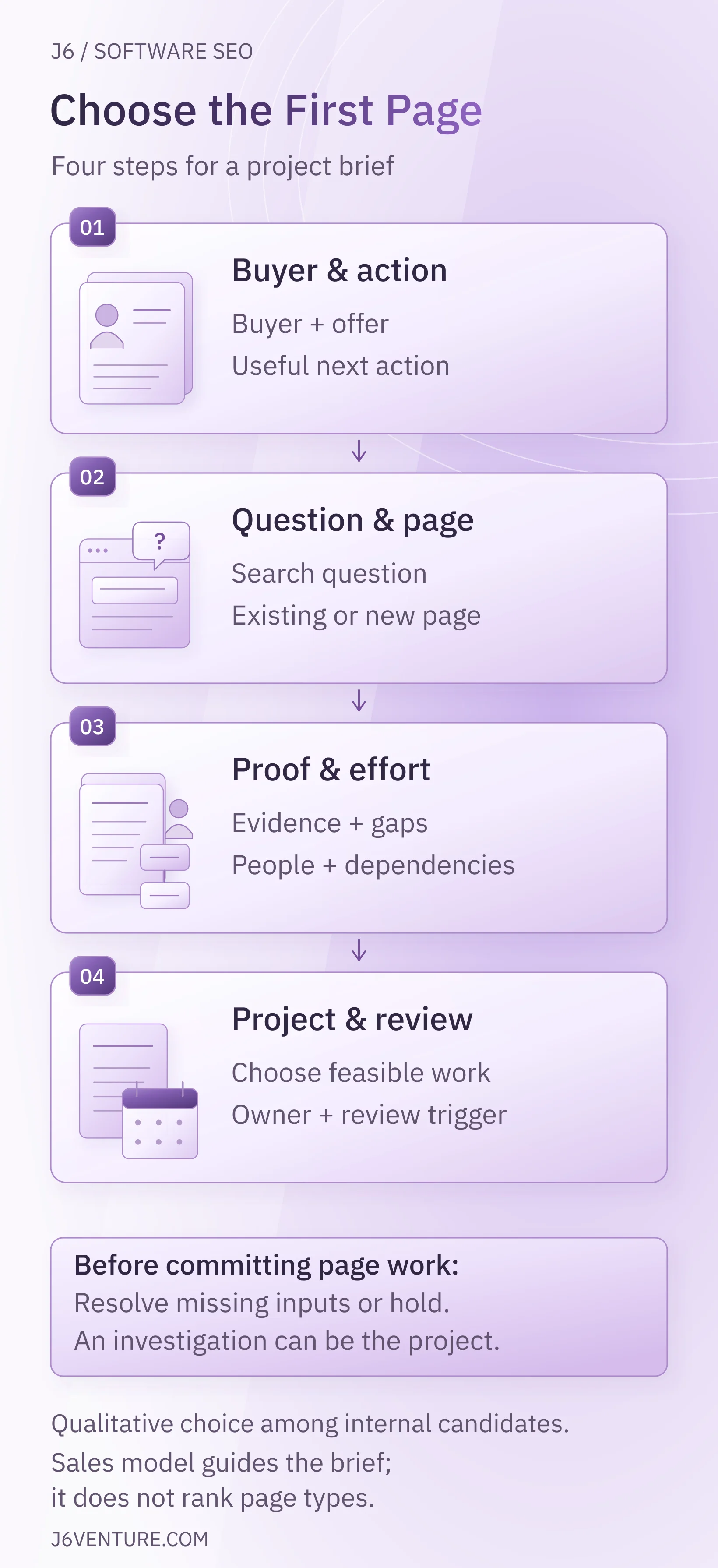
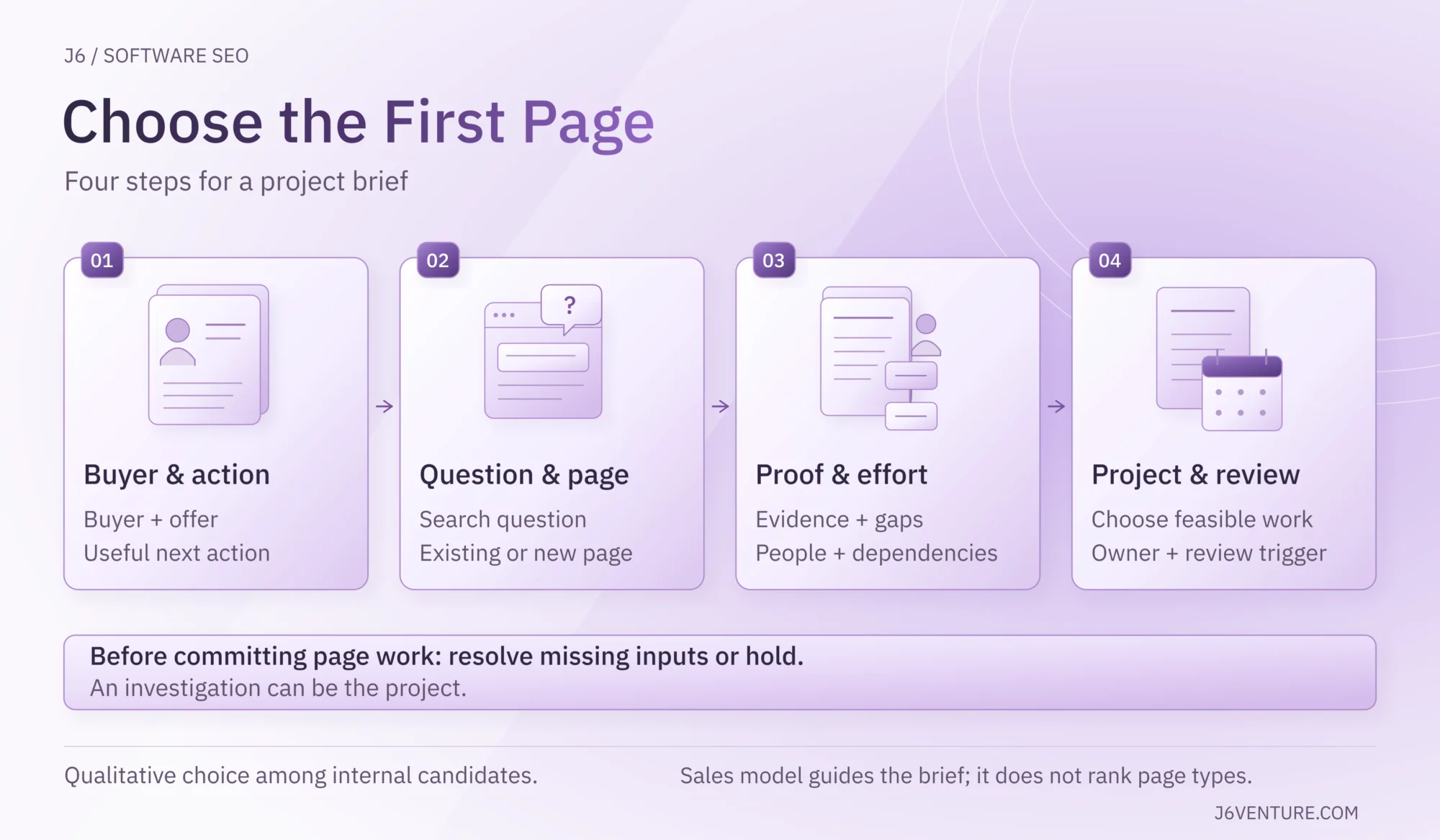
Choose a first page by establishing the buyer’s task, checking the search and existing destination, assessing the evidence and delivery work, then defining a bounded project. The result may be a new page, an improvement to an existing one, or an investigation that must happen before either.
Step 1: Define the Buyer and the Next Useful Action
Write one sentence naming the audience, the problem, and the action the business can support. “More software traffic” leaves the page’s job unresolved. “Help an agency evaluate whether our product can manage separate client campaigns and choose signup or a product conversation” gives the team a concrete task.
Use sales and support records to collect the questions buyers ask before taking that action. Separate prospect questions from existing-customer troubleshooting. Both can deserve searchable answers. Use different destinations when the tasks differ, and choose measures for each audience.
Define who handles the response. A demo request has little commercial value if nobody qualifies or answers it; a signup needs a usable onboarding path.
Step 2: Match the Search Question to a Page
Inspect results for the actual question, in the market you serve, and check your existing URLs. Establish whether searchers are being offered products, comparisons, explanations, tools, or documentation. Then ask whether your proposed page can provide the expected help.
Use these as candidate relationships to test:
| Buyer Question | Possible Page | Evidence the Page Needs |
|---|---|---|
| Which product fits this category? | Category or product page | Audience, capabilities, limits, and a usable evaluation route |
| Can it handle this workflow? | Feature or use-case page | A concrete workflow, requirements, and supported behavior |
| Does it connect to our existing system? | Integration page | What connects, prerequisites, permissions, and limitations |
| How does it compare with another option? | Comparison page | Fair criteria, current evidence, and meaningful trade-offs |
| What will this purchase cost? | Pricing or commercial explanation | Charging basis, inclusions, exclusions, and how unresolved costs are established |
| Can this team build or modernize it? | Service page | Delivery scope, comparable work, constraints, and a scoping route |
| How do I complete this task? | Documentation, tutorial, or tool | Instructions or functionality that complete the task |
Improve the existing destination when it already owns the same task. A new keyword variation alone does not justify another URL. For the deeper research method, use the J6 guide to SaaS keyword research and page decisions. The six SaaS BOFU keyword patterns develop the evidence buyers need for evaluation questions.
Step 3: Check the Proof and the Work Required
List what a visitor would need to trust the proposed answer. Then establish which evidence exists, which claims need a product or delivery owner’s confirmation, and which requirements remain unresolved.
For a product page, inspect a demonstration of the required workflow, current documentation, plan restrictions, and prerequisites. For services, check whether a case describes comparable constraints and the team’s role. A customer logo alone leaves the actual work unexplained.
Check whether people and search engines can reach the intended public page, whether important content and links are available, and whether the signup, booking, or inquiry route works. Keep customer data behind appropriate access controls.
Budget the whole project: research, writing, design, implementation, product review, instrumentation, promotion, and expected refresh work. Assign who writes, who verifies claims, who implements, and who checks the released result. A page that depends on unavailable engineering or unconfirmed product behavior is not ready for production.
Step 4: Choose the Project and Its Review Conditions
Compare feasible candidates on buyer relevance, evidence, current search opportunity, delivery effort, and maintenance. Current search opportunity means evidence of a buyer search you can serve and a reason to improve or create its destination. For example, an existing page may attract suitable queries while leaving an evaluation question unanswered, or your research may reveal an unmet task in the returned pages. Explain the choice in words. An invented numerical opportunity score can conceal how uncertain the inputs are.
Favor a bounded improvement when the existing page already serves a buyer task and the missing work is clear. A comparison may deserve priority when buyers need a choice and you can substantiate the differences. A guide may come first when people need to understand the problem before they can evaluate a product.
Record why the other candidates wait. Assign the review date at publication, the signal you expect to inspect, and the result that would cause a change. A broken inquiry route needs immediate attention; a commercial outcome needs an observation period appropriate to the buying cycle. The guide to how long SEO takes to work develops that distinction.
Work Through an Illustrative Alore Page Decision
Apply the method to a proposed improvement for Alore’s existing product page. Public sources establish what the page describes. The buyer brief and priority below are teaching assumptions, not a record of work already delivered or a forecast.
J6’s case-study book records different starting priorities: commercial comparison coverage for a wealthtech SaaS client, and intent mapping with existing-content refreshes for Alore. One engagement needed evaluation coverage; the other involved reorganizing an existing article library. These reported choices do not establish Alore’s priority today or isolate one page’s effect.
Establish What the Public Evidence Shows
Alore’s homepage describes outbound-sales software and offers both a demo and a free-signup route. Its Drip Campaigner page describes sequences, analytics, and an agency section with separate client campaign bases, client invitations, and reports. These are public product claims retrieved on October 16, 2026, not an authenticated capability test.
For this illustration, assume page-level search evidence and sales conversations support two observations: agency prospects reach the Drip Campaigner page from searches about agency campaign tasks, and their evaluation conversations repeatedly leave client separation and reporting unresolved. The goal is a qualified agency signup or demo request. The team has capacity for one focused page project. A real brief would record the actual queries, dates, and page baseline; those records have not been supplied for this exercise.
If those search and buyer observations are unavailable, collect them first. Visits from paid or referral sources alone do not establish an SEO opportunity for this destination. Public feature text cannot settle that question.
A separate Firecrawl search for “cold email software for agencies,” using United States settings on October 16, returned five comparison-list results. This was a provider-ranked excerpt sample, not a full study of those pages or a stable Google ranking record. It warns against assuming that a product-page refresh will satisfy the comparison query.
Compare Three Page Candidates
The assumed search relevance and evaluation gap favor improving the existing agency explanation first. They give the writer a search audience and buyer question, an existing destination, and product claims to verify. The comparison search remains a separate opportunity to investigate.
| Candidate | Why It Might Help | Decision Under This Brief |
|---|---|---|
| Improve the agency section on the existing Drip Campaigner page | Answers the assumed questions about client separation, access, and reporting near the evaluation route | First candidate, conditional on confirming search relevance, the buyer observations, and current product behavior |
| Build a fair agency-software comparison | Could help readers choosing between products; the search sample points toward this format | Investigate criteria and competing products first; no current comparison evidence has been assembled |
| Publish a broad cold-email introduction | Could help someone learning the channel | Defer for this project because it does not resolve the assumed agency evaluation gap |
Scope the selected improvement around a concrete demonstration: how a separate client campaign base is created, what a client can access, and what a report contains. Ask the product owner to establish current restrictions and whether any account or plan conditions apply. Do not invent the answers from the marketing copy.
Explain signup and demo as distinct next steps, with enough context for the visitor to choose. Check the routes before release. Link from existing agency content where it helps the reader continue, using accurate anchors.
For review, inspect the revised page’s relevant query traffic, agency-fit inquiries or signups where measurable, and whether the previously recorded questions persist. Set up that comparison before release. Improvement in this buyer route would not prove that the page became competitive for the sampled comparison query.
Change the Assumption and Reconsider the Priority
Change the goal to attracting people actively comparing agency platforms, and the first project can change. The comparison-list sample now matters more. If the team can assemble fair, current product evidence, a comparison resource becomes a stronger candidate; if it cannot, the next task is research.
Change the offer to a custom outbound-operations implementation service, and the page needs delivery scope, comparable project evidence, dependencies, and a scoping route. A self-serve signup would not complete that buyer’s task.
The decision also changes if the original agency section already answers the objections, the visitors are mainly existing users, or the claimed capability is unavailable. Remove the assumed gap and the case for that refresh disappears. Reassess the candidate list before funding it.
Make the Page Discoverable, Usable, and Worth Citing
Technical eligibility lets a page be considered for search. Its competitive value comes from completing the visitor’s task. Check the public route, explanation, and connections before release.
- Access and indexing: the intended public page must be accessible and free of unintended indexing blocks. Protect private application data with access controls.
- Content and usability: make the explanation and links available, use an accurate title and heading, and ensure the main task works on mobile.
- Internal connections: link from product, use-case, documentation, and editorial pages where the destination helps the reader continue.
- External discovery: if the project produces verified integration instructions, share them with the partner’s documentation team when they answer its users’ questions.
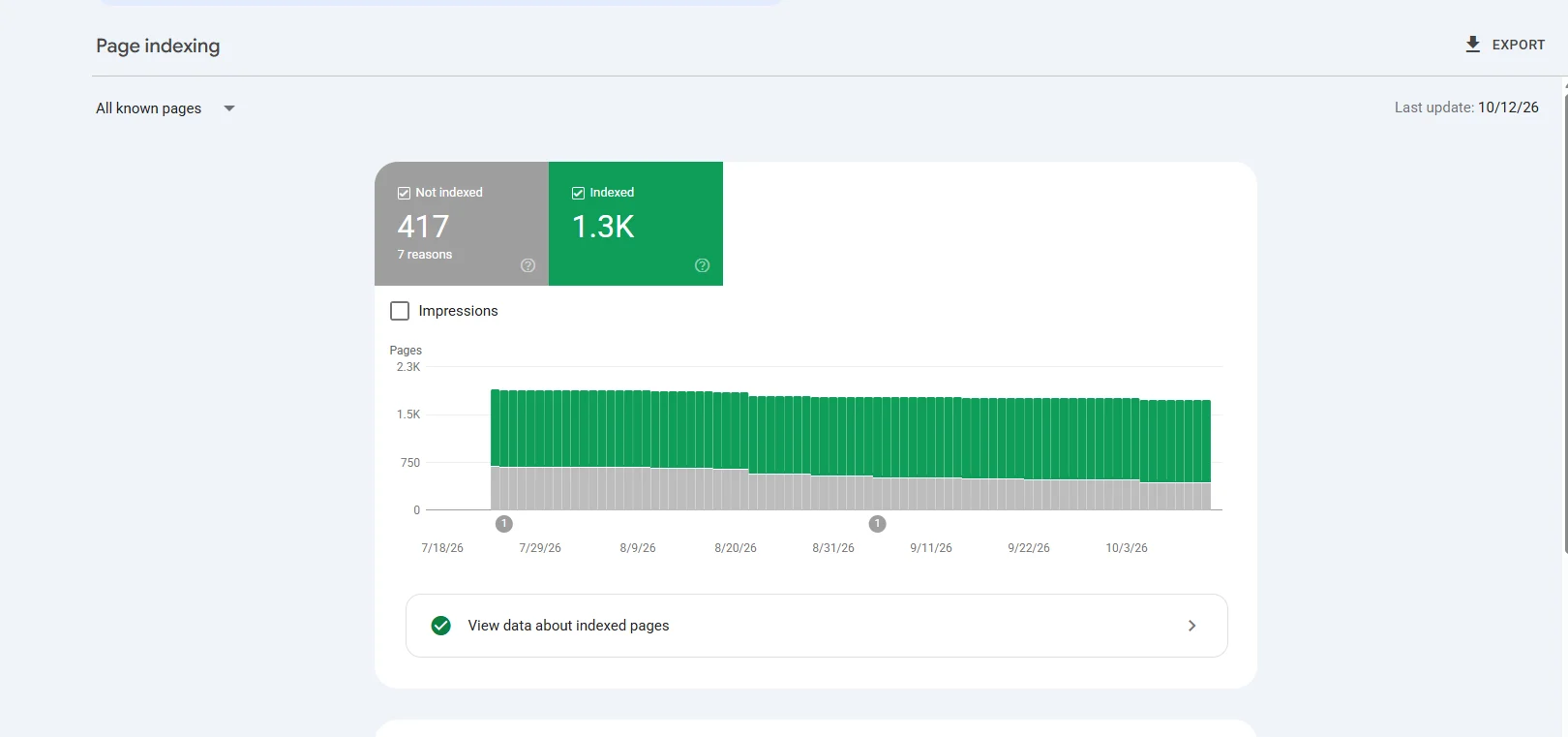
Use the Page indexing report to choose the next check. The supplied Search Console snapshot shows 1.3K indexed pages and 417 not indexed. Inspect the reason and whether the intended landing page should be indexed before treating that total as a backlog. Canonical alternatives and intentional redirects can be expected. Google’s Page indexing guidance explains the categories; URL Inspection checks a specific page’s indexed record.
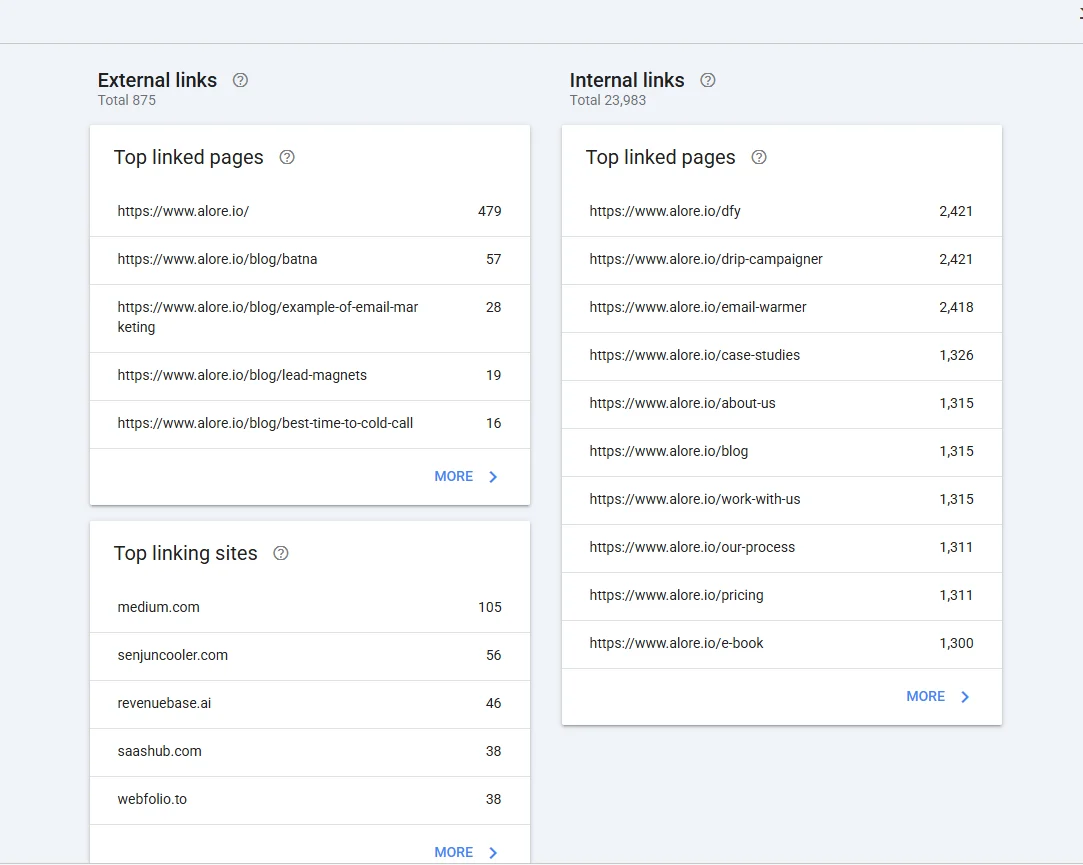
The supplied Alore Links report lists the drip-campaigner page among its top internally linked destinations. Use that as a starting point: inspect which pages link to your chosen destination and whether those connections help its buyer. Counts alone do not establish useful placement or results; the report is sampled and may contain historical links.
For optional page checks, J6’s SEO Inspector lists metadata, canonical, robots, and raw-HTML inspection features. Get the Chrome extension. A request using a crawler’s user-agent is a diagnostic probe, not evidence that the actual crawler visited. Keep Search Console for Google’s indexed record.
Avoid purchasing links for ranking credit or scaling near-identical pages primarily to manipulate visibility. Google’s spam policies address both practices.
For Google AI Overviews and AI Mode, Google’s guidance applies established SEO practices. Supporting pages must be indexed and eligible to appear with a snippet. There are no additional technical requirements for these features; eligibility does not guarantee selection.
Measure Progress Through to the Sale You Need
Measure the selected page’s search visibility and relevant visits, then follow the business action it was designed to support. Keep the stages separate so an increase in impressions does not become a claim about revenue.
| Buying Route | Useful Progress to Inspect | Commercial Check |
|---|---|---|
| Self-serve | Relevant visits, signups, and a defined activation event | Does the user reach a meaningful product outcome and later become a suitable paying customer? |
| Sales-assisted | Relevant visits and qualified evaluation requests | Do suitable accounts advance to opportunities and purchases? |
| Development service | Inquiries that match the offered work | Do they reach a viable scoping discussion, proposal, and project? |
Define activation for the product. In an automation tool, a successfully completed workflow that solves the user’s problem could be a candidate; a signup alone does not establish that value. Agree on qualification with sales or delivery before comparing lead counts.
Use Search Console for query and page evidence, analytics for recorded behavior, and product analytics or CRM for later stages where available. Google’s key-event documentation explains how configured important actions are recorded and how credit can be attributed to touchpoints. That credit is not proof the sale would not have happened without SEO. Identity, consent, and system limitations can also leave journeys incomplete.
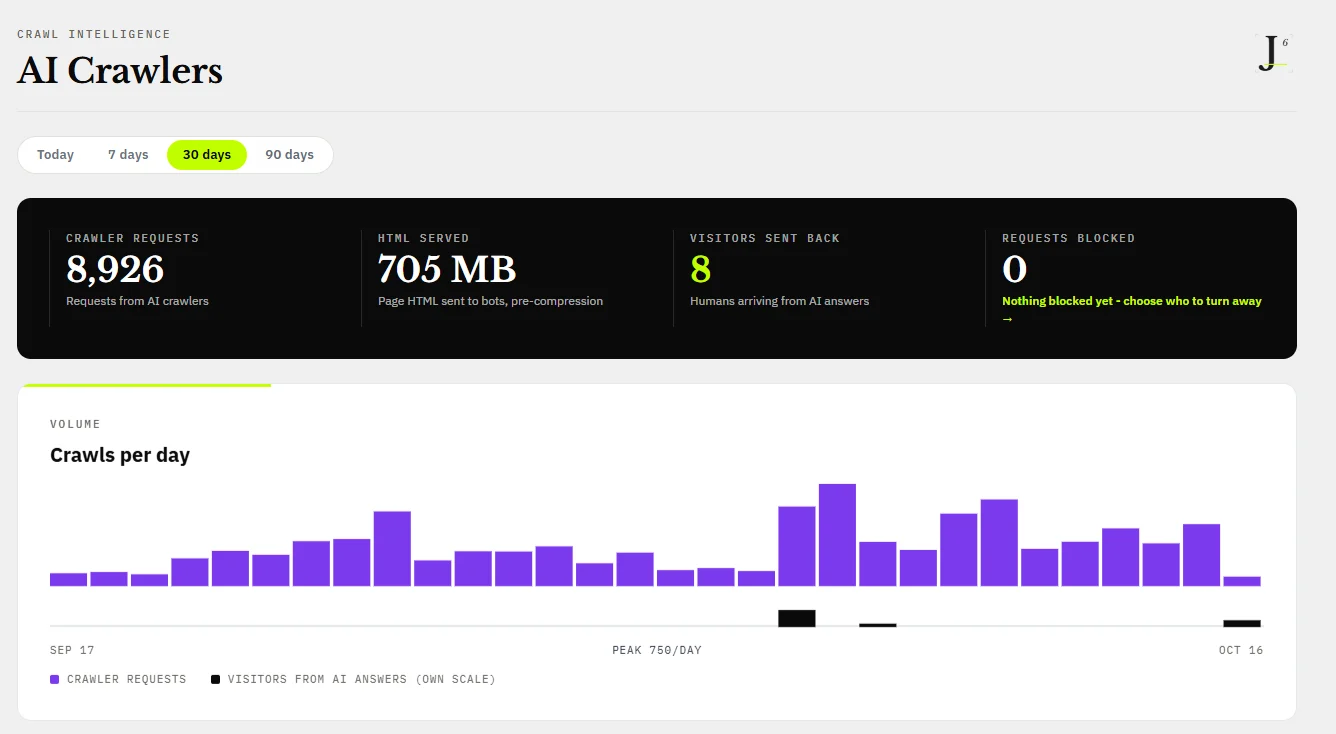
Crawler activity needs its own measure. The supplied J6 AI Crawler Control dashboard shows 8,926 requests and 8 visitors sent back in its selected 30-day window. Those are displayed counts, not evidence of citations, qualified leads or sales. Its companion tables flag failed or unconfirmed crawler identities and explain that missing browser referrers can hide referrals; request totals also combine training and search bots.
If you use WordPress, download J6’s AI Crawler Control plugin to investigate this separate layer. Both tools are J6 products. Use their findings alongside page, buyer and commercial evidence when deciding what deserves work next.
Compare groups with similar intent, market, offer, and time to convert. A long evaluation may lag behind search progress. Include ongoing maintenance in the cost view and distinguish a forecast from observed economics.
At the agreed review, expand a project when the evidence supports further work. Revise the page or its route when intended buyers arrive but remain poorly served. Reduce or defer investment when buyer fit is weak, required proof cannot be supplied, or the team cannot sustain delivery. A traffic increase alone does not settle those decisions.
Write a Brief Your Team Can Deliver
Finish with a one-page brief that another person can act on. Use the fields below to expose an unresolved assumption before it turns into production work.
- Buyer and offer: who the page serves and what the company can provide.
- Question and destination: the search task, expected format, and existing or proposed URL.
- Evidence and limits: what is supported, what needs confirmation, and who owns that answer.
- Work and action: the change to make, its dependencies, and the visitor’s next step.
- Choice and alternatives: why this project comes first, why others wait, and what would change that order.
- Delivery and upkeep: writer, product reviewer, implementer, cost, and expected refresh needs.
- Review: the date this change goes live, baseline, review date, signals, and the condition for expanding, revising, or stopping.
Before adding another page to the content calendar, identify the buying question it will resolve. Improve an existing page when it can do that job. Build a new resource when the task needs a different destination. Establish missing proof before turning a product claim into published copy.
Choose the smallest complete project that can resolve an important buyer question with evidence your business can support. Give it an owner, a working next step, and a review date. Use that review to justify the next investment.