SEO inbound is a context-dependent label that can mean either using search inside an inbound marketing strategy or buying an SEO service shaped around inbound goals. SEO itself is one discipline within inbound marketing, helping businesses attract people who are already searching and support discovery, evaluation, and conversion over time.
SEO Inbound, Inbound Marketing, and SEO Services Explained
Term confusion does more than blur language; it distorts planning. SEO inbound is not the same thing as inbound marketing, and neither phrase automatically means a packaged service. Inbound marketing is the broader system of digital marketing efforts, while search engine optimisation is one discipline inside those inbound marketing efforts. The phrase SEO inbound marketing can point either to how a team uses search inside digital marketing or to how a provider labels an offer.
- Inbound Marketing: the wider framework that coordinates channels and content around buyer discovery and conversion.
- SEO: the search discipline inside that framework, not the framework itself.
- SEO Inbound: a context-dependent label that can describe a strategy or a service offer.
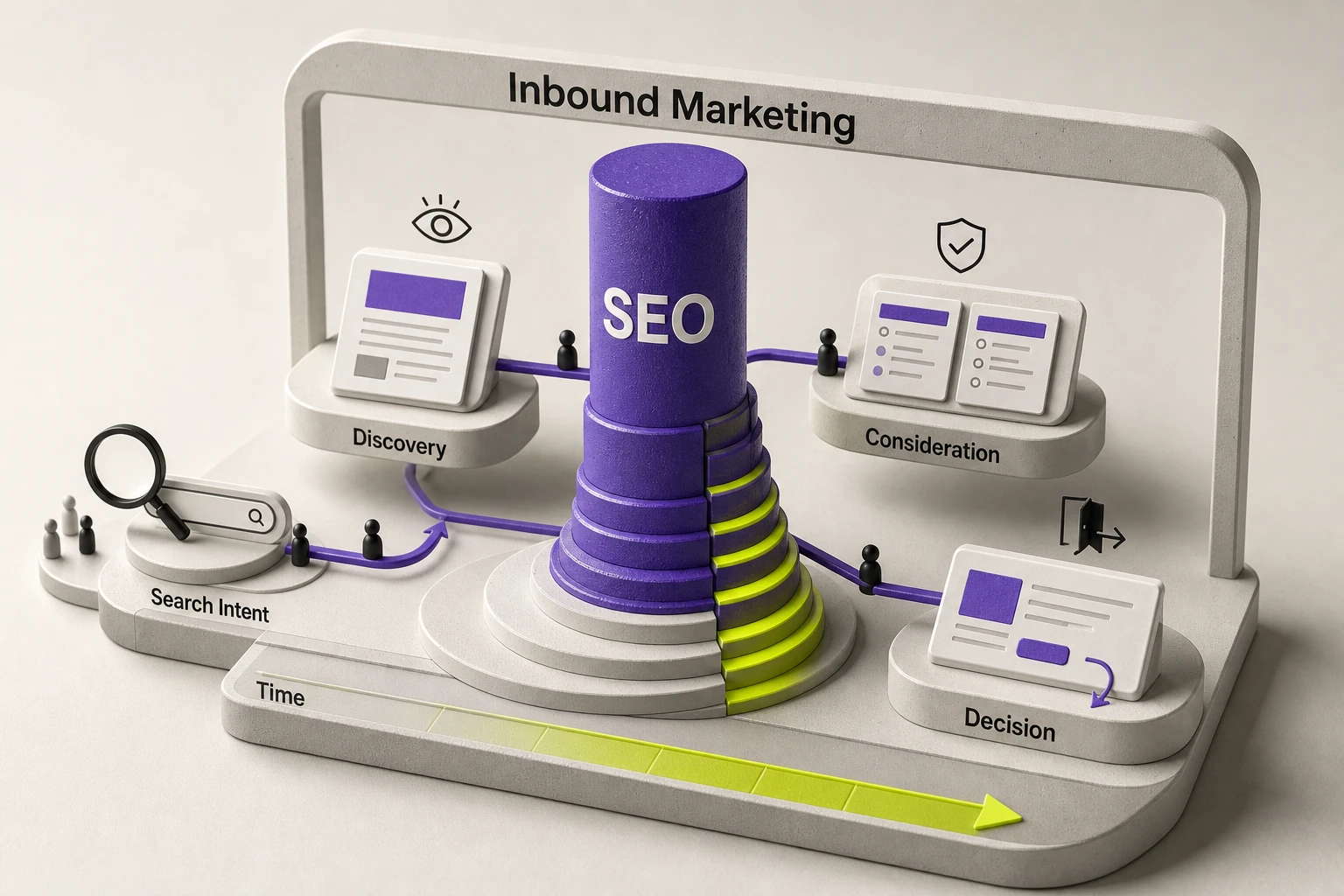
Where SEO Fits Inside Inbound Marketing
SEO is a capture mechanism inside inbound marketing, not a substitute for it. The broader system includes marketing strategies that help a buyer discover a company, evaluate it, and move toward action across multiple digital platforms. Search matters because it meets existing intent, but inbound marketing can also involve social media channels, email, on-site conversion paths, and other connected ways of earning attention rather than interrupting it.
That distinction gets lost when teams treat SEO as the whole model. SEO helps a business appear when someone is already searching. Inbound marketing organizes the wider experience around that moment and beyond it. By contrast, outbound marketing and older push tactics such as direct mail ask for attention before the buyer has shown clear intent. Search belongs firmly inside the inbound side of that divide, but it remains one operating part of a larger system.
For a SaaS product, our guide to SaaS inbound marketing connects that experience to product evaluation, follow-up, and team handoffs.
Why SEO Inbound Can Describe a Strategy or a Service Offer
The phrase SEO inbound does double duty, and that confusion distorts judgment. In one sense, it names a business methodology: using search-led content and site structure to attract buyers without interruption. In another, it names a service offer: an agency or provider packaging SEO work around inbound goals such as qualified traffic, lead support, or conversion assistance. The same words describe a different category.
- Ask what is being described. If the answer is an operating approach, SEO inbound is being used as strategy language.
- Ask what is being bought. If the answer is a scoped deliverable or monthly engagement, SEO inbound is being used as a service offer.
- Ask how success is judged. Strategy is judged by how search supports inbound movement across the system, while a service offer is judged by the specific work and outcomes it owns.
Miss that split, and buyers start comparing proposals as if they were strategic frameworks. SEO may be only one discipline within inbound, but that raises the real question the next section needs to answer: why this one discipline so often is the most durable source of demand over time.
Why SEO Becomes the Strongest Pillar in an Inbound Strategy Over Time
SEO becomes the strongest pillar in an inbound strategy not because it creates a brief spike, but because it keeps extending the reach of work that already exists. Useful pages can keep earning attention through organic search after the original push ends, meet people who have already declared a need, and build familiarity through repeated presence across related searches. That is what makes SEO less of a campaign channel and more of a durable growth asset.
- Durable Visibility: Unlike channels that fade when promotion stops, search-driven assets can keep surfacing when they remain relevant and useful.
- Declared Intent: SEO can reach people who are already asking for an answer, a category, or a solution rather than waiting to be interrupted.
- Compounding Search Presence: repeated useful appearances across the same topic area can strengthen familiarity, credibility, and the case for SEO as the strongest pillar in the system.
SEO Keeps Generating Demand After Paid Spend Stops
Paid channels are powerful, but they are still rented attention. When paid search or other paid campaigns pause, distribution usually pauses with them, because the reach was purchased for a moment rather than built into an asset. SEO works differently. If a page remains relevant, useful, and technically accessible, search algorithms continue surfacing it after the launch window ends. That is the deeper distinction: spend-dependent distribution buys access, while a strong organic page can keep competing for attention on its own terms and, in some cases, keep producing more traffic long after the initial promotion has stopped. The point is not that SEO is free or automatic.
- Paid channels buy immediacy. They often stop generating demand when the budget stops.
- Organic assets earn residual value. A strong page can keep appearing while search algorithms continue evaluating it against live queries.
- Maintenance still matters. Rankings can slip, competitors can improve, and stale pages can lose ground, but the asset does not vanish the moment spend is withdrawn.
How SEO Helps Attract Customers Who Are Already Looking
Search is powerful because it starts with declared intent, not interruption. Potential customers type a need, a comparison, or a problem into search engines before any brand reaches for them. On the search engine results page, that creates a moment where the best answer can earn attention by being useful rather than loud. A query like "best CRM for a small law firm" is only an example, but it shows the mechanism clearly: the search itself announces what the person wants. That matters because the visit arrives with context already attached. The reader is not being persuaded to care from scratch; the need, the category, or the comparison is already active. SEO can attract customers at that moment, which is why strong intent matching often brings high quality traffic and stronger lead quality before any sales conversation begins. Across search engine results, that makes useful relevance do the qualifying work that interruption usually cannot.
Compounding Search Presence Builds Brand Visibility and Trust
Trust in search rarely comes from a single appearance. It builds when the same brand keeps showing up across related search results with answers that are relevant, clear, and consistent. That repeated visibility expands brand visibility and makes search engine results feel less like isolated luck and more like evidence of competence. Over time, compounding search presence can move a company from being merely visible to being familiar, and from being familiar to being credible. The hidden advantage is not just reach. It is legibility. Buyers start to see the brand as a reliable guide across the topic. That can support brand loyalty and create loyal customers. In some cases, it can even turn a satisfied reader into a brand advocate before any formal relationship is fully established. Repeated search visibility is what gives those judgments time to accumulate. That is why the next question is not whether SEO drives traffic, but how this same pattern shapes discovery, comparison, and decision across the buyer journey.
How SEO Supports the Buyer Journey From Discovery to Decision
SEO is not merely an awareness channel. Its real power is that it can keep surfacing across the sales funnel: when buyers are first trying to name a problem, when they are weighing competing paths, and when they are deciding whether a choice is credible enough to act on. The content job changes as intent sharpens. So does the metric that matters most.
| Buyer-journey stage | Primary SEO goal | Typical content type | Primary metric focus |
|---|---|---|---|
| Awareness | Capture early discovery | Educational articles, explainers, question-led guides | Qualified organic visits |
| Consideration | Support evaluation and comparison | Comparison pages, versus pages, shortlist guides | Engaged visits to evaluation content |
| Decision | Reduce friction before action | Service pages, pricing or process pages, objection-handling FAQs | Conversion-ready visits or inquiries |
What looks like one channel is really a staged support system. The sections below trace that shift from early questions to comparison logic to decision-stage reassurance, which is the bridge into building a strategy on purpose rather than collecting traffic by accident.
Awareness: Content Marketing Captures Early Questions
Worked example: an article built around a search such as "why are demo requests dropping".
Awareness-stage SEO is usually misread as light traffic work when it is really problem-naming work. Before buyers can compare vendors, they have to recognize their own pain points clearly enough to search for them. That is where content marketing matters most. The page's job is not to pitch a platform or force a meeting. Its job is to meet uncertainty with language the reader already uses.
The article would open by unpacking common pain points behind the query: low-intent traffic, unclear offers, weak follow-up, or a mismatch between landing-page promise and buyer expectation. From there, creating valuable content means walking through causes, examples, and diagnostic questions in plain language. The piece earns search access because it is valuable content first, not disguised sales copy.
That kind of marketing content builds trust before product awareness exists. High quality content can introduce the next step gently, perhaps with a related guide on lead qualification or a template for auditing conversion paths, but the primary win is discoverability and relevance. This is how creating valuable content turns an early question into a durable first interaction.
Consideration: Creating Content That Helps Buyers Compare Options
Worked example: a side-by-side comparison page for a buyer searching "in-house SEO vs agency support for B2B SaaS."
By the consideration stage, the reader is no longer asking what the problem is. The question has hardened into choice. Search visibility matters here because evaluation rarely happens in one sitting; buyers leave, compare, return, and test new queries as they narrow a shortlist.
The page should organize tradeoffs rather than posture as a verdict machine. Creating content for this moment means laying out decision criteria such as speed, control, internal expertise, budget range, and reporting demands. Relevant content does more than describe two options. It helps the buyer see which option fits which operating reality.
A lean team that needs speed might see that agency support offers faster ramp-up, broader specialist coverage, and less hiring friction, even if control is lower. A team with strong internal expertise might land on the opposite conclusion: keeping SEO in-house preserves day-to-day control and institutional knowledge, but it usually requires more headcount, slower execution in specialist areas, and heavier reporting demands. The point is not to close the sale. It is to let the buyer use the same criteria to rule one path in and another path out.
That is the hidden value of mid-funnel SEO. It keeps the brand present while judgment forms, and it turns comparison intent into a structured decision instead of a fog of competing claims.
Decision: SEO Content Reduces Friction Before Conversion
Consider this worked example: a service page for an "enterprise SEO consulting" query paired with a clear contact path.
Decision-stage SEO content is less about persuasion than about removing the final excuses for delay. By this point, the buyer usually understands the category and may already have a shortlist. What slows action is uncertainty: how the engagement works, how long it takes, what proof exists, and whether the team behind the page seems credible enough to trust.
A strong page would answer practical objections directly. It might explain onboarding steps, scope boundaries, expected collaboration, and the kind of outcomes the service is built to support. It would also add proof in the forms of proof buyers actually check, such as testimonials, case snapshots, or references to third-party review sites, because trust often depends on validation outside the brand's own copy.
The page should then make the next move explicit: Book your enterprise SEO consultation. That kind of direct close can delight customers before any formal handoff because it reduces ambiguity, answers late objections, and makes action feel legible.
That is why SEO still matters near conversion. Once the journey logic is clear, the next question is operational: how to build this sequence into a repeatable system.
How to Build an SEO-Driven Inbound Marketing Strategy That Compounds Over Time
SEO stalls when teams mistake activity for strategy. A strong inbound marketing strategy keeps SEO inbound tied to judgment: real demand first, then priorities, then conversion paths, then review. That is what turns SEO inbound marketing into a durable SEO strategy rather than a tactic pile.
- Start with buyer-language signals instead of abstract volume alone.
- Group demand into content priorities that fit intent and journey stage.
- Connect each asset to a logical next step so visits can move toward action.
- Review outcomes to decide what to iterate, reallocate, or retire.
Technical SEO, local SEO, and selected inbound marketing tools support execution, but they do not govern it. A strong inbound marketing strategy, or SEO inbound marketing strategy, depends on what the right audience is asking and where that attention should go next. That is the real work of inbound marketing.
Start With Keyword Research Around Real Buyer Intent
Keyword research goes wrong when teams treat a dashboard as demand. The useful signal is not raw volume but the meaning inside the search terms: what the target audience is trying to solve, compare, or buy. Tools such as Google Keyword Planner can help identify keywords, but they cannot tell a team whether those phrases come from the right audience or reflect the right stage of intent. Judgment still has to sit above the tool.
A practical starting pass is simple. Collect the language that appears in sales calls, demos, support questions, site-search logs, and industry conversations, then compare that language with external keyword research. The point is to hear how buyers actually describe the problem before the team starts sorting phrases into targets.
- Relevance: Does the phrase come from a problem, task, or comparison that the business actually serves, or is it adjacent traffic with weak commercial meaning?
- Intent Depth: Does the wording signal early curiosity, active evaluation, or readiness to act? A useful list should contain all three, not just high-volume informational terms.
- Audience Fit: Would the person using those search terms plausibly be part of the right audience, or does the phrase attract students, job seekers, or general readers with no buying path?
That filter changes what counts as a good keyword. A smaller phrase set with clearer buyer intent usually does more for SEO planning than a large list built around abstract volume. Compounding starts here, because the strategy is choosing whose questions deserve to shape the system.
Turn Search Themes Into Content Creation Priorities That Match Buyer Intent
A long keyword list is not a plan. The work only starts to compound when content creation is organized around search themes that deserve repeated coverage, clearer positioning, and distinct jobs in the journey. That means grouping related queries into a few priority lanes instead of treating every phrase as a separate publishing assignment.
One theme may center on early education, another on category comparison, and another on decision support. Each theme can then produce a cluster of assets with a shared purpose: a main page, supporting articles, comparison pages, or implementation-guidance assets. On page SEO sharpens that structure. Meta tags, meta descriptions, and descriptive alt text help clarify what each page is for, but those elements only work when the underlying priority is coherent.
- Prioritize themes that match a recurring buyer problem, not one-off curiosities.
- Give each theme a single strategic job, such as attract discovery, support evaluation, or reduce decision friction.
- Favor clusters over isolated posts so content creation builds topical depth instead of scattered coverage.
- Demote themes that attract attention but do not lead to meaningful commercial conversations.
- Use on page SEO to reinforce page purpose once the theme and asset role are clear.
An operating example makes the logic visible. If research shows repeated searches around software selection, implementation concerns, and pricing questions, those do not belong in one generic article. They become separate content priorities, each with its own asset set and level of urgency. That is how a team turns search interest into a publishing system buyers and search systems can both interpret.
Connect Organic Traffic to Conversion Paths That Turn Interest Into Pipeline
Traffic without direction is just audience waste. When organic traffic lands on the website, each visit should meet a next step that matches the page's intent and the reader's level of readiness on its own website. Otherwise, SEO produces attention while the business loses the chance to turn that attention into movement.
The conversion path should feel like a continuation of the page, not a demand placed on a cold visitor. An awareness article might point to a related guide or category page through internal links. A comparison page might lead to a template, calculator, or product overview. A decision-stage page might direct the reader toward a demo, consultation, or contact path. Different pages earn different asks.
- Match the offer to the page intent so the next step feels proportional to the visitor's readiness.
- Use internal links to move readers from broad questions to narrower evaluation pages.
- Place conversion paths where they support understanding, rather than interrupting it.
- Distinguish between soft conversions that capture interest and direct conversions that support generating leads.
- Review whether pages attract qualified leads or merely produce sessions with no onward movement.
The practical test is simple: after this page, where should the visitor go next? If the answer is unclear, the page may still win visibility, but it will struggle to contribute to pipeline. That is the hidden weakness in many SEO programs. They attract attention, but they do not govern it.
Review Which SEO and Content Efforts Compound and Which Stall
Compounding work usually looks steadier than teams expect. Stalled work often looks busier. The review job is to separate pages and themes that keep building discoverability, trust, and action from those that spike briefly and then fade. That is why marketing teams need a repeatable way to read SEO rankings, broader search rankings, and conversion behavior together rather than in isolation.
- Iterate when a page keeps attracting relevant visits, supports the right intent, and shows signs of helping readers move deeper into the journey. Improve clarity, coverage, or internal routing rather than replacing the asset.
- Reallocate when a theme matters, but the current format or page type is wrong. Move effort toward a better asset, stronger cluster support, or a clearer conversion path.
- Retire when a page attracts the wrong audience, duplicates stronger coverage, or no longer serves a meaningful strategic job. Removing noise can strengthen the system.
- Check whether visibility is broadening across related queries or staying trapped in one narrow term. Compounding usually spreads through a theme.
- Ask whether the asset still supports the buyer journey you intended, or whether traffic and purpose have drifted apart.
This review loop is where discipline enters the strategy. It prevents a team from mistaking motion for progress and prepares the next question: how supporting signals such as inbound links can strengthen the system without becoming the system itself.
What Inbound Links Add to SEO, and Where Link Building Fits
Links matter, but they are easy to mistake for the strategy itself. Inside inbound marketing, link building works as a supporting input: Google says it uses links as a signal for relevance and to find new pages to crawl, which means links can help organic visibility when they point to content that already earns attention. That is the hierarchy that matters. Links can amplify useful content, but they do not rescue weak content.
- Their best contribution is support for discovery and credibility, especially when relevant, reputable sites point to pages that already deserve notice.
- The common mistake is turning link building into a mechanical proxy for trust, as if links can substitute for audience fit, intent alignment, and useful content.
- The Final Distinction Is Strategic: inbound links can strengthen SEO, but they should remain subordinate to the broader inbound system that creates value in the first place.
How Inbound Links Build SEO Authority Within Inbound Marketing
Links are best understood as a signal, not a magic switch. Google Search Central says Google uses links both to judge the relevancy of pages and to find new pages to crawl, and its Starter Guide says the vast majority of new pages are discovered through links. Inside inbound marketing, that gives inbound links a legitimate but limited role: they can help search algorithms discover useful pages, and they can contribute to relevance, credibility, and the website's authority signals around a page's visibility when other websites and other reputable sites point readers toward work worth citing. The pattern matters most when high quality backlinks come from relevant sources, including some local directories where those listings make sense, because links amplify useful content rather than creating value on their own.
When Guest Blogging Supports Link Building Without Becoming the Strategy
Guest blogging can still help when the aim is reaching relevant readers, earning referral traffic, and placing useful expertise where it belongs.