
A content library can look complete while leaving a reader's important question unanswered. A help center might mention importing contacts throughout its pages, yet never explain how someone should check whether an import worked.
That gap deserves attention even if the site already publishes regularly. Start with the help someone needs, inspect what your content delivers, and establish what supports its advice. You can then choose a useful improvement instead of treating another article as the default next step.
In everyday SEO usage, topical authority describes a source's credibility and depth of knowledge within a subject. Semrush's guide uses the idea of subject-specific expertise and credibility. It is a broader judgment than whether a page contains the right phrase.
For a reader, that credibility has practical meaning. Can the site explain the problem accurately, address important conditions, provide useful examples, and support its recommendations? Someone who finds a basic explanation may later need help applying it or resolving an exception. Useful connected answers can serve that progression.
A site can demonstrate knowledge in one area while offering little support in another. A software publisher may be well placed to explain its product's import behavior; that does not establish expertise in every business process its customers use. Choose a subject the site can serve credibly and make those limits visible.
Connected pages can make relevant help easier to find. A single substantial page can also complete a bounded task. The editorial question is what the reader needs to accomplish and where the explanation belongs. Constructing the wider content-cluster map is a separate planning job.
What Google's Named Topic Authority System Describes
Google has published an explanation of a system called topic authority. Its stated context is helping identify useful expert sources for news-related queries in specialized areas, including health, politics, and finance, in Google Search and News.
The explanation describes source notability for a topic or location, influence through original reporting, and reputation. Google illustrates the idea with a hypothetical flood: publications that regularly cover the affected community can offer relevant local knowledge alongside national coverage. This is Google's explanatory illustration, not a measured ranking experiment.
Keep that context when using the example. It does not disclose a universal formula for ranking every evergreen guide or software page. Google's ranking systems guide separately explains page-level systems and site-wide signals; favorable site-wide signals do not mean every page will rank highly.
For a content team, the practical foundation is Google's people-first guidance: an intended audience, a useful site purpose, demonstrable knowledge, and enough information to help someone achieve their goal. The review below applies those principles to editorial decisions. It is not a reconstruction of Google's internal evaluation.
Why Article Counts and Tool Scores Do Not Settle It
An article count tells you how much you have published. It leaves the usefulness and support of those answers unexamined. Several pages can repeat a basic definition while omitting the condition someone needs to act safely or accurately.
Tools can help find candidate gaps and observe search performance. Semrush's guide, for example, describes its own topical assessment within Keyword Overview. Interpret a tool's label using that tool's definition and limitations; the official Google sources cited here do not establish it as Google's measure.
Domain Authority and similar named third-party metrics have their own owners and methodologies. They should not be substituted for a review of subject coverage. Likewise, Google's guidance about experience, expertise, authoritativeness, and trustworthiness, or E-E-A-T, concerns qualities of helpful content. Covering many related subjects does not supply missing expertise or make an unsupported claim trustworthy.
Recognition and links also need context. Google's ranking guide describes link-analysis systems, and its news explanation discusses original reporting cited by other publishers. Those statements do not turn a link count into proof that your answers are complete. Use relevant internal links to help readers reach supporting explanations; leave acquisition campaigns and link implementation to their own plans.
Review Your Subject Coverage in Four Steps
Work on one subject at a time. You need a short audience description, a page inventory, important reader questions, and access to the people or evidence needed to assess the answers. A spreadsheet or document is enough to record the decisions.
Step 1: Define the Audience and Subject You Can Serve
Name the reader and the task. Customer relationship management (CRM) software helps businesses manage customer and contact information. “CRM software” is a broad subject; “help an operations lead prepare and check a contact import” gives the review a useful boundary.
List the questions needed for that task, then identify nearby questions that belong elsewhere. Choosing which CRM to buy is different from preparing data for one the business already uses. Both may deserve coverage, but they require different inputs and explanations.
Use actual audience evidence when available: support conversations, customer questions, sales discussions, search research, or a subject expert's knowledge of recurring mistakes. Distinguish those sources. A search suggestion identifies a possible question; it does not establish how often your customers ask it or how important it is to them.
Also check whether the team can support the subject. Access to the product owner, relevant first-hand work, reliable documentation, or qualified expert review may determine what you can explain confidently. A new subject can be appropriate when that capability exists. A narrow focus is not a rule forbidding a capable publisher from covering several subjects.
If competing subjects need a business investment decision, take that to the wider SEO content strategy. This review assesses the coverage within the chosen subject.
Step 2: Inspect the Answers to Important Reader Questions
For each question, find the actual passage, example, or resource that answers it. Record the location and inspect the content. A page title, matching term, or crawler inventory tells you where to look, not whether the answer is adequate.
Ask whether the intended reader can complete the task from what is supplied. A field list might explain which columns a file contains but leave required values unclear. A product overview might mention results without showing how to check them. Identify the missing explanation or condition specifically.
Keep distinctions between these situations:
- The answer is useful and sufficiently supported for the defined question.
- The answer exists but omits a material condition, example, or explanation.
- A distinct reader task has no useful answer in the current coverage.
- A claim is present, but its supporting knowledge or evidence is missing.
These are editorial findings, not numerical authority levels. A topic tool can point to a missing term; you still need to determine whether the reader lacks something important. Conversely, different wording may already answer the question well.
Step 3: Check the Knowledge and Evidence Behind Each Answer
Match the support to the claim. Current product behavior may need current documentation or a controlled product check. A specialist recommendation may need review by someone qualified in that field. A reported result needs its source, what was measured, and the conditions under which it occurred.
Look for evidence that helps the reader evaluate the answer: a documented example, an explanation of how a conclusion was reached, appropriate sources, or relevant experience. An author biography can identify who is involved. It cannot replace evidence that the person knows the particular issue or that the claim is accurate.
Separate existing proof from planned work. “The product engineer will check this” identifies a dependency; it does not establish the behavior today. Record the exact question, the responsible person, and what evidence would close it.
If an unsupported assertion is already published, deal with that current problem while investigating. Remove the categorical claim or accurately state what remains unknown when that information helps the reader. Verify the corrected passage. Deferring a replacement claim should not leave the original unsupported advice in place.
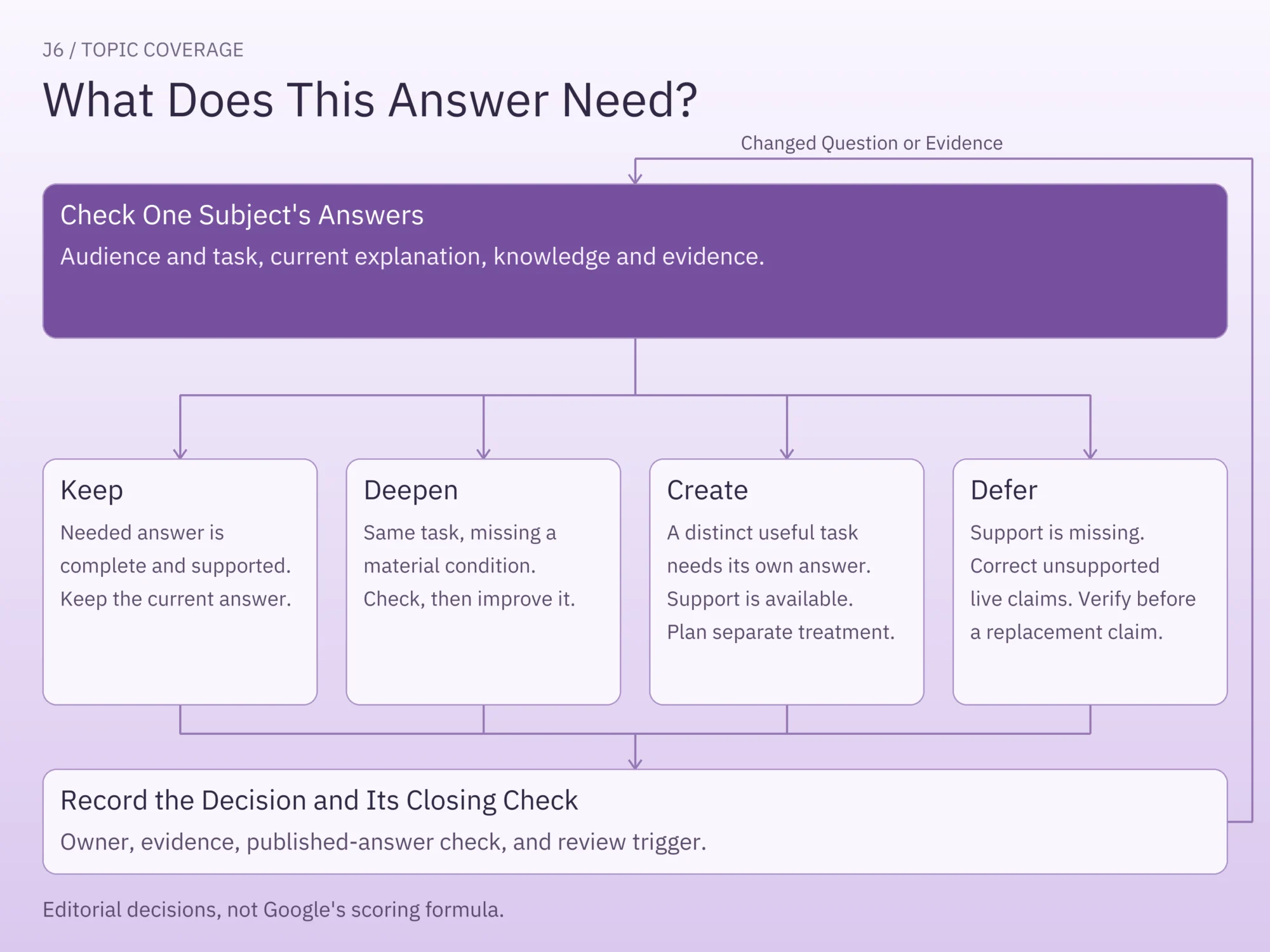
Step 4: Choose What to Keep, Deepen, Create, or Defer
Choose the action that follows from the question and its support:
- Keep an adequate answer. Give it a relevant review trigger; a new keyword variant does not automatically justify another page.
- Deepen an existing answer when the same task needs an important missing condition, example, or explanation.
- Create a separate treatment when there is a distinct useful task, the existing page cannot serve it coherently, and appropriate support is available. Confirm URL ownership in the content map before commissioning a new page.
- Defer an unsupported answer until the missing knowledge is established. Correct any unsupported version already live, and assign the evidence work.
Useful connections between answers belong in the plan. Link where the current passage creates a reason to visit the supporting resource, rather than connecting every page mechanically. The work may improve a section, an example, or an existing resource instead of increasing the URL count.
Record an owner and a completion condition for the chosen action. “Improve expertise” is too vague to implement. “Product lead verifies the required-value behavior, then the editor adds that condition and checks the published explanation” names what needs to happen.

A Worked Coverage Review for a SaaS Help Center
Set the Assumed Inputs and Subject Boundary
Imagine a software as a service (SaaS) product’s help center for teams importing contacts from a CRM. The pages, evidence, and roles in this example are fictional.
The reader is an operations lead preparing and checking an import. The subject includes required file information, matching file columns to product fields, understanding duplicate behavior, and checking the result. Which CRM to buy falls outside this review.
Here, field mapping means matching a column in the file to the corresponding field in the product. A required value is information the assumed product needs in a record. Duplicate handling concerns what it does when records refer to the same contact. This review judges the explanations and their support.
The assumed review date is October 25, 2026. The cases distinguish support already available in this setup from verification still pending.
Make Four Different Coverage Decisions
Case 1: Keep the Required-Columns Guide
Question and current answer: Which columns are required? The assumed guide includes a complete current list and an accepted example for this defined question.
Evidence and gap: The product lead has verified the list against the current product in this fictional setup. No material gap is identified within this question's scope.
Decision: Keep the answer. No new page is needed.
Owner and done when: The content editor records the guide's location and the product-lead verification reference. This finding is closed when that supported answer and its reference are recorded.
Review trigger: Reopen when product requirements or the reader's question change.
Case 2: Deepen the Mapping Guide After Verification
Question and current answer: What happens when a required value is missing? The assumed mapping guide explains field names but omits this condition.
Evidence and gap: The product lead is available to verify the behavior, but that check has not happened. The missing condition belongs with the existing explanation.
Decision: Deepen the existing guide after verification.
Owner and done when: The product lead supplies the current rule and an appropriate example. The editor adds the condition to the mapping guide. Complete when the support is recorded and the published passage accurately explains the verified condition.
Review trigger: Recheck after the required-value rule changes.
Case 3: Plan a Separate Answer About Checking Results
Question and current answer: How should I check an import's results? The assumed overview mentions completion, but no current resource explains this distinct checking task.
Evidence and gap: Assume a product specialist can supply a documented controlled example covering the input, expected checks, actual result, and relevant exceptions. That example is still to be supplied and verified; the answer also needs to be written and reviewed.
Decision: Plan a separate treatment for the distinct task.
Owner and done when: The specialist supplies and verifies the example. The editor confirms page ownership and commissions the answer. Complete when the task is explained, supported, and checked in its published location. The decision does not automatically assign a new URL.
Review trigger: Reopen when the checking process or product behavior changes.
Case 4: Correct the Duplicate Claim and Defer Its Replacement
Question and current answer: What happens to duplicate contacts? The assumed overview makes a categorical behavior claim that neither documentation nor the product team has confirmed.
Evidence and gap: Current behavior is unresolved. A confident rewrite or expert byline would leave the factual gap open.
Decision: Correct the existing claim now; defer a replacement claim until its support is verified.
Owners and done when:
- Editor, immediate correction: Remove the unsupported assertion or accurately state the unresolved status where useful. Check the corrected live passage. Opening an investigation does not complete this correction.
- Product engineer, evidence: Obtain current documentation or a recorded controlled check that establishes the behavior.
- Editor, conditional replacement: Publish a replacement claim only after its support is verified. Check that the published passage accurately reflects the evidence. The replacement is complete only after those checks.
Review trigger: Recheck when the product's duplicate behavior changes.
These findings show what the team can reasonably say about its coverage and what work remains. An assessment can identify a valuable question that the team is not yet ready to answer.
Keep a Reusable Assessment Note
For your own site, keep these fields together:
- Audience and subject: Who needs help, what task this review covers, and what is outside it.
- Question and current answer: The reader's question, the actual page or passage, and what it currently delivers.
- Support and limitation: Relevant evidence or expertise, when it was checked, important conditions, and what remains unknown.
- Decision and reason: Keep, deepen, create separate treatment, or defer; explain why that action fits the finding.
- Owner and completion: Who obtains evidence, edits, approves, and checks the published answer; what closes each dependency.
- Review trigger: A changed need, source, product condition, or planned review that should reopen the finding.
The fictional cases identify assumed resources rather than real URLs. A real assessment needs the actual locations and evidence references. Preserve an unresolved status until the required check is complete.
Track Progress Without Inventing an Authority Score
Start by checking the work you intended to complete. Was the missing condition verified and explained? Was an unsupported assertion corrected? Can the reader reach the answer they need? Those checks establish a specific improvement in coverage or support.
Search and audience measurements can add another view. Kevin Indig's Topic Share workflow, for example, compares the share of estimated search traffic different sites receive across the same chosen queries. Such comparisons depend on the selected queries, competitors, and data source. They are observations or proxies, not access to Google's internal assessment.
| Observation | What It Establishes | What Still Needs Checking |
|---|---|---|
| A missing condition is now supported and accurately explained. | The identified editorial gap has been repaired. | Whether readers can use that explanation successfully; rankings and broader reputation are separate questions. |
| Relevant readers report that an answer resolved their question, or a suitably defined behavior measure improves. | Evidence about those responses or actions within the observed sample and period. | Who was represented, how the evidence was collected, and whether other changes affected the observation. |
| Visibility or estimated topic share rises across the chosen query set. | An observed change under that measurement method. | Changes in pages, competitors, demand, or search presentation; the movement does not isolate topical authority as its cause. |
| Search results stay flat after a coverage repair. | No improvement is visible in that chosen measure and period. | Discovery, page suitability, competition, demand, measurement limits, and other explanations; flat results alone do not prove inadequate subject depth. |
Review the assessment when important questions, product behavior, or supporting sources change. Set any recurring review around the subject's maintenance needs and an accountable owner. A new publication date or a larger content inventory does not establish that the help has improved.
Close One Supported Gap
Choose one subject and follow an important reader question through the content you already have. Identify the actual answer, inspect what supports it, and make a specific decision: keep it, deepen it, develop a distinct treatment, or defer an unsupported claim.
Give the work an owner and a completion check. Correct existing unsupported advice while evidence is gathered, and record what would reopen an otherwise adequate answer. You will finish with a clear decision, the evidence behind it, and an owned next step where work remains.