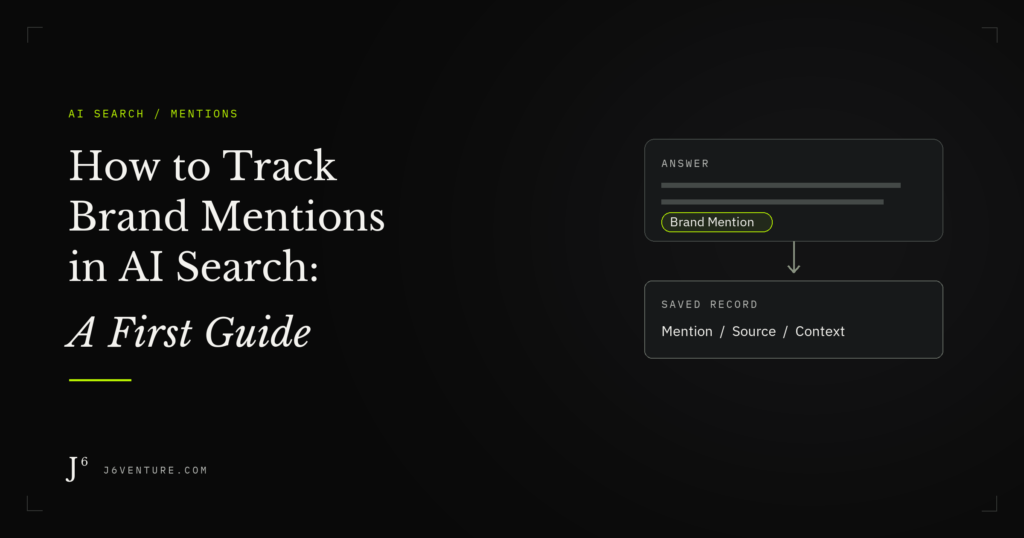
Choose a fixed set of buyer questions about needs your business serves, run them on named AI platforms, and save the complete answers. Record brand mentions, source citations, and recommendations separately. Calculate how often your brand appears among completed answers, then inspect the wording and evidence before deciding what needs attention.
Your first useful AI mention report should let someone open an answer and understand why it was counted.
A percentage alone cannot do that. You need the question, the response, the conditions of the check, and a clear rule for what counts. Otherwise, a changed prompt or an unchecked product claim can turn into a misleading performance story.
Two saved Google AI Mode answers about tracking tools show how to build that record. You can follow the same process manually before paying for monitoring software.
What Counts as a Brand Mention in AI Search?
A brand mention is an identifiable reference to your brand in an AI-generated answer. It can appear as a company name, product name, or recognizable alias. For this workflow, count the answer text separately from advertisements, ordinary search results, and the list of sources supporting the answer.
Write down accepted names before counting. Include product aliases only when you intend to measure them as part of the same brand. If a name could refer to another company or an ordinary word, inspect the surrounding description and domain. Mark unresolved matches for review instead of guessing.
Mentions, Citations, and Recommendations Can Overlap
Use three independent fields:
| Field | What Earns a Yes? | What to Save |
|---|---|---|
| Brand Mention | The answer text identifies the brand | The relevant sentence and complete answer |
| Owned-Domain Citation | The answer presents a page on the brand’s domain as a supporting source | The source URL and its association with the answer |
| Recommendation | The answer proposes the brand as an option for the stated need | The wording and any conditions attached |
A recommendation can be conditional or one of several options. A warning about a product still counts as a mention, but it does not earn a recommendation flag.
A linked brand name may send readers to a homepage. Open the source controls before recording it as a citation. Conversely, an owned page can appear among supporting sources without the brand being named in the answer text.
Count each field at most once per brand per answer. Five repetitions of a name still produce one answer containing that brand.
Choose the Buyer Questions You Want to Track
Track questions whose answers could matter to an audience you serve. Start with the decisions buyers make, their constraints, and the alternatives they consider. Keep the exact wording in a prompt list so future checks measure the same questions.
Use sales questions, support conversations, site-search terms, and relevant search queries to identify those decisions. Remove private customer details before entering anything into a public AI service. Search terms can suggest wording; they do not establish how frequently people ask an AI platform that question.
Our guide to keywords in SEO explains the underlying reader-job approach: group language around the question someone needs answered.
Separate Brand Questions From Category Questions
Keep two groups in your sheet:
- Brand questions: explicitly name your business and test how it is described, compared, or qualified.
- Category questions: describe a need without naming your business and test whether it appears among the options.
Report these groups separately. A prompt that supplies your name gives the answer a different starting point from a question about the category.
For the worked example, we used two category questions:
- 1A: Which tools can a small marketing team use to track brand mentions in AI search?
- 2B: Which tools can track brand mentions in AI search without a paid subscription?
The budget condition changes the buyer’s job. Keep that difference visible even when summarizing both answers.
Choose AI Platforms and Record Your Settings
Choose the AI surfaces your intended audience uses for that decision. Name the actual surface: Google AI Mode, Google AI Overviews, ChatGPT with search, or another specific experience. Keep results from different surfaces in separate groups.
Record date and time, language, intended market, visible mode or model, sign-in state, and whether the check starts a new conversation. Note location or personalization settings you cannot verify. A clean conversation removes earlier messages from that thread; it does not establish that every other influence is controlled.
API output and the consumer interface belong in separately labeled series unless you have evidence that the collection conditions match.
Run Your First Checks and Save the Answers
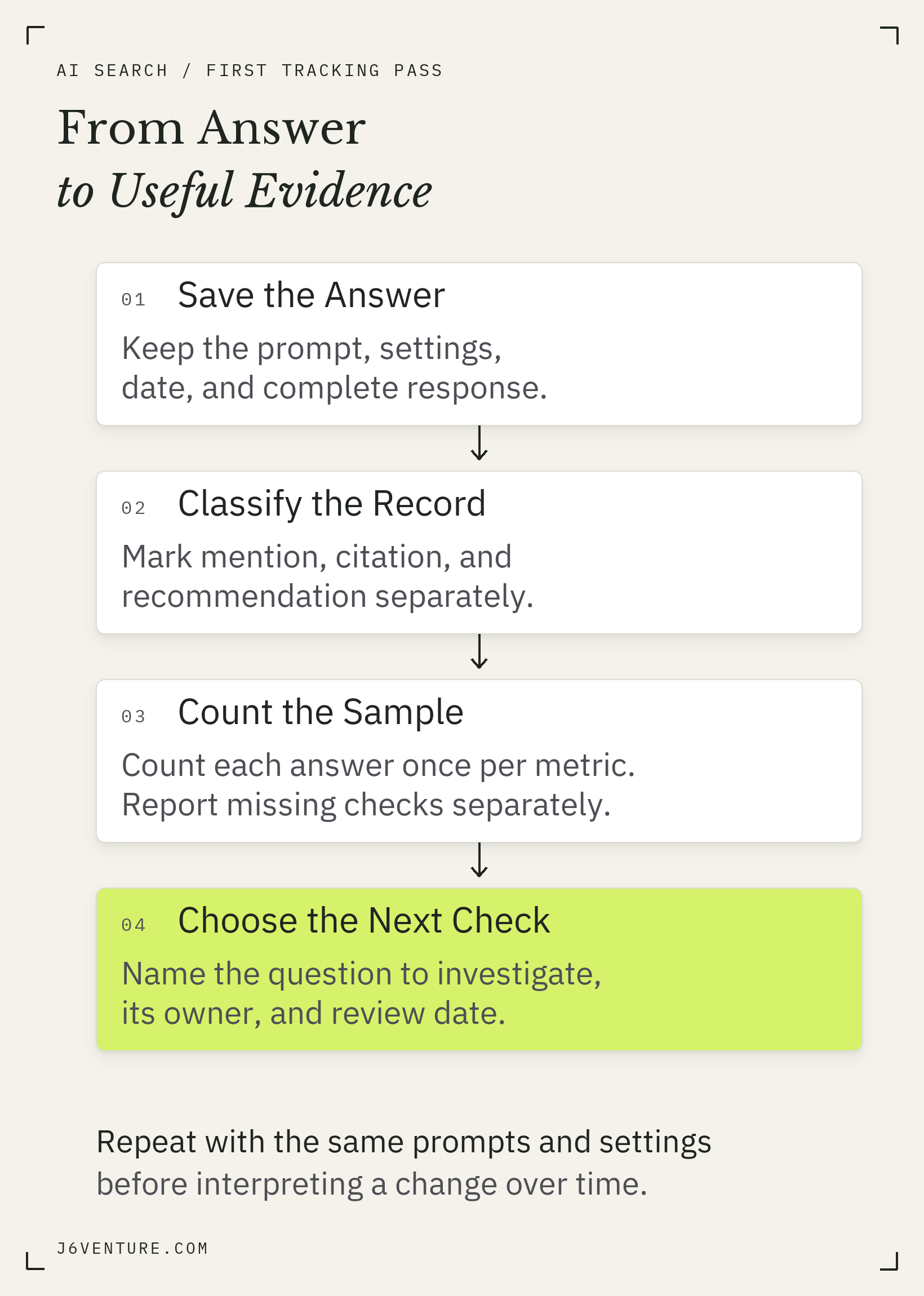
Run the saved prompts, retain the complete responses, and classify each answer using the same rules. Assign one person to resolve uncertain matches and set the next collection and review dates. Preserve the original response even when a later check returns different wording or different sources.
Start With a Small, Repeatable Prompt Set
Choose a set small enough to inspect properly. Cover the buyer decisions you care about rather than filling a quota. There is no universal prompt count that makes a sample representative of your market.
For each scheduled check:
- 1Open the recorded surface and start a fresh conversation where applicable.
- 2Submit the exact saved prompt without adding your brand to a category question.
- 3Let the answer finish, then save its text, sources, and a screenshot of the passage you will classify.
- 4Record completion status and classify the answer.
Choose a cadence the owner can sustain and that fits the decision. A team reviewing its positioning monthly may choose a weekly collection for its workload; this establishes no statistical threshold. Repeat checks help reveal variation, but repeating one prompt more often also gives it more weight in an answer-based rate. Keep the schedule balanced or report prompts separately.
Record Each Answer in a Tracking Sheet
Keep one row per answer per tracked brand. If one answer covers several competitors, reuse its answer ID across their rows. That preserves a shared denominator without pretending each brand row is a separate response.
The minimum useful fields are:
- Identity: answer ID, prompt ID, exact prompt, brand/category group, and tracked brand.
- Conditions: surface, settings, collection time, and run number.
- Evidence: saved full answer, screenshot, and source URLs.
- Status: completed, failed, unavailable, or no AI answer displayed.
- Classification: mention, owned-domain citation, recommendation, and accuracy note.
- Follow-up: action, owner, and next review date.
Use yes, no, and unresolved for classification, plus not checked where a check was deliberately omitted. A blank cell should never silently mean no. Keep unresolved cases visible and finish them before presenting a final rate for that field.
Work Through a Public AI Answer, From Evidence to Record
We collected one answer to each of questions A and B in Google AI Mode on October 10, 2026, using a signed-in account and US/English search parameters. The model version, actual location effects, and personalization were not verified. The calculation uses these two original answers only. A later screenshot check, labeled below, is excluded.
Mark the Mention, Citation, and Recommendation Separately
Answer A listed Otterly.ai among tools for smaller teams. It described a fit for smaller budgets, so the recommendation flag is yes under our rule. Expanding the source control beside that passage also revealed the Otterly homepage and its agency-monitoring page.
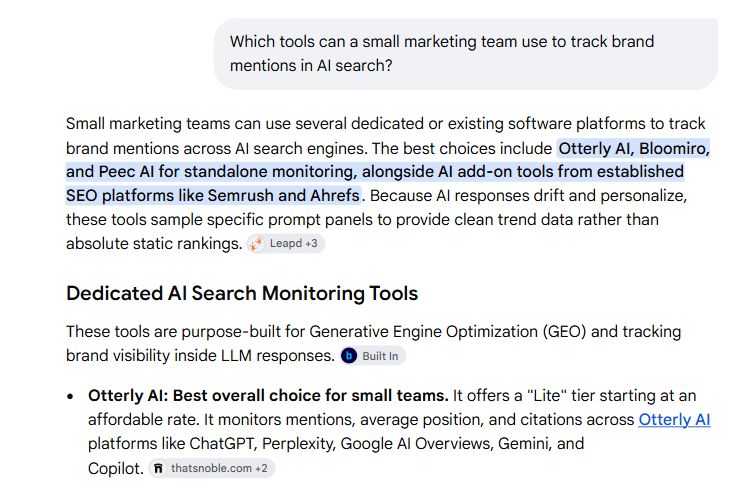
Later check of question A, October 10, 2026: the wording changed, but Otterly remained a named option. This screenshot illustrates a mention and recommendation; it is excluded from the original two-answer calculation. The original citation classification comes from its separately retained source list. Product claims require verification before a buying decision.
The Otterly record therefore reads:
| Field | Recorded Value | Evidence |
|---|---|---|
| Answer ID | A | Small-marketing-team question |
| Completion | Completed | Full response retained |
| Mention | Yes | Otterly.ai appears in the answer text |
| Owned-Domain Citation | Yes | Expanded source list includes otterly.ai URLs |
| Recommendation | Yes | Proposed as an option for smaller budgets |
| Accuracy | Not Fully Checked | Product capabilities and price need their own verification |
Answer B named Ahrefs AI Visibility Checker among free checking options. Otterly did not appear in its complete answer text. Ahrefs also appeared in answer A, under Brand Radar. We count these as the same parent brand for this example while preserving the product names in the notes.
We checked the full saved response to establish Otterly’s absence from original answer B. A later attempt to recapture B failed to return a usable answer; it is logged separately and does not change the original sample’s two completed checks.
Check What the Answer Says About the Brand
Presence and accuracy deserve separate fields. Answer A grouped Ahrefs Brand Radar with SEO platforms it described as adding no extra cost. That cost framing needed checking before anyone used it to choose a tool.
At our October 10, 2026 check, Ahrefs’ official Brand Radar page distinguished included custom-prompt allowances on paid plans from separately priced AI Visibility Index access. The answer’s broad cost framing omitted that distinction.
The useful accuracy note is specific: “Cost description needs qualification: distinguish included prompt allowance from separately priced index access.” It would be too broad to label every Ahrefs capability paid or to mark the entire answer false.
For your own brand, prioritize claims that could change a buying decision: price, availability, service area, integrations, eligibility, or who the product suits. Save the claim, the official page used to check it, and the check date. A positive description can still send the wrong customer your way.
Calculate Mention Rates for Your Sample
An answer-based mention rate is the percentage of completed, classified answers in a defined sample that name the brand. Show the fraction alongside the percentage. Label the prompt group, surface, and collection period so readers know what was counted and can inspect the underlying responses.
Mention Rate = Completed Answers Mentioning the Brand ÷ Completed Answers Checked × 100
Count Completed Answers and Report Missing Checks
Our two checks both completed, and both mention classifications were resolved:
| Brand | Answer A | Answer B | Answers Mentioning Brand | Sample Mention Rate |
|---|---|---|---|---|
| Otterly | Yes | No | 1 of 2 | 50% |
| Ahrefs | Yes | Yes | 2 of 2 | 100% |
The total is two answers, even though the table contains four brand-answer observations. Missing checks: zero. Each question contributes one answer.
These percentages describe only these two chosen questions. They measure neither audience reach nor a trend, and the different constraints matter. The per-question yes/no record is more useful here than treating 100% as a performance target.
For ongoing monitoring, report scheduled, completed, failed, and unavailable checks alongside the rate. A failed request is missing evidence. A completed answer without the brand is a valid no. With zero completed answers, the rate is unavailable; reporting 0% would imply observed absence.
For AI Overviews, also record when no overview appears. The answer-based mention rate uses completed, displayed AI answers. If you also count mentions across all searches checked, label that separately as mentions per search checked: it includes searches with no overview. Keep both denominators visible.
Compare Competitors Within the Same Sample
Use the same answers, naming rules, and collection conditions for every competitor. Our comparison supports a narrow statement: Ahrefs appeared in both saved answers, while Otterly appeared in one. It provides no basis for claiming that Ahrefs leads the whole market.
Mention rates can total more than 100% because one answer can name several brands. Calling this number share of voice would hide a different denominator. If a tool supplies that metric, inspect its definition before comparing it with your sheet.
Ahrefs’ methodology explains how its estimated visibility measures are modeled. Read a vendor’s metric definition before comparing it with your own answer count.
Decide What Your Results Need Next
Use the record to choose an investigation, correction, or recheck. A mention count tells you where to look. The saved answer explains the issue: an inaccurate description, a relevant omission, a change in sources, or a different buyer constraint. Assign the next action to someone who can resolve it.
Compare Like-for-Like Checks Before Calling a Trend
Before comparing periods, check that these conditions match:
- Exact prompt wording, topic mix, and brand/category split.
- Surface, mode, language, and recorded settings.
- Number and schedule of runs per prompt.
- Completion coverage and classification rules.
If you add questions, report the unchanged group separately or start a new baseline. Keep the old records. A change in the question set can change the percentage even when every repeated answer stays the same.
Our sample has no earlier comparable period, so its trend field remains not assessed. A later check would need to rerun A and B under the documented conditions before a comparison could begin.
Investigate Inaccurate Claims and Relevant Gaps
Use this order to keep the work proportionate:
| Observation | Next Action | Completion Condition |
|---|---|---|
| A buying-relevant claim conflicts with current facts | Verify against an authoritative page; inspect the cited material | A documented claim/source comparison and a correction owner |
| Your brand is absent from a relevant answer | Check product fit, the question’s constraints, and cited alternatives | A reasoned decision to investigate further or leave it alone |
| A rate changes | Check comparability and the actual changed responses | A matched comparison with missing checks disclosed |
| Classification is ambiguous | Review context and accepted aliases | A resolved flag or explicitly unresolved record |
In this sample, the cost qualification in A is actionable research. Otterly’s absence from B calls first for a check of fit with the no-subscription constraint. Neither observation alone justifies rewriting a website.
For work on search visibility after that diagnosis, our ChatGPT search guide covers the adjacent optimization task. Keep the monitoring record focused on the evidence that prompted it.
Keep Mentions Separate From Visits and Sales
A recorded mention establishes appearance in the captured answer. Website visits and sales require their own evidence. Keep analytics referrals, inquiries, and qualified outcomes in separate fields, then investigate any relationship without assigning revenue to an unseen conversation.
Native reporting also has a defined scope. Bing’s AI Performance documentation describes citation reporting across supported experiences; citation counts do not establish answer placement. Use such reporting for the activity it measures, alongside your saved-answer checks.
Our guide to SEO timelines develops the broader distinction between search progress and business outcomes.
Know When to Automate Your Tracking
Automate when the manual workload prevents consistent collection or review. Estimate that workload from prompts, surfaces, locations, and scheduled runs, then include the time needed to inspect ambiguous results. Buying more checks helps only when you can preserve their evidence and use the findings to make a decision.
Before choosing a service, check whether it provides:
- Exact prompt control and recorded collection conditions.
- Complete answer history and inspectable source URLs.
- Separate mention, citation, and recommendation definitions.
- Visible failures, missing checks, and exportable records.
- Clear collection methods, refresh frequency, and quota limits.
Test a small export against answers you can inspect. Check which product or domain an alias matched and whether a reported citation is a supporting source. A free one-off checker can help explore; verify whether it supports the recurring, fixed-prompt workflow you need.
Build Your First AI Mention Report
Finish with a report someone else can audit: the questions checked, completed-answer count, brand results, evidence links, and one next action with an owner and date. Preserve uncertainty in the relevant field. The report should make the next decision easier without pretending the sample represents every conversation about your market.
For our worked example, the report is:
- Scope: two category questions, one Google AI Mode answer each, collected October 10, 2026.
- Completion: two of two; zero missing checks.
- Mentions: Otterly 1/2; Ahrefs 2/2. Different buyer constraints; no trend assessed.
- Citation evidence: Otterly owned sources verified in A; other brand-answer citation flags not fully checked, so no citation rate reported.
- Completed action: we checked A’s cost framing against Ahrefs’ official page and documented the distinction between included prompt allowances and separately priced index access.
- Follow-up status: this teaching sample is closed. No ongoing monitoring owner or recheck date has been assigned. Before using the answer for a purchase, the buyer should check the current terms for the named product and plan.
For your own first report, name that owner and put the review date in the sheet. Start with a decision you care about and build a record you can return to. A useful mention report ends with a next action you can explain from the saved answer.