A B2B SaaS case study explains how a business customer used a software-as-a-service provider’s product to address a problem, including the starting situation, implementation, and reported results. Useful examples show how to build a story another buyer can evaluate and which writing choices you can adapt to your own evidence.
The biggest number on a case-study page can be the least useful detail to copy. A buyer deciding whether to change software also needs to understand the work involved, the people affected, and how the reported result was established.
A useful SaaS case study supplies evidence for one important buying question.
These five B2B SaaS case study examples offer different lessons: defining a task precisely, explaining a migration, connecting operational changes to a result, describing qualitative value, and showing the decisions behind adoption. Start with the question your buyer needs answered.
What Is a B2B SaaS Case Study?
A B2B SaaS case study turns a customer’s experience into an account another business can evaluate. It connects a recognizable problem to the software’s use and the outcome the customer reports. The SaaS provider is the vendor; the featured customer can be a retailer, manufacturer, or another software company.
A testimonial might say the accounting team likes a product. A case study can explain what that team previously did by hand, which work changed after implementation, and how someone assessed the difference. That extra detail lets a reader compare the experience with their own situation.
For example, a coffee company’s accounting story can be relevant to another business dealing with expense reconciliation. The useful connection is the shared task, systems, and constraints. A familiar logo alone leaves those questions unanswered.
The examples here are public vendor-published customer accounts, reviewed on October 18, 2026. We are examining their writing and evidence, without independently auditing the customers’ results or testing the products.
Choose an Example That Answers Your Buyer’s Question
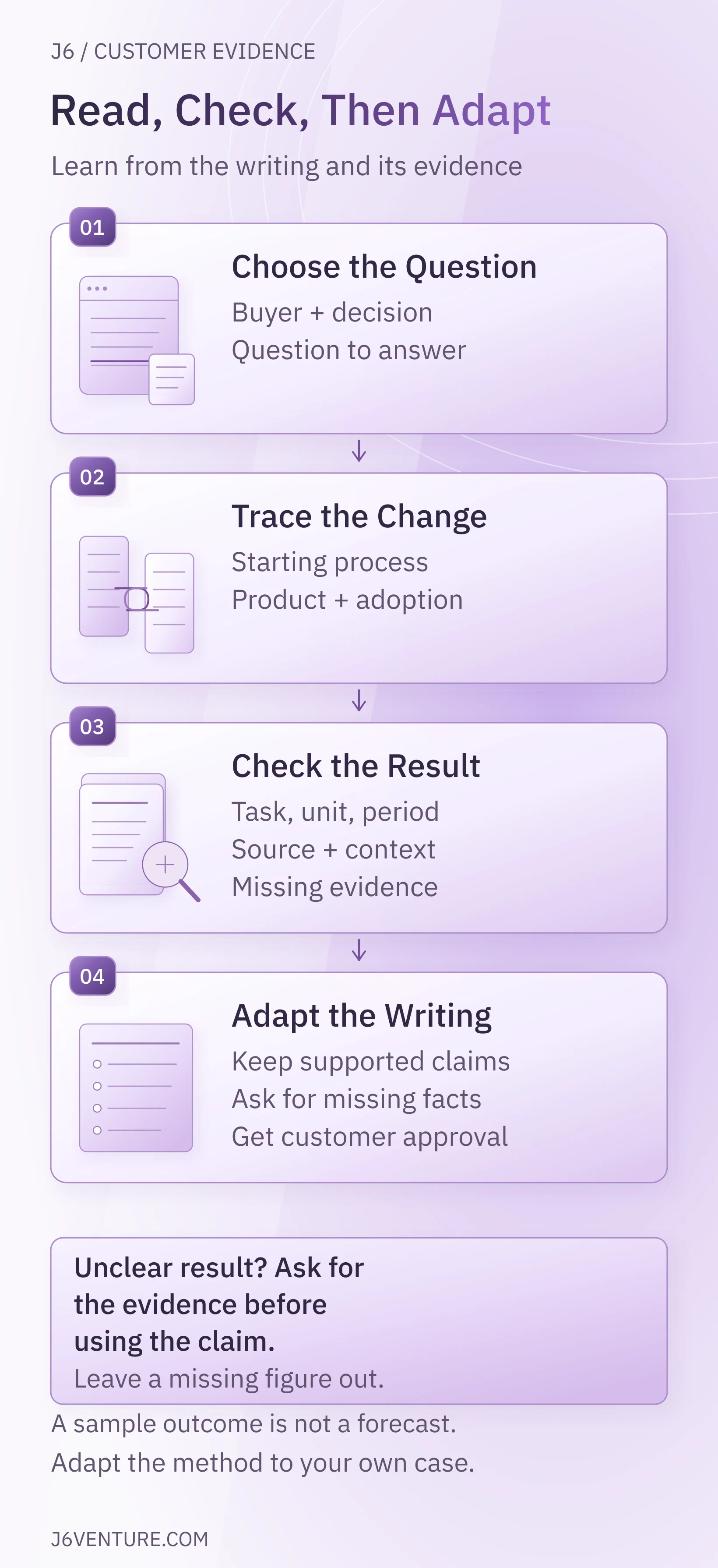
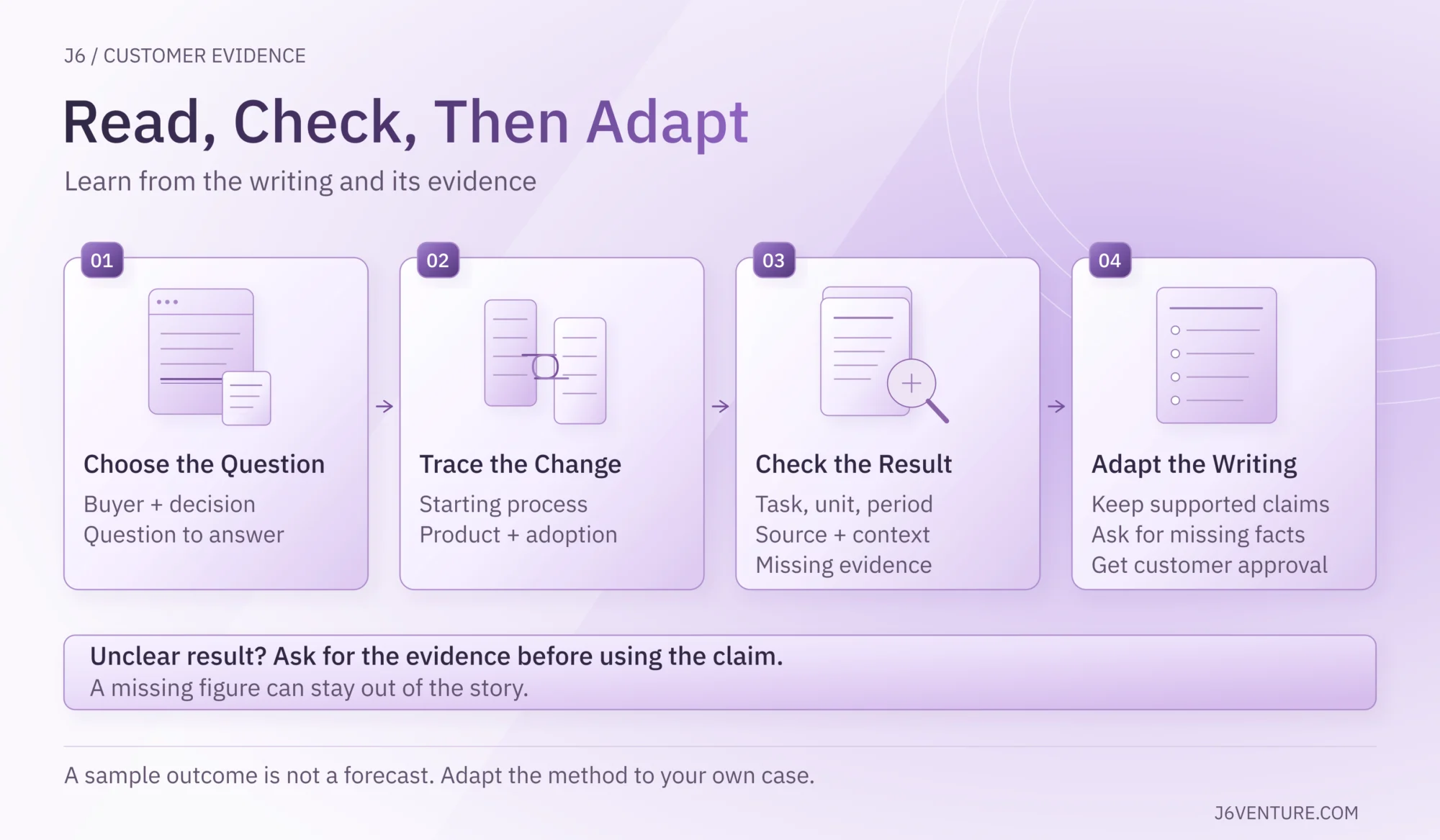
Choose a case study by the decision it helps a buyer make. A migration story serves someone worried about rollout differently from a story about a recurring accounting task. Read each through the same four checks, then borrow the writing choice that fits the evidence you have.
- 1Choose the question. What does a particular buyer need to understand before moving forward?
- 2Trace the change. Show what the software did and what the customer had to do. Identify implementation work, process changes, employee adoption, training, vendor support, and parallel operational changes relevant to the account.
- 3Check the result. Identify the task, measure, period, and source. Record what the page leaves unresolved.
- 4Adapt the writing. Use the structure with your own supported material; ask for missing facts before making a stronger claim.
Borrow / Do Not Copy
- Borrow: evidence structure, task definition, implementation detail, measurement logic, and the way the writing captures the customer’s perspective.
- Do not copy as your own experience: another customer’s numbers, timeline, ROI, context, or causal claim. Substantiate each with your customer’s evidence.
| Example | Buyer Question It Helps Address | Writing Choice to Study |
|---|---|---|
| Expensify and Philz | What recurring accounting work could change? | Tie a time saving to the task it describes |
| GitLab and Fanatics | What did a migration involve? | Show the champion, evaluation, and rollout |
| ServiceChannel and Freshpet | How did the operational process improve? | Connect the starting process to a defined measure |
| AppDirect and ADP | What value can a shared marketplace provide? | Explain the mechanism when numeric ROI is unavailable |
| Zendesk and Docebo | What decisions accompanied AI adoption? | Separate governance, implementation, and channel results |
These are editorial examples, presented in teaching order. A case study’s role is to answer an evidence need in a buying decision. The evidence buyers need when evaluating software also changes with the question they are asking.
Five B2B SaaS Case Study Examples to Learn From
Open the original page alongside the analysis to see how the source material supports the lesson.
1. Expensify and Philz: Define the Task Behind the Metric
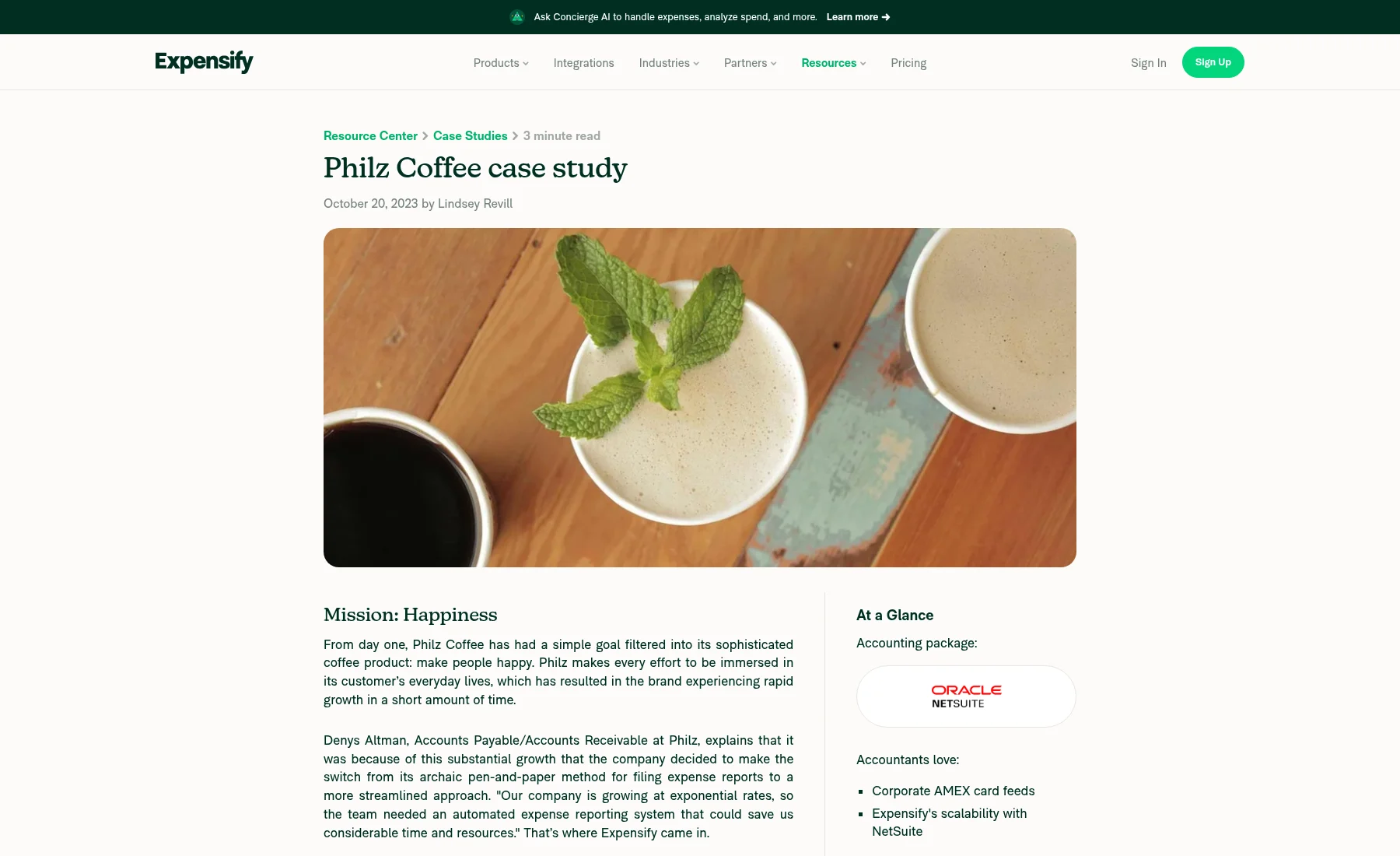
Expensify’s Philz Coffee story makes an accounting problem concrete. Its October 2023 account describes growth outpacing a manual expense-reporting process, the connection with NetSuite, and a procedural approach to helping employees make the switch.
The reported time saving becomes more useful when you read the explanation beneath it. Denys Altman describes AMEX reconciliation taking three or four days before and two or three hours afterward. That identifies the work behind the number. The surrounding narrative explains journal-entry exports and employees processing their own reconciliation reports.
The writing gives an accounting buyer something to investigate: which part of our reconciliation process consumes time, and how would a different workflow change it? A claim that the entire finance department became a certain percentage faster would lose that precision.
Borrow two choices:
- Name the task alongside the result. Keep the before-and-after units visible so readers know what changed.
- Explain the operating change. Include the integration, handoff, or employee action that makes the account understandable.
The account does not establish a standard workday length, a measurement period, or comparable transaction volumes for a new percentage calculation. Keep the attributed values until those inputs can be established.
2. GitLab and Fanatics: Make Implementation Tangible
GitLab’s Fanatics story gives a buyer concerned about disruption an account of how a software change happened. The reported switch began at the end of 2018; the story says the transition took about three months and covered 800 projects.
Before the migration, a cloud-team lead investigated alternatives, ran proofs of concept, demonstrated GitLab internally, and encouraged colleagues to try it. The story identifies a champion and shows the evaluation work around the software.
Those details give substance to an implementation claim. A reader can ask who would sponsor a comparable change, what they would need to test, and which teams would have to participate. The reported improvement in continuous integration stability has an operational setting, rather than appearing as an isolated endorsement.
For your case, interview the person who drove the change:
- Which failure made the previous arrangement difficult to sustain?
- What did the team test before committing?
- What had to move, who was involved, and how long did the rollout take?
Borrow the sequence and division of work. Keep the three-month timeline tied to this historical migration; it does not establish a usual implementation time or which GitLab hosting model the customer used.
3. ServiceChannel and Freshpet: Connect the Before and After
ServiceChannel’s Freshpet account connects a maintenance problem with changes in data, dispatching, and asset management. The customer had relied on a third party and manual tracking, making work-order information and performance reporting difficult to use.
The solution narrative explains what changed: integrations with other systems, centralized analytics, warranty-based routing, and after-hours support. Its results section reports that average issue-resolution time fell from eight days to four days. Those starting and ending values make the stated 50% reduction interpretable.
The lesson is the connection between the workflow and its measure. A facilities buyer can see why more accessible work-order data or faster dispatching might matter, then inspect the reported resolution result. The story provides material for a substantive question about the operation, beyond whether users liked the interface.
For a comparable story, ask the customer to define:
- The measure: what starts and ends an issue-resolution clock?
- The comparison: which locations, issue types, and periods are included?
- The contribution: what changed in staffing, suppliers, or operating procedures alongside the software?
Four days is an average, not a promise about every issue. The detailed measurement method remains open in the public account; establish it with your customer for a new case.
4. AppDirect and ADP: Explain Value Without Inventing ROI
AppDirect’s ADP story shows how a case can explain value without a headline percentage. It describes the purpose of an application marketplace launched in 2014: help employers discover complementary applications and give developers a route into the ecosystem.
The account then connects the platform to several activities: integrating third-party services, onboarding providers, and letting customers discover and purchase services through a shared identity. AppDirect reports reduced resource investment and time to market when adding applications, without supplying a numeric reduction on the page.
A marketer can explain how the marketplace serves employers and developers even when there is no publishable ROI figure.
Borrow that relationship between a business objective and the process that serves it. A qualitative customer account can identify a changed workflow, its participants, and why they value the difference. Ask for a recent concrete instance: what did adding a partner require previously, and what does it require now?
If the customer cannot quantify the change, keep the approved account qualitative. Dates, direct observations, and a clear explanation of the work can support the account without inventing a cost saving.
5. Zendesk and Docebo: Show the Decisions Behind Adoption
Zendesk’s Docebo story combines an AI-support rollout with organizational decisions. It describes fragmented tools, difficulty sharing reliable reports, and an executive discussion about security and data governance before adoption progressed.
The implementation has distinct layers: AI agents for automated resolutions, Copilot to assist human agents, and quality assurance (QA) to review interactions. That separation helps a support leader see what changed for different parts of the operation. The narrative also addresses employees’ concern that automation would replace their roles.
The page reports AI agents resolving 43% of inbound chats and 30% of inbound email, while describing 50% AI-driven resolutions as a future objective. Keep the channels and goal separate. Combining them into one achieved automation rate would change the account.
The writing choice to borrow is its attention to adoption questions:
- Who needed to assess security and data concerns?
- Which work was automated, assisted, or evaluated?
- How did the change affect the people doing that work?
The page also presents several savings figures with different descriptions and time bases. Their relationship is not sufficiently clear to build a new combined savings total from the public account. If a number will anchor your own story, reconcile it with the customer before placing it in the headline or summary.
Across these five accounts, the evidence worth studying takes different forms: a precisely named task at Philz, an evaluation and migration sequence at Fanatics, a reported average at Freshpet, an operating mechanism at ADP, and governance and adoption decisions at Docebo. Each makes a different buying question easier to examine. Choose the form of evidence that answers your buyer’s question, then establish what your own customer can support.
Turn an Example Into Your Own Case-Study Brief
Turn an example into a brief by keeping its useful structure and replacing the source material with evidence from your customer. Choose one buyer question, establish the relevant experience, and decide which claims can be supported. The Philz account shows how that preparation works before you draft a full narrative.
1. Choose the Question and Interview the Right Person
For this worked public-source exercise, the question is: How did Philz change its recurring reconciliation work? We are reading the published account, not conducting a new interview or reconstructing an unpublished measurement study.
For your own customer, speak to someone close to that work. A project sponsor can explain the buying decision; an operator can explain the recurring task. You may need both perspectives.
Ask for a walkthrough of the previous process, the point at which it became difficult, the implementation, and a recent example of the new process. Follow a broad answer with a concrete question: which handoff disappeared, which record became available, or which employee action changed?
2. Preserve the Evidence and Identify What’s Missing
The Philz source gives us a task-specific result, a named speaker, an integration context, and an employee-onboarding account. It does not answer every measurement question. Record those details and unanswered questions separately:
| Brief Field | Filled From the Philz Source |
|---|---|
| Buyer question | How did the company change recurring reconciliation work? |
| Starting situation | Manual expense-related work became difficult as the business grew |
| Operating change | Expensify connected with NetSuite; employees could process their own reconciliation reports |
| Reported outcome | Denys Altman describes AMEX reconciliation moving from three or four days to two or three hours |
| Adoption context | The company introduced a procedural system to help employees move from the previous approach |
| Follow-up needed | What period and transaction volume were compared? Do days mean elapsed time or staff working time? Which other changes contributed? |
| Drafting decision | Attribute the reported task and values; omit a newly calculated percentage pending those answers |
For a new case, link each material claim to its source: an approved interview passage, a report, or another record the customer can verify. A statement about saved time needs the task and units; a revenue claim also needs a defined period and a defensible account of the product’s contribution.
3. Build a Story the Customer Can Approve
The worked brief supports this bounded summary: Expensify’s Philz account describes a change in expense-related workflows, including NetSuite reporting and employee reconciliation. Denys Altman reports that AMEX reconciliation moved from three or four days to two or three hours.
It supports a story about a particular accounting task. A claim about a universal productivity improvement would need different evidence.
Build your draft around the same core sequence: customer context → problem → decision and implementation → supported result → relevant next step. Put the strongest supported point near the opening, then explain how the work happened. Use a quote where the customer’s perspective adds information. Before release, agree with the customer on:
- Identity and context: the customer name, logo, descriptive details, and any boundaries on identification.
- Wording and evidence: the exact quotes, metrics, surrounding context, and qualifications to be published.
- Reuse and channels: the versions and intended uses, including the website, PDF, sales materials, newsletter, social posts, or video excerpts you actually plan to publish.
Keep that approval with the approved version. If a later edit changes a claim or adds a use outside the agreement, seek approval for the changed scope.
If the customer cannot be named, agree on an anonymous account, the descriptive context allowed, the claims and quotes, and where they may be reused. Remove identifying details as needed without inventing a replacement identity. If the required scope cannot be authorized, hold the customer story. Anonymity does not supply permission.
Choose a Format and Use It Where Buyers Need It
Choose the format according to the explanation a buyer needs. A written page can carry implementation detail; a one-page version can support a focused sales conversation; a video can convey the customer’s reasoning and experience. Keep key facts available as text so someone can check them without watching the whole recording.
Length follows that job. Include enough context to interpret the result and enough implementation detail to understand the change. Cut company history or feature descriptions that do not help answer the chosen question.
Place the story where that question already arises: a relevant product page, a sales follow-up about rollout, or a newsletter addressing the same operational problem. Connect it to the next useful action, such as reviewing an implementation guide or discussing requirements. A wider SaaS inbound journey needs those connections to be planned around the buyer’s needs.
AI can help organize approved interview material or draft a version for another channel. Check every resulting claim against the source, and preserve the customer’s qualifications and permissions. A fluent draft cannot supply missing results or a customer approval.
Finish With a Story You Can Stand Behind
A case study is ready for customer review when its narrative answers one useful buyer question and its claims can be traced to evidence. A qualitative outcome can be enough. An ambiguous number can remain out of the draft while you seek clarification.
Before sending it, check:
- The intended reader can recognize the problem and understand what changed.
- Product use and customer effort are both visible.
- Results retain their task, units, period, source, and relevant limits.
- Customer identity and logo, quotes, metrics, context, and intended channels are ready for approval.
- The ending offers a next step that fits the question the story answers.
Choose one customer and one unresolved buyer question for your next brief. Gather the account of the work before choosing its headline number. If you are deciding which evidence page to prioritize, connect that choice to your software company’s SEO priorities. The finished case should let a buyer judge what changed, what the software contributed, what the customer had to do, and how that experience relates to the decision in front of them.