The strongest shortlist starts with the work you need done and the people available to implement it. For a migration supported by internal engineers, Seer Interactive and iPullRank warrant initial conversations; a different assignment or loss of engineering capacity changes the shortlist. Compare documented services against your brief, then confirm the proposed team, implementation responsibilities, timing, and fee before appointing an agency.
An enterprise SEO agency can produce an excellent recommendation that never reaches your website. Someone still needs to turn it into a technical change, an approved page, or a release your organization can support.
That division of work should shape your shortlist early. A company preparing a website migration needs a different engagement from one trying to produce expert content or connect search activity to qualified sales opportunities. Even two companies with the same problem can need different support if one has available engineers and the other does not.
Which Agencies Should You Shortlist First?
For a migration supported by your own engineers, Seer Interactive and iPullRank warrant initial conversations: their reviewed technical pages document relevant migration work, with different levels of detail about the engagement. For business-to-business (B2B) buying journeys and commercial measurement, investigate Directive. For SEO connected to website design and conversion work, look at Orbit Media. For content production and digital public relations (PR), examine Siege Media. For a published enterprise SEO plan that explicitly includes implementation of approved technical updates, review WebFX.
These are starting points based on the specific public evidence below. They do not establish exclusive specialties or a best overall agency. J6 Venture publishes this comparison and also offers SEO services; we have not included J6 in the sample.
| Agency | Documented Work That Merits a Conversation | What You Still Need to Establish |
|---|---|---|
| Directive | B2B search opportunities, buyer decision mapping, technical and content work, commercial measurement | How its proposed work connects to your sales records, and who implements it |
| iPullRank | Complex technical investigation, migrations, prioritized audits, and technical specifications | The assigned delivery team and responsibility for coding, launch support, and follow-up |
| Orbit Media | SEO strategy, copy, conversion work, and website design/development | Whether the proposed team can make the required changes in your website platform |
| Seer Interactive | Technical consulting and migration services spanning prelaunch, launch, and postlaunch checks | The exact split between agency support and your engineering work |
| Siege Media | Content strategy and production, design, content development, and separate digital PR services | Expert input, approval capacity, publishing responsibilities, and the commissioned scope |
| WebFX | Enterprise SEO plans with target-page limits, consulting hours, and approved technical updates | Which technical changes are included and whether the plan covers your scale and platform |
How This Comparison Uses Public Evidence
We reviewed these agencies’ service pages on October 23, 2026. The six form a bounded, unranked sample with contrasting documented work. This is a public-document comparison, with an illustrative buyer scenario; we did not test their services, obtain proposals, interview account teams, or independently audit their client results.
An agency’s service page establishes what it advertises. A case study can describe work it reports having performed. Neither establishes who will be assigned to your account or what your contract will include. When a reviewed source does not supply a price or responsibility, that detail remains unknown.
Here, enterprise needs mean technical complexity, multiple teams, or organizational dependencies that affect delivery. Company size or a recognizable client logo alone does not establish a suitable engagement. For the broader distinction between an agency, consultant, and internal team, use our guide to what an SEO agency does.
Six Enterprise SEO Agencies Compared by Documented Work
The useful difference is the work each source describes and the question it leaves you needing to answer. Use the profile most relevant to your assignment, then compare the resulting proposals on that same assignment.
Directive: Connecting B2B Search to the Buying Process
Directive’s B2B SEO service describes commercial opportunity assessment, buyer decision mapping, technical optimization, and content work. Its approach prioritizes the questions people use to evaluate solutions and relates measurement to traffic, conversions, pipeline, and revenue.
That makes Directive a relevant conversation when the difficult question is which search opportunities can reach suitable business buyers. A page that attracts researchers may require a different next step from one used by a buying committee comparing suppliers. The agency’s published buyer-mapping approach gives you something specific to examine.
Ask it to demonstrate how one proposed page would connect to an agreed sales outcome in your customer relationship management system, or CRM. Define that outcome, such as an accepted sales opportunity, before accepting a reporting example. You also need to know which records are available and where attribution remains uncertain: a search visit cannot by itself prove that SEO caused a sale.
For delivery, request the named owners of technical changes, product-expert review, and publication. The service positioning supports a commercially focused discussion; it does not establish that the agency can resolve your data or implementation dependencies without your team.
iPullRank: Investigating Complex Technical Problems
iPullRank’s technical SEO page names JavaScript SEO, log-file auditing, website migrations, and complex site architecture. JavaScript SEO concerns whether search engines can access and interpret content delivered through website code; server logs record requests that help investigate crawling behavior.
The page also identifies concrete deliverables: an audit with prioritized recommendations, a technical specification for a new website or experience, and a presentation explaining findings and next steps. That is useful when the first job is to diagnose a complicated problem and give engineering a usable specification.
Bring a representative page template or migration requirement to the conversation. Ask what its specification would contain, how the priority would be justified, and what evidence would show that a fix addressed the problem. A sample deliverable should help your engineers judge whether they could act on it.
The reviewed page does not settle who would commit production code, support your launch, or verify every released change. Establish those responsibilities in the proposed scope. This limit concerns the evidence available for your decision; it does not show that iPullRank cannot provide implementation.
Orbit Media: Bringing SEO and Website Optimization Together
Orbit Media’s enterprise SEO service discusses organizational complexity alongside strategy, audits, copywriting, and conversion rate optimization. Conversion work improves the page experience and the actions visitors can take. The page also describes designers and developers executing the optimization plan.
Orbit is therefore worth investigating when an SEO priority depends on changing the website itself. For example, a page may address a relevant buyer question yet lack a useful explanation, a clear action, or a workable layout. Copy, design, and development can all affect the assignment.
Ask for a proposed change to one representative page, with the writer, designer, developer, and approver identified. Then establish whether that team can work in your content management system, or CMS, and how it would handle the release. Access to designers and developers does not establish capacity for every software stack or custom application.
A website optimization engagement also needs a defined boundary. Determine whether the proposal covers changes to existing templates, new templates, or a larger rebuild. Those are materially different commitments even when all appear under website improvement.
Seer Interactive: Defining Support Across a Migration
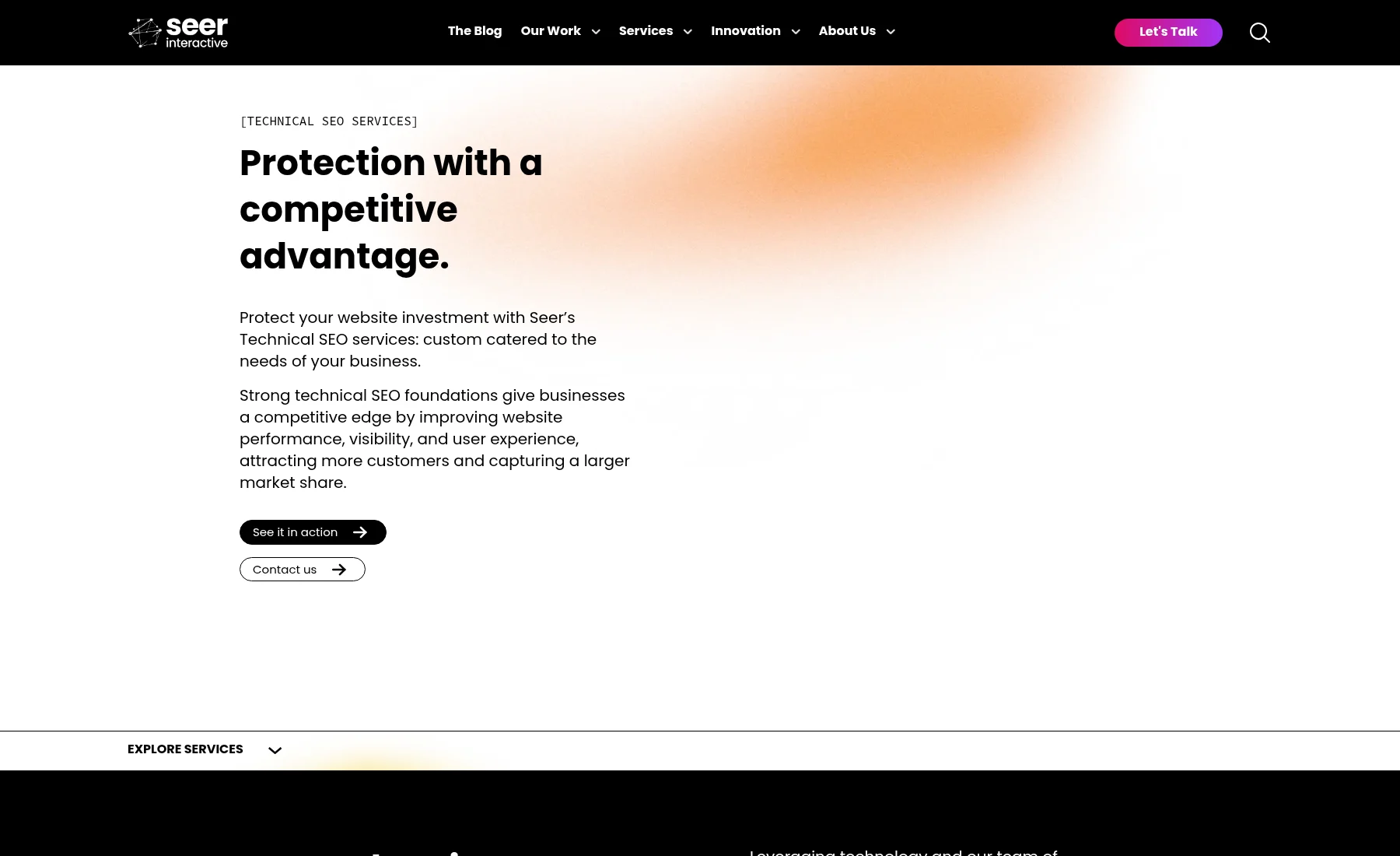
Seer’s technical SEO service separates consulting, monitoring, migration support, and lighter maintenance. Its migration description explicitly includes prelaunch benchmarking, launch-day support, and postlaunch monitoring and quality assurance, or QA, of high-priority fixes. QA means checking that the change works as intended.
That phase-specific description gives a migration buyer a useful starting scope to discuss. Ask what would be checked before launch, who would be available during the release, and which observations would trigger action afterward. Establish which fixes your developers would own and how Seer would verify them.
A separate Seer case study published in 2023 describes remediation following a redesign and CMS migration. In one task, Seer reports presenting a new redirect map to the client for implementation. A redirect map specifies where old URLs should send visitors after a move.
That detail matters if your engineers are already overloaded: obtaining the map and putting it into production are separate jobs. The case does not establish that Seer always delegates implementation, and other tasks in the story have less explicit responsibility boundaries. Use this reported handoff to ask a sharper question about your engagement. Keep the historical remediation case separate from the current service offer’s broader launch-phase description.
Siege Media: Producing Content and Earning Coverage
Siege Media’s content marketing service describes strategy, writing, design, development of content assets, SEO, and analytics. Its digital PR service separately describes creating and promoting material intended to earn editorial coverage and links. Digital PR here means outreach around material others may choose to cover.
This is a relevant conversation when your main constraint is producing useful content or research with the design and promotion needed to support it. The reviewed services also discuss expert and legal review. Your team’s ability to supply accurate subject knowledge and approve material therefore belongs in the scope discussion.
Ask what a defined production allocation would buy: which assets, what research, how much expert input, which revisions, and whose publishing work. For PR, establish whether the engagement includes creating the underlying material, promoting existing material, or both. Siege’s PR FAQ says it does not guarantee a mention count or buy links, so do not treat outreach activity as a promised number of placements.
Siege’s reviewed content service includes design and development. Its suitability for your particular engineering work remains a scope question to resolve with Siege.
WebFX: Scoping an Enterprise SEO Plan With Implementation
WebFX’s enterprise SEO service publishes a plan table that includes implementation of approved technical updates, target pages, and monthly consulting hours. The listed Silver plan has up to 80 target pages and 11 consulting hours per month.
Those fields give a buyer concrete limits to inspect. Ask which of your important pages would count toward the allocation, which technical updates would be included, and whether implementation uses the consulting-hour allocation or a separate resource. The table does not resolve that operational detail for your proposed work.
Bring examples of your actual website changes. Updating a page’s metadata, modifying a shared template, and changing application behavior require different access and skills. A feature-table checkmark for implementation does not establish that all three are included at any volume.
This option warrants a conversation when you want an explicitly scoped ongoing plan with implementation described in the public offer. Obtain the current statement of work and assigned responsibilities before deciding that its page and hour limits cover your enterprise needs.
What the Published Fees Cover
The reviewed service pages supplied numerical pricing for the following offers. We found no fee for the reviewed service offers from Directive, iPullRank, Orbit, or Seer. Their fees remain a budgeting question; the missing prices establish nothing about service quality.
| Public Offer, Reviewed October 23, 2026 | Published Price in US Dollars | Scope and Contract Details to Keep Attached |
|---|---|---|
| Siege content marketing | Minimum $8,000 per month | Content service; a 12-month contract with a 30-day out clause is described. Confirm its notice and exit terms in your contract. |
| Siege digital PR | Starts around $12,000 to $15,000 per month when creating and promoting PR content | A separate PR offer; smaller retainers may be possible when suitable content already exists. |
| WebFX enterprise Silver | $12,550 per month | Listed plan includes up to 80 target pages, 11 monthly consulting hours, and implementation of approved technical updates. Confirm exact included work. |
These amounts are attached to different services and units. Siege’s content minimum is not a complete enterprise SEO quote, and its PR price is not automatically included in that minimum. WebFX’s page and consulting-hour allowances do not measure the same output as content production.
The same WebFX page gives a lower $2,500 to $7,500 monthly estimate in its enterprise-cost FAQ while listing Silver at $12,550. Use the named plan for this comparison and ask WebFX which scope and price would apply to your work. None of these public figures establishes your negotiated total, taxes, additional work, or the current team’s availability.
Give shortlisted agencies the same required work and ask each to separate the agency fee, additional services or tools, and the internal time your team must provide. You can then compare what completing the assignment would require. A lower monthly figure alone cannot answer that question.
A Worked Shortlist for a US Website Migration
Illustrative buyer brief: a US company with several product lines is moving its public website to a new CMS. Its internal engineers will make and release production changes. Marketing needs help inspecting the site before launch, checking the staging version, planning redirects, supporting launch, and checking important fixes afterward. Staging is a prelaunch copy used to inspect the new site.
The initial outside assignment is migration diagnosis and support. The company is not currently buying a new content-production program or a broader sales-measurement engagement. No agency has supplied this hypothetical buyer with a proposal.
Start With Two Agencies Whose Published Scope Fits
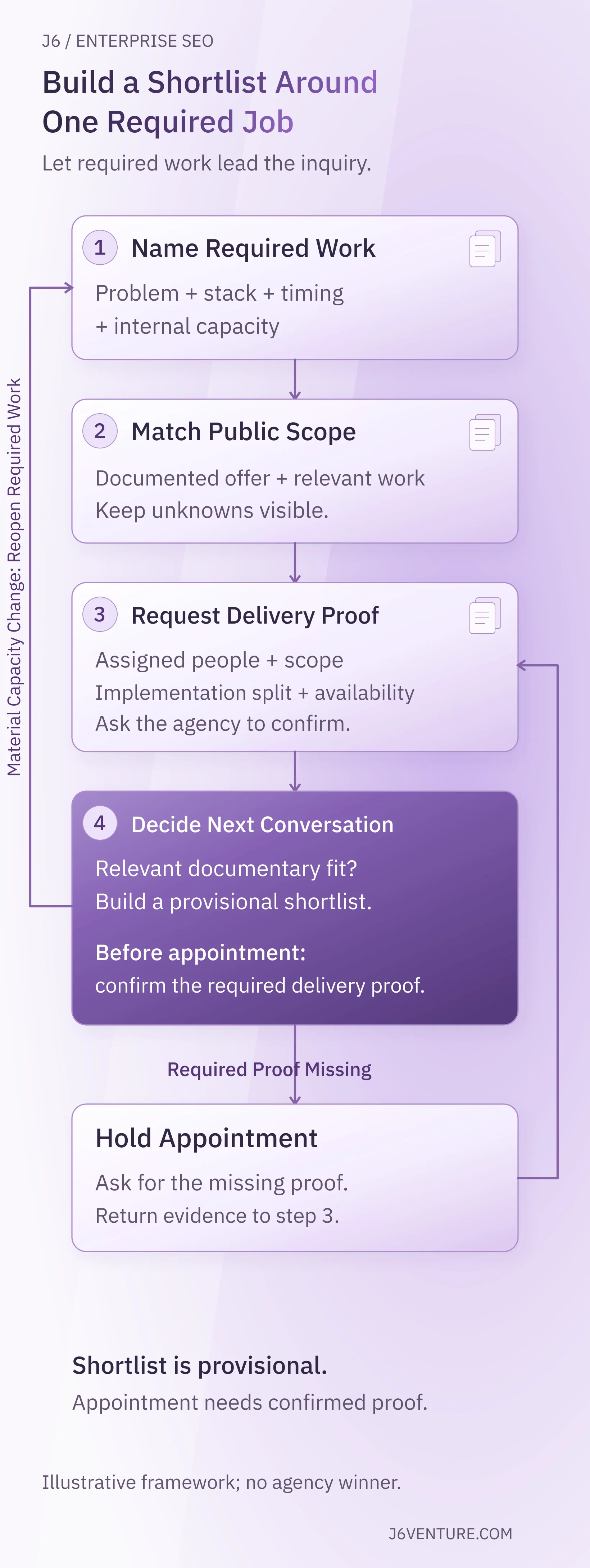
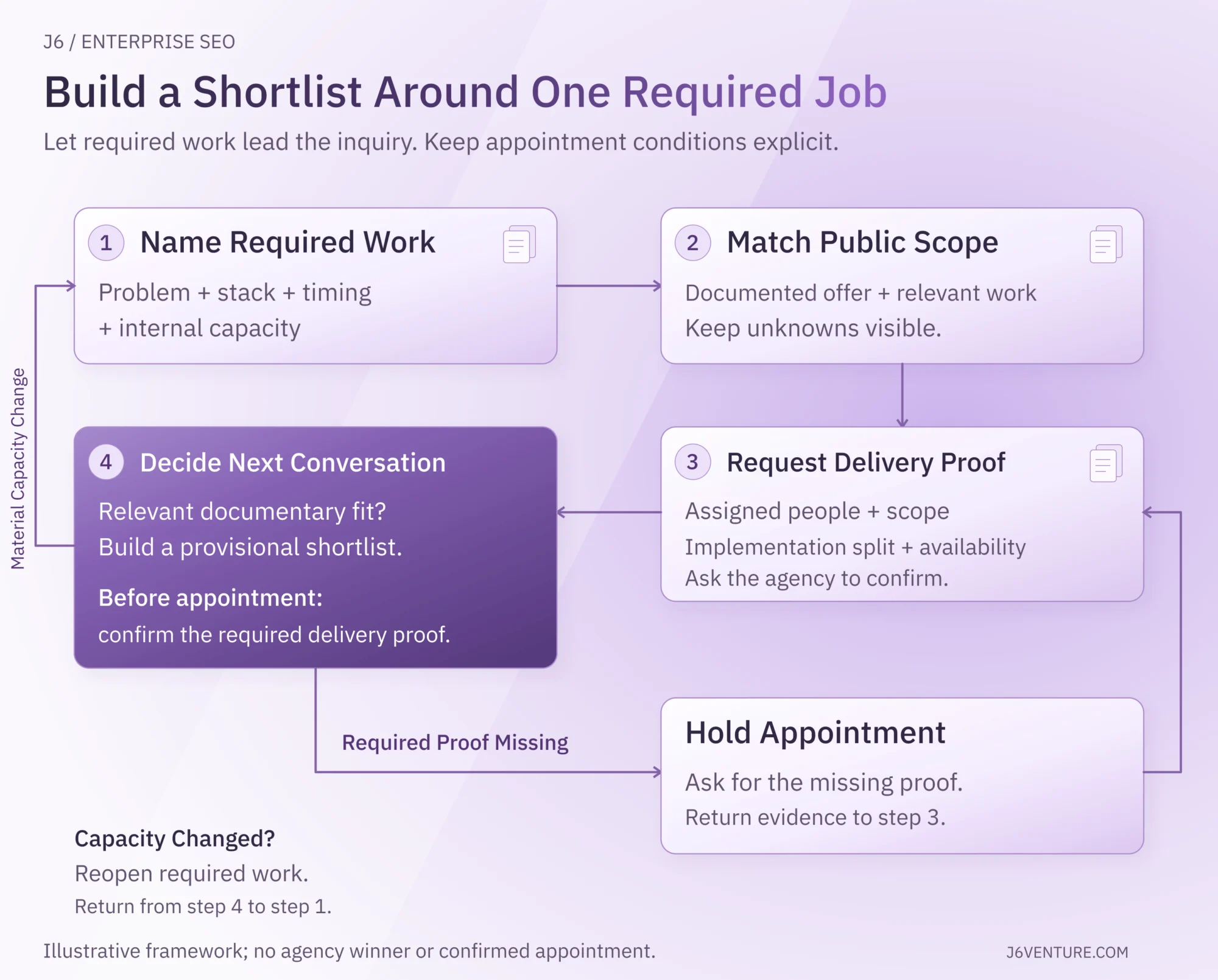
For this brief, build the initial two-agency shortlist around Seer and iPullRank.
Contact Seer first for a phase-by-phase migration scope. Its current service description explicitly spans prelaunch benchmarking, launch support, and postlaunch QA. Ask it to turn those phases into named deliverables and responsibilities for this CMS migration. Its published scope is the more explicit documentary match to that sequence; that is not evidence of superior performance.
Invite iPullRank to scope the technical investigation and specification. Its page explicitly describes migrations, complex architecture, prioritized audits, and technical specifications. Ask how that work would extend through launch and follow-up. Its reviewed source leaves more of that phase-specific responsibility to establish in the conversation.
Defer Directive and Siege from these first two conversations because the reviewed buyer-mapping and content/PR offers are less directly matched to the immediate assignment. Defer Orbit and WebFX initially because this buyer already has engineers committed to production work, and Seer’s and iPullRank’s reviewed pages more directly describe the selected migration/technical investigation. These decisions follow the relevance of the reviewed evidence to this brief. The other four agencies’ ability to support the migration remains open to investigation.
The shortlist has now narrowed the conversation, but appointment remains open. Require a relevant migration reference, the proposed people, agreed deliverables, launch availability, and the implementation split. If either agency cannot establish a required condition, do not appoint it on the strength of the website description.
Change the Inquiry When Engineering Capacity Disappears
Now change one input: the internal engineers are reassigned, and nobody is available to make production changes.
Pause appointment on the original support-only brief. The required engagement now includes implementation capacity and release responsibility. Reopen that scope with Seer and iPullRank, and add Orbit and WebFX to the conversations about implementation. Orbit’s published design/development service and WebFX’s approved-update feature justify investigating them for the changed requirement.
Send all four the same representative code or template changes, platform details, expected change volume, and launch constraints. Request a named implementation owner, evidence of relevant platform experience, an allocation of developer time, and agreement on who can release and reverse a change if necessary. A rollback is the action that restores a previous working version after a harmful release.
If Seer or iPullRank can establish that capacity in scope, either may remain a candidate. If Orbit or WebFX cannot establish the required platform work, its broader public implementation language is insufficient for appointment. If none can, the buyer needs to arrange engineering support or change the launch plan before committing to this engagement.
The enterprise SEO project management guide explains the subsequent work of moving agreed changes through release and verification.
Turn the Shortlist Into a Delivery Conversation
Send a short brief to the agencies whose documented work best matches the assignment:
We need [specific work] on [website platform and scale] by [timing]. Our team can provide [implementation and approval capacity]. Please propose the deliverables, named people, agency/client responsibilities, relevant reference, availability, and total scoped cost. Identify anything the engagement depends on that is not yet available.
Read each response against the brief. A migration proposal should explain its migration responsibilities. A content proposal should define its production and approval work. A pipeline-focused proposal should identify the sales information it needs and the limits of its measurement. An unresolved dependency stays visible until someone accepts and can perform the work.
Google’s guidance on hiring an SEO supports checking relevant work and references and warns against guaranteed first-place rankings. It recommends read-only Search Console access during an initial audit; later implementation access should follow the work and permissions you approve.
Choose the first conversation from the evidence you have. Make the appointment when the proposed team, scope, implementation capacity, timing, and fee answer the assignment you need completed. That leaves you with a defensible agency decision and a clear starting point for the work.