
A supplier can deliver a useful article and still leave you with no evidence that it changed an AI answer. That makes the proposed publication, its audience, and its terms important parts of the buying decision.
You should be able to explain why the work deserves funding even while future AI pickup remains uncertain. Five checks can help you reach that decision: commission the defined work, ask for a better proposal, or decline it.
LLM seeding describes an effort to put accurate, relevant information where an AI system might encounter it. A large language model, or LLM, generates responses to prompts. Depending on the product and the request, an answer can draw on information learned during training, information retrieved from the web, or other supplied material.
The publishing work might involve a product reference page, an expert contribution to an industry publication, a detailed customer review, or a useful comparison. Marketers use the same label for activities with different owners and routes to an answer. Ask what the proposed work involves before judging the label.
Material retrieved to answer a current question is different from material that may be used in future model training. OpenAI's crawler documentation describes independent controls for its search crawler, OAI-SearchBot, and GPTBot, which collects content that may be used to train its foundation models. A site can allow the former while declining the latter. Permission to crawl does not establish that a page entered training or caused a later recommendation.
For Google's generative Search features, its current guidance describes retrieving relevant pages from the Search index so an answer can use information from those pages. This describes Google's features; it does not establish one universal process for every AI product.
Useful publishing, PR, and SEO work can contribute information to this environment. “LLM seeding” does not give a supplier control over what an independent system will say.
What Can a Supplier Deliver, and What Remains Uncertain?
A supplier can agree to research an opportunity, draft supported material, conduct outreach, or deliver a publication where it has the necessary agreement. Each is a different service. Establish whether you are buying outreach, an article awaiting editorial acceptance, or a confirmed placement.
“We will pitch three relevant publications” is assessable as outreach. “We will publish an approved comparison on this named site” requires a credible publishing arrangement. Neither establishes that ChatGPT, Google, or another system will recommend your business.
Keep the following outcomes separate:
| Observation | What It Establishes |
|---|---|
| The agreed article is published | The publication deliverable exists, subject to the agreed content and terms. |
| An AI answer links to the article | That answer contains a citation to the page. Check the claim it accompanies. |
| An answer names or recommends your business | Your business appears in that response; a mention and a recommendation have different meanings. |
| A visitor arrives or becomes a customer | A downstream event occurred. Its connection to the placement needs its own evidence. |
A citation to an educational article can appear in an answer that recommends a competitor. A recommendation can occur without a link to your site. Buying the first item in the table does not purchase the other outcomes.
Check Five Things in the Proposal
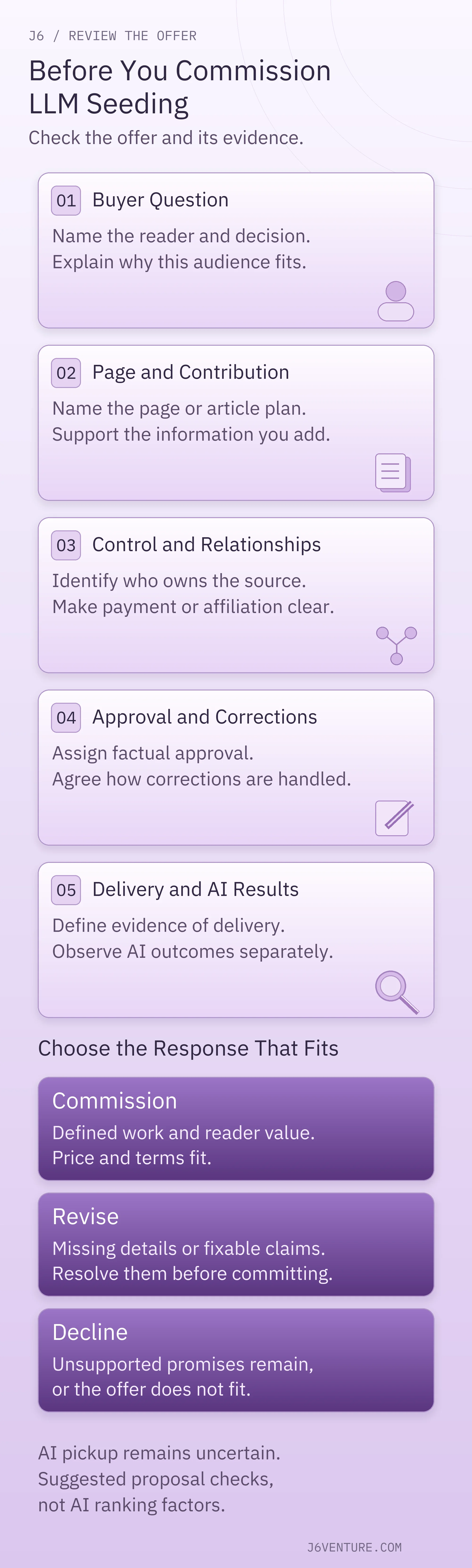
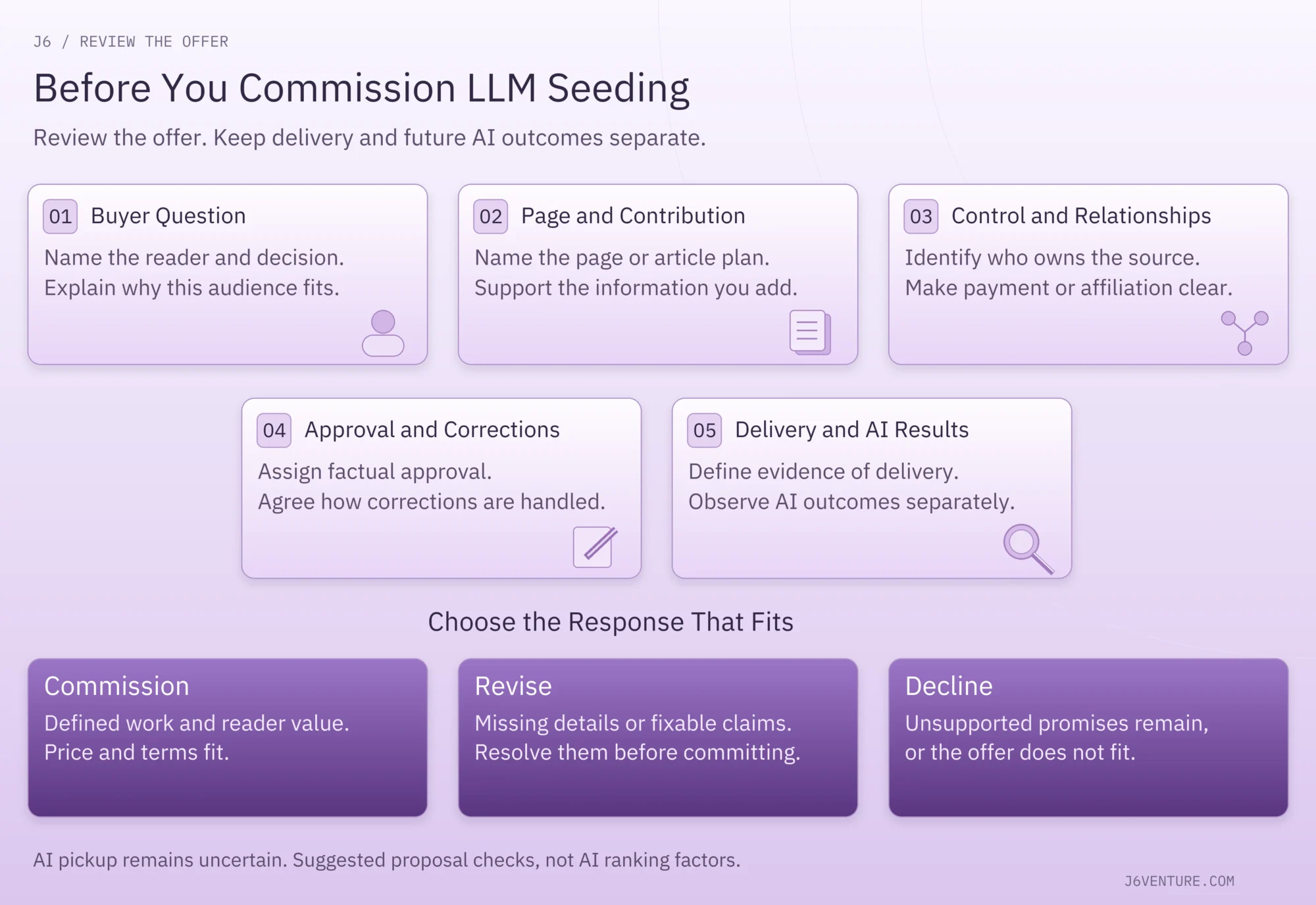
These five checks are a suggested way to assess the offer. They are not a list of validated AI ranking factors. Use them to define useful work, resolve missing details, and decide whether the proposed terms are acceptable.
Start With a Buyer Question
Name the question the proposed content helps a suitable customer answer. “Increase AI visibility” is an objective; it does not tell an editor what useful information to publish.
A comparison for a small creative agency might need to explain client-budget reporting, freelancer access, and approval workflows. A generic mention in an unrelated business article would serve a different purpose, even if the site has appeared in AI citations.
Ask the supplier to connect the publication's audience, the article's subject, and your supported contribution. Evidence might include relevant existing articles, the publication's stated audience, or audience information the publisher can substantiate. A claim that the domain is authoritative is insufficient on its own.
Name the Actual Page and Contribution
Identify what will be created or changed and what readers will gain from your inclusion. A proposed new article can have a working title and outline before it has a URL. An update to an existing page should identify that page and the intended contribution.
The contribution could be a supported product distinction, an original finding, an expert explanation, or a customer account approved for that use. Supply the evidence behind it. A product feature should be described with its relevant plan limits; a customer result needs its circumstances.
If the proposal relies on previous AI citations, request dated examples with the prompt, platform, and linked page. Those observations help explain the opportunity. They do not prove that your addition will be selected, and a placement without prior citations can still have useful reader reach.
Establish Who Controls the Source
Find out whether the proposed source is independent, owned by the supplier, affiliated, sponsored, or part of a partner arrangement. A different domain name does not establish independent editorial judgment.
Related publications and paid contributions can provide useful distribution when the relationship is clear and the material serves readers. Assess that value on its own terms. Do not describe five related placements as five independent endorsements.
Ask how payment or affiliation will be made visible, who decides what is published, and whether an editor can retain a fair limitation or criticism. A proposal that depends on invented customer reviews or concealed promotional identities should be declined.
Google's generative Search guidance specifically warns about seeking inauthentic mentions. Its advice is scoped to Google; it also gives a practical reason to question a package whose main asset is manufactured agreement.
Define Approval and Correction Responsibilities
Agree who checks the facts before publication and who handles a correction afterward. Your team should know which product claims, quotes, screenshots, and customer details it is approving, and which editorial decisions remain with the publisher.
For an earned contribution, an editor may control the final wording and publication timing. The supplier should describe those limits. For an agreed paid placement, ask what the publishing arrangement covers: the approved content, relationship disclosure, expected availability, and the process if delivery differs from the offer.
Assign someone to maintain facts that can change, such as product availability or plan restrictions. The ability to ask for a correction is different from a promise that every AI answer will immediately reflect it.
Separate Delivery From AI Results
Write an acceptance condition for the service you are buying. For a publication, that could be the agreed article appearing on the named site, containing accurate approved information and the stated relationship disclosure. For outreach, it could be documented pitches and responses; editorial acceptance remains a separate outcome.
If the supplier also reports AI visibility, ask what that report will count: citations to the page, brand mentions, recommendations, or visits. Request the prompts, platforms, dates, and sample behind any comparison. A demonstration that asks an AI tool to summarize a supplied URL shows what happened with that supplied input. It does not establish independent discovery or persistent model memory.
For an ongoing reporting setup, use the separate AI visibility monitoring guide. The proposal still needs to state which result it will claim and what evidence would support it.
What a Published Seeding Case Can Tell You
A campaign case can show how a company combined publishing and distribution, while leaving the effect of an individual placement unresolved. Read its measurement scope before treating its result as a forecast for your offer.
In its published AI visibility case, displayed May 29, 2026, Semrush uses share of voice to describe how often AI mentions it compared with competitors across the tracked answers. The company reports that this measure rose from 13% to 32% during one month in summer 2025, on its original set of 39 target prompts. It is a company-reported result, not an independently reproduced experiment.
The company later expanded to 726 prompts and reset the baseline, explicitly stating that the two sets were not directly comparable. It also says that several tactics ran together, so it cannot fully isolate which tactic drove which result. Revenue attribution remained difficult.
The reported gain does not isolate the effect of a purchased mention. Its seeding explanation also describes distribution through owned publishing and partners. That context should stay attached to any claim of independent corroboration.
When a supplier cites a successful case, ask what was delivered, what was observed, and how the two were connected. A case with clear limits can support a sensible test. It cannot transfer its outcome to a different business, source, prompt set, or AI product as a guarantee.
Apply the Checks to One Proposed Placement
Consider a hypothetical US software company selling project-management software to creative agencies. Its team is reviewing a paid contribution to an industry comparison article. The following inputs and decisions are illustrative; they are not a J6 client campaign or measured result.
The buyer question is: “Which project-management software suits a 15-person agency that works with freelance designers?” The company's proposed contribution concerns client-budget tracking and freelancer access. Its product team must substantiate those capabilities and their plan restrictions before anything is approved.
A Proposal That Needs Revision
The supplier offers an inclusion in a “best software for agencies” article on an unnamed industry site. It says the site is frequently cited by AI and promises that the inclusion will teach models to recommend the product. It has not supplied the page, source relationship, audience evidence, or correction terms.
Decision: request a revised offer before committing. The subject could suit the buyer, but the current proposal does not define a publication you can assess. The training and recommendation promise is unsupported by the information supplied.
Ask for the proposed publisher and page or outline, the reason its audience fits, the information your inclusion will add, the relevant publishing relationship, and the approval/correction process. Ask the supplier to replace the promised model outcome with a service deliverable it can substantiate.
When the Revised Offer Is Worth Commissioning
Suppose the revised offer identifies the publisher and proposed article. For this illustration, assume your team has checked audience evidence showing that it reaches agency operators, reviewed a useful comparison outline, and confirmed the publishing arrangement. The supplier discloses that the contribution is paid. The editor will assess supported capabilities against the same criteria used for other products, including relevant limits.
Assume the marketing lead has also reviewed and accepted the quoted fee within the campaign budget, the payment terms, and the agreed publication deadline.
The revision also identifies who approves your product facts, how corrections are requested, and what happens if the agreed publication is not delivered. It removes the AI-recommendation guarantee. Any later AI observations will be reported separately.
Decision: commission the defined publication under these stated assumptions. The reason is its relevant audience and useful comparison contribution. Future AI pickup remains an uncertain potential benefit.
The completed decision note is:
- Buyer and question: agency operators comparing budget tracking and freelancer access.
- Contribution: substantiated product facts and plan limits, assessed against the article's declared criteria.
- Source and relationship: named industry publisher; paid contribution made visible.
- Approval and corrections: the product lead approves product facts and maintains them; the marketing lead sends correction requests to the publisher’s named editorial contact.
- Delivery evidence: the agreed article, approved facts, disclosure, and publishing terms can be checked.
- Unresolved outcome: whether an independently generated AI answer later cites the page or recommends the company.
- Decision and approver: the marketing lead commissions this defined publication.
- Accepted commercial terms: the quoted fee fits the budget; payment terms, publication deadline, and the response to non-delivery have been accepted for the publication's reader value, without relying on the removed guarantee.
These are assumed conditions for the teaching example. In your own offer, missing evidence stays unresolved until supplied and checked.
When to Decline
Decline if the supplier insists that a placement guarantees model training or recommendation but cannot substantiate that promise. Decline an offer requiring invented customer experiences, concealed promotional identities, or product claims your evidence cannot support.
You can also decline a legitimate publication because its audience, cost, or editorial terms do not fit your business. It does not have to be deceptive to be the wrong purchase.
A missing previous AI citation alone is not a reason to reject useful publishing. Equally, a screenshot of one citation is insufficient reason to buy an irrelevant placement.
What to Put in the Final Brief
A usable brief lets both parties identify the work being commissioned and the conditions for accepting it. Keep the following fields together so the sales promise cannot drift away from delivery:
- Buyer question: who the contribution helps and the decision it supports.
- Proposed publication: publisher, existing page or new-article outline, and supported audience fit.
- Contribution and evidence: the facts, findings, or experience being supplied, with relevant limits.
- Relationships and control: ownership, payment or affiliation, editorial decisions, and visible disclosure.
- Approval and maintenance: who approves facts, requests corrections, and handles changing information.
- Deliverable and acceptance: outreach or publication, fee and payment terms, delivery date or milestone, evidence of delivery, and the agreed remedy if the service is not delivered.
- Separate outcome claim: what any later AI report will measure, with its sample and limitations.
If the offer instead reveals an existing inaccurate description of your business, the next job may be correcting AI brand visibility. If it requires platform-specific website work, use the relevant ChatGPT Search or Perplexity citation guide.
Before paying, confirm the agreed brief with the supplier. Commission the work when its contribution, terms, and reader value justify the purchase. Keep the evidence for any later AI result separate, so a delivered article never quietly becomes a claim of a trained model or a new customer.