Buyers have new AI tools for comparing products, some B2B buyers report contacting sellers sooner to clarify AI features, and surveyed teams already using AI agents report increasing that use. Your response should depend on how customers evaluate your software, the evidence of an unmet need, and the resources you can commit to testing it.
A trend can be real and still deserve none of your budget. Adding an AI research tool, publishing another comparison page, or offering more demos only helps when it addresses something your customers need.
Ask what has changed enough to reconsider. The three developments below have dated public evidence behind them. Each leads to a different decision about product information, access to expertise, or how marketing work gets done.
What Has Changed in SaaS Marketing?
A marketing trend is a direction of change in behavior, technology, or working practice that could affect how you reach and serve customers. A new survey showing that buyers value trust does not, by itself, establish that trust has become more important.
Look for a comparison over time, a reported recent change, or a dated release that changes what people can do. Then check whether the evidence describes people and purchases resembling yours.
An AI agent is generally described as a system that can carry out a sequence of tasks. The survey discussed below uses the term broadly, so its adoption figures should not be read as a measure of fully autonomous marketing.
| Development | Evidence of Change | What It Cannot Establish |
|---|---|---|
| AI-assisted search offers another route into product evaluation | Google began rolling out AI Mode in the US in May 2025 and announced further AI search developments in May 2026 | How much of your SaaS audience uses it, or whether your pages will be cited |
| Some complex buyers are contacting sellers earlier | 6sense reported earlier first contact in its 2025 B2B survey comparison, with a separate survey examining questions about AI features | That AI caused the overall timing shift, or that a self-serve product needs more sales calls |
| AI use is extending into marketing workflows | HubSpot reported that 76% of surveyed agent-using marketing teams had increased that use over six months | Autonomous execution, better-quality output, or a revenue return for your team |
These sources are useful for US SaaS planning, but the surveys cover broader populations. They are starting points for checking your own situation. They do not supply a universal list of investments every SaaS company should make in 2026.
AI Search Gives Buyers Another Way to Compare Products
Google’s May 2025 AI Mode announcement introduced US access without a Labs sign-up, with follow-up questions and links to the web. Its May 2026 search announcement described further conversational search developments. Some capabilities in those announcements were future plans; an announcement does not mean every feature is available to every user.
For SaaS marketing, the relevant change is that people have another way to investigate a product and compare the information available about it. A buyer may ask whether a feature is included in a plan, whether an integration supports a particular task, or what implementation requires.
There is evidence of this research behavior beyond Google’s releases. In 6sense’s 2025 Buyer Experience Report, comparing vendor offerings was the most common reported use of large language models. The main survey covered just under 4,000 global B2B buyers who had spent at least $25,000 on purchases over the previous two years. Software represented 33% of purchases and North America 46% of respondents. This describes substantial B2B purchases, rather than a US SaaS-only audience or low-cost trial sign-ups.
The practical response is to make important product answers verifiable. Review public pricing, plan limits, integration documentation, implementation requirements, and relevant customer evidence. Someone comparing products should be able to distinguish an included capability from a paid add-on, a supported integration from a proposed connection, and a demonstrated result from a marketing claim.
Give a product owner responsibility for checking those facts when plans or features change. Publish the explanation where a prospective customer can access it; keep confidential implementation and customer information protected. Product marketing may write the answer, while engineering or security approves the details that fall within its responsibility.
Google’s guidance on content for AI search emphasizes useful, reliable information. It does not give you a promise of citation or customer acquisition. Treat accurate public information as an investment in the buyer’s evaluation, with AI discovery as one possible route to it.
If an AI answer mentions your product, check the source and the claim. If it sends a visit, examine what the visitor does next. Neither observation proves that the mention created a sale. Our guide to ranking in ChatGPT search covers that narrower discovery task.
Buyers Report Earlier Sales Contact to Resolve AI Questions
Independent research and a conversation with a vendor can serve different parts of the same evaluation. A buyer may understand the product category and still need someone to explain how an AI feature handles company data.
6sense’s report places first seller contact at around 61% of the way through respondents’ reported buying journeys in 2025, compared with about 69% in 2023 and 2024. These group estimates are not a timetable for your next SaaS sale. The surveys used different samples, with changes in purchase mix; the comparison does not show that one factor caused earlier contact.
The report then examined uncertainty in a separate survey of 766 B2B buyers in North America and the UK. In that group, 58% said they had engaged vendor representatives sooner to clarify how AI was implemented. Questions concerned capabilities, costs, and issues such as training data, security, and privacy. That is a reported reason for earlier contact within this sample, not a prediction for all SaaS purchases. Read the study’s “Is the Potential Presence of AI Inside Solutions Impacting Vendor Engagement?” section and Methods.
For a product requiring substantial implementation or approval, check whether prospects can get those answers before a generic demo. A response could combine a public explanation with access to someone qualified to discuss the remaining technical or commercial question.
Make the public answer sufficient for a basic evaluation. Requiring a meeting to disclose basic plan limits creates another task for someone who may only need a straightforward answer. Reserve the conversation for what depends on the buyer’s environment, requirements, or contract.
A self-serve product with clear pricing and a short, low-risk evaluation may need better documentation or in-product guidance. More sales contact is not an automatic improvement. One product can support both routes, depending on what the customer is trying to establish.
Do not interpret the report as a reason to race to make the first call. Its analysis associates first contact with an existing vendor preference; it does not establish that contacting someone first creates that preference. Help customers form an informed view before and during the conversation.
Marketing AI Is Expanding Into Workflows
The change to examine inside your team is how much of a task AI can help complete, with acceptable accuracy and review effort.
In its October 2026 reporting on AI in marketing, HubSpot described a study of 1,754 marketers across North America, Europe, Asia, Australia, and Latin America. Among teams in the survey using AI agents, 76% said that use had increased over the previous six months. The denominator matters: that is a share of agent-using teams, not 76% of all marketers or all SaaS companies.
The report uses a broad agent category. Increased use does not mean those teams have deployed fully autonomous campaigns, nor does it demonstrate better business results.
Start with one task whose inputs and acceptable output you can define. For SaaS product marketing, that could be preparing a draft update from approved release notes and current documentation. Before testing such a workflow, specify:
- Inputs: the approved documents and versions the system may use. Customer records require appropriate permission and handling.
- Output: a draft that preserves feature availability, plan restrictions, prerequisites, and relevant qualifications.
- Reviewer: the person accountable for verifying product claims before anything is published or sent.
- Comparison: the normal workflow’s time and usable output, including checking and correction time for both approaches.
- Stop condition: an error or data-handling issue that requires pausing the workflow and finding the cause.
This is a task specification, not a report of a J6 experiment.
Count material corrections and whether the finished work is usable. A faster first draft can still create more total work if it invents a capability or removes a pricing condition. If review effort makes the task uneconomical, narrow the task or keep the existing method.
Match Your Response to How Customers Buy
Choose a response for the evaluation happening in front of you. Self-serve and assisted routes can coexist; complexity can change the help a person needs within either route.
| Buying Situation | Response to Evaluate | Check Before Committing | Reason to Defer |
|---|---|---|---|
| Customers can assess a low-risk product through a trial | Clear plan, use-case, integration, and activation answers | Which questions repeatedly interrupt evaluation or first use? | The proposed page addresses no observed question, or the underlying feature is unreliable |
| A buyer needs help comparing a product with requirements | Public comparison evidence and a relevant specialist handoff | Can the team answer the remaining question accurately and follow up? | Sales capacity or missing product information prevents the team from answering those questions |
| AI, security, data, or implementation concerns affect approval | Reviewed technical explanations, limitations, and a qualified discussion where needed | Who can approve the claims and handle buyer-specific requirements? | Required product or security decisions remain unresolved |
| Marketing has a repeated, reviewable production task | One bounded AI-assisted workflow | Are inputs approved, output criteria clear, and review costs measurable? | Sensitive inputs cannot be used appropriately, or nobody can verify the output |
The last row concerns your operating capacity, so it can apply across the buying situations above. You do not need to change your acquisition channel to improve an internal task.
Customer proof, subject expertise, helpful onboarding, and retention work remain valuable where they answer a real need. Their usefulness does not make them newly emerging trends. A specific customer case study may resolve an implementation objection better than a new channel. An adoption problem may require product and customer-success work before additional promotion.
If you need to diagnose a stalled outcome first, use our guide to SaaS marketing challenges. This article’s decision is narrower: whether a documented change gives you a reason to adjust something you already understand about your customers.
Turn One Change Into a Bounded Test
Use the 6sense finding to see how a source becomes a decision. This is a walkthrough of the public research, not a claim that J6 ran a campaign or achieved a result.
- 1Extract the actual change. The study comparison reports earlier first seller contact. Record the dates and the fact that the samples differ.
- 2Read the explanation separately. The companion survey reports that some buyers contacted vendors earlier to resolve questions about AI implementation. It is a separate sample of 766, not another result from the nearly 4,000-person main survey.
- 3Check the purchase conditions. The main research concerns substantial B2B purchases. It gives a stronger reason to investigate a complex evaluation than to add sales calls to an inexpensive self-serve product.
- 4Identify what your company still needs to know. Do prospects repeatedly ask an unanswered AI capability, cost, data, or implementation question? Review approved sales notes, support questions, or customer interviews. The public study cannot answer this for you.
- 5Choose a conditional response. If an important, recurring question is inadequately answered, test a reviewed public explanation with an appropriate route for remaining buyer-specific questions. If no such gap appears, this finding does not justify that project.
The study gives you a reason to investigate an unanswered buyer question. Your company evidence must establish whether that gap exists before you test a response; the study does not forecast more demos or revenue.
Write the Test Record Before Starting
Complete the record below using your own evidence. The baseline is what happens before your change: record what you counted and out of which group. Fields requiring company data are deliberately unfilled. A missing baseline, responsible reviewer, or usable comparison is a reason to prepare further before launching.
| Field | What You Need to Record |
|---|---|
| Source and finding | Link, publication date, population, observed change, and the limit on your inference |
| Customer need | The actual recurring question or blocked task, with approved evidence and the affected customer group |
| Response and owner | The one change to make, the person accountable, and who verifies product or security claims |
| Current position | How often the question appears and what happens today, with the period and relevant group counted, such as the qualified evaluations reviewed |
| Comparison | A comparable existing route, a suitable control group, or a before-and-after period with other changes recorded |
| Effort and spend limit | Your team’s maximum time and budget for preparation, delivery, and review |
| Quality guardrail | The accuracy, permission, or customer-experience condition that must remain acceptable; name what triggers a pause |
| Useful outcome | The question resolved, qualified next step completed, or relevant product task achieved; define how it is observed |
| Review date and decision | The time needed to observe that outcome, who decides, and what would support continuing, changing, stopping, or investigating further |
Choose the comparison with care. Randomly assigned comparable groups may support a stronger conclusion about the effect of a change than a simple before-and-after comparison. Where a controlled test is impractical, record differences in traffic source, customer fit, product releases, pricing, and sales follow-up. Describe a directional observation honestly if these factors remain unresolved.
A small company with few qualified evaluations may not have enough observations for a confident quantitative comparison. It can still collect direct evidence about whether people understood an answer, while withholding a claim about conversion improvement.
Set the review date around the outcome you can reasonably observe. A documentation task may reveal unanswered questions quickly; a complex purchase may take much longer to progress. An arbitrary month-end deadline does not make the later outcome available sooner.
Decide What the Results Allow You to Do Next
Read results in layers. An AI citation indicates that an answer referenced you in that observed response. A tracked referral indicates a visit your system attributed to that source. Engagement shows some interaction. None is the same as a qualified opportunity, successful activation, or retained customer.
Connect the signal to the task you chose. Did the buyer find the plan restriction? Could the specialist resolve the remaining implementation issue? Did the assisted workflow produce accurate work after review? These observations help explain what to investigate even when a sale is too far away to assess.
Referral tracking and buyer self-reports can be incomplete. Use them as complementary evidence, and keep attribution separate from a claim that your change caused an outcome.
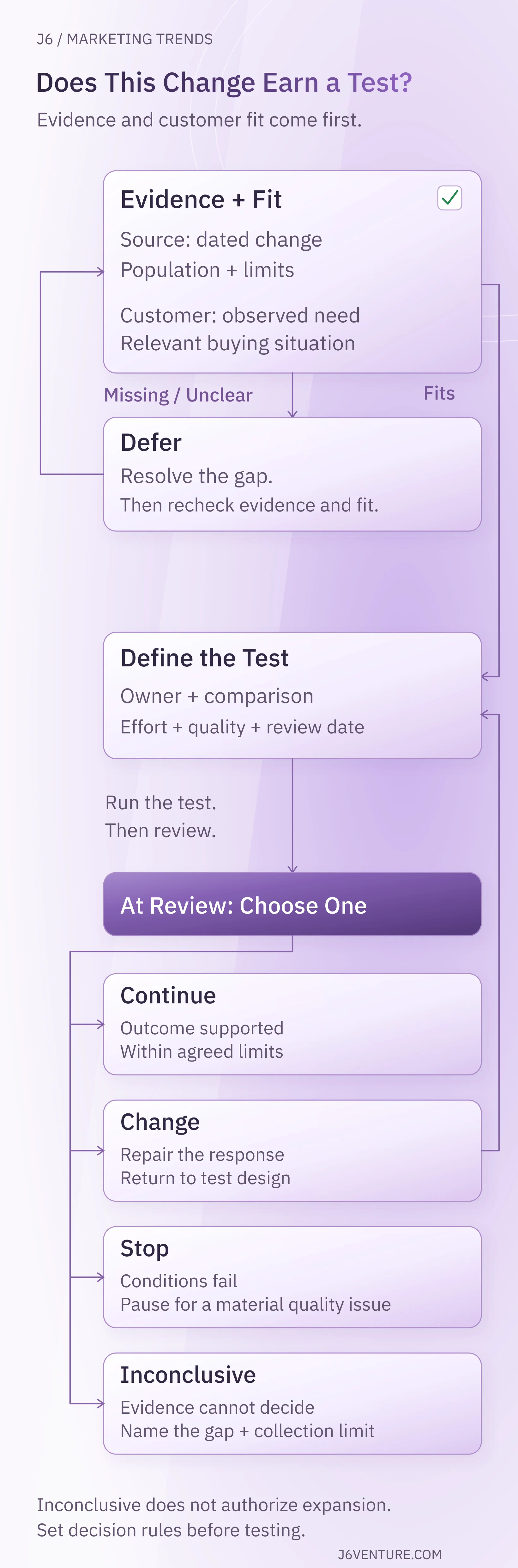
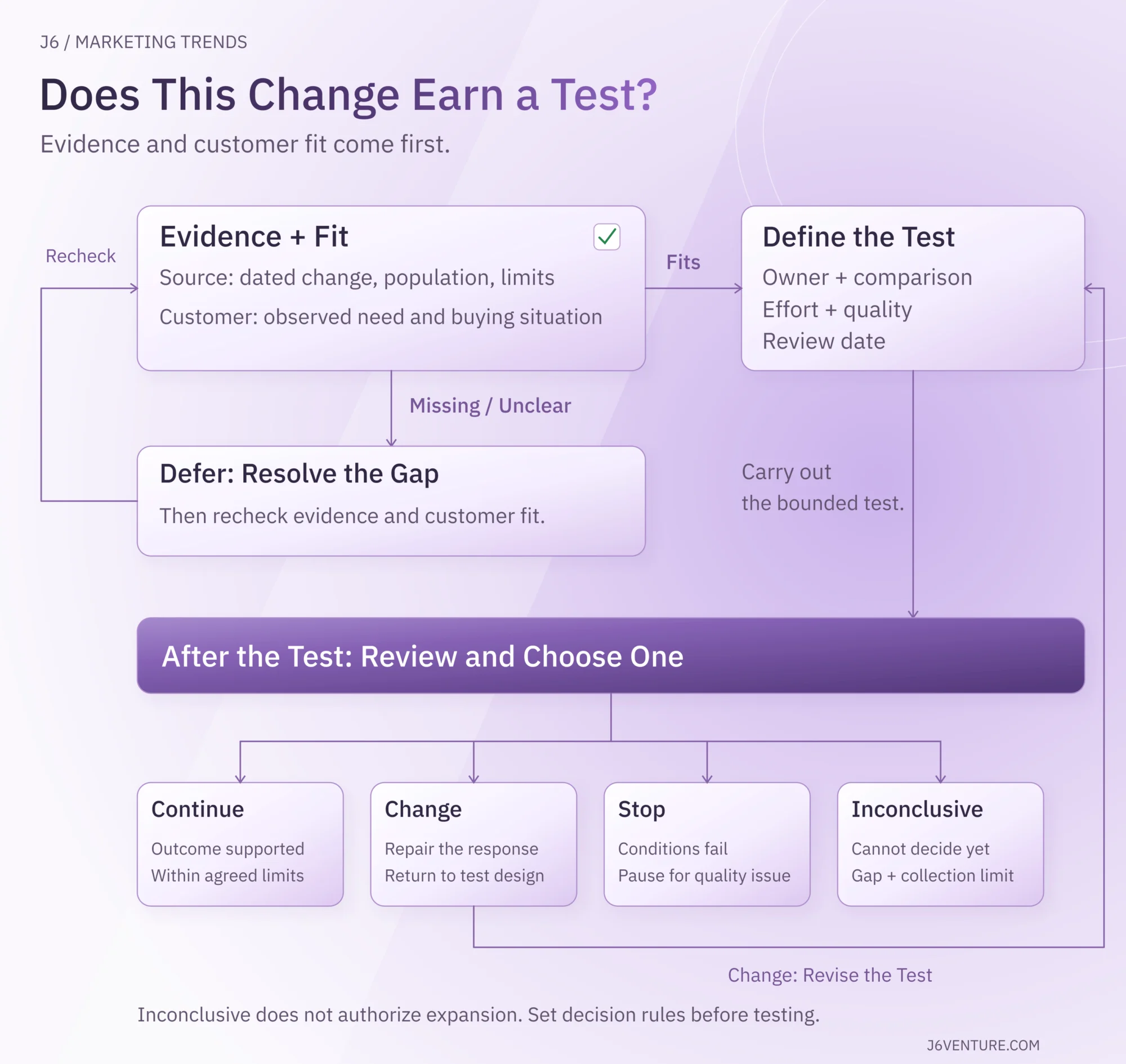
At the review date, make one of four decisions:
- Continue when the useful outcome and quality conditions you specified are supported within the effort limit. Record the uncertainty that remains before increasing the commitment.
- Change when the evidence identifies a repairable problem in the response. Name the change and set the next review condition.
- Stop when the response fails the agreed conditions or a material accuracy, permission, or customer-experience problem makes continuation inappropriate.
- Inconclusive when too few suitable observations, an unreliable comparison, or incomplete follow-up prevents a decision. Specify the missing evidence and a sensible limit on further collection. Do not expand by default.
Before committing resources, you should be able to complete this sentence: “This documented change matters to these customers, our evidence shows this unmet need, and this owner will test this response under these limits.” If part of that sentence is missing, resolve it first. Complete the test record above, including the quality guardrail and review date, before launching. Use the same check when the next trend competes for your budget.