Promote a software company by showing a defined group of buyers how you solve a problem, providing evidence they can examine, and offering a way to try the product, see a demonstration, or discuss a project. Choose a channel those buyers use, prepare the page or conversation it leads to, and limit the time and money you will spend before reviewing the response.
A campaign can attract attention and still leave a buyer unsure what to do. Someone commissioning custom software may need to discuss scope and the delivery team before evaluating an offer. Someone exploring a simple tool may be able to test its value independently.
Your first campaign should give one kind of buyer a clear way to find, assess, and act on your offer. The channel, evidence, and invitation need to support that same buying decision.
Start With How Customers Buy Your Software
Some customers can try a product and decide whether it helps. Others need several people to examine its security, implementation, and commercial terms. A company buying custom development must also assess the team that will do the work.
Those differences change what your promotion should offer:
| Buyer Situation | Useful Proof | Appropriate Next Step | A Meaningful Response |
|---|---|---|---|
| Someone can evaluate a product with little assistance | A clear demonstration, sample output, and understandable limitations | Try the product or complete a relevant task | A user in your intended audience completes the defined evaluation task; signup is recorded separately |
| A product purchase needs assistance or internal approval | A use-case demonstration, implementation information, and evidence relevant to the approver | Discuss requirements or arrange a focused demonstration | A suitable organization takes an agreed evaluation step |
| A business needs software designed or developed for it | Comparable work, delivery approach, and the team’s relevant experience | Discuss the workflow, constraints, and project fit | A conversation establishes a plausible project and a useful next decision |
These are planning routes, not permanent labels for entire companies. One product can support both self-service and sales conversations. The person trying it may also need a manager to approve the purchase.
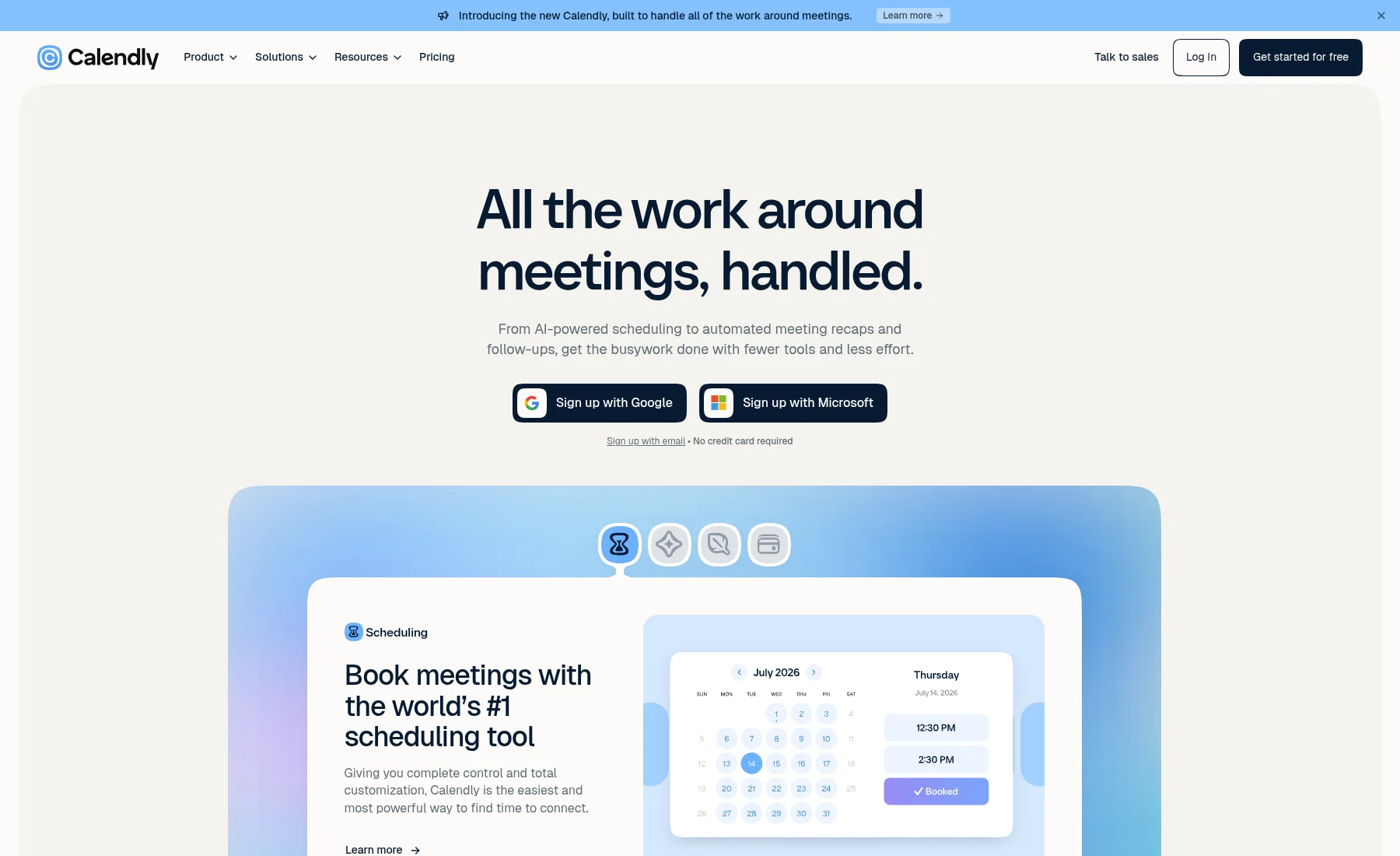
On Calendly’s homepage, visitors can start for free or talk to sales. The two routes coexist. A company adapting this idea should decide when a visitor can evaluate independently and when assistance would help.
thoughtbot’s website presents design and development services, links to examples of its work, and invites visitors to talk about their needs. A service business can use that combination to help someone evaluate its suitability before a project discussion.
These are observations of public pages checked on October 21, 2026. They show available evaluation routes; they do not establish which route converts better or which promotion channel brought the visitors.
Build a Promotion Campaign You Can Deliver
For a small team, a first campaign can be one coordinated effort: a defined buyer, a way to reach that buyer, evidence worth examining, and a next step someone can deliver. It can be a series of relevant introductions or a resource shared through an industry newsletter. It does not have to involve paid advertising.
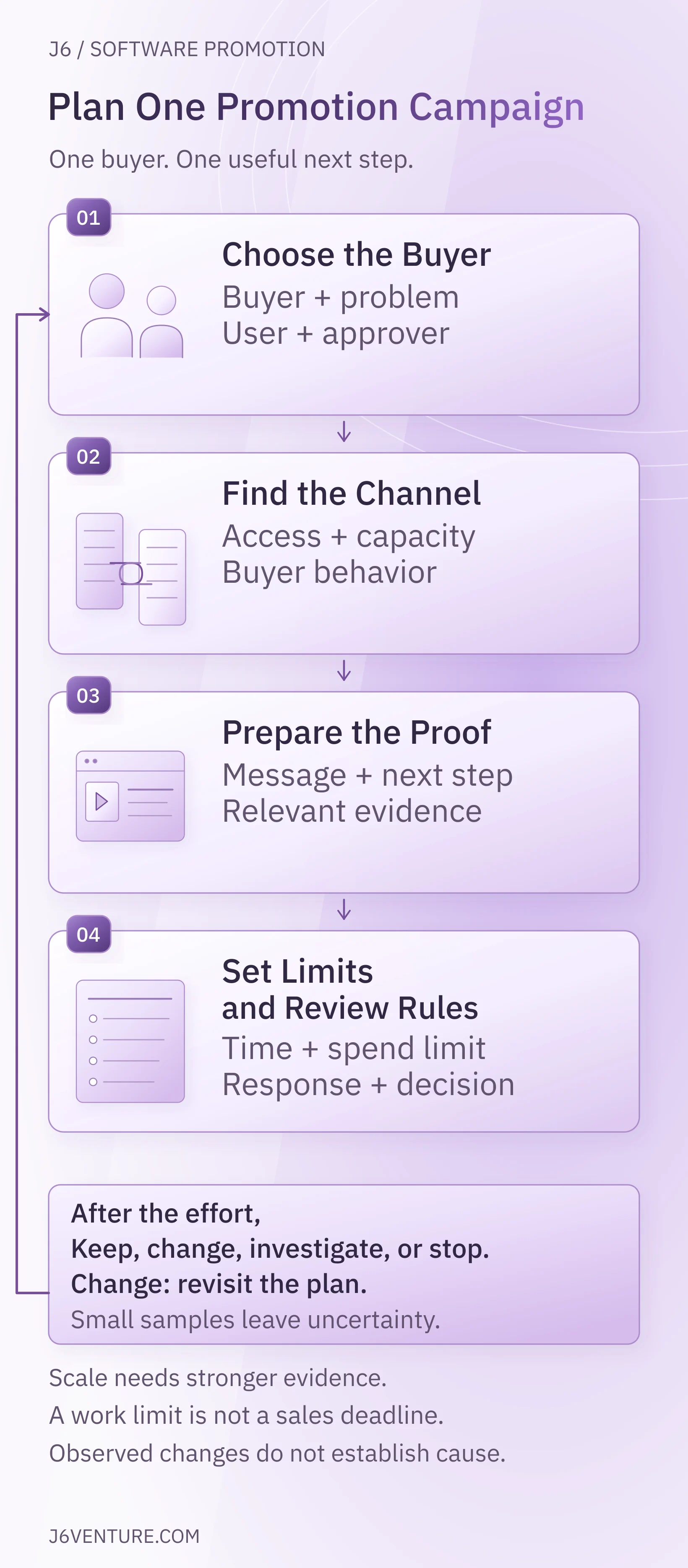
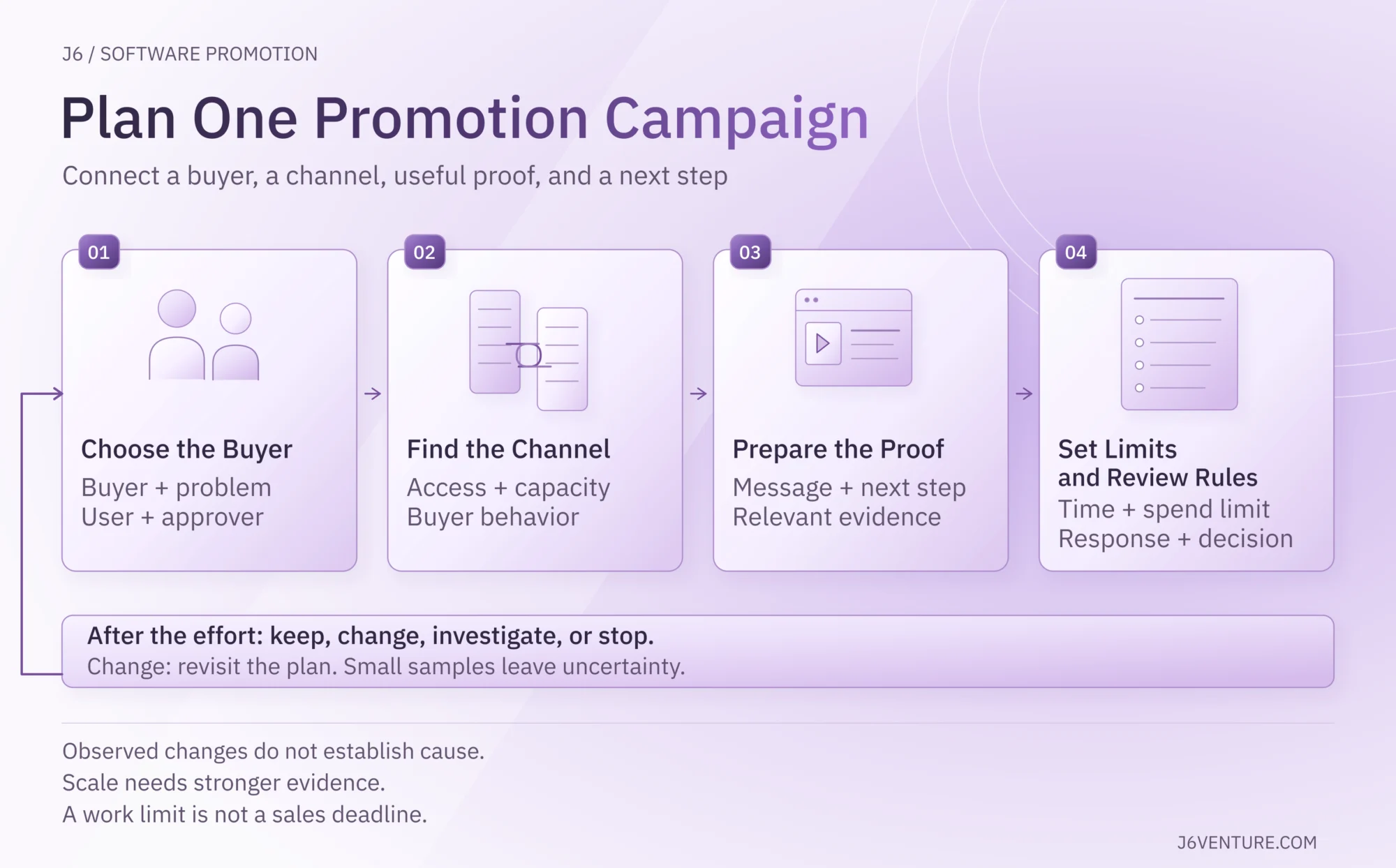
Use the following four steps to assemble that effort. The worked example afterward applies the same sequence to a software development company.
1. Choose One Buyer and One Problem
“Small businesses that need software” leaves too much unresolved. A more usable starting point is “operations managers at regional distributors who reconcile stock between disconnected systems.” You can investigate where those people ask for help and what would make a discussion worthwhile.
Establish four things before choosing a channel:
- Who experiences the problem? Name the person doing the work and the kind of organization involved.
- Who approves a change? The user, budget holder, and technical reviewer may be different people.
- What happens today? The alternative might be a spreadsheet, an existing product, an internal process, or tolerating the problem.
- Why would they act? Look for a consequence the buyer recognizes, such as repeated reconciliation work or a system that cannot support a new requirement.
If you do not yet know the answers, a few relevant conversations can help you refine the audience and language before committing to a larger campaign. Treat early comments as discovery. They are not proof that an entire market wants the same thing.
The current alternative belongs in your message. “Replace manual stock reconciliation” gives a potential buyer more to assess than “innovative software solutions.” State a benefit you can demonstrate, without attaching an invented time saving or return.
2. Choose a Channel That Reaches That Buyer
Compare channels against what you know about your buyers and what your team can sustain. Being able to create an account on a platform does not establish that you can reach appropriate customers there.
| Route | When It Is Worth Considering | What You Need to Prepare | What Can Make It a Poor First Choice |
|---|---|---|---|
| Search and useful content | Buyers already search for the problem, product category, or service | A page that answers the search and provides a suitable next step | An urgent sales deadline, weak relevance, or no capacity to maintain the content |
| Professional posts and relevant communities | You can identify places where buyers discuss the work | A useful explanation, demonstration, or answer that respects the community’s rules | Posting to a broad audience with no evidence of buyer relevance |
| Paid search or social advertising | You have an audience hypothesis, a suitable destination, and money for a bounded test | Clear targeting, an offer, tracking, and someone to inspect the response | Paying to send people to an unclear proposition or an unattended inquiry form |
| Direct outreach and introductions | You can identify suitable organizations and explain a relevant reason to contact them | A short, accurate message, useful evidence, and capacity for replies | A generic bulk pitch or a list whose relevance you have not checked |
| Newsletters and follow-up email | You have an appropriate audience or can work with a relevant publisher | A resource that answers an existing question and a clear invitation | No credible route to the intended readers or nothing useful beyond an announcement |
| Referrals and complementary partners | Customers or partners understand whom you help | A specific description of a good fit and a responsible introduction process | Asking for referrals before you can explain whom to introduce and why |
| Launches, events, and relevant listings | The audience and timing match the product or service | A focused demonstration or proof page and a plan for follow-up | Treating launch attention, a listing, or event attendance as a complete sales process |
Narrow the table to routes that pass three checks:
- Buyer access: can you identify the intended buyers and a credible way to reach them?
- An offer they can evaluate: can you show evidence that answers their uncertainty and offer a next step they can take?
- Capacity to learn: can you handle the replies and inspect the response within your time and spending limit?
If several routes pass, start with the clearest access you have today and a bounded effort you can deliver. Record why that route comes first and what would justify trying an alternative. If none passes, identify the missing access, proof, or capacity before distributing the campaign.
For example, a scheduling product might demonstrate a task in a community where that task is discussed. A custom-development firm might reach a prospective client through an industry relationship. Neither route follows automatically from the word “software.”
Platform controls have limits. Google’s keyword-matching guidance explains that exact match can include searches with the same meaning or intent; it is not a literal-word guarantee. Inspect the searches and responses your campaign receives.
LinkedIn documents professional targeting data, including job title, company, industry, and seniority. Those options help define an audience; they do not establish that the people reached need your offer. Both sources were checked on October 21, 2026.
Choose a primary route for the first effort and identify any supporting work it needs. A relevant introduction can still need a credible website. That does not require launching a separate content program at the same time.
If search is the likely route, use the separate guide to choosing SEO priorities for a software company for the deeper implementation decision. A connected SaaS inbound journey becomes relevant when you need to connect several ongoing interactions.
3. Match Your Message, Proof, and Next Step
A useful message lets the buyer recognize the problem and judge whether examining your offer is worth the effort. Build it around the work they want to complete.
For a product, that might mean showing how a user imports a sample file and gets a result. For a development service, it might mean explaining how you investigate a disconnected workflow, what you delivered on comparable work, and which constraints remain unresolved.
Choose evidence that addresses the buyer’s uncertainty:
- A demonstration helps someone see what a product does.
- A relevant customer story can explain the starting problem, the work involved, and the result supported by the evidence.
- A delivery outline can show what happens after an inquiry, who participates, and what the first engagement includes.
- A sample output helps a buyer assess the quality or usefulness of the work.
If you have no customers yet, use an honestly labeled demonstration or sample. Keep it separate from a customer success story. Obtain appropriate permission for client material, use genuine reviews, and make any compensated referral or endorsement arrangement clear to the reader. The case-study examples guide explains how different kinds of evidence answer different buyer questions.
The destination should carry the same promise as the promotion. Someone who clicks a demonstration should find the demonstration. Someone invited to discuss a workflow should learn what the conversation covers and how to arrange it.
Make the next step proportionate to the decision. A low-commitment product task, a focused demo, and a project-scoping conversation ask for different amounts of effort. Confirm who responds, what information they need, and whether the company can deliver what it offers.
4. Set a Work Limit and Review Decision
Promotion consumes time even when no advertising bill arrives. Include preparation, distribution, replies, meetings, and follow-up in the effort you are prepared to fund.
Set a review date and decide what evidence you need. Separate three questions:
- 1Did the effort reach relevant people? A post’s impressions do not establish that the intended buyers saw it.
- 2Did they take the intended next step? Examine the fit and substance of responses, not the total alone.
- 3Did those responses progress toward a commercial result? A trial, conversation, proposal, and paying customer are different outcomes.
Record the source where known, the response, buyer fit, and the next decision. Give responses enough time to progress before comparing them. A two-week activity window does not mean a purchase should close within two weeks.
For a first effort, a spreadsheet and a named person responsible for follow-up may be enough. Choose tools for the records you need; adding a dashboard will not settle whether the offer is useful.
At review, you might continue a small effort, change the message or destination, investigate weak evidence, or stop. Low response can reflect poor reach, an unsuitable offer, timing, or missing proof. It does not isolate the cause by itself. The guide to SaaS marketing challenges develops that diagnostic question.
Worked Example: Promote a Small Software Development Company
A small US development company can test existing adviser relationships as a route to project conversations, supported by a problem page and permitted work evidence. The following four-week, 18-hour plan is illustrative: it describes a work limit, not achieved J6 results or a universal marketing budget.
Assume the founder has permission to discuss one relevant integration project and has relationships with a few operations advisers who work with regional distributors.
1. Define the Buyer and the First Conversation
The intended buyer is an operations manager at a regional distributor dealing with repeated manual reconciliation between systems. A manager may experience the problem, while a director or owner approves a project and an IT colleague assesses access and implementation.
The current alternative is a recurring spreadsheet-based reconciliation process. The company will invite an initial conversation about where mismatches occur and whether an integration investigation is appropriate. It will not promise a fixed-price build before examining the systems.
A suitable response means an organization recognizes the problem and someone who understands the reconciliation work agrees to discuss the workflow with the development company. A friendly acknowledgment from an adviser is not yet that response.
2. Choose a Route and Explain What Can Wait
The first route is a small series of introductions through the existing adviser relationships, supported by one page describing the problem and the company’s relevant work.
The access assumption matters. If the advisers do not serve the intended businesses or are unwilling to make appropriate introductions, the founder must revisit the route. A relationship on its own does not guarantee access to buyers.
The company postpones broad social advertising because it has not established an audience or offer worth paying to distribute. It postpones a general launch campaign because there is no new product to launch. Search content remains a possible future investment, but the company will not expect it to produce immediate project inquiries.
These choices depend on the company’s buyer access and the offer it can support. A company with existing search demand, a working conversion path, or a different route to customers could choose differently.
3. Prepare the Message and Evidence
The founder prepares a short problem page with:
- the reconciliation problem and whom the company can help;
- a permitted account of the relevant work, including its constraints;
- a simple description of the initial conversation;
- a contact route and the person who will respond.
The introduction request could read:
Illustrative Introduction Request
We’d like to speak with operations managers at regional distributors who reconcile stock records across disconnected systems. Our team has relevant integration work we can share with permission. If a business you advise is dealing with that problem, would an introduction be appropriate? We can start by discussing the workflow and whether an investigation would help.
The message gives an adviser a problem and buyer to recognize.
For US commercial email, check the FTC’s CAN-SPAM business guidance, which includes business-to-business email. Sender identification, truthful subjects, required disclosures, and opt-out handling need attention. This introduction example is message content, not a complete compliant email template or legal advice.
4. Set the Run Limit and Review Rules
The founder sets an illustrative four-week activity window and an 18-hour work limit: six hours for the page and proof, six for adviser conversations and introductions, four for buyer conversations, and two for review. Any additional cash expense needs separate approval. Existing delivery commitments still take priority.
Before starting, the founder records the intended review decisions:
- Suitable buyers engage: retain the records and agree on a useful next step with each business. Consider another small effort if the company can support it; a few conversations cannot establish a reliable channel ranking.
- Advisers engage, but introductions are unsuitable: inspect whether the buyer description was clear and whether the relationships reach the intended organizations.
- Appropriate buyers see the evidence but decline: record their reasons before deciding whether the offer, proof, or timing needs to change.
- Reach is unknown or the work is incomplete: record the work completed. The plan has not supplied enough evidence to judge buyer demand.
Stop work at the limit and make an explicit decision about any further effort. Keep agreed buyer follow-up on its own schedule; the campaign’s review date does not cancel a live conversation or establish that no sale will follow later.
For a self-service inventory product, the user might be an operations analyst who needs to compare two stock files and identify mismatches. Choose a route where those users already seek help, if you have evidence that you can reach them there. Show a demonstration using sample files, then invite the user to run the comparison in the product.
Record a completed comparison separately from signup, name who handles questions, and set the time and cash limits before starting. This is an illustration of transferring the method: your product and buyer access determine the actual task and channel.
Put Your First Campaign on One Page
Copy the following decision brief and fill it in for your company. In the illustrative service campaign, that means carrying the distributor buyer, adviser-introduction route, permitted integration example, 18-hour limit, and planned review decisions into these rows. Someone else should be able to read the brief and understand whom you want to reach and what happens if they respond.
| Decision | What to Record |
|---|---|
| Buyer and problem | Organization, user, approver, current alternative, and reason to act |
| Route | Primary channel and evidence that the intended buyers can be reached there |
| Message and proof | The promise, supporting material, and any limits or permissions |
| Next step | The action offered, who responds, and what makes the response suitable |
| Work limit | Preparation, distribution, follow-up capacity, cash limit, and owner |
| Review | Date, records needed, and reasons to continue, change, investigate, or stop |
Start with an effort you can deliver and a decision you can learn from. Useful responses can justify a next conversation or a further bounded campaign. Larger investment needs stronger evidence about customer fit, costs, and commercial progress.
If search appears to be a suitable part of that plan, explore J6 Venture’s SEO services. Bring the buyer, problem, and intended next step so the discussion can focus on whether search belongs in your promotion effort.