A useful resource can deserve a place in your marketing even when few people search for it. An existing product page can deserve SEO work even when you have no plans to publish another blog post.
That distinction changes the conversation. Before commissioning more content, agree on who needs help, what the resource should help them do, and how they will reach it. Then give search and content work the responsibilities that serve that purpose.
What Is the Difference Between SEO and Content Marketing?
SEO, short for search engine optimization, is the work of helping search engines discover and understand relevant pages and helping searchers decide whether to visit them. It includes the page's explanation, technical accessibility, descriptive presentation, and connections to other pages. Google's SEO Starter Guide describes both search-engine understanding and the visitor's decision.
Content marketing is a strategic approach to creating and distributing useful content for an audience and a business purpose. The Content Marketing Institute's definition includes attracting and retaining a defined audience and encouraging profitable customer action. Distribution is part of that definition: a resource needs a way to reach the people it is meant to help.
| Question | SEO Contribution | Content Marketing Contribution |
|---|---|---|
| What is the work meant to achieve? | A relevant page can be found, understood, and considered in search. | People receive help that lets them evaluate an option, solve a problem, or use a product, in support of a business purpose. |
| What might the work involve? | Researching search questions, improving page explanations and titles, checking access, and connecting related pages. | Choosing an audience problem, developing the resource, distributing it, and planning the response that follows. |
| What would we examine? | Relevant search appearances and visits, alongside evidence of specific technical or page problems. | Whether the intended audience receives the resource, uses it, and takes an action appropriate to its purpose. |
| Can it operate separately? | An existing service or product page can need search improvements without a new content campaign. | A customer newsletter or sales resource can be useful through a direct distribution route. |
These are overlapping responsibilities. Audience research matters to both. A content writer's explanation can affect how a page serves a searcher; an SEO specialist's query research can reveal a question the resource has missed. A small business may have one person doing both jobs.
The phrase SEO content marketing usually describes the overlap: creating and distributing material with a meaningful role for organic search, meaning unpaid search results. It does not mean that every resource needs a target keyword or that SEO is confined to blog production. A product page can also participate in a content strategy, depending on its purpose.
If you need the broader technical, on-page, and external-link picture, our guide to the components of SEO develops those responsibilities separately.
How Do SEO and Content Marketing Help Each Other?
Search research can reveal how people describe a problem, the distinctions they care about, and the task they want to complete. That task is the search intent behind the query. A person learning a concept needs different help from someone comparing options or trying to set something up.
The content work turns that understanding into an answer worth using. A comparison needs meaningful criteria and evidence. An instruction needs usable steps and relevant conditions. Repeating a phrase across a page cannot supply either. Google's people-first content guidance asks whether the material serves its intended audience and provides enough understanding to achieve its goal.
SEO also helps the useful answer function as a discoverable public page. A descriptive title tells people what to expect. Accessible content lets search engines examine the page. Relevant internal links help visitors continue to related material and help Google discover and understand connections between pages. See Google's guidance on crawlable links and descriptive link text.

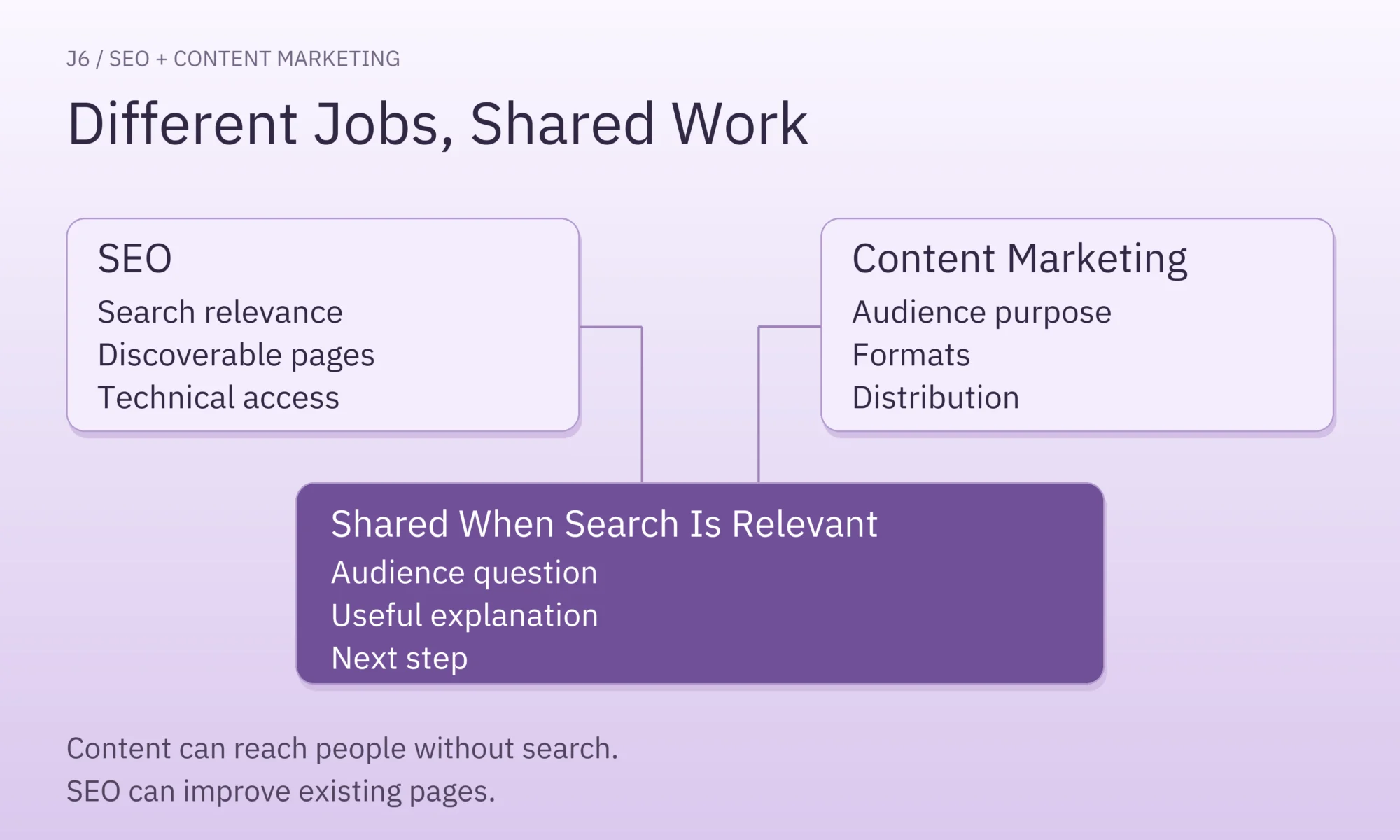
The contribution runs in both directions. Search findings can improve the resource; a clearer resource gives a search visitor a better answer to encounter. Neither substitutes for the other. A technically accessible comparison can still omit the buyer's decisive question. A thorough guide can still have an access problem that prevents Google from examining its intended public page.
Distribution also extends outside search. A relevant newsletter, a customer conversation, or a community discussion can be the right place to offer a resource that answers an existing question. Choose the route because the audience can use the answer there. A social share, referral visit, external link, and search ranking are different observations; one does not establish all the others.
Even when a page meets technical requirements, Google does not guarantee that it will be indexed or shown. How Google Search works separates discovery, crawling, indexing, and serving results. Those stages help explain why “we published something useful” is only part of the search question.
Connect a Reader Question to a Useful Next Step
Begin with one resource you can describe clearly. Agree on the reader's question before dividing the work into SEO tasks and content tasks. The question should be specific enough that another person can tell whether the resource answers it.
Use a short shared note:
- Audience and question: Who needs help, and what are they trying to understand or decide?
- Useful contribution: What explanation, evidence, or instruction will leave them better able to act?
- Route: How will the audience encounter it? Search may be one route alongside direct distribution.
- Next step: What action fits the help they have just received?
- Observation to review: What would tell you whether the intended route and action are working, and who will check it?
The next step should follow from the resource. A beginner learning a concept may need a more detailed lesson. A buyer checking compatibility may need documentation or a conversation about their configuration. Asking both readers to book the same sales call can leave the first reader without a useful continuation.
Assign responsibilities around that note. Someone needs to establish the audience question and substantiate the answer. Someone needs to check the public page's search presentation and access where search matters. Someone needs to own distribution and the action that follows. These responsibilities can sit with one person or several; they still need an agreed review date.
Assumed example: A software company's sales team repeatedly receives a question about migrating historical records. The marketing team proposes a resource showing supported data, preparation requirements, and the questions that require technical confirmation. The immediate route is the salesperson's follow-up email to those prospects. The intended next step is a migration discussion supported by the prospect's actual requirements.
A keyword tool's low or unknown estimate would not settle whether this resource is useful. The team could review whether prospects received it, which questions remained, and whether the discussion became more specific. No results are assumed here.
A public search version would need its own evidence that searchers need the answer and that the material is suitable to publish.
That contrast prevents the search plan from becoming the only test of a resource's value. It also prevents an audience need from being treated as proof of search demand.
See How the Pieces Connect on HubSpot's Lesson Page
HubSpot Academy's public page for Creating a Digital Presence With Content Marketing and SEO provides an observable example of the relationship. We examined the public landing page and captured it on October 24, 2026. The videos, completed signup flow, and performance data were not examined.
Here is the shared note completed from that public evidence:
- Audience and question: A learner asking how SEO and content marketing relate. This is a match to a listed objective, not evidence of HubSpot's audience research.
- Useful contribution: A lesson promising to explain that relationship. Its stated objective and format are visible; teaching quality and learning remain unexamined.
- Route: The public landing page is observable. How visitors actually arrive, including whether search brings suitable learners, is unknown.
- Next step: Creating an account is a visible option. We did not complete the action.
- Observation to review: The owner would need relevant search appearances and clicks, separate evidence of participation or learning, and an appropriate connection to business value. None of those results is available in this public-page reading.
A Clear Promise and a Defined Learning Format
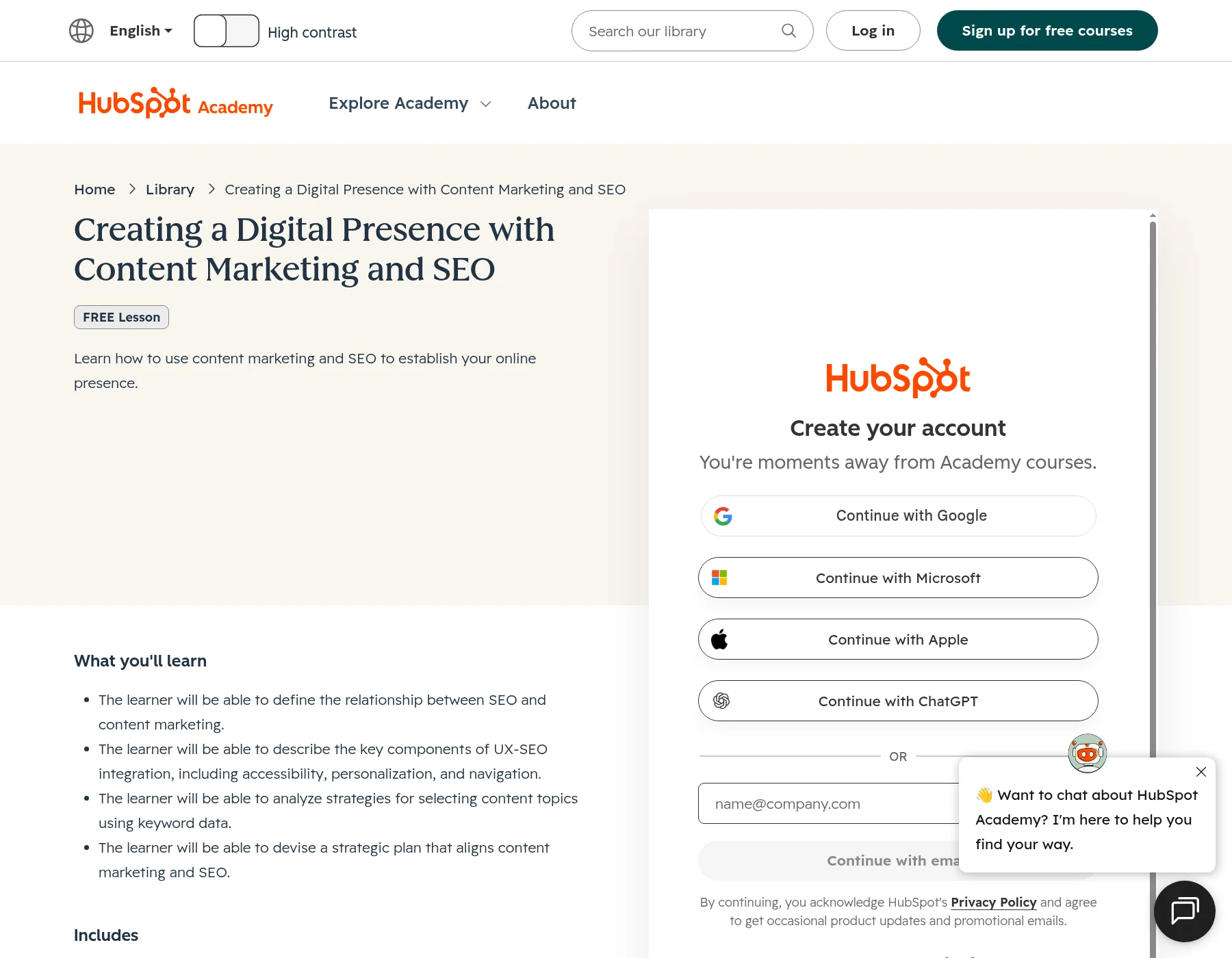
The lesson title names a learning task: creating a digital presence using content marketing and SEO. One listed objective is learning to define the relationship between SEO and content marketing. That directly addresses a learner asking, ‘How do these disciplines relate?’ The objective lets that person assess the promised answer before committing to the lesson. It does not demonstrate what they will actually learn.
The public page lists four videos, one quiz, and 20 minutes. Those are HubSpot's stated format and duration, not our measurement of completion time or teaching quality. The screenshot below shows the title, description, objectives, and account panel; the full format listing is recorded in the retrieved page text.
The format information answers a different question from the title. The title describes what someone might learn; the listing describes the commitment they are being invited to make. Your resource can do the same by explaining its scope and what the reader will need to use it.
These descriptions can also help a search engine understand the page's subject. We did not inspect its technical SEO settings; the visible page alone cannot establish its search reach.
A Public Page Leading to an Account Signup
The page also presents a Create Your Account panel. The public explanation and the account action have different jobs: one helps a visitor evaluate the lesson; the other offers a route toward participation. The available preview is another visible option, although we did not watch it.
For your own resource, look at the relationship between those jobs. If visitors need an account to continue, explain what they will receive and what commitment you are asking them to make. If part of the resource is protected, distinguish its access requirements from those of the public page describing it. Confidential material needs appropriate access controls; a search exclusion instruction is not a substitute for them.
The HubSpot page supports a limited conclusion: it presents a defined lesson and an account-creation option. Whether people discover it through search, register, begin the lesson, finish it, or become suitable customers would require other evidence. Each action answers a different question.
On your own resource, choose a continuation suited to the question. A buyer seeking a compatibility answer might need a public specification or a technical contact.
Measure Search Reach and the Resource's Intended Action
Choose measures after agreeing on the resource's purpose. A dashboard can show activity without establishing that the intended people received useful help.
For actions on your site, ask the measurement owner which actions are recorded and check that the recording works. Analytics systems often call a recorded action an event. A signup button and a label in a report do not, by themselves, establish that completed signups are being counted correctly.
Google Search Console distinguishes impressions, which record appearances under its reporting rules, from clicks from Google Search. Its Performance report documentation explains those measures and the available query, page, country, device, and date views. They help examine search exposure and visits. They do not directly establish qualified demand, learning, or revenue.
| Question | Observation That Could Help | What Remains Unknown |
|---|---|---|
| Is the intended public page reaching searchers? | Relevant query and page impressions and clicks in a defined market and period. | Whether every visitor matches the intended audience or receives useful help. |
| Are visitors taking the resource's intended action? | A checked recording of the intended action, such as a lesson start, download, completed signup, or contact request. | Whether that action represents understanding or a suitable buyer. |
| Does the activity contribute to the business purpose? | A defined link to qualified conversations, customer use, or another agreed business outcome. | How much of the outcome this resource caused, especially across several interactions. |
For a lesson like HubSpot's, you might want to know which visitors start learning and whether they complete the relevant task. These are measurement questions for the resource owner, not claims about HubSpot's tracking setup or results. Account creation alone would leave much of that question unanswered.
Set a review date and preserve the same page, market, reporting definitions, and comparison period where possible. If traffic changes after a revision, examine other plausible explanations before assigning credit or blame. Google lists technical problems, changing demand, competition, and other causes in its traffic-drop guidance.
Use the observations together. Search reach can indicate that discovery is happening; the intended action can indicate that visitors are progressing; business evidence can help establish relevance. A gap between them identifies a question to investigate, not an automatic diagnosis.
Decide Which Part Needs Attention
Use what you know to assign the next piece of work. A weak outcome can have several explanations, so state the uncertainty alongside the action.
| What You Observe | Next Work and Owner | When That Piece of Work Is Complete |
|---|---|---|
| The intended public page cannot be fetched or its access is blocked. | The technical owner checks the specific obstacle and whether public access is intended. | The intended access is restored and checked. Indexing, rankings, and business results still require separate evidence. |
| Suitable visitors report that a needed answer or next step is missing. | The content owner reviews those questions against the page and corrects the identified gap. Check the action path with whoever receives the response. | Each identified gap is corrected: the explanation is supported and usable, and any broken next step can be completed. Review later evidence before claiming improved outcomes. |
| A known audience needs a resource through sales follow-up or customer education. | The marketing owner chooses that route and a useful response to observe. Search can remain secondary if it does not serve the immediate purpose. | The resource is delivered through the agreed route and the owner has reviewed the intended audience's response. |
| You have an outcome change but insufficient evidence about its cause. | Assign a bounded investigation: one page, audience, period, and question, with an owner and review date. | The evidence supports a particular next action, or the remaining uncertainty is recorded with the next check. |
The second row needs evidence of audience fit and the missing help. A fall in signups by itself would not tell you whether the explanation, the offer, the visitors, or the signup mechanism caused it.
Choose one resource now and complete its shared note. Name the audience question, useful contribution, route, next step, and first observation to review. Assign the owner and date. That gives your SEO and content work a shared purpose while leaving each contribution open to an appropriate test. If the unresolved question is how search connects to the wider customer relationship, the worked guide to inbound SEO develops that path further.