An SEO content strategy is a resource-allocation plan: it decides where a team’s limited writing capacity goes to create the highest business return. It sets which topics to open now and which to postpone or close. For a small B2B team, it should fit on one page.
Every content team has more topics than hours. An SEO content strategy is the set of decisions that allocates those hours: which topics to cover, in what order, at what pace, and how each page will be judged. It also decides what to stop. A topic that stays on the list without a reason is still spending attention, even before anyone writes it.
That framing draws a clear boundary. SEO content strategy decides what deserves resources. Editorial planning decides how the chosen work gets executed: dates, owners, briefs, and drafts. Most guides list steps from audience to measurement; few rank a backlog or size it to a team. This guide covers those allocation decisions, with J6’s scoring rubric, a three-wave publish order, measures for searches that end without a click, and a one-page sheet to fill in.
What an SEO Content Strategy Decides
Everything below serves one of those four decisions: what to cover, in what order, at what pace, and how to judge each page.
| Layer | Question it answers | Output |
|---|---|---|
| Strategy | What deserves our limited capacity, in what order, and how do we judge it? | Ranked topic list, sequence, capacity, measures |
| Calendar (editorial planning) | When does each chosen piece ship, and who owns it? | Dated schedule |
| Creation | How do we make this one page good? | Brief, draft, edited page |
A calendar full of dates can still have no reason behind its order, which is why the strategy layer comes first. Once the plan exists, SEO and content work as a loop to run it.
Start From the Pages That Make Money
For an established B2B offer, start with the pages where buyers act: service, product, pricing, comparison, and integration pages. Every topic you choose later should either be one of these pages or send qualified readers toward one. A company creating a new category, where buyers don’t yet search for the solution, may need problem-education pages first; the scorecard below still applies.
For SaaS teams, connecting content to product evaluation and follow-up helps put those next steps into practice.
List three things before you open a keyword tool:
- 1Revenue pages. Every page a buyer can convert on, with its URL.
- 2Questions sales hears. The objections and comparisons that come up on calls. These have proven business fit, whatever a tool says about their volume.
- 3What you already have. Every published post, the Search Console queries it gets impressions for, and any two pages that answer the same question.
The inventory is where capacity gets recovered. Google’s guidance is to “update it as needed, or even delete it if it’s not relevant anymore” (SEO Starter Guide). When two of your pages overlap, choose one of four moves: rewrite the stronger page in place, merge and redirect the weaker one, split ownership so each page answers a different question, or retitle one page to a narrower job. Each move resolves an overlap before you open anything new.
For a SaaS offer, use SaaS keyword research to check product fit, inspect search intent, and choose the existing or new destination before adding a page to the backlog.
Score Every Topic Before You Commit
J6 ranks topics with a weighted scorecard. It is our working heuristic, not an objective formula: the weights encode our judgment about what a small B2B team can least afford to get wrong. Change them to fit your business, and write down why.
Score each topic from 1 to 5 on five factors, multiply by the weight, and add. The maximum is 45.
| Factor (weight) | 1 | 3 | 5 |
|---|---|---|---|
| Business fit (×3) | No plausible path to anything we sell | An adjacent problem; the reader is one step from a revenue page | The exact problem our offer solves, asked by the person who buys it, including comparisons, pricing, and objections sales hears |
| Proof you can show (×2) | We would be summarizing what already ranks | Some first-hand examples or a clear point of view | Our own data, screenshots, or client results the current results lack |
| Ability to win (×2) | Intent mismatch, or dominant results we cannot realistically displace | Mixed results with a credible angle for us | Weak existing results plus a clear first-hand advantage |
| Demand (×1) | No signal anywhere | Results-page signals (People Also Ask, an AI Overview) or a few Search Console impressions | Steady Search Console impressions across the topic’s queries |
| Effort (×1, inverted) | A large new build: original research, a tool, a long glossary | A standard new article | A light update to a page that already exists |
Business fit carries the most weight because traffic that never reaches the pipeline still costs the same hours. Demand carries the least because keyword tools estimate volume, and a B2B query with a few dozen searches a month can still be worth a deal. Proof and ability to win carry double weight because a page needs both to displace what already ranks. On proof, Google’s guide to its AI features separates “commodity content,” which “typically adds little unique insight for readers,” from content with “unique expert or experienced takes” (Google).
For J6, we use 3/5 as the minimum business-fit threshold. It is an operating rule, not a law. The one exception we allow is a wave-3 asset (see the publish order below) whose job is earning links or citations: we admit it only with that job written down, measure it on that job, and run one at a time.
What is the 80/20 rule in SEO? It is the Pareto idea applied to content: a minority of topics and pages may produce most of the results. Google does not document it. A scorecard is a way to bet on that minority before you spend effort, and the quarterly review shows whether the bet paid off.
Publish in Order: Revenue Pages First, Then the Clusters That Feed Them
Order matters most when capacity is small, because each quarter holds few new pages and each page waits weeks for a verdict. Publish in three waves:
- 1Revenue pages and existing pages you can rewrite. They sit closest to a conversion, and a rewrite starts from a page Google has already found.
- 2The cluster that feeds them. Explainers and how-to pages that answer the questions buyers ask before they compare vendors. Each one links to the revenue page it supports.
- 3Citation and link earners. Original data, tools, templates, and glossaries. These can earn mentions and links once you have pages worth pointing at.
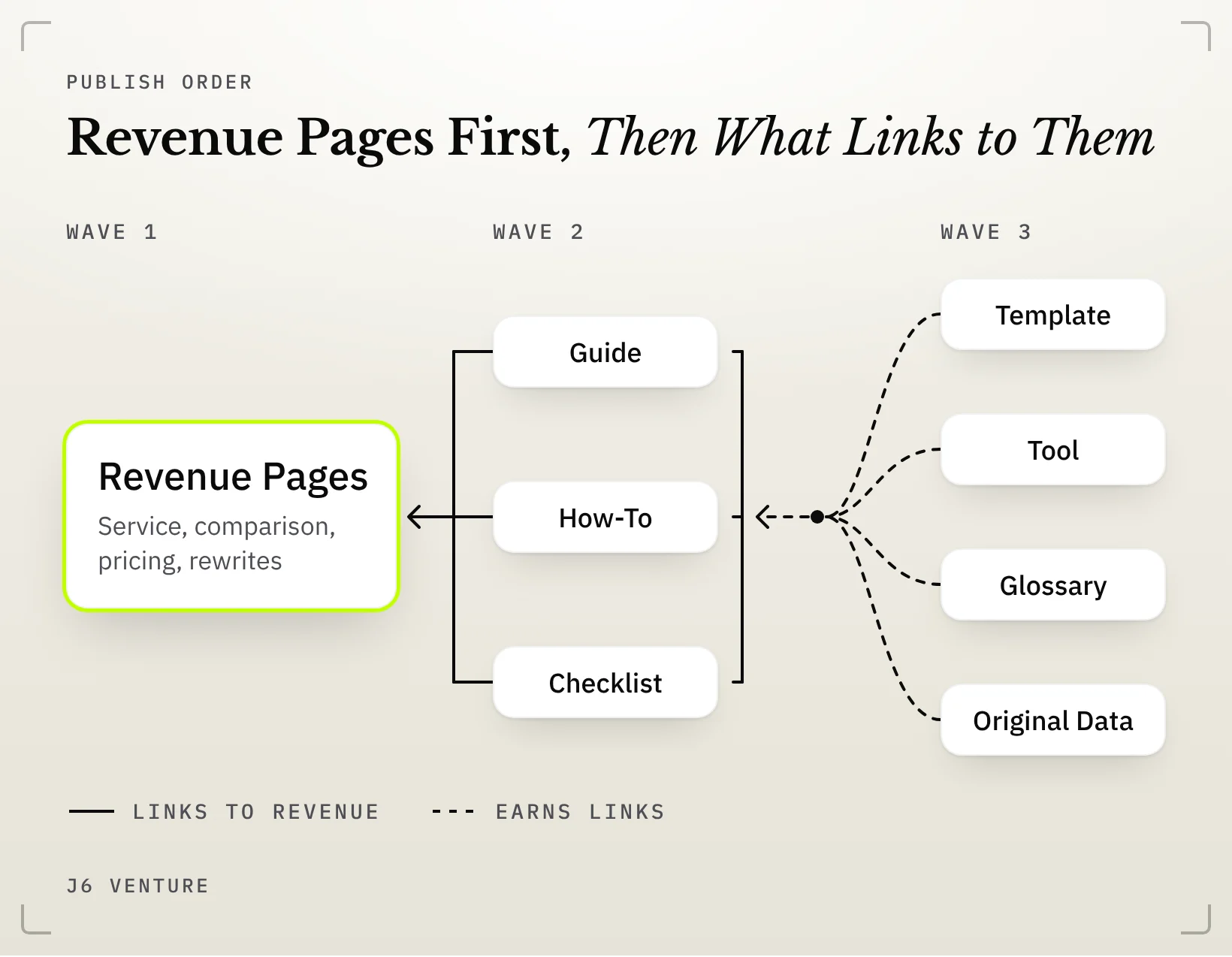
| What the searcher wants | Page type | Wave |
|---|---|---|
| Hire, buy, or compare vendors | Service page, comparison, pricing | 1 |
| Solve a problem or learn a method | Guide, how-to, checklist | 2 |
| Look something up or reuse it | Template, tool, glossary, original data | 3 |
Distribution follows the same waves: wave 3 assets are worth pitching to newsletters, partners, and journalists, while wave 1 and 2 pages reach readers through sales follow-ups, email, and internal links.
Link each cluster page to its hub and its revenue page. Google says it “uses links as a signal when determining the relevancy of pages and to find new pages to crawl” (Google link guidance).
Size the Plan to What Your Team Can Publish and Maintain
Estimate the pages required to cover the buying journey for each cluster, then open only as many clusters as your capacity can complete. A half-finished cluster leaves some of the revenue page’s buyer questions unanswered, and the pages already live still need updates.
The arithmetic below is one way to make that estimate. Replace every number with timings from your last three pages.
| Step | Formula |
|---|---|
| Hours per quarter | Weekly content hours × 13 |
| New-page hours | Hours per quarter − hours reserved for updates |
| New pages per quarter | New-page hours ÷ hours per new page |
| Clusters to open | New pages per quarter ÷ pages per cluster (round down) |
Illustrative capacity math
A founder and one writer with 10 content hours a week have 130 hours a quarter. Reserving 30 for updates and spending about 16 per new page leaves room for six pages: one cluster of a hub and four supporting pages, plus one revenue-page rewrite.
How many blog posts should you publish per month? Neither Google’s SEO Starter Guide nor its helpful-content guidance sets a publishing frequency. The right number is what your capacity returns after maintenance.
Plan for Searches That Don’t Click
Many searches no longer send a click, AI summaries reduce clicks further, and sessions alone undervalue pages that buyers see without visiting. SparkToro, using Similarweb’s US desktop and mobile clickstream panel, found that 68.01% of Google searches in January to April 2026 “ended without a click” (SparkToro, June 9, 2026). Pew Research Center found that users who saw an AI summary clicked a traditional result in 8% of visits, against 15% without one, and that summaries appeared on 53% of searches of 10 words or more (Pew, July 22, 2025).
For the plan, this changes two things:
- Allocation. Keep click-dependent topics (comparisons, pricing, vendor selection) in wave 1, because the buyer must visit a page to act. Expect long, question-style explainers to be read in the summary more often than on your site.
- Measurement. Judge visibility by the business outcomes it should move: more branded searches, assisted conversions, downstream comparison queries that name you, inclusion in AI answers, and prospects who arrive at sales calls already familiar with your approach. Google’s guide points to the Generative AI performance report in Search Console for appearances in its AI features; for ChatGPT and other assistants, track a fixed list of buyer prompts.
Is SEO dead with AI? The evidence shows fewer clicks per search, especially where AI summaries appear. It does not show search demand disappearing. SEO still shapes whether your pages are found, cited, and visited when a buyer is ready to compare; what changes is how you measure the return.
Measure Each Page by Its Job
Each page gets one job from the publish order, and its measures follow from that job. Every measure should connect to a business outcome; a metric that cannot is a vanity metric.
| Page job | Early signal (first weeks) | Verdict signal (a quarter on) | Business outcome it should move |
|---|---|---|---|
| Revenue page | Indexed; impressions for buyer queries | Organic conversions and sales-qualified leads | Pipeline |
| Cluster explainer | Impressions and query breadth in Search Console | Position on its query set; AI-feature impressions; clicks to its revenue page | Assisted conversions; branded and comparison queries |
| Citation or link earner | Indexed; first mentions | Links, mentions, AI-feature impressions, inclusion on the prompt list | Brand familiarity before the sales call; AI-answer inclusion |
| Rewrite or merge | Old queries return to the new URL | Recovered impressions and clicks vs. the old pages | Whatever the page’s job was before |
The verdict is also an allocation decision. A page that misses its verdict signal goes back into the scorecard: rewrite it, merge it, or close the topic and move the hours elsewhere.
How long does SEO content take to work? Google gives a range: “Some changes might take effect in a few hours, others could take several months,” and “you likely want to wait a few weeks to assess” (SEO Starter Guide). The common “3 to 6 months” figure is an industry rule of thumb; Google does not publish it. Check early signals after a few weeks and give each page its verdict at the quarterly review; our guide to how long SEO takes to work covers which signals move first.
Signs Your Strategy Is Search Engine-First
Google’s guidance on helpful, people-first content lists questions that flag “search engine-first” content. Several describe planning decisions, so a strategy can fail them before anyone writes a word.
| Google’s warning sign | What it looks like in a real content plan | What to do instead |
|---|---|---|
| “lots of content on many different topics in hopes that some of it might perform” | A 50-topic spreadsheet sorted by volume, with no scores, no order, and no revenue page attached to any row | Score every row, attach a revenue page, and open one cluster at a time |
| Topics that “seem trending” rather than serving “your existing audience” | A monthly slot for whatever the trend tools show, written for readers who will never buy | Hold the business-fit floor; give trend slots to topics that meet it |
| A niche entered “without any real expertise” for search traffic | A cluster on an adjacent industry where nobody on the team has done the work | Score proof honestly; drop topics that score 1, or bring in someone who has done it |
| “extensive automation to produce content on many topics” | A topic count set by how much an AI tool can draft, with editing time missing from the plan | Size the plan by review and maintenance hours per page, as well as drafting time |
| Writing “to a particular word count” (“No, we don’t”) | Word-count targets per page type in the brief template | Size each page to its job and the questions it must answer |
| Bulk adding or removing content to “seem ‘fresh'” (“No, it won’t”) | A fixed quarterly purge or republish cycle | Update, merge, or delete page by page, on evidence from the verdict signal |
We have seen added length waste capacity. On a B2B SaaS blog we rebuilt in 2026, five posts rewritten at 4,400 to 5,300 words, still carrying invented examples and unsourced statistics, did not recover traffic that had fallen site-wide in line with Google core updates; the rebuild put the effort into verified evidence instead, and most pages got shorter. Budget hours for verification; word count follows from the job.
The One-Page SEO Content Strategy Sheet
Fill in these ten sections before you brief a single page. If a section stays empty, that allocation decision has not been made yet.
| Section | What to write down |
|---|---|
| 1. Business goal | What content must contribute this quarter; the revenue pages it supports (URLs) |
| 2. Reader | Who you write for (role, company type, stage); the questions sales hears most |
| 3. Inventory | Published pages and drafts; each overlap found and its decision (rewrite, merge and redirect, split, or retitle) |
| 4. Scored topics | Topic, fit ×3, proof ×2, win ×2, demand ×1, effort ×1, total (max 45), page type, wave |
| 5. Publish order | Wave 1: revenue pages and rewrites. Wave 2: the cluster that feeds them. Wave 3: citation and link earners |
| 6. Capacity | Pages needed per cluster; clusters you can complete this quarter; hours reserved for updates |
| 7. Measures by job | For each page: job, early signal, verdict signal, business outcome, review date |
| 8. Open and close | What opens this quarter; what is postponed or closed, and why |
| 9. Rules you won’t break | Business fit 3/5 minimum (one wave-3 link or citation asset at a time may be the exception, with its job written down). No word-count targets. Update or delete on evidence, not on a calendar |
| 10. Owners and review | Strategy owner, writers, editor; quarterly review date |
Worked Example: The Rubric on J6’s Own Six-Article Plan
This is an illustration of the rubric, not proof that it changes decisions. In October 2026 we chose six articles for j6venture.com and their sequence first, then scored them for this article. The table shows how the rubric reads a real inventory.
The inventory was 47 published posts and 1 draft, and Search Console (July to October 2026) showed only 2 related queries, both at positions 80 to 98. The existing-content check settled three overlaps before scoring. We chose to rewrite an older ChatGPT citations post and move it to a new slug with a 301 redirect; to retitle an older “5-area SEO audit” post so a new Search Console-first audit owns the keyword; and to split strategy and creation from our team-loop page, which stays as it is.
| Topic | Fit ×3 | Proof ×2 | Win ×2 | Demand ×1 | Effort ×1 | Total | Wave |
|---|---|---|---|---|---|---|---|
| How to rank in ChatGPT search (rewrite) | 5 | 4 | 3 | 3 | 4 | 36 | 1 |
| How to do an SEO audit | 5 | 5 | 2 | 3 | 2 | 34 | 2 |
| SEO content strategy | 5 | 4 | 2 | 3 | 3 | 33 | 2 |
| SEO content creation | 4 | 4 | 2 | 3 | 3 | 30 | 2 |
| SEO copywriter | 3 | 2 | 1 | 3 | 3 | 21 | 2 |
| All SEO terms (glossary) | 2 | 2 | 2 | 3 | 1 | 18 | 3 |
What the scores show:
- The rewrite leads because the page already exists, which makes it the cheapest of the six, and because our corrections of what AI answers get wrong give it a credible angle in a mixed field. Demand scored 3 everywhere (results-page signals only), so it did not change the order.
- The copywriter page clears the floor at 3: it is written for a founder deciding when to hire one, next to what we sell, but ability to win is 1 because the US results are mostly career pages.
- The audit scores 2 on effort because it is the longest standard article in the batch (planned at about 2,800 words across 13 sections) and needs Search Console screenshots of our own site.
- The glossary fails the floor and enters only as the single wave-3 exception, judged on links and mentions.
The batch is six pages this month: one rewrite and five new. Each article links to its closest service page: AEO, Tech SEO, SEO, or Content Marketing. A team with less capacity would work down the table and stop when the hours run out; the glossary, the most expensive page, would wait.
Turn the Sheet Into Briefs
An SEO content strategy decides where limited writing capacity goes to create the highest business return, and what waits. It is finished when every page in this quarter’s plan has a score, a wave, a job, an owner, and a review date, and every postponed topic has a reason. From there, editorial planning takes over: our guide to the brief that builds a rankable article covers the next step, and SEO content creation follows one page from brief to publish.
Each quarter, re-score with new Search Console data, close finished clusters into maintenance, close topics whose pages missed their verdict, and open the next cluster only when capacity allows. If you want a second pair of eyes on your scored list or publish order, talk to J6 Venture; we build these plans with B2B teams.