Link building mistakes include buying ranking credit, choosing placements by a domain score, pitching weak resources, neglecting destinations, treating tool warnings as removal orders, and reporting volume without purpose. Check the placement, acquisition relationship, and supporting evidence before deciding what to stop, correct, investigate, or leave alone.
An impressive backlink report can hide a weak campaign. A placement can meet a domain-score target while its readers have no reason to open your page. A useful citation can also be rejected because its publisher has a modest score.
The decision starts with what the link does and how it came about. Buying a ranking link, sending an unhelpful pitch, and receiving an unfamiliar backlink are different situations. Applying the same cleanup rule to all three can waste the next round of work.
What Counts as a Link Building Mistake?
A link building mistake is a choice in acquiring or maintaining external links that undermines the campaign’s purpose. The failure might be a manipulative arrangement, a poor editorial fit, or a broken route to the information someone expected.
For example, imagine a software company with a useful migration checklist. A relevant publisher cites it, but the URL now opens a generic product page. The immediate defect is the destination. Buying more links would leave that reader’s problem unresolved.
A backlink is a link from another website to yours. Links remain relevant to search: Google describes using them to discover pages and assess relevance. That does not establish that a particular placement will improve rankings.
Separate a campaign decision from something you merely observe. An unfamiliar incoming link is not evidence that your team made a mistake. Establish its origin and significance before assigning a remedy.
This article covers external-link practices. The way your own pages connect belongs to internal-link architecture. For problems across a software company’s wider search program, see the guide to SaaS SEO mistakes.
Six Link Building Mistakes and How to Check Them
Each mistake needs a different kind of evidence. Read the linking page, inspect the destination, and keep the acquisition terms available as you work.
1. Buying Ranking Credit or Trading Links at Scale
Google’s link-spam policy concerns links primarily intended to manipulate rankings. Its examples include buying ranking links, compensation through goods or services, excessive exchanges, and automated link creation.
A relevant audience or impressive domain score does not settle that policy question. Read the arrangement: what was promised in return for payment, a product, or another link?
Advertising and sponsorship can use qualified links. Google prefers rel="sponsored" for paid placements; nofollow is also acceptable. See its link-qualification guidance.
A useful editorial guest contribution differs from a paid advertorial or distributed guest piece carrying optimized anchors for ranking manipulation. Assess the contribution and arrangement. A guest-post label alone cannot establish whether a link is appropriate.
What to change: stop purchasing ranking credit or participating in manipulative exchanges. For a legitimate paid promotion, agree on appropriate link qualification and judge it against its advertising purpose. Do not ask an editor to remove that qualification to satisfy an SEO report.
2. Letting a Domain Score Choose the Placement
A domain-level metric cannot tell you whether a particular paragraph helps its readers. A broad publication may have a highly relevant section; a specialist site may have little history in a tool’s database.
Ahrefs defines Domain Rating as the relative strength of a website’s backlink profile on its 100-point scale. Ahrefs also cautions against judging a source by sitewide authority alone. DR is a vendor metric, not Google’s approval of a placement.
Before accepting a prospect, establish:
- Audience fit: who reads this page, and why would your resource help?
- Passage fit: does the surrounding discussion create a reason for the citation?
- Destination fit: does the linked page deliver what the anchor promises?
- Editorial credibility: can you identify the publisher and inspect its other work?
Use a score to inform research. Base your acceptance decision on the page and acquisition relationship. A high score cannot repair an irrelevant passage; a low one alone does not justify removing a useful citation.
3. Asking for a Link Without a Useful Reason
Personalizing a greeting does little if the request still asks an editor to do work for your benefit. The resource needs something their readers can use: a relevant source, a method, a documented example, or a tool that completes the task.
Before writing, open the page you want to approach. Identify the exact reader question and the part your resource answers. If you cannot explain that connection in a sentence, improve the resource or choose a better prospect.
Illustrative Pitch
Your migration guide explains how to export records, but readers still need to check field mappings before importing them. Our checklist includes a worked mapping example and an import-validation sheet. It may be useful beside your export section if it meets your editorial standards.
It does not claim the editor will accept it or owe a link. The underlying checklist would need to contain the promised material before you used this wording.
What to change: fund the missing resource work before scaling outreach. Offer a relevant contribution and let the publisher make an editorial decision. Repeating a weak request across a larger list does not resolve its weakness.
4. Failing to Check the Link and Its Destination
A placement report is a starting point for checking delivery. Open the live source and follow the link yourself.
Check that the visible anchor describes the destination, the link appears in the expected context, and the final page contains the promised information. An intentional redirect to a suitable replacement may serve the reader; a redirect to an unrelated homepage may not.
If search discovery is part of the objective, inspect the actual link markup too. Google’s link best practices describe crawlable links and recommend descriptive, concise, relevant anchor text.
If the destination is intended to appear in search, ask its owner to check for an unintended noindex rule in its meta tag or HTTP response header. Preserve an intentional exclusion; correct a mistaken setting before commissioning more links to that page.
Choose wording that fits the passage. Forcing the same exact-match phrase into every placement does not establish relevance. Nor can a target anchor percentage explain whether a specific link is editorially useful or part of a manipulative arrangement.
What to change: ask for the precise correction, such as restoring the correct resource URL or fixing misleading anchor text. Record the original, the agreed correction, and what a recheck should show. Recheck important destinations when resources move or placements change.
5. Treating a Tool Warning as a Removal Order
A warning is a reason to inspect the evidence. It is not a decision about removal or disavowal.
Open the flagged source, establish whether your team arranged the link, and look for a documented pattern. A link that looks unfamiliar, a low domain score, and a ranking decline do not by themselves establish the same problem.
Google says most sites do not need the disavow tool. Its stated conditions require both a considerable number of spammy, artificial, or low-quality backlinks and that those links have caused, or are likely to cause, a manual action. It recommends removal efforts first and warns that misuse can harm search performance.
Check the Manual Actions report for an actual notice. A clear report does not certify every acquisition practice as acceptable. Known manipulative work still needs correction.
What to change: replace automatic cleanup with a documented investigation. Escalate a qualifying case to someone competent to review the affected links and existing records. A general ranking decline warrants a broader SEO investigation before you attribute it to backlinks.
6. Reporting Link Counts Without the Campaign’s Purpose
Ten new links describe output. They do not tell you whether the right people found a useful resource, whether a paid placement met its advertising objective, or whether the work justified its cost.
Define the purpose before commissioning the campaign. An editorial citation campaign might seek recognition for a research asset. A qualified sponsorship might seek relevant referrals to a product demonstration. Each needs its own evidence.
Keep a small set of observations:
- Which relevant pages cited or promoted the resource.
- Whether the promised placement and destination remain intact.
- Referral visits and useful actions that your measurement can observe.
- Campaign and resource-maintenance costs.
- The next decision those observations should inform.
Referral data can be incomplete, and a recorded conversion does not prove the visitor would otherwise have been lost. Changes in rankings or leads after a campaign do not isolate its causal contribution.
What to change: report the observations with their limits, then recommend continuing, changing the approach, or stopping further spend. A link quota alone is an incomplete reason to renew.
Check One Link Before Choosing a Fix
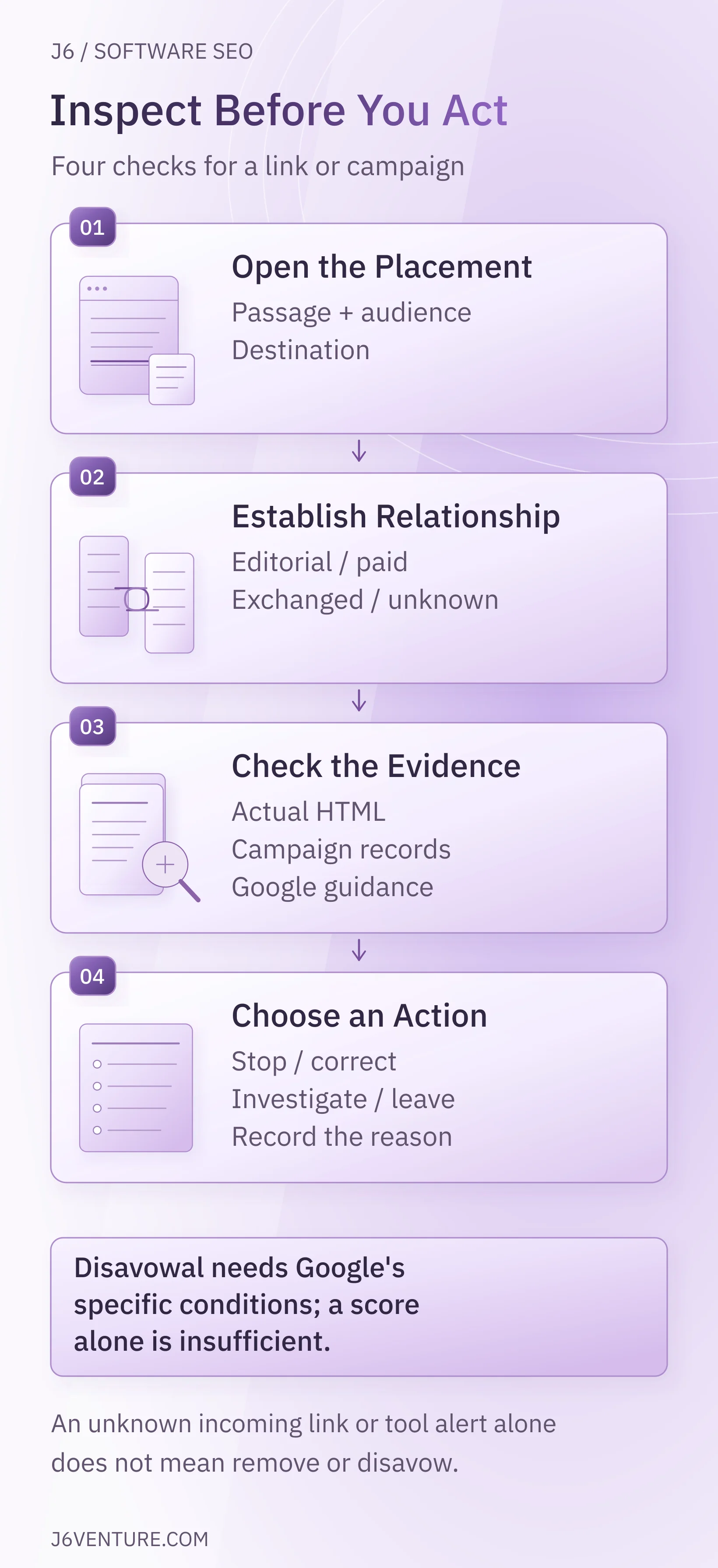
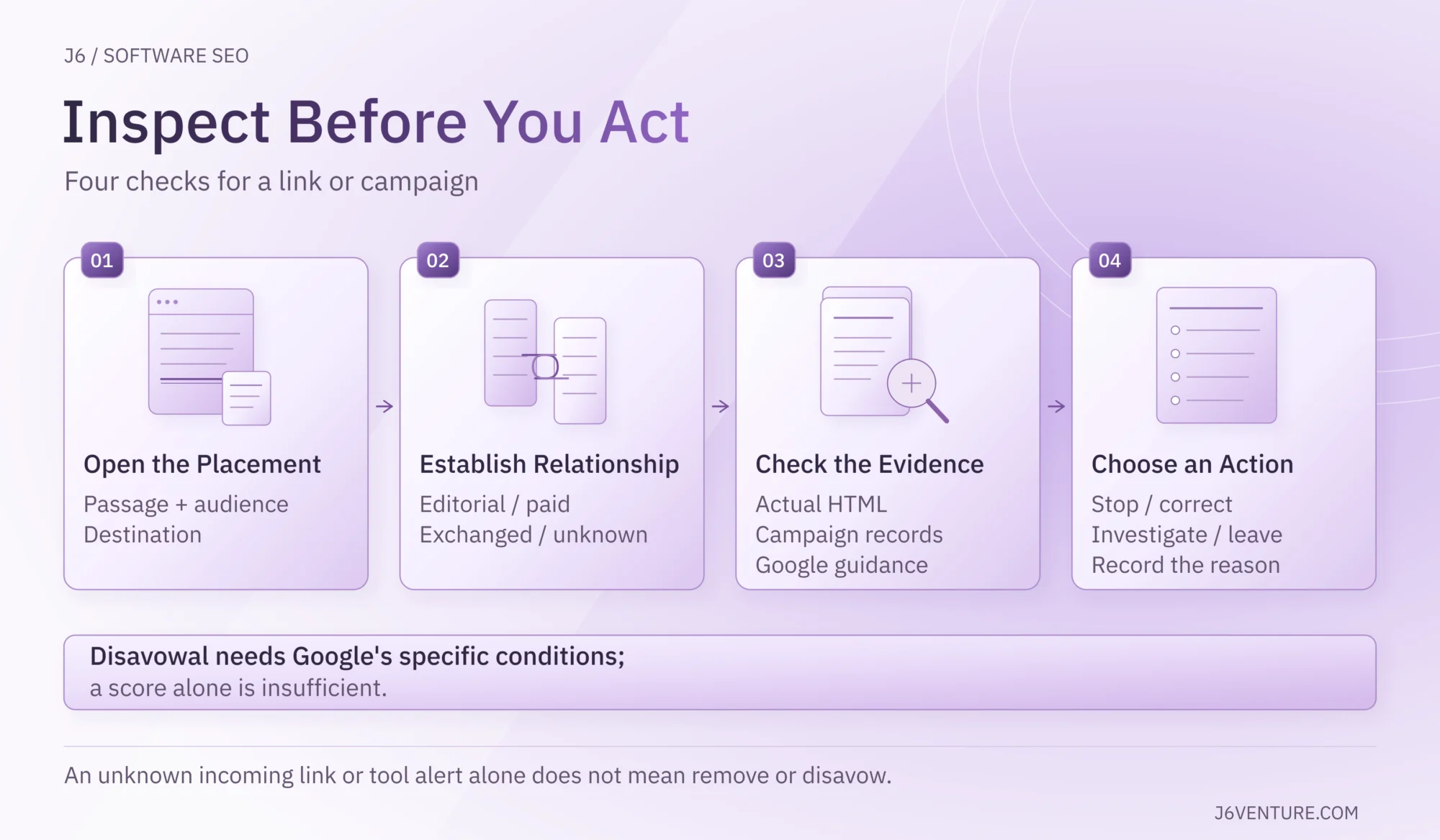
Use this sequence for one existing backlink. For a proposed placement, inspect the intended page, destination, and agreement now, then verify the live link and its markup after publication. Finish with a short decision record that another person can inspect. If you cannot establish a fact, write “unknown” and name the next check.
Step 1: Inspect the Page and Destination
Open the source page and find the passage. Read enough surrounding text to identify its audience and purpose. Follow the link to its final destination.
Record the source URL, anchor, destination, and the reason a reader would follow it. If a report lists a page that no longer contains the link, record that observation before requesting any change.
Avoid opening a suspicious download or entering information to investigate a backlink. If you cannot inspect the source safely, retain the URL and uncertainty for a qualified reviewer.
Step 2: Establish the Relationship
Ask whoever commissioned the work for the agreement, placement record, or outreach thread. Establish whether the link was independently chosen, paid for, exchanged, contributed with an article, or remains unexplained.
Then check that the relationship and relevant qualification agree. A guest byline does not answer whether compensation or ranking-link requirements were involved.
A sudden increase in reported links needs an origin check too. Independent coverage of a launch and bulk automated placements are different acquisition processes. A weekly count alone cannot tell you which occurred.
Step 3: Check the Evidence
Use the tool that answers the particular question:
- Browser link inspection: inspect the source URL, visible passage, link target, and relevant
relattribute. - Acquisition records: check payment, exchange, placement, or editorial terms.
- Search Console Links report: find reported linking sites and pages, then verify the source directly.
- Manual Actions report: inspect any specific notice and its stated scope.
- Backlink tools: locate prospects or patterns that need examination, keeping vendor scores separate from conclusions.
The Search Console Links report is a sample, can include historical links, and does not identify whether a link is nofollow. It is not a complete live inventory or a verdict on each link’s value.
Step 4: Choose and Record the Action
Match the response to what you established. “Leave alone” is a legitimate decision when the available facts do not justify changing an independent citation.
| Observation | Evidence That Changes the Decision | Proportionate Next Action |
|---|---|---|
| Resource link opens the wrong page | Source passage and final destination confirm the mismatch | Correct the destination or ask the publisher to update it; recheck the reader’s path |
| Paid placement is being sold as ranking credit | Agreement and live qualification confirm the arrangement | Stop the manipulative arrangement; correct the link or remove it as appropriate |
| Independent citation fits its passage and destination | Actual page, relationship, and resource support that use | Leave it in place; do not reject it on a score alone |
| Unfamiliar backlink is flagged | Origin, source inspection, pattern, and any notice remain unresolved | Record the uncertainty and investigate proportionately; do not automate removal |
Assign an owner and a checkable completion condition. “Editor updates the link to the current checklist; we verify the destination” finishes more work than “improve backlink quality.”
Three Worked Link Decisions
These are illustrations using hypothetical software-company resources and placements. They are not J6 campaign results, live-site audits, or evidence of a ranking effect.
1. A Relevant Sponsorship With the Wrong Link Attribute
Inputs: a software company sponsors a newsletter’s public web article. The article introduces its migration checklist to a relevant audience. The agreement describes promotion, but the live link has no paid-placement qualification.
Work the checks: read the passage, follow the checklist link, inspect the link HTML, and compare the sponsorship terms. Audience fit establishes a reason for promotion; it does not settle the link relationship.
Decision: ask the publisher to qualify the paid link appropriately. A simplified example is:
<a href="https://example.com/migration-checklist"
   rel="sponsored">
  Migration checklist
</a>
Recheck the saved link and evaluate the sponsorship against its promotion objective.
What would change the decision? If the seller requires an unqualified link and sells it for ranking credit, stop that arrangement. If qualification is corrected and the campaign serves its stated purpose, evaluate renewal from the relevant campaign evidence. Neither case supplies a promised ranking result.
2. A Small Publication With a Useful Citation
Inputs: an independent publication cites a software company’s field-mapping example in a relevant migration guide. A backlink tool assigns the publication a modest DR.
Work the checks: the guide addresses the right reader problem. Its anchor accurately describes the example, and the destination contains it. The editor chose the reference independently; no payment or reciprocal requirement is recorded.
Decision: on those stated facts, leave the citation in place. There is no score-only reason to request removal. For future outreach, this is the kind of audience-and-resource connection worth investigating further.
What would change the decision? If the resource later disappears, fix the destination. If new records reveal a paid ranking-link requirement, reassess the arrangement. The example does not establish that every small publisher is suitable or that this citation improves rankings.
3. An Unfamiliar Backlink Flagged by a Tool
Inputs: a tool flags a link from a site the marketing team does not recognize. The team has no acquisition record. No relevant manual-action notice has been found.
Work the checks: preserve the source URL and inspect what can safely be inspected. Check with the person or agency that handled prior campaigns. Establish whether this is an isolated observation or evidence of an arranged pattern.
Decision: the facts supplied do not justify automatic removal or disavowal. Record the unknown origin and what, if anything, warrants further investigation. Do not turn one alert into a sitewide cleanup project.
What would change the decision? A discovered manipulative campaign or relevant notice would require a different assessment. Apply Google’s stated disavow conditions before using that advanced tool; a warning score cannot substitute for them.
Illustrative decision record:
- Source and date: https://example.org/reference-page; October 17, 2026, for this hypothetical inspection.
- Known and unknown: one reported backlink; origin remains unknown; no relevant notice found.
- Decision and owner: no link-change request on current evidence; the SEO lead checks with the former agency.
- Completion: record the agency’s answer or that no acquisition records are available, then state whether any further work is justified. Missing records do not prove the link harmless.
- Reopen if: a relevant notice or evidence of an arranged manipulative pattern appears.
This example also does not prove the site is free of link-related problems. It establishes the limit of the evidence currently available.
Review the Campaign Before You Renew It
Before funding the next batch of work, complete a short review that connects the purpose to a decision:
- Purpose: name the resource, intended audience, and useful result the campaign supports.
- Acquisition: confirm that the arrangement and link qualification are understood.
- Delivery: inspect relevant placements and the resources they lead to.
- Evidence: record useful observations, costs, and what cannot be attributed.
- Decision: continue, change the approach, or stop; state the reason.
- Ownership: assign the next action and a review date tied to the campaign or renewal.
A missing export example may need resource work. A mismatched URL may need one correction. A documented manipulative scheme needs a policy-led response. Naming the problem keeps the next task useful and proportionate.
Choose one placement from your current plan or report. Complete the four checks, record the evidence and decision, and give the next action to a named owner.