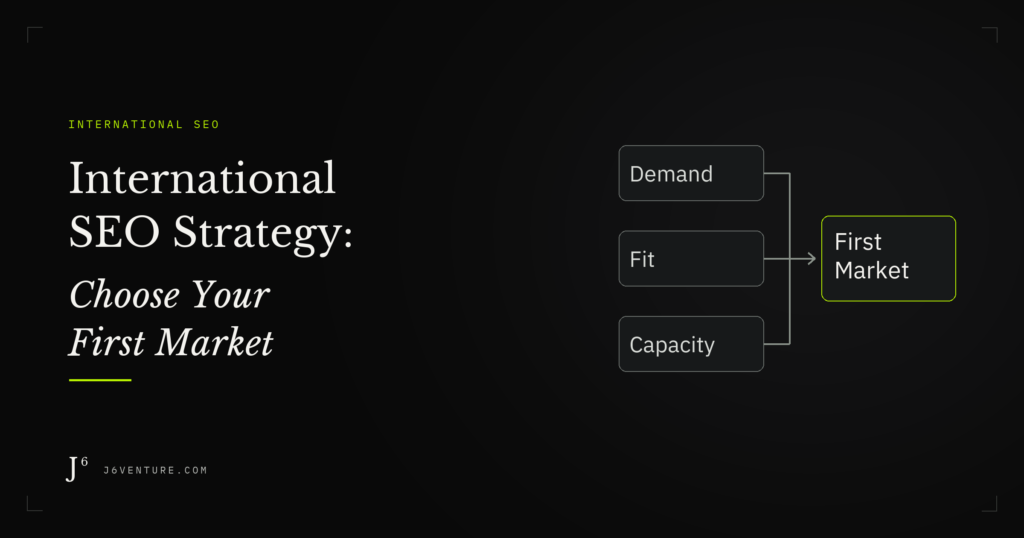
An international SEO strategy connects a target market, relevant search demand, and a business objective. Choose your first market by checking customer fit, economics, and readiness together. Commit to a commercial launch when you can serve the customer; use a bounded exploratory test when you still need to validate the opportunity.
A country can look attractive in a keyword tool while being a poor place to launch. The searches may concern a service you cannot provide there. The local results may serve a different buyer. Your translated landing page may send interested visitors into a sales process that cannot help them.
For your first international expansion, choose the market and proposed offer before commissioning localization. Ask: which market gives us a credible opportunity we can support? Your URL structure, content, and launch scope should follow that answer.
What Is an International SEO Strategy?
An international SEO strategy is a plan to attract relevant organic search visitors across countries, languages, or both, and help them complete an appropriate next step. It connects market selection, search intent, localized content, technical delivery, and business outcomes. A global SEO strategy applies that planning across the markets a business intends to serve.
The basic work of organic SEO still applies. International expansion adds decisions about who each version serves, how the offer changes, and who keeps the experience current.
How Country Targeting Differs From Language Targeting
Language and country answer different questions. A French-language page serves readers who use French. A page for customers in Canada may also need Canadian availability, prices, delivery information, or a local inquiry route. Those requirements need separate decisions.
Google distinguishes multilingual sites, which offer multiple languages, from multiregional sites, which target different countries. A site can do both. Its documentation recommends separate URLs for language versions. Google: Managing Multiregional and Multilingual Sites.
Write the intended audience before commissioning content: country or region, language, customer type, and available offer. That short description helps prevent a translation request from becoming an undefined expansion project.
Which International Market Should You Consider First?
Start with a short list of markets where relevant demand and customer fit appear plausible. Investigate what people search for, what they expect to find, and whether your offer belongs in that decision. A large search market earns further investigation; it does not settle the launch decision.
Start With Relevant Demand and Customer Fit
Use existing evidence where you have it: inquiries from the country, customers you already serve, country-level search performance, sales conversations, and the questions prospects ask before buying. Each source helps explain a different part of the opportunity.
International traffic alone leaves important questions unanswered. Which pages attracted those visitors? Which searches were relevant to your offer? Did inquiries come from organizations you could serve? A popular educational page and a service page reaching qualified buyers represent different opportunities.
Research local ways of describing the problem, including terminology that differs from a literal translation. For a B2B service, look at the buyer’s role, company type, purchase requirements, and available alternatives. A narrow query can matter when it connects directly to an offer with meaningful business value.
Check the economics early: expected customer value, margin, sales cycle, and cost to serve. Include payment friction, support costs, and implementation work in the estimate. Record the assumptions alongside search-volume estimates. Demand becomes a stronger investment case when you can explain how serving it could pay for the commitment.
Compare the opportunity at the level of the offer you would launch. A country’s total searches for your industry can include jobs, training, consumer products, or services you do not sell. Remove those from the business case. The remaining searches should connect to a customer you want to reach and a page that can help them make progress.
Check Local Search Intent and the Pages You Would Compete With
Inspect representative searches in the intended country and language, using the search engines your target customers use. Record the engine, query, location settings, and date. Compare the job competing pages perform, the offers available, and the proof a prospective customer can assess.
- Page type: Are results guides, product pages, service providers, directories, or comparisons?
- Decision: Is the reader learning, evaluating suppliers, checking availability, or preparing to buy?
- Local expectations: Which delivery details, credentials, prices, or support information appear?
- Your contribution: Can you provide a useful answer and a credible next step?
Compare the proof, depth, and resources behind those pages with what your team can supply. If you cannot yet offer a credible alternative, record the gap and its cost before treating the query as a reachable opportunity.
If the local results address a different task from your existing page, translating that page may preserve the mismatch. Use the reader job behind the keyword to decide what the localized page needs to do.
Separate What You Know From What You Still Need to Validate
Label each important input as observed, estimated, or unverified. Existing qualified inquiries are observed evidence. A keyword tool’s volume is an estimate. The belief that customers will accept your current onboarding process remains unverified until you investigate it.
This distinction changes the next action. Missing demand evidence calls for research. An unavailable offer calls for a business decision. A broken localized inquiry form calls for a repair. Giving each issue the right owner makes the plan useful.
Can Your Business Serve the Market You Want to Target?
For a commercial launch, your business needs to support the customer journey it promotes: the offer, purchase or inquiry route, delivery, and ongoing support. A bounded educational test can precede that readiness. Give it a narrower learning objective and describe availability accurately, so visitors understand what they can do today.
Check Offer Availability, Sales, and Customer Support
Follow an interested visitor’s path from the page to receiving what you promise. Can the customer buy or inquire? Will the correct team respond? Can that team communicate in the required language and support the relevant working hours?
For ecommerce, examine product availability, shipping destinations, payment options, returns, and support. For a service business, examine scope, contracting, onboarding, delivery capacity, and the inquiry handoff. Assign any market-specific legal, tax, or regulatory questions to the appropriate specialist before making commitments.
Distinguish a smaller available offer from an unavailable one. A business may be able to launch a particular service in a country while deferring others. The pages and calls to action should describe that available scope accurately.
Estimate Localization and Ongoing Maintenance
Budget for the complete experience: research, writing, language review, design adjustments, development, sales materials, and maintenance. Include the people who will update prices, availability, product changes, and support information after launch.
Assign a content owner and a review trigger for each important page. A pricing change should prompt a check of the versions affected. A product withdrawal should reach the localized catalog. If nobody owns those updates, publishing creates work the team has not yet agreed to perform.
Consider the cost of keeping linked information consistent. One localized service page may depend on a pricing page, booking tool, confirmation email, and sales response. List those dependencies when estimating the launch. This gives the team a more useful workload than counting translated pages alone.
Ask a competent reviewer in the target language to assess meaning and usefulness in context. Fluent sentences can still describe an irrelevant offer or omit the information needed to choose it.
Identify the Blockers That Should Delay a Launch
Separate commercial launch blockers from uncertainties you can test. An unusable purchase route blocks a sales launch. Uncertainty about local terminology can justify a small research or content test. Define the commitment first, then identify what prevents that commitment from working.
Define the condition that clears each blocker. “Improve support” is vague. “Assign a team that can handle inquiries in the launch language, and verify the handoff” gives someone a deliverable.
Turn Your Research Into a First-Market Decision
Bring opportunity and readiness together in a short decision brief. State what the evidence supports, what remains unknown, and what must happen before launch. Compare the commercial case for each feasible candidate, then name the market you would fund first and the finding that could change your choice.
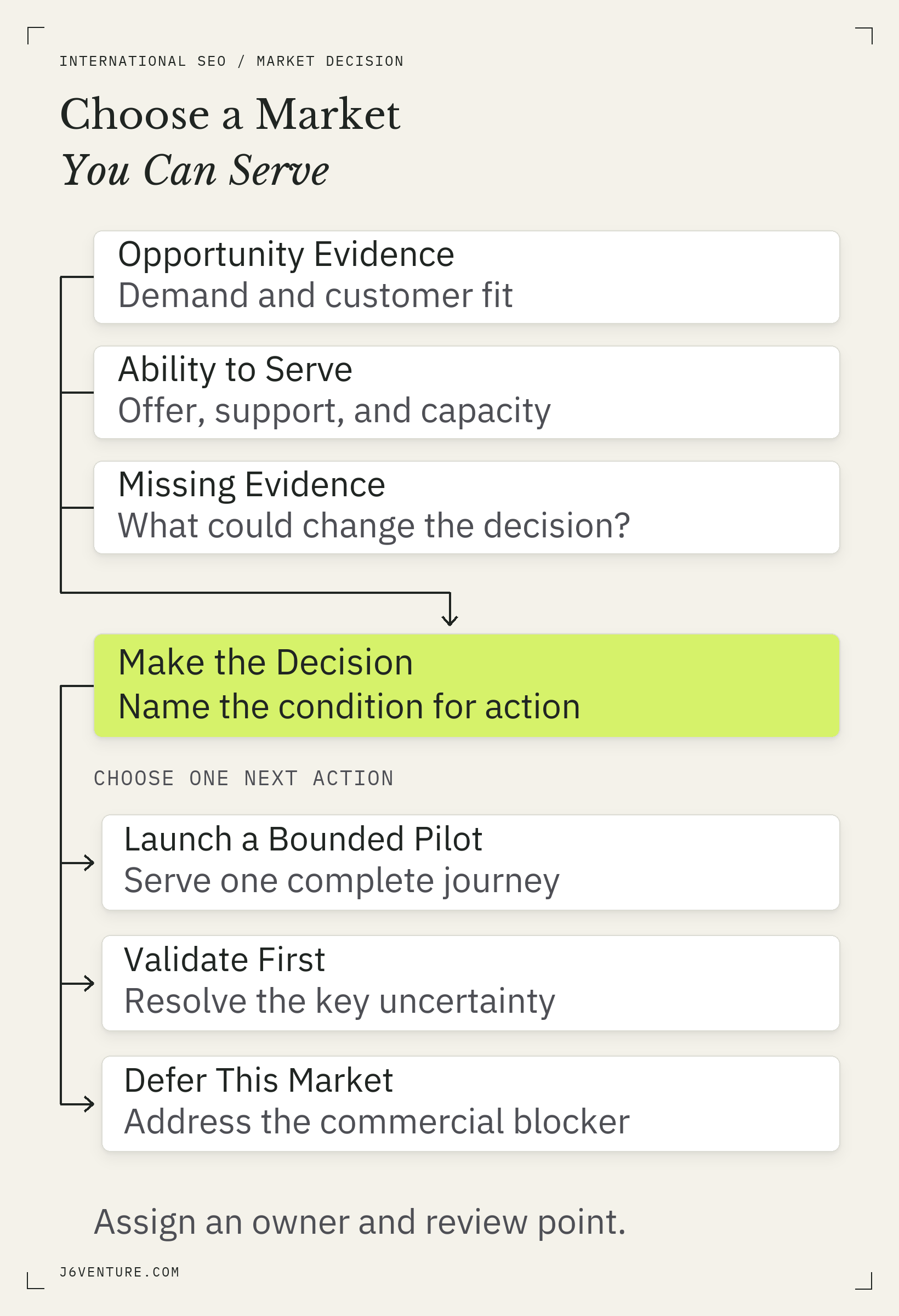
J6’s suggested decision aid. The pilot branch represents a commercial launch; an exploratory content test belongs under Validate First and needs a defined learning objective.
Build a Market Decision Brief
We suggest using the following brief for each shortlisted market. It keeps the evidence behind the recommendation visible without pretending that every uncertainty can become a reliable numerical score.
First-Market Decision Brief
| Decision Input | What to Record |
|---|---|
| Target Customer and Offer | Country, language, customer type, proposed offer, and current availability. |
| Relevant Opportunity | Observed inquiries, relevant searches, local result patterns, and the source and date of each finding. |
| Ability to Serve | Available offer, delivery route, sales or purchase experience, and support owner. |
| Commercial Case | Expected value of suitable customers, delivery and support costs, launch and maintenance budget, and the assumptions behind each estimate. Record what would make the launch unaffordable or unattractive. |
| Missing Evidence | The unanswered question most likely to change the recommendation. |
| Launch Blocker | The condition preventing the proposed journey from working, plus its owner. |
| Next Decision | Commercial launch or exploratory test; its scope, budget, owner, decision date, and the finding that permits expansion or requires deferral. |
Compare Opportunity, Readiness, and Missing Evidence
A weighted score can conceal a consequential gap. A market with attractive searches and an unusable buying path still requires a solution to that path. Compare the evidence in separate columns before deciding whether a numerical model adds anything useful.
Our suggested comparison uses the same offer scope, budget limit, and planning period across shortlisted markets:
- 1Separate markets with delivery blockers. Set them aside for commercial launch and record the condition for reconsideration. Fund an exploratory test only if its learning would inform a realistic next commitment.
- 2Compare the commercial case. Assess evidence of suitable customers, the cost of reaching and serving them, and the work needed for a complete first launch. Label assumptions in any forecast.
- 3Choose the first commitment. Favor a market where customer evidence supports an affordable launch and the team can maintain it. Record why this case is stronger than the alternatives.
- 4Resolve a close decision. If the cases remain comparable, we suggest favoring the smaller reversible commitment that can answer an important commercial question. If missing evidence could reverse the order, investigate that question before funding the launch.
This comparison can produce three next steps: fund a commercial launch, fund a validation task, or defer the market.
The public Shopify documentation provides a concrete way to work through one part of this brief. It documents Canadian English and French URL examples and explains how a hardcoded cart link can lose the localized experience. Shopify: About Shopify Markets.
What the Shopify Evidence Lets You Decide
| Brief Entry | Evidence and Resulting Decision |
|---|---|
| Market Under Consideration | French-speaking customers in Canada, using Shopify’s documented locale example. This evaluation exercise makes no claim about a merchant’s launch. |
| Known Requirement | The localized route needs to retain the intended language and market context through the cart. |
| Documented Risk | Shopify warns that hardcoded cart URLs can return visitors to the domain’s default language and currency. |
| Commercial Evidence | Demand, offer availability, fulfillment, and support remain unknown. Documentation cannot supply those answers. |
| Next Validation | The development owner checks the complete localized journey; the business owner investigates customer fit and ability to serve. |
| Decision | The example supports a journey check before launch. Choosing this market requires the missing commercial evidence. |
Choose What to Validate Next Before Committing
Prioritize the uncertainty most likely to reverse the decision. If the offer cannot be delivered, resolve that before commissioning a large content batch. If delivery is ready but local search intent is unclear, examine the results and customer language before choosing pages.
Give each validation task a budget, an owner, and a decision date. Define what answer would justify further investment and what would stop the work. This keeps research tied to a decision instead of becoming an open-ended project.
What Should Your First International Launch Include?
Define whether you are launching an offer or testing an opportunity. For a commercial launch, build a complete journey around a bounded offer. For an exploratory content test, define the reader question, the evidence you will collect, and the investment decision it will inform. Page count follows the chosen job.
Choose the Pages Needed for One Complete Customer Journey
Work backward from the intended action. A service buyer may need an offer page, relevant evidence, answers about delivery, and a working inquiry route. An ecommerce buyer may need category and product information, availability, shipping and returns details, and checkout.
An exploratory page can instead answer a local audience’s question before sales operations are ready. Review the relevant queries and audience response against the test objective. Those signals can inform content and language choices; buying intent and delivery economics still need their own evidence. Avoid inviting purchases or service inquiries your team cannot fulfill.
Check what each page links to. An inviting local landing page loses usefulness if its essential pricing explanation, booking form, or support information is unavailable to the same audience. Keep shared pages where they serve the reader adequately, and make transitions clear.
Write the launch boundary in one sentence: the audience, the available offer, and the action supported. Use that boundary to decide which content is essential now and which belongs in a later expansion.
Decide What to Translate, Localize, or Create
- Translate when the underlying answer and offer remain appropriate and the task is to express them accurately in another language.
- Localize when examples, terminology, pricing, availability, proof, or the next step need adjustment.
- Create when the market presents a reader need your existing content does not address.
- Defer when a page falls outside the defined launch or test, or promises an action you cannot support.
These are editorial choices to make page by page. A business can reuse a sound explanation while rewriting the buying information around it.
A Public Example: Follow the Local Experience Through to the Cart
Shopify’s developer documentation gives a useful warning: a hardcoded /cart link or Ajax request can force a visitor back to the domain’s default experience, with the wrong language or currency. The localized landing page can therefore be only part of the implementation. Shopify’s Market-Aware URL Guidance.
For a launch review, follow the intended route through product selection, cart, and checkout. Check the links and interactions used along that route. Verify product availability and the information shown at the next step, alongside language and currency.
The practical test is to confirm that the experience you promise survives the next click.
Choose a Technical Setup Your Team Can Maintain
Choose a structure that supports the planned countries and languages, fits your platform, and has a clear maintenance owner. URL structure helps organize the versions; content, access, and the customer journey still need attention. Resolve the choice before creating a large collection of pages that may later require migration.
Compare Subfolders, Subdomains, and Country Domains
URL Structure Tradeoffs
| Structure | What to Consider |
|---|---|
Subfolders example.com/fr/ |
Keep versions within one site. Consider how the platform handles localization and shared administration. |
Subdomains fr.example.com |
Allow greater separation. Establish who maintains each version and its connections to the rest of the site. |
Country Domains example.fr |
Provide a country signal. Account for separate domain ownership, administration, and country-specific constraints. |
Google documents advantages and disadvantages for each approach. Use those tradeoffs to evaluate your operating model; none supplies a universal ranking promise. Google’s URL Structure Guidance.
Map Language and Regional Versions With Hreflang
Hreflang identifies alternate language or regional versions so Google can better understand their relationship. Use it for equivalent pages available in those versions. It does not create the localized content or establish that an offer is available.
Google supports annotations in HTML, HTTP headers, or a sitemap. Choose an approach your team can maintain. The mapping needs valid language and optional region codes, fully qualified URLs, and the required reciprocal references, including the page itself. An optional x-default can identify a fallback page. Google: Tell Google About Localized Versions.
Ask your implementation owner to show the mapping for representative pages and explain what happens when a version is added or removed.
Check Crawlability, Canonicals, and Language Switching
Verify that the intended pages are accessible to search engines and eligible for indexing. Review canonical choices alongside alternate versions, especially where regional pages contain similar same-language content.
Provide clear links for visitors to choose an appropriate version. Google advises against automatically redirecting users based on inferred language or location, which can impede access. Its documentation also addresses canonical handling for similar regional pages. Google’s Access and Regional Content Guidance.
Include representative localized pages in your SEO audit, along with their navigation and conversion paths.
How Will You Earn Visibility and Judge the First Launch?
Match measurement to the commitment. A commercial launch needs search and business outcomes; an exploratory test needs evidence that answers its defined learning question. Examine whether the intended audience finds the pages and benefits from them. Expand when the findings, economics, and capacity support the next commitment.
Build Relevant Credibility in the Target Market
Show evidence a prospective customer can use: applicable experience, clear delivery information, useful explanations, and customer proof you have permission to publish. State where that evidence applies. Experience serving one audience should not be presented as a local case study for another.
Look for relevant industry relationships, publications, associations, and partners where your expertise makes a useful contribution. Evaluate these opportunities for audience fit and credibility. Avoid turning the plan into a quota of country-specific links.
Measure Search Progress and Qualified Outcomes Separately
Review the target country, launched pages, and relevant queries together, keeping their results separate from site-wide totals. Google Search Console reports clicks, impressions, and average position. Search Console Performance Reporting.
For a commercial launch, compare those search metrics with inquiry or purchase records. Review lead quality and delivery requirements with the team receiving those inquiries. For an exploratory test, assess relevant queries and audience response against its learning objective. Keep implementation dates and, where applicable, buying-cycle delays in view when deciding how long to evaluate SEO progress.
Write down the next decision the measurement should inform. If relevant impressions rise while inquiries remain unsuitable, inspect the searches, page promise, and qualification route. If suitable inquiries arrive but the team cannot deliver, expansion would deepen the capacity problem. If an important page has not been indexed, investigate access and indexing before treating its lack of traffic as evidence against the market.
Decide Whether to Expand, Repair, or Defer
- Expand a commercial launch when relevant demand, a functioning journey, affordable delivery and maintenance, and the capacity to serve support the next offer or page group. Extend exploration when the next learning question warrants its cost.
- Repair when a defined issue interrupts the path, such as an inaccessible page, mismatched intent, or a failed inquiry handoff.
- Defer a commercial launch when customer fit remains weak, the offer is unavailable, or the maintenance commitment exceeds what the team can support. Defer an exploratory test when its likely learning no longer justifies its cost.
If you need more observation, name the signal you are waiting for, the review date, and the finding that would change the decision.
What Should Your First-Market Plan Say Before Work Begins?
Your plan should identify the customer, proposed offer, and evidence behind the market choice. State whether you are funding a commercial launch or an exploratory test, and what each commits you to deliver. Name unresolved blockers, responsible owners, and the conditions for the next decision.
- We know which country, language, and customer we intend to serve.
- We can explain why the search opportunity matters to the business.
- We have separated observed evidence from estimates and unanswered questions.
- We have defined the commercial journey or the narrower learning objective.
- We have assigned blockers, localization, and maintenance to owners.
- We know the budget, decision date, and evidence needed for expansion, repair, or deferral.
Complete the brief for each shortlisted market, then record which one you would fund first and why. Name the unresolved question that could reverse that choice, its owner, and the next review date.